Subscribe via:



Show Summary
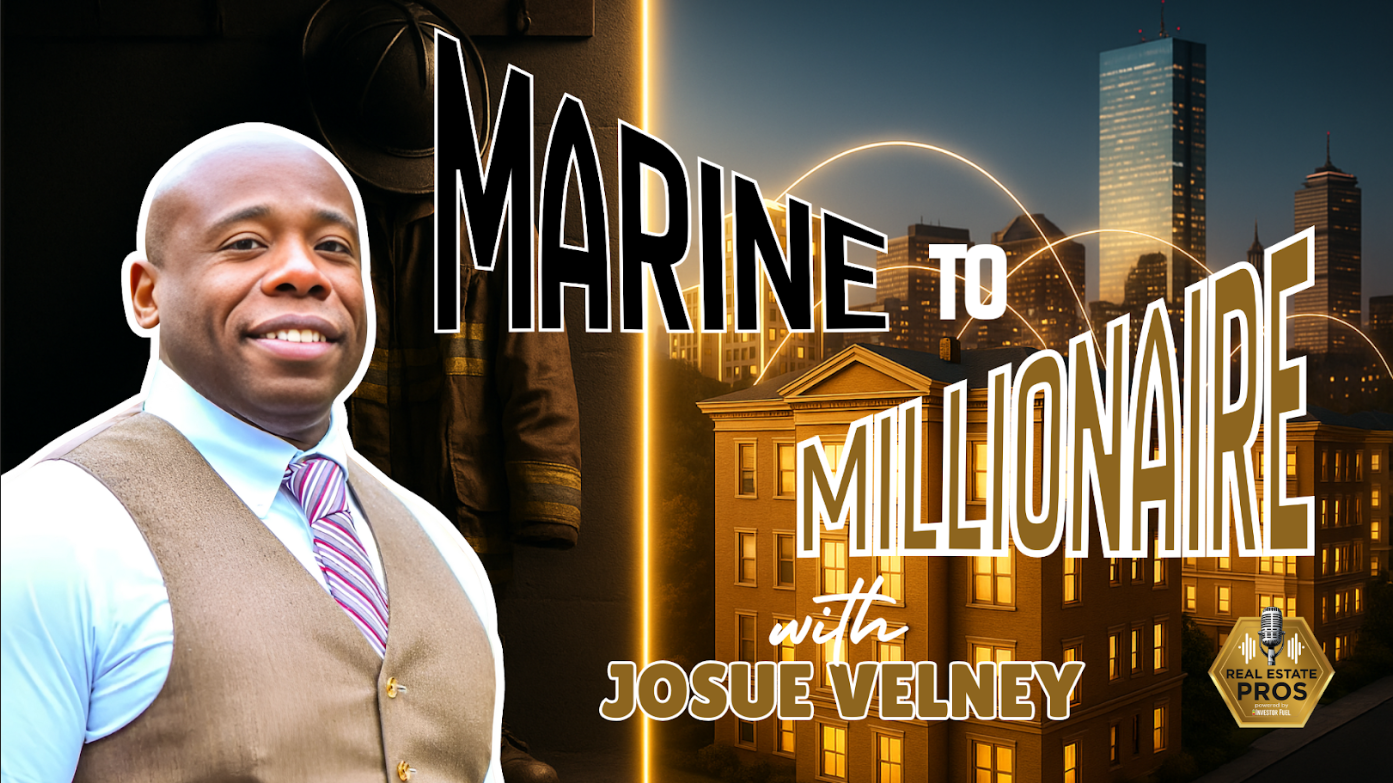
In this episode of the Real Estate Pros podcast, host Kristen Knapp interviews Josue Velney, founder of Velney Development, a veteran-owned and minority-owned development firm based in Boston. Josue shares his unique journey from serving in the Marine Corps to becoming a successful real estate entrepreneur. He discusses the importance of building a vertically integrated business model, focusing on culture and relationships, and the lessons he learned throughout his career, including the value of mentorship.
Resources and Links from this show:
-
Listen to the Audio Version of this Episode
Investor Fuel Show Transcript:
Josue Velney (00:00)
I mean, think relationship is key. I learned that from my days in the Marine Corps. I was fortunate to go to some special programs. One was Marine Corps Combat Hunters course. And it was, I think it was about two and a half years into my Marine Corps career. through that, before that time, I already did two tours in Iraq. I was a machine gunner. And it was about like self-defense and how to take care of yourself. But this course was very, very different. And it was more of how do you understand theperson and understanding that hey if you can have dinner with somebody and not have to see him on a combat field later that night it’s probably a better better solution so that’s when I started understanding okay relationship understanding body language understanding if I go to say somebody that’s looking to sell me their house and they say would you like something to drink and they have coca-cola I don’t like coke but today I like coke right so understanding those things that those little things that that you wouldn’t
Kristen Knapp (00:55)
Yeah.Josue Velney (00:59)
that matter but helps build that relationship because honestly if if you can only sell things on either price or relationship right so if you need your price to be lower you better build a strong relationship you better build a confidence that they know that you will closeKristen Knapp (02:50)
Welcome back to the Real Estate Pros podcast. I’m Kristen and I’m here with Josue Velney, who’s the founder of Velney Development, a veteran-owned, minority-owned development firm out of Boston. So thank you for being here.Josue Velney (03:01)
Thank you for having me.Kristen Knapp (03:04)
Awesome, well I would love to hear a little bit about your background. You know, were in the Marine Corps for a while and I would love to hear kind of how that was and how you transitioned.Josue Velney (03:13)
Yeah, no, that’s great starting point. Yes, like you said, I did five years, five years in the Marine Corps, three combat tours. Two of them were in Iraq. One of them was on ship with the Navy where we ended up getting 32 pirates. At the time, I was either going to reenlist in the Marine Corps and do another four years or five years, or I was going to come home and become a firefighter, which I did. I became a firefighter. And during that time, I started talking to somethe firefighters in the firehouse and they all seem to own at least one home. So I decided that it was time for me to purchase my first home. So that’s how I dived in into the real estate as a first time homebuyer. I really know much, but I learned very, very quick. I made an agenda to go look at 10 to 20 open houses per week. I started talking, going to meetups and started to really understand this business. And after my first transaction, after I purchased that,
I ended up growing my portfolio to 32 units in Springfield, Massachusetts. It’s a lower tier market than Boston, just price point wise. And so from there, I decided I wanted to bring everything on home in Boston. So I started acquiring more property in Boston. And then I had the courage to do my first rehab. And that went terrible. So I had to fire the contractor. And I decided to, you
Kristen Knapp (04:42)
What wentJosue Velney (04:42)
ThankKristen Knapp (04:43)
wrong about it?Josue Velney (05:32)
everything. If you end up in court and something went wrong, it was just, you know, we wasn’t on time. We wasn’t on budget. Just trying to get them on site was a challenge. And the whole time I’m paying a mortgage on it. and I’m paying Boston prices for the mortgage. So it was very, very painful. But I saw that that was actually an opportunity. And I said to myself, if he can be a contractor, why can’t I? So I pursued getting my construction likeKristen Knapp (05:34)
andJosue Velney (06:02)
and realized there was more to the understanding of construction. So I went and I went back to school and I got a full degree in construction management. And during that time I actually got promoted to fire lieutenant. So I was still doing a lot of work at the fire house and doing a lot of work in the real estate business. And then from there, 2021, I retired and I just really just, I just dived in deep. So right now my company,Kristen Knapp (06:17)
Wow.Josue Velney (06:31)
This is for Bellany Development, but we also have Bellany Realty, which is a brokerage arm, and Bellany Construction, which is a construction arm. So we’re very vertically integrated into the business. So we’re always looking for different opportunities. I always say I’m in the opportunity business, not any of those sectors. Whichever one’s gonna provide me the greatest margin, that’s where I wanna be.Kristen Knapp (06:42)
Wow.Wow, so you just really hopped right into everything. After your first home, you purchased a multifamily.
Josue Velney (07:03)
Correct, correct. I’ll do some groin pains. Don’t get me wrong. We went from,Kristen Knapp (07:06)
Yeah, I imagine.Josue Velney (07:08)
Two units two units in the city of Somerville using a first-time homebuyers loan and I put that I ended up purchasing that property for three I think it’s two thousand seven hundred fifty After it when I figured out that we the city gave me five thousand dollars back towards my closing and then I Barack Obama was the sitting president and he gave eight thousand back to to veterans and then my closing attorney also helped with that today that propertyrents for over $6,000. So clearly that was a great investment that really got me off to a great start. But when I went to Springfield, we started off buying two units and then we bought four units. And then we bought a 14 unit portfolio, but it was a combination of six units and two units. And I kept seeing like all these snow, we get a lot of snow in Massachusetts. So I kept getting a lot of snow invoices and I said, this doesn’t make
So that’s when I decided to buy 16 unit because I was like well It’s gonna cost you the same to shovel snow for 60 units that it was gonna be too So that was really the driver of understanding that and I was I also worked as an agent for for that firm that was in Springfield So I really started understanding the property management side of the business. They were currently managing over 700 units so I end up getting that background of understanding real estate and then after
I did about a year and half with them. I felt like I was comfortable and I understood that part of the business and then I started I went work for another firm in the city of Summable We’re selling high-end condos so anywhere between a million dollars to two million dollar condos and it was very very different It was it wasn’t boots on the ground and cleaning toilets It was you know you had initials in your in your sleeves and in very no more jeans. It was very very clean so it was it
Just seeing that from a different perspective. So I say one of the things that I had the benefit of early on was being able to see a lot of different things in a lot of different ways. People looked at real estate, which helps me be in that mindset today that I’m not really in a box. I’m more of looking at opportunities.
Kristen Knapp (09:29)
Totally, and you also have the formal education behind you, is wonderful, especially in the construction side of things, which I feel like a lot of people are self-taught. That’s awesome that you were able to get such formal education on it. ⁓ I mean, it seems like you are so busy. mean, when you were juggling being lieutenant and you were juggling all of these ⁓ properties, what are your time management tips? It seems like you’ve been able to really do a lot.Josue Velney (10:32)
Well, I was fortunate when I was actually single at the time. I hit so that so that actually freed up a lot of my time. It was myself. I had a doorman pincher. So it was just the dog and I. So because of that, I had a lot of flexibility. I was able to really, really put 40 hours into the firehouse and also put 40 hours into the real estate because I felt like I had this learning curve in what I find fascinating and like in real estate. And some people would disagree with that, especially if they like starting off with like wholesaling.I think you need some money to really get this really off the ground and being ⁓ having my W-2 for for 12 years Really really helped me create that stabilization, you know like when I go to a lender and And they’re looking at me and they’re looking at my my financials of being a fire lieutenant It was very easy to get some of those loans ⁓ Approved where today I get approved based on my the assets that I have acquired not my W-2 because I
don’t have a W-2.
Kristen Knapp (11:35)
Wow, well that’s really impressive. I you’re able to scale really deep and wide with that. I would love for you to talk more about Valme and kind of what you guys are doing in the Boston area and what makes you guys so unique. I know that you have such a good service model behind you.Josue Velney (11:55)
Yeah, I think we’re always looking for opportunities. Like I said, like as far as like the brokerage, we just recently sold one of one of my properties just to free up capital. I feel like I’m at this stage in my in my journey that having two units or possibly a condo doesn’t really make much sense anymore. So we’re targeting bigger projects anywhere between 10, 10 to 30 units. I think that’s really the sweet spot, you know, but being fully integrated actually allows us to be to to really wear multiple hats.What I mean multiple hats I wear my development hat when I’m trying to acquire a new asset or something that we can redevelop We’re always looking for value at this one project I can tell you that we we turned a two family and then we got a rezoned for seven units So we created a lot of value just by doing that and we didn’t start construction yet Right and then from there we can wear our construction hat and build it and then from there we can sell it with the brokerage so a very
integrated and trying to really cut out that middleman and just try to increase the profitability of the company as a whole.
Kristen Knapp (13:03)
Yeah, and I feel like being vertically integrated sounds great from the outside and simple, but it’s so difficult to do. How did you go about, you know, executing this so well?Josue Velney (13:15)
Took it took many many many years and what I have learned is ⁓ and I talked to Mike Holmbrecht about this ⁓ Long time ago and when I was trying to have this idea of how to do it So he definitely guided me in the the right direction But I really had to really pick one one of those one of those vehicles and make that the lead vehicle and then make the other vehicles around it more like support elements until they could support themselves andKristen Knapp (13:18)
Yeah.Josue Velney (13:45)
That was really the key. I focused on being a real estate investor, building out those assets, building out those relationships. From there, when the brokerage was supporting and the property management arm was supporting, was doing my own rentals, which I was able to acquire more capital or save more capital through my projects to now I’m understanding construction. I already built a roundup project and you sandwich it all together.Kristen Knapp (13:45)
right.Josue Velney (14:15)
really a developer, right? A developer is a master of everything and trying to put the whole show together.So now I have the opportunity because everybody says, know, like the strange thing about development is we literally walk into a building and walk out and tell you how much we can pay for it. Like we’re not taking days, you know, you just know, like you just, and it takes a lot of time and effort. it’s, you know, I’m reading a book now and it talks about some of the best investments. It’s like you hold them like buy and hold or stocks. You hold them for a very, very long time.
I feel that’s really what we have been able to do is really look at look at the projection of the journey as a journey not like not in short term. So it’s always like okay here we are now where do we want to be in five years? Where do we want to be in 10 years? How do we want to impact our people? Because I truly believe that the people that I work with are my greatest assets.
Kristen Knapp (15:55)
youAbsolutely, mean very thoughtfully growing rather than trying to scale quickly. I think that’s so important and that’s something that a lot of people don’t really take the time to do because I think everyone has goals to be bigger and better but growing very thoughtfully as you said is so important. As you start hiring people, you you say your team is so important to you, what do you look for in people? How do you know when they’re a good culture fit for you, a good professional fit? Because I think hiring people is like one of those challenging parts.
Josue Velney (16:26)
Yeah, I think the biggest focus is not what I always want people to qualify. Right. So that’s the that’s the first part is to actually qualify your candidates, make sure that they’re good fit. But then I also in my interview process, I showed them my culture. It’s not about just them me asking questions. So they have a stem asking questions to me as well. And I make sure to always show that, you know, I wasn’t a Marine Corps for five years and it was a big impact in my life. And that’s reallythe culture that I’m looking to bring. I tell my people, if we don’t have nothing to do, we have nothing to do. But if we need to get something done on Saturday, then I would like for you to be there on Saturday. And if that’s not your culture, then you’re just not a good fit for my company. And I think that’s the secret is keeping that culture and understanding, especially now, as my company continues to grow, and the culture is going to continue to change, and we’re to have subcultures.
It all starts with the main culture and hiring that making sure the people fit the culture more than they fit the position.
Kristen Knapp (17:34)
Right, absolutely, I think that’s a really good point. ⁓ And I know a huge part of your business is kind of this high end service you provide as well. So I’d love for you to go into that extra step that you’re willing to give your clients.Josue Velney (17:50)
Yeah, absolutely. You know, I think especially on the rental side of the properties that we currently own I hate turnovers and the best way to get rid of turnovers is to have quality service if someone’s leaving they’re leaving because they you know, either sometimes maybe they found a new job whatever it may be but a lot of times it’s just because you know, they don’t like the service that you that you provided is one property I bought in 2016 and I had the same tenant since 2016 right so no turnover is agreat is a great thing. But even on the construction side is really having that conversation with the owners and saying, hey, you know, did we exceed your expectation or what were your expectations or how can we provide a better service? And most of the time they will tell you how do you provide a better service. I’ll give you an example. just recently, my daughter is going to be two in December. So eventually we’re going to start looking for a kindergarten, preschool and stuff of that nature. anytime I have
opportunity to work at a school I usually take it because I’m building those relationships and it was a referral from another preschool that we got and they wanted to get some floors done and wanted to get some paintings done. The project size was about $90,000 and they said you know they have somebody that came in they wanted to do the floors they said hey just pick them up at Home Depot I’ll tell you the square feet and then you bring them in right and that was the service that they provided. So I listened to
what they were saying that it was a preschool that they have young kids so it can’t be a slip hazard and we get snow so it can’t be it’s they don’t want something that’s gonna just track all over the place and I said I think I need my floor my floor provider so my my vendor literally came in with the samples so we had the client able to touch the samples I kid you not we were done with the project the samples were still in our office so that just shows you the impact
of that the opportunity for her that hurt that we were listening that the floor was the main thing that they wanted to solve and being able to bring that piece of material and did not only bring that piece of material tell her where we have used that material and other projects and ask her if she would like to visit those those those sites in which she did and that’s what sold the deal.
Kristen Knapp (20:12)
Yeah, that’s amazing. mean, yeah, the white glove service is so important and it’s probably very important in, you know, fostering a long-term relationship with certain people who are using you over and over again. Can you talk about the relationship building portion of this?Josue Velney (20:30)
I mean, think relationship is key. I learned that from my days in the Marine Corps. I was fortunate to go to some special programs. One was Marine Corps Combat Hunters course. And it was, I think it was about two and a half years into my Marine Corps career. through that, before that time, I already did two tours in Iraq. I was a machine gunner. And it was about like self-defense and how to take care of yourself. But this course was very, very different. And it was more of how do you understand theperson and understanding that hey if you can have dinner with somebody and not have to see him on a combat field later that night it’s probably a better better solution so that’s when I started understanding okay relationship understanding body language understanding if I go to say somebody that’s looking to sell me their house and they say would you like something to drink and they have coca-cola I don’t like coke but today I like coke right so understanding those things that those little things that that you wouldn’t
Kristen Knapp (21:25)
Yeah.Josue Velney (21:29)
that matter but helps build that relationship because honestly if if you can only sell things on either price or relationship right so if you need your price to be lower you better build a strong relationship you better build a confidence that they know that you will closeright that is a lot of what we do to really build those relationships and build a company that because if you’re only building it on price you’re not going to be in business very long because you’re not going to make any profit margins
Right. I believe that’s part of that’s the part of making a higher revenue. And the second part of a higher revenue is is that value add right. A value add of something like two units and two family in Boston. Can we get a zone for seven units and add five more units. Right. So that. So I’ll give you a project that we did. And it was exactly that. We bought it for for eight hundred thousand. And then we got we added five units to the approval process.
So we haven’t built anything yet and the bank appraised it at 1.2. We created value through that process, right? And we have great universities in Boston. So one thing that we can do is can we add bedrooms, right? The college kids don’t want a living room. They want an extra bedroom, right? And an extra bedroom equals more rent. So that’s a way of creating value that helps that spreadsheet that making this deal better than what somebody else seen because Boston’s a very competitive market.
Kristen Knapp (22:47)
Yeah.Absolutely, ⁓ that’s wonderful. I think you brought up some really good points about scaling a successful business in general. So I would love to kind of wrap this up with maybe something you wish you learned earlier in your real estate career that you can share with us today.
Josue Velney (23:16)
wish I knew how to find great mentors ⁓ early on. I have some very, very great mentors now. And what I learned is that you just really got to get out there, take action, and as they start seeing you grow, they’re going to want to help you. And that’s really the key. To get to the top, somebody taught them. And believe it or not, a lot of the people that we see as possible mentors, they want to help. They just don’t want to waste their time.Kristen Knapp (23:20)
Mmm, yeah.Josue Velney (23:46)
putting that effort and hard work they’re gonna help and a lot of them believe it or not usually their kids want nothing to do with it so in a way you kind of think that plays because they always they hope even mine included me to pass it on to the next generation but my daughter could want to be a doctor or a dentist or a lawyer or whatever she wants to be so she might not want to be in my profession and then I’ll be looking to mentor somebody else coming in to the gameKristen Knapp (23:54)
Yeah.Totally, and I think also when you’re approaching people, adding value to them as well, not just taking, but trying to give as well. I think that’s a good point with mentorship. So please tell everybody where to find you and where to find Velney Development.
Josue Velney (24:29)
Well, the best place to find me is on my website, VelneyDevelopment.com, or you can find me through my name. My name is Josue Velney. It’s on the screen. if you put it in, I’m pretty sure I’m the only one with that name. So I’m not that very difficult to find.Kristen Knapp (24:47)
Amazing. Well, thank you so much. think that you gave a lot of great inspiration and great practical tips for people to follow. So thank you for being here.Josue Velney (24:55)
welcome.Kristen Knapp (24:57)
Thank you everybody for listening. Please check out Velney Development and we will see you back next time. Bye.