Subscribe via:



Show Summary
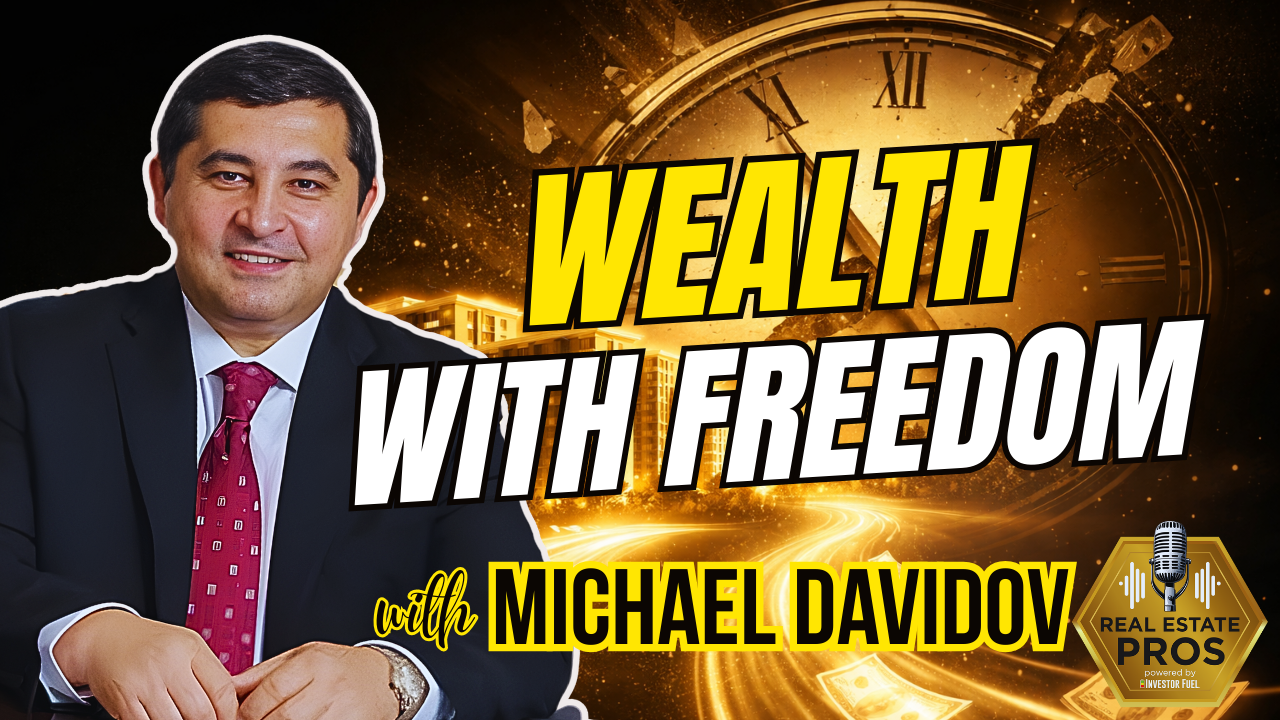
In this episode of the Real Estate Pros podcast, host Micah Johnson interviews Michael Davidov, a seasoned real estate syndicator with over 20 years of experience. They discuss Michael’s journey in real estate, focusing on multifamily investments, the importance of building generational wealth, and how real estate can provide financial freedom. Michael shares insights on lifestyle design, the significance of having a clear vision for the future, and the power of networking in the real estate industry. The conversation emphasizes the importance of saying no to distractions and aligning personal and family goals with professional aspirations.

Resources and Links from this show:
-
Listen to the Audio Version of this Episode
Investor Fuel Show Transcript:
Michael Davidov (00:00)
It’s a life created by design rather than by default. Absolutely. Everything that I’ve wanted to happen is happening by choice, not by default.Micah Johnson (01:44)
Hey everyone, welcome to the Real Estate Pros podcast. I’m your host, Micah Johnson. And today I am joined by Michael, who’s been making some serious waves in the real estate industry for the last 20 years from across the board as an attorney, financial planner, and even syndications and new ground development. So I’m really excited to have him here. Michael, welcome in man, glad to have you.Michael Davidov (02:06)
Now it’s a pleasure to be here. Great way to start the year.Micah Johnson (02:09)
Heck yeah, man, brand new year, climbing out of the gate fast here. think our listeners are really gonna take something away from honestly how you’re approaching what you do in general. We’ve had some interesting topics before or conversation before we started recording just on your overall mindset towards real estate, how you’re using it, even how your family’s involved with it. So let’s dive in with that. For people who may not know you yet, what’s your main focus right now and what markets are you operating in?Michael Davidov (02:34)
Sure, ⁓I’m a real estate syndicator. I’ve been operating in the multifamily space for a number of years. ⁓ We set up a company called Grovia Capital, myself and four other ⁓ partners. And we’ve been pretty active over the last, just the last 14 months. We’ve purchased over $40 million of property. We’re ⁓ doing due diligence on a property now. ⁓ We operate in two markets and that’s in the Tampa Bay, Florida area.
and in Texas, in Dallas, Fort Worth, and in the Houston ⁓ MSA. We just had a closing on the 19th of December, bought two properties that were sweetheart kind of properties there. It’s 200 units. ⁓ And we’re already in ⁓ an LOI and a PSA on a new one in Clearwater. ⁓ So those are the kinds of properties that we go for.
Micah Johnson (03:13)
Nice.Excellent.
So when you’re targeting those, what is it that makes it a deal for you? What are y’all looking for that shows you, okay, this is something we wanna take a step further, keep digging in on possibly buying it.
Michael Davidov (03:40)
Yeah, typically the deals are ⁓ B type of assets, ⁓ something that’s not too old, in a great location. ⁓ There has to be a value add component. So either operationally something’s missing or there needs to be some rehab to the property. Maybe it’s been a little neglected over the years. And if we can bring that up in terms of value in some way, or if we can operationally improve things,⁓ then ⁓ those are the kinds of deals that we typically look for. They’re usually 100 units or more ⁓ in these kind of markets. So either in secondary markets or in primary markets.
Micah Johnson (04:25)
And what led you to that asset class? What was it about large multifamily?Michael Davidov (04:28)
That’s a good question. You know,I’ve been an attorney and a wealth manager for a number of years. My practice is focused on helping wealthy families keep more of what they have. over the years, and I’ve worked with many, clients over the years, but over the years, you begin to see some trends. so real estate has really been ⁓
an evidenced way for me to see that wealthy families have built their wealth through real estate. ⁓ And so it was something that I started doing early on as well and understood that I need to have real estate component as one of the things ⁓ that I do. ⁓
That’s pretty much ⁓ how it started. ⁓ And ⁓ from there, I started doing fix and flips. Then I did rentals in and around New York City where ⁓ I’ve grown up. And after that, it got to be, ⁓ you know, it was too big to manage ⁓ on my own. And I just thought, let me go after particular markets that I can focus in.
Micah Johnson (06:01)
that it’s.Michael Davidov (06:26)
where they’re landlord tenant kind of laws are favorable to the landlords and where it makes sense financially to do that. And so that’s how I started investing in real estate first in Florida and then, and that was maybe a dozen years ago and then Texas as well.Micah Johnson (06:44)
So started in single family and then worked your way up.Michael Davidov (06:46)
Yep, ⁓ kind of it started out as flips. ⁓ I then picked up a two, ⁓ a duplex in New York City and I thought, you know, maybe I’ll keep it ⁓ rented out afterwards. And I just sold that property. It’s been well over 10 years, ⁓ 10, 12 years. I think I’ve held onto that one and I probably have a hundred, a hundred thousand turned into a million plus in terms of equity. So it’s. ⁓It’s definitely been a good thing. And over time, deals started coming that were bigger.
Micah Johnson (07:21)
Now, when you’re working with your clientele, what was it that you really saw in terms of how real estate builds that generational wealth? If someone’s listening to this and they’re thinking, okay, I want to do that, what kind of thought process do they need to have in that?Michael Davidov (07:37)
Great question. And I see it today also, for example, the ability to be able to write off a lot of the depreciation benefits that you have. I’ve got clients that make a million dollars a year from cashflow and they’re paying very close to nothing just because they’ve got all of that depreciation that they’re taking over time.⁓ other clients that are ⁓ doing very well in their own businesses, but there’s a component of real estate, know, the ability to want to be able to say one day, okay, I need to do something that’s lighter on my time, on my energy. How do I do that and still continue to have the income coming in? ⁓ So I’ve seen a lot of families, ⁓ the real estate is the component that allows them to do that. ⁓
Of stocks and bonds and other portfolios of companies where somebody else is doing the managing are part of it, but real estate has really been a big part of what’s made ⁓ my client successful.
Micah Johnson (08:42)
because that’s, I love real estate. It’s such a fascinating thing, how people use it, different, you can either have a business doing it, using it as part of your portfolio. It’s something that it touches our lives in ways that oftentimes we don’t even think about.Is that something you said that you were experiencing personally as you’ve grown? been doing a lot for a long time now and you have that entrepreneurial spirit.
Michael Davidov (09:00)
Yeah.Micah Johnson (09:05)
In your own experience, what’s that shift been like and how has real estate been a part of that?Michael Davidov (09:09)
That’s a great question. I’ll share with you a quick story. About 12 or 13 years ago, I was really, it was the first time I’ve ever taken a vacation that was two weeks. And it was, very difficult to do that. My wife is my partner in a law firm. And so when you both run the same business, it’s very hard to be out of it. I love to travel. I love to be able to explore the world and to be able to, you need some time to do that.Micah Johnson (09:13)
Peace.Michael Davidov (09:36)
⁓ And that’s where for me, a lot of my creativity comes in and I need to be able to think about ⁓ how to continue building my business. ⁓ So with that, about 12 or 13 years ago, I realized that if I wanted to do this, I needed to structure my life in a way that would allow me to be able to take off two weeks at a time. at this point, I can probably take off.12 weeks out of the year with a couple of weeks at a time ⁓ in the business. ⁓ So I’ve tried to engineer everything that we do in a way that would allow me to kind of live the life that I want to have. And real estate really became an integral part of that. so ⁓ being able to do what I need to do, even if I’m somewhere else,
Real estate is so much easier to be able to do, particularly when you have a bigger ⁓ property and you have third party managers and now you have just the ability to manage the asset. ⁓ It’s very different than managing the day to day of a small business. And so for me, ⁓ as a professional, I make money when I’m seeing clients ⁓ and when I’m helping them get a result that they need.
With real estate, that money continues to come in. It’s based so much more on other people’s efforts than it is on mine. And that was very important to accomplish.
Micah Johnson (11:44)
You think you nailed a really important part there about taking that time to think about what you actually wanted in life. I know it’s easy to get caught up, especially for entrepreneurs. Our proclivity is to action. We like to go like doing things. Isn’t our normal problem. And typically we run into doing too much or kind of losing sight of what it is we were trying to do to begin with. What were some resources that you use and frameworks that helped you kind of build that guiding light ofOkay, this is where I’m trying to get to, whether it’s that you talk about, know, you’re creative, so you needed time off. Like, how did you come to those conclusions? So if someone’s listening is thinking those same things where they could get a little help there.
Michael Davidov (12:25)
Yeah, that’sa great question. I think for me at that time, this was on a vacation in 2012 when I had this little epiphany. And I thought, you know, what would I love to see my life be 10 years from now? And I just made a declaration. Some of it was just obnoxiously ⁓ impossible at the time. ⁓ But I thought, you know, you got to think big. And I…
really wrote everything down in a lot of detail and it was all aspects of life. It was about relationships. It was about travel. It was about money. It was about business, ⁓ time, you know, where I wanted to see my kids be in life and all of that. ⁓ And then I worked it backwards and I said, well, if I need to end up being there 10 years from now, where would I need to be five years into it? And then I did it.
three years and two years and one year. And it became a very specific roadmap. It became my GPS system for getting from where I was to where I needed to be. I think for a lot of people, we stored out and said, well, I want to end up there. You know, I think I’m supposed to go west. Let me go west. And instead, what I realized is I’ve got to start it at the end and work my way backwards.
and it’s not going to seem as big of a project. ⁓ It was much more manageable. And 10 years later, when I look at ⁓ many of the things that I set out, many of them happened. And when they didn’t, I was able to adjust a little bit ⁓ because I had these ⁓ these markers on the road that I can see. And ⁓ so today, getting back to that question of
⁓ Today, if I look at all the entrepreneurial things that I’d love to be doing, but if it doesn’t help me accomplish what is my 10-year plan or 20-year plan, I just say no. I just don’t do it because it’s taking away from the time. If I spend time on that, it would take away time from the things that would help me get to my designated designation.
Micah Johnson (14:34)
reminds me of Charlie Munger’s quote, invert, always invert. Always start at the end. Know what you don’t want and what you do want and be able to work backwards from there. And it does lay that map out for you, helps you see what you’re trying to get to.Michael Davidov (14:49)
Yeah.And it becomes a lot more achievable when it’s drawn out that way for you.
Micah Johnson (14:56)
How has that helped in overall? Do you feel like you’re actually creating the life you want?it lining up for you?
Michael Davidov (15:01)
Absolutely, I haveand I’m continuing to do that. It’s a life created by design rather than by default. Absolutely. Everything that I’ve wanted to happen is happening by choice, not by default.
Micah Johnson (16:00)
it lining up for you?Michael Davidov (16:00)
Absolutely, I haveand I’m continuing to do that. It’s a life created by design rather than by default. Absolutely. Everything that I’ve wanted to happen is happening by choice, not by default.
Micah Johnson (16:18)
How powerful is saying no for you now, than at this stage of your career?Michael Davidov (16:22)
⁓it’s empowering because that means that if I, and it, if I say no, that means that it gives me an opportunity to say yes to something that is more impactful and, ⁓ more valuable to me in terms of my time. And so if I can figure out how to do that kind of, how to say no to many more things and to do just those.
things that I’m really, really good at that I can really make an impact, that would be helpful.
Micah Johnson (16:55)
It’s, I think people get that backwards a lot too, because whenever you’re first starting out, you got to say yes to things. You’re always telling you, say yes, say yes, say yes. And then at some point along the way, you have to learn how to say no, or you just get spun out. You get so spread out into so many different things. Because one thing I’ve noticed in my own life, opportunity is really everywhere. It’s not that there’s a lack of opportunity. It’s that focus onhow do I pick the right opportunity besides just, it give me a lot of money or will it make my career go better? Whatever those things are where what I love about what you’re doing is you said you took more into account than just money, just how much you wanted to have at the end of it. You’re thinking relationships, how you wanted to be as a parent. And you’re doing that 12 years ago. Heck, your kids are probably pretty small at that point. And you were thinking out into the future of what do I want for them?
How does it look? What can I do today to actually pull that off? What would you say that did for your family life in the meantime, your time outside of work? it enrich it, make life more, I don’t know, full in a way?
Michael Davidov (17:57)
It did and plenty of challenges there as well. ⁓ There are times when I’m super hyper on what I’m doing and that means that I, and that might be work related and maybe not the kind of time that I would like to devote for ⁓ family, but we have assured purpose and assured ⁓ shared goal that they understand or that we understand collectively.I think when you have that with your spouse, with your family, and everybody is on that same page of we’re going in that direction and that means that it may not be so comfortable at certain points, ⁓ there’s more slack that your family will give you during that period of time. And then when it’s really family time and we can… ⁓
We can go on vacation as a family together and spend really a lot of time, just us. And that’s wonderful, yeah.
Micah Johnson (18:57)
turn it off.you can actually be
there. And I love that about the shared assurances. I think it’s easy to kind of just keep stuff to yourself and keep going. And then you kind of just think other people understand you and what you’re trying to do. But it sounds like you’ve been intentional in those around you knowing, hey, this is the guiding light. This is the whole point of all this. It’s not just random, I’m waking up today to do this.
Michael Davidov (19:21)
Right, and it’s not only my goal, it’s a shared goal between myself, my spouse, our children.Micah Johnson (19:29)
That’s cool. That’s cool. Cause I don’t hear that one too often out of the folks that I speak with is that it’s really tying that together. Cause I’m, got two younger kids and I think about them and what life looks like 10 years from now and the things that I want to do with them. And I’m, I’m going to apply that. I’m stealing some of that from today is, is connecting it more to their goals. Now, did you find anything particular that helped you have that conversation more that helped them?your family voice their goals too. So it wasn’t just, hey, this is what dad wants. This is, this is more of a collective. What was it like to have that conversation?
Michael Davidov (20:02)
Yeah, I think it was it was my wife and I driving that ⁓ in terms of of a vision, but ⁓ really being open with our family, with our kids, communicating with them, telling them about the tough times as well, not just not just all the positives. ⁓ And so that they grow up grounded, they understand that there’s that that you need to have something to look forward to in that way. AndAnd you know that you have a purpose. The reason why you’re getting up in the middle of winter in New York when it’s snowing and you still have to go to school or to work, you know, at seven or eight in the morning is because you have a particular purpose. The accomplishment is not just that day. It’s a stepping stone to get you closer to where you’re looking to go. And that makes it much more palatable for them when they have that.
kind of vision.
Micah Johnson (21:00)
That’s powerful. I agree. Now, with that being said, looking ahead, what are your most focused on solving or scaling next? What’s the next real goal?Michael Davidov (21:08)
Yeah, so I think for ⁓ you’re talking about in terms of ⁓ in terms of the real estate or yeah, okay. Well, in terms of the real estate, we ⁓ were five partners, ⁓ part of Grovia Capital. ⁓ We formalized our relationship about a year ago. ⁓ We’ve we’ve just had a call this morning and ⁓ congratulated each other onMicah Johnson (21:15)
Yeah, as broad as you want to go.Michael Davidov (21:36)
on a year well done. We’ve worked together for more time than that, but it was a looser relationship. For us now, ⁓ the goal over the next five years is really to build a strong, vertically integrated kind of a company that ⁓ focuses on multifamily and these two markets. We want to delve deep into them. ⁓ And I suspect, ⁓ or I intend to have thousands of units in those markets. ⁓between all of us now we have about 2,000 units and we’re continuing to grow. We’re probably going to take on another 500-600 units every year.
Micah Johnson (22:16)
Now do you have a certain number you’re trying to get to or as high as you can get it?Michael Davidov (22:19)
⁓ We do. We have, ⁓ it’s not the numbers, it’s probably the assets under management and how many deals we want to, so I think our cadence is probably three to four deals a year and ⁓ we want to continue to buy ⁓ with that kind of a bandwidth. So that we see we can have.Micah Johnson (22:41)
For listeners who are earlier in their careers are trying to level up, what’s made the biggest difference for you when it comes to building relationships and growing your network?Michael Davidov (22:49)
⁓ It took me a while to understand that the more connections, the more people I know, the more relationships I have, the easier things get to be able to get things done. Because I realized that I know very little about lots of different things, but I have a good network of lots of other people that could help me do things.For example, we are doing a redevelopment project in Long Island and we’re purchasing a house and there’s an opportunity to possibly build another house there. And so it’s a difference between making, I don’t know, 20, 30 % return and making 150 % return if I’m able to build that second property. Well, I needed an expert in variances. I needed an architect expert. And so…
because of my involvement in the town that I live in, I’m one of the trustees, the attorney there happens to work for a big firm that does this kind of work. so having those kinds of connections really makes it easier. And they also represent the town that we’re asking the variance for. So it makes things a lot smoother and faster. ⁓ So being able to…
to have those kinds of relationships, connections, really super helpful. And it took me a while to realize that that’s really a big part of my net worth is, how do I utilize connections? How can I help other people bridge a gap for them? And how can they help me connect to the things that I need to connect to?
Micah Johnson (24:31)
Absolutely, because I’ve said this for a long time, real estate is a relationship business. That’s what it taught me. is fine. There’s so many different little aspects like you were just saying, where when you know who to talk to, your problem solved. There’s way less stress. You can do bigger and better deals because you have the people in place that allow you to get those done. And it’sIt changes your life. My mentor is very big on that. A guy I still work with, he’s actually based out of New York City, did commercial leasing for years up there, had his own brokerage. And it’s one of the things that he harps on all the time. He says, go put people in your phone that you can’t get their number in 30 years. Put them in, put them in because as you have them, there’s a quote, your network is your net worth. You kind of just touched on it a second ago where one thing I enjoy about it is
even when those hard times do hit, where you have people around you, you have that support. So it’s not just for when things are good, it’s for when things get challenging too, that you won’t feel left out on your island. Because that’s what I’ve learned in real estate too. It’s easy to feel all alone out there because not many, once you’re in it, you meet people that do it. But before you really get into it, it’s like nobody’s into it. You’re just kind of out there on your own.
Michael Davidov (25:41)
Yeah, entrepreneurship in general, I think is kind of a lonely ⁓ place because you’re doing something that the majority of ⁓ people just don’t get or don’t support. And you’re going one way, they’re going a different way or they’re thinking a different way. And so it’s nice to be able to have a network of other people that are doing something similar and to be able to lean on each other when things don’t go 100%. ⁓to be able to lift each other up.
Micah Johnson (26:11)
Yeah, that’s a good way of saying it, lifting each other up. Cause that is, it’s what gets us through. You were talking about earlier how, how you even got your kids through challenges. That’s its own little network having that guiding light. This is what we’re doing. This is how you get through a day. That’s hard. That’s powerful. I appreciate you sharing that. So to wrap up here, if someone wanted to connect or collaborate with you and learn more about what you’re doing, what’s the best way for them to reach out with you?Michael Davidov (26:33)
Yeah, absolutely. LinkedIn is probably the best way. So I think my food there is a Davidov Michael. So linkedin.com slash Davidov, D-A-V-I-D-O-V,Micah Johnson (26:46)
So if you’re listening to this and you want to talk about syndications, financial planning, whatever it is that connects with that Michael, even if it’s about, man, how do you structure that guiding 10 year journey? Reach out to them, let them know. I’m sure he’d be happy to talk with you. So Michael, I appreciate your time, your story, your perspective for joining me today. I think we need more folks out there doing it like you’re doing it.And if those you tuning in, if you enjoyed today’s episode, please like it, subscribe to our channel. We’ve got more conversations coming up with operators just like Michael, who are out there building real businesses. Thank you so much. We’ll see you on the next episode.