Subscribe via:



Show Summary
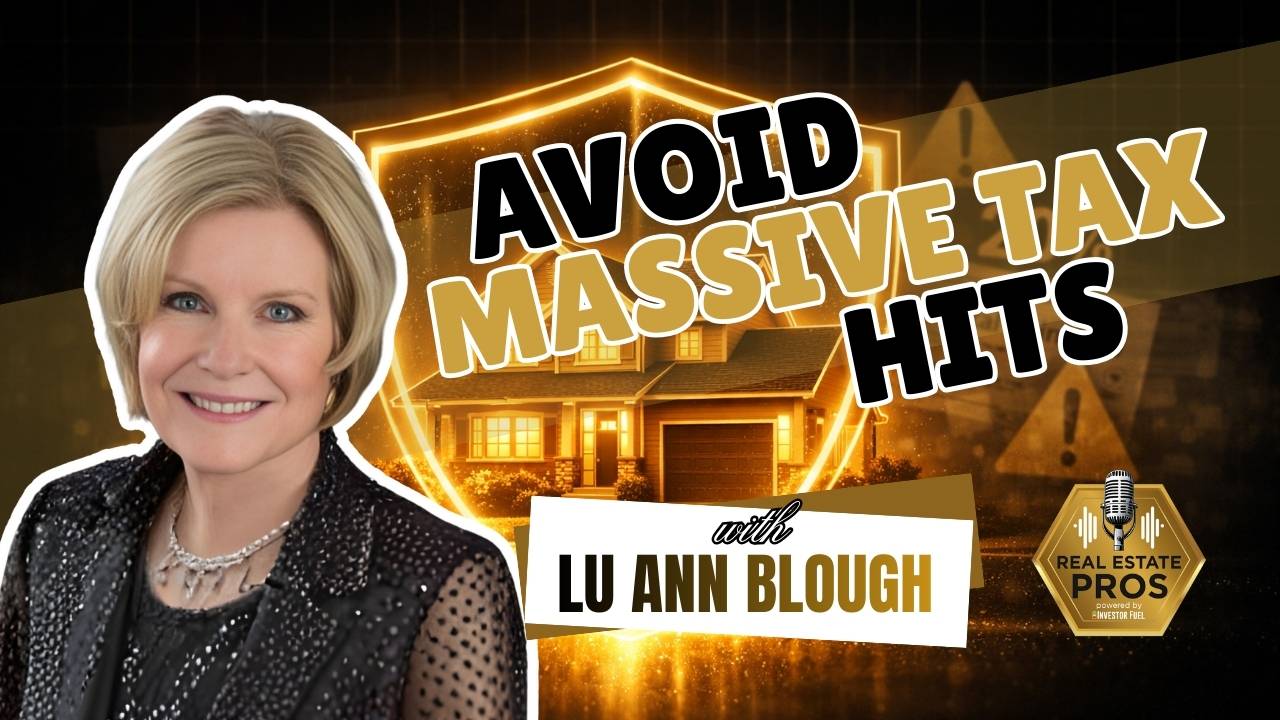
In this episode of the Real Estate Pros Podcast, host Micah Johnson speaks with Lu Ann Blough, a qualified intermediary specializing in 1031 exchanges. They discuss the fundamentals of 1031 exchanges, including tax implications, required timelines, and the importance of working with experienced professionals. Lu Ann explains the rules surrounding forward and reverse exchanges and highlights how missing deadlines can result in significant tax consequences. The conversation emphasizes education, collaboration, and building a strong professional team to succeed in real estate investing.

Resources and Links from this show:
-
-
- Investor Fuel Real Estate Mastermind
- Investor Machine Real Estate Lead Generation
- Mike on Facebook
- Mike on Instagram
- Mike on LinkedIn
- Erg1031’s Website
- 1031 Exchange assistance on Facebook Group
- Lu Ann Blough’s Phone: 972-863-1031
- Lu Ann Blough’s Email Address: [email protected]
Listen to the Audio Version of this Episode
Investor Fuel Show Transcript:
Lu Ann Blough (00:00)
So most people, when they call me, they’ve got an investment property for sale or under contract to sell. At that point, we get with the title company. We open up their bank account. We don’t hold anybody’s money internally. It’s all sitting in a segregated account, FDIC insured in a bank.We get it set up with closing. We do our documents, which is our contract. They close, the money goes to their exchange account. The day they close starts the 45 days to identify what they want to buy. That’s also called the dreaded 45 days, because nobody thinks it’s enough time. And the 180 days to close on one or more of the properties that they identify.
Micah Johnson (02:22)
Hey everyone, welcome to the Real Estate Pros Podcast. I’m your host, Micah Johnson. And today I’m speaking with Lu Ann Blough who’s been making some serious moves in the real estate space for quite some time now. Lu Ann, welcome in, glad to have you. I’m excited for our talk today. We’re gonna dig in on a conversation that I think a lot of investors need to know about, especially when it comes to tax implications and just things that have to do with the deal. So let’s dive in. For people who may not know you yet.Lu Ann Blough (02:35)
Thank you very much. Glad to be here.Micah Johnson (02:50)
What’s your main focus right now and what markets do you operate in?Lu Ann Blough (02:55)
We are a nationwide qualified intermediary, meaning we can deal with any state, anybody in any state. We deal with all markets, ⁓ single family, commercial, whatever you’ve got, because we don’t want you to have to pay taxes. So, the 10th of July,Micah Johnson (03:15)
And what do y’all do?Take us into that intermediary term. What are you doing for the folks that are working with you?
Lu Ann Blough (03:21)
We, well, the 1031 exchange has been around since 1904. The government, the IRS put it in place to help get more money into the real estate market. So instead of the capital gains tax that you would have to pay on an investment property when you sell it, you can defer that gain by rolling it into new property. a 1031 exchange always involves a sale and a purchase.or with the reverse exchange of purchase and then the sale.
Micah Johnson (03:57)
Okay, let’s start with the first version. Take us through that. For someone that’s listening or watching and they’re not that familiar with 1031s, what is it that you feel like they should know first? Because you’re an educator too. You teach about this. Educate us. What is something that we need to know out of the gate?Lu Ann Blough (04:15)
So if you are aninvestor and if you’ve owned a property longer than a year in a day, you’re going to pay tax on the gain if you sell it without the 1031. Federal tax is normally 20 % of your gain. Our friends in California have an additional, I’m in Texas, so we don’t have a state, you’re in Florida, so no state capital gains, but California’s got the highest and it’s 14.8 % on top of that 20 % federal.
Plus a little known fact is depreciation recapture. Most investors when they own real estate, they will depreciate it yearly. If they sell it and they don’t do an exchange, the government is gonna want 25 % of that total back. So the 1031 exchange allows you to defer the tax and defer the depreciation recapture by purchasing more real estate. And it can be anything
We talking about that earlier, Micah. can be anything defined as real estate in any state in the country.
Micah Johnson (06:10)
Are there particular asset classes it works better with or truly across the board it’s a useful tool?Lu Ann Blough (06:16)
It’s across the board a useful tool. You just have to have owned the property in your own taxpayer ID. So syndications, syndications where there’s an entity that has a taxpayer ID and has a bunch of investors in it, that doesn’t always work. Because one of the rules of exchange is that the taxpayer ID on the sale has to be the same as the taxpayer ID on the purchase.Micah Johnson (06:26)
Okay.Okay.
Lu Ann Blough (06:45)
Does that make sense?Micah Johnson (06:45)
Yeah, if they’re not going to buy again, then if that same EIN is not making the purchase, then it won’t go across. Is that what you’re saying? Gotcha.Lu Ann Blough (06:49)
Yeah, I can’t becausethey own a percentage of the entity that owns a real estate. They don’t actually own real estate.
Micah Johnson (07:00)
Sure, that makes sense completely. Now, when is there too small of a property to use a 1031 for like, is it, do you need enough to do it? Does that make sense? Like if someone’s thinking about, you know, I only got one house or do I need, do I need enough houses? When does that really kick in or is it out of the gate?Lu Ann Blough (07:03)
That’s good. ⁓It’s personal. I talked to a guy, excuse me, this morning who only had $5,000 worth of gain. To him, minus our fee, it was still worth it to do it. Some people I talked to, I’ve only got 10,000 in taxes. I don’t want to mess with it. I’m going to go ahead and pay the tax and not do the exchange. So it’s really the individual person, which is what I like about it. What their goals are, what their financial situation is.
Micah Johnson (07:35)
Okay.Lu Ann Blough (07:52)
which is why I like to talk to him.Micah Johnson (07:52)
That makes sense.Well, I mean, doing it long enough now, mean, one thing I know about 1031 exchanges, you need to work with professionals on it. You got to work with folks who are doing what they’re doing, because take us through that process on the buy and then sell, because there’s timelines involved, correct? Like there’s all these different little pieces you have to hit at the right time to make sure it goes through. So take us through a mock-up transaction for that process.
Lu Ann Blough (08:04)
Go.Can I do both? Can I do the sale and the buy and then the buy and the sale? Okay.
Micah Johnson (08:23)
Absolutely, absolutely. I want to hear both sides.Lu Ann Blough (08:26)
So most people, when they call me, they’ve got an investment property for sale or under contract to sell. At that point, we get with the title company. We open up their bank account. We don’t hold anybody’s money internally. It’s all sitting in a segregated account, FDIC insured in a bank.We get it set up with closing. We do our documents, which is our contract. They close, the money goes to their exchange account. The day they close starts the 45 days to identify what they want to buy. That’s also called the dreaded 45 days, because nobody thinks it’s enough time. And the 180 days to close on one or more of the properties that they identify.
those two timelines run concurrent. And we send little reminders saying, hey, 45 days is coming up. We send them forms. And then once they go under contract for a replacement property, then we do the same thing on the other end. We get with the title company, we get them set up, we get the documents in place. They sign off on the wire form along with us in the bank, allowing the amount of money to be transferred to title for that purchase.
And then after they’re done, we send them a closeout package so that they’ve got it for their CPAs for the following year.
Micah Johnson (10:29)
Now what happens if you miss the 45 day mark? What happens on day 46? So that’s the rule. Like you got 45 days or you’re paying taxes once you open up this process.Lu Ann Blough (10:34)
you get your money back and you pay tax.Or you have a hurricane or COVID hits and the federal government says there’s a disaster. then we did, we have had some of those, the flooding in Texas last year, did the fires in California. There were extensions.
Micah Johnson (10:57)
What’s your,yeah, those things that we can’t account for. Right, yeah, that we can’t control, they just come out of nowhere. Okay, so there’s a little flexibility there. Now, let’s talk about that 180 day date. they get to day 181, is it the same thing? It’s all over now, we’re paying the jack.
Lu Ann Blough (11:01)
or control, exactly.Yeah, and the only
time we run into trouble with that, honestly, Micah, is if a property that they want to buy is in probate and it gets held up, or if it’s a new construction from the ground up, in which case I will try to talk them out of identifying it. Because the builder is going to tell you they can get it done. And experience has shown that they don’t always get it done. And they’ve got somebody waiting in the wings to buy.
Micah Johnson (11:27)
youLu Ann Blough (11:46)
So yeah, they’re hard and fast.Micah Johnson (11:47)
180 days ina new build. Holy cow, you’re pushing the limit right there. I don’t want to go to sleep for those 180 days. I’d be stressed out every night.
Lu Ann Blough (11:54)
YeahNo,
we do a lot of new builds, but they’re three quarters of the way done when they start.
Micah Johnson (12:05)
Gotcha. Okay.That makes way more sense because yeah, you’re living on the edge if you’re starting to build it. That concrete ain’t even set yet. You’re trying to close.
Lu Ann Blough (12:12)
Dude, jump.We’re jumping off the edge. And the reverse exchange, I can go over that quick, a brief, more complicated, but what if you found a property that you wanted to buy before you were able to sell your property or properties? So a reverse 1031 is you can’t buy that before you sell, but we as your intermediary can set up an entity in the state you’re buying.
Micah Johnson (12:20)
Right, right, yeah, no thanks.Easy, yeah, take us to the next way.
Lu Ann Blough (12:47)
borrow the money from you or from you and a lender, we actually take title to that property only as a placeholder, not as a we’re gonna take your property. ⁓ It’s leased back to the buyer, to our clients. It’s very tightly, tightly wound. And then once you sell the property, then you get any money that you’ve had to front return to you. So the sale will also go into an exchange. And then we do what we call, we flip it back.to the client, they file a form with the appraisal district and then they’re done. They’re more expensive, but because they’re a lot of work.
Micah Johnson (13:26)
Yeah.Yeah. You got two things happening at the same time right there. Especially with the accounts that you’re needing to set up and moving it all between title. That is a lot of work going on. However, do you do that one often? Is that one more popular than the other one? They’re about the same? Like what’s the ratio?
Lu Ann Blough (13:36)
It’s a lot of words.They’re growing. I would say from my book of business, probably I’ve done more reverses in the past year and a half than probably the first 10 and a half years combined. It’s interesting. It’s really interesting.
Micah Johnson (14:03)
I see why it would make sense to do it. Because you never know when you’re going to find a property and you don’t always want to sell your property. the timing, like when it comes to selling a property, it’s such a timing thing anyways, when you’re doing it to make sure you’re getting into that right thing. So the forward, easier, cheaper option has some level of difficulty to it if the market’s not right, if the timing’s not right, if all these things where this other, now are there time, is that one time bound to what are the…Lu Ann Blough (14:32)
180 days. Yeah, you’ve already ID’d what you’re going to buy when we take title checks for you. So the 45 days goes out the window. The key is the 180 days. have to your other properties sold within the 180 days because it’s going to be yours anyway at the end of 180 days. So yeah, I’ve got one client.Micah Johnson (14:32)
or the David. So that one, are youRight.
Okay. Now you just gotta make sure you’re controlled.
Yeah. Interesting. I love this. I love learning everything.
Lu Ann Blough (15:42)
This is so fun. I’ve got one client right now up in Salina, which is the fastest, one of the fastest growing cities. And I won’t name names, but he and his family are, they’ve got land worth $50 million up there. So we are doing reverses on that one.Micah Johnson (15:56)
Wow.Okay. What they found, they had the 50 million in land and they found something they want to buy. So now they’re going to buy that, set this up, set up the exchange backwards and then sell that land. And when that closes, then the money goes basically, switches, right? You get them. Okay. I appreciate that.
Lu Ann Blough (16:03)
Yeah, we’ve been hiring.done. Well, actually,
they have found several things they want to buy. And they’re selling off the land parcel by parcel. So it’s yeah.
Micah Johnson (16:33)
That gives me the next thing. Cause you can buy,don’t have to just why it’s not a one for one, right? You can buy multiple things with that money coming out.
Lu Ann Blough (16:42)
yeah, you can identify up to three with no cap on the value. If you go over three, so say you sold, I don’t know, a condo for what, half a million in Florida? I don’t know. And you wanted to buy six other properties. The IRS puts a cap on it called the 200 % rule. So we would have to take your sales price of half a million, multiply it times two. So that’s a million.And then when you send us your 45 day list, those six properties added up together could not be more than a million. That’s probably the most confusing rule in the whole exchange, I think.
Micah Johnson (17:20)
Gotcha. Okay.Why is it there? When did it get there? Who put that one in?
Lu Ann Blough (17:29)
Thisis 1984 to IRS. I have no words.
Micah Johnson (17:33)
Okay.Gotcha. And 84, they just said, all right, if it’s three, doesn’t matter if it’s six, we’re only 200 % of you.
Lu Ann Blough (17:42)
I think it’s honestly, think there probably is a logical reason that they don’t want people going out and putting earnest money down on 15 properties without, you know, and screwing up the market. That would be my guess, but I don’t really know.Micah Johnson (17:58)
I could I could swallow that answer. I could believe that could be the case because if it doesn’t work out and now you got 50 properties tied up and they’re all falling apart, we got a big mess. We’re cleaning up now.Lu Ann Blough (18:09)
Exactly. And up until 2018, we could do 1031 exchanges on some personal property. So like if you had cows on a ranch, you wanted to sell the cows, you would have to buy cows of a higher value. But we could do exchanges on those. We could do exchanges on Learjets as long as you bought a better Learjet. You couldn’t buy a helicopter.I had a client in San Antonio who had an amazing violin with the San Antonio Symphony that he’d had forever. So we didn’t exchange on that, but then Trump had to kind of make a compromise if you will, and just go to real estate. I missed some of those fun ones.
Micah Johnson (18:55)
Gotcha. now we can.Right.
Well, one thing I love about real estate is how old it is. It’s such an old industry. has the oldest code of ethics that are written down in America. You’re talking about this has been around since 1904. It’s an industry that’s been here for a long time. It’s been operating. And there’s so many things that are in it that, man, it’s already happened. We learn them and think they’re new, but it’s not new at all. It’s been going on for a long time. There are these just different ways.
If you’re creative, real estate is a great industry for you to be in. You really get to stretch your mind and do things. And if you’re good at it, that’s what draws people to you. Y’all aren’t working with all these folks nationwide because you’re not good at it.
Lu Ann Blough (19:38)
yeah.No, and I work for three attorneys in Denver. One of them, McCabe, our senior member, he’s a real estate attorney. He’s been doing these for 50 years. So if I have questions, which sometimes I still do, because I’m not afraid to say, hey, I don’t know the answer to that, but I know a guy.
Micah Johnson (20:00)
I know a guy, he’s got 50 years of telling me, man, you’re not doing it for 50 and don’t know a little bit about it. That’s for sure.Lu Ann Blough (20:05)
No,absolutely. So are you asking me or?
Micah Johnson (20:08)
And you found something you like to do.I say, you found something you like to do.
Lu Ann Blough (20:14)
I love this. Yeah, my skill set is being a go-between. I didit in the insurance business. I worked in London for a year, worked at Lloyd’s, learned that skill set. And then I did it having a mobile notary company. I was the go-between. And so now I’m the go-between. Trying to help people understand, which is probably the biggest, getting people over that hump of being afraid of it because it’s the IRS is
Yeah, but I learned something ground up, so I’m pretty good.
Micah Johnson (20:46)
makes sense.I heard
that’s the best way to learn. Cause you know the nuts and bolts and that’s what I’ve learned about real estate. Like education is everything. It’s always step one. ⁓ don’t making the offer isn’t step one. It’s, it’s educating yourself on it because that’s the rules. Once you know the rules of the game, now you know how to play. Now you can go do the other part, which is the people. Like there’s the rules of the game and then there’s the people in the industry. The better you are at the rules. Now you know how to engage with the people and the more you know, and then the better you can serve.
And like you’re saying, I to be the middle man too. I love being the connector in the middle. And there’s so many opportunities for that in real estate where you’re again, your personality can line up with it. I’m big on getting my emotional paycheck paid along with my financial paycheck. And real estate has been one of the industries that’s done that for me pretty much the whole time I’ve been in it. Now I’ve switched around when one section of it stopped, but I didn’t have to leave the industry.
Lu Ann Blough (21:45)
Right.Micah Johnson (21:45)
togoing, right? Like my experience could just keep compounding inside. Where before that I came from the medical field and I was pretty much locked up unless I wanted to go to school for a lot longer to do the next thing. And I quit like the thing I was doing. I was like, all right, what do I want to do? How many more years of school I want, or do I want to jump into something that lets me grow way more? gives me that same high earning potential and even more in reality. I was talking to a doctor yesterday. got, now he’s a real estate investor. I’m like, okay, understood.
Lu Ann Blough (21:57)
Right.Micah Johnson (22:15)
I know that now we know the good direction, even the physicians come our way.Lu Ann Blough (22:19)
Well, the best ones are those that have real jobs while they’re learning. And then they can eventually transition to do, you know, to do the real estate. I’m a psych major. most of them. Yeah. I mean, most of them, most of my skillset is people skills, I think. And then just listening and being able to find out what, what is your dream? What do you want to do? How can we make it the easiest for you?Micah Johnson (22:31)
⁓ love that.Right.
That’s when you get to have that service. That’s when the like your real you can come out. And that’s something again, in real estate, I mean, so many people that are truly service oriented, they actually want your good at the end of it. They’re not just trying to take something from you. They’re there to serve part of it. And we were saying this earlier, I mean, to close a real estate deal, even without a 1031 exchange person, you still need a lot of people. You’re still needing a title company or an attorney or
Lu Ann Blough (23:12)
You didn’t really need to.Micah Johnson (23:15)
Like there’s, you can’t do it alone. This is not an alone business. There’s nothing you can do in it by yourself. And typically you’re not good at all the parts. That’s what I’m in another, one of the groups I’m in, we talk about this, we call it the deal triangle, where some of us are deal finders, some of us are deal funders, and some of us are deal builders. We actually bring it off the ground, but very rarely are you all three. It’s very common for you to be two of the three, but to be all three,Lu Ann Blough (23:38)
right?Micah Johnson (23:41)
That’s just not a normal person. Like most of us don’t have all those in there. And for us as a group, we all saw it. Now we all know which one we are. they could, and when we were like talking, it’s like, man, man, I feel free now. I know what a section of the triangle I’m in. Now I can just focus and keep all that other stress away. Now I know a guy. you’re good at that side of the triangle deal. Hi, I’m Micah. Good to meet you, man. Let’s talk.Lu Ann Blough (24:05)
Unless my operations director is grouchy, then I get in trouble because I’m not an operations person. So keeping Scott happy is a little bit tricky sometimes. ⁓Micah Johnson (24:09)
true.⁓ yeah. More.
⁓ We
all got some burden to bear.
Lu Ann Blough (24:22)
And that’s what David, I will brag on my son. My son, the youngest son’s name is David Blough and he played quarterback in the league for five years. But his goal is always to become a coach. That was his skill set and he transitioned and was assistant quarterback coach and just got named the offensive coordinator for the Washington commanders. So he’s happy as he can be. A little bit terrified, but happy as he can be.Micah Johnson (24:48)
Thank you.Well, I came from the football world, not that high level at all, but football, there’s so many analogies from football and real estate that I, that I run into, especially when it comes to building your team. Like if you’re a business owner, the idea of a coach and how they set their staff up. I love the model because it’s, I’m a Gators fan. I’m from Florida and we’ve had really big issues with coaches recently, but one we had, he just hired all his friends.
Lu Ann Blough (25:16)
You have.Micah Johnson (25:18)
That’s everybody that came was his friends. And the one we just got in his first press conference, he said it like, it’s okay if you’re my friend, but if you’re not right for the job, you don’t get hired. And I loved it. I was like, my God, I love that because that’s how you do anything good. You put together a high quality team of qualified people, someone that’s equipped to do that job well. And then when you do that, now you have a system that’s running. You have an organization that can.Get to the playoffs, win the Superbowl, whatever, whatever it is that you want to do. without that, unless I get hurt, right. That’s in the, in the football world, man, you live and die on those injuries. And it’s, and it’s, it’s, it’s tough. It is it’s I, and when I was in the medical world, I used to go get into, ⁓ I was out of base out of Jacksonville and I got to do some work with the Jaguar team and their locker room.
Lu Ann Blough (25:49)
The last year quarterback, I guess,You definitely do.
I bet that was fun.
Micah Johnson (26:13)
It was so interesting being around the trainers and seeing like what’s the behind the scenes with the group and how it all worked. Cause it’s, it’s, that’s where I realized, my God, one, you don’t realize how many folks are hurt. Like that game is it’s already violent, but it went, it’s grown men running into each other at full speed. There was so many guys coming through there and just learning what they were going through and how, how it affected them and how it affects their whole, it was just fascinating getting to listen to the stories and the things you’re doing.Lu Ann Blough (26:41)
Did youplay, Micah?
Micah Johnson (26:42)
Becauseit’s 100 % a business and it’s also a sport at the same time and just how they connect, fascinating.
Lu Ann Blough (26:50)
Did you play football? Did you play football?Micah Johnson (26:54)
I played, I did play football froma little kid until they do high school. And then, ⁓ I was training to play. was trying out for an arena team, but I hurt my neck. And at that point, I, I, at that point with the neck injury, said, no, I’m, I’m done. I’m going to hang them up now. I’m it’s time for me to, to move on. And, I was a wide receiver and this was the timeline when you could just annihilate.
Lu Ann Blough (27:07)
never a good thing.You’ve done it. You’ve done it.
Micah Johnson (27:22)
people going over the middle where targeting was what everybody loved to see. uh, you know, and there was no calls for it, right? Like Ed Reed was eating people for lunch at about this time when I was still playing football. And I was one of the things that went into it was like, okay, do you want to put your whole self back together and keep doing this? Or do you want to start shifting and thinking about other stages of life?Lu Ann Blough (27:28)
and they didn’t get called for it.Micah Johnson (27:48)
And at that point in time, I was like, I think I’m going to switch. I’m in my mid twenties now. I, how much more time do I really have? Right? Cause I was looking at the guys, you know, who’s the oldest guy still playing college football and all this stuff. And it’s like, okay, this train may have sailed for it or train may have set on a tracks for you, buddy. What are we going to do? Isn’t that the craziest part? Yeah. Now that all changed. But,Lu Ann Blough (27:48)
Right.Well, now they get paid in college to play. that there. Yeah.
Micah Johnson (28:13)
Lu Ann would talk about stuff like this with you for a long time. I really appreciate your time with me today, your story perspective. Thanks for just what it is that y’all do, that service you provide and the education. I think folks do need to know about the 1031 exchange. It is a powerful tool in your arsenal, especially as an investor.Lu Ann Blough (28:27)
They do.Can I say one more thing? The most, if they don’t take anything else away from this, the most important thing is you have to set it up before you close on the sale. It makes me so sad when somebody calls and said, I closed 10 days ago. They told me I’ve got 45 days to set up my exchange. Once the money hits the seller’s bank account, they’re toast. We can’t help them.
Micah Johnson (28:33)
Please.Okay? Okay.
Go out. Thanks for that last final note. So you got to set your exchange up before closing day. So call Lu Ann before it closes so that she can help you through this. Work with folks that are professionals at this and they’re going to get it done right. Because if you those timelines, this game over. Now you’re paying those taxes again. Lu Anne,thank you so much for joining me for folks that are listening or watching that would like to reach out to you, follow along with you and touch base. What’s the best way for them to find you?
Lu Ann Blough (29:26)
Well, our website is exchange resource group www.erg.com. My number is 972-863-1031. And my email is Luann, L-U-A-N-N at erg1031.com. I also have a Facebook group that has about 3,200 members in it right now called1031 exchange assistance.
Micah Johnson (30:00)
Excellent.Again, if you’re listening or watching in, check our show notes. We’ll make sure to have all of Lu Ann’s links there for you. Check her out. Also see how our son’s doing as an offensive coordinator for the commanders next year. Keep an eye out for that. Looking forward to it. Thanks everybody for listening with us today. If you got value out of today’s episode, please like this episode. Share it with someone else you think needs to learn about a 1031 exchange.
As always, please don’t forget to subscribe to our podcast. We appreciate every single one of you that follows along with us. We got more conversations coming up with operators just like Luan out there building a real business in the industry and serving investors. Thank you so much. We’ll see you on the next episode.
-