Subscribe via:



Show Summary
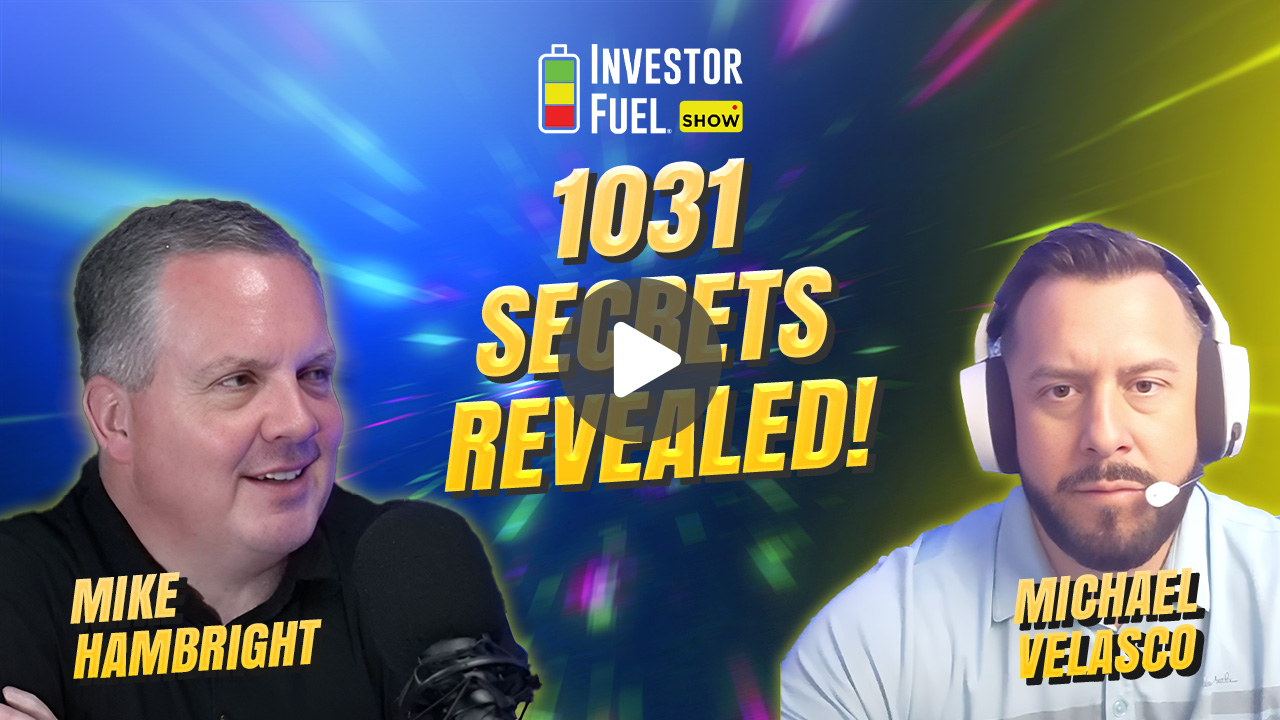
This conversation delves into the intricacies of the 1031 exchange, focusing on its requirements, eligible properties, and the importance of value in exchanges. Michael Velasco explains the fundamental aspects of 1031 exchanges, including the necessity for investment properties and the types of real estate that can be exchanged. He also emphasizes the requirement to purchase properties of equal or greater value to the sold property, providing clarity on common misconceptions.

Professional Real Estate Investors – How we can help you:
Investor Fuel Mastermind:
Learn more about the Investor Fuel Mastermind, including 100% deal financing, massive discounts from vendors and sponsors you’re already using, our world class community of over 150 members, and SO much more here: http://www.investorfuel.com/apply
Investor Machine Marketing Partnership:
Are you looking for consistent, high quality lead generation? Investor Machine is America’s #1 lead generation service professional investors. Investor Machine provides true ‘white glove’ support to help you build the perfect marketing plan, then we’ll execute it for you…talking and working together on an ongoing basis to help you hit YOUR goals! Learn more here: http://www.investormachine.com
Coaching with Mike Hambright:
Interested in 1 on 1 coaching with Mike Hambright? Mike coaches entrepreneurs looking to level up, build coaching or service based businesses (Mike runs multiple 7 and 8 figure a year businesses), building a coaching program and more. Learn more here: https://investorfuel.com/coachingwithmike
Attend a Vacation/Mastermind Retreat with Mike Hambright:
Interested in joining a “mini-mastermind” with Mike and his private clients on an upcoming “Retreat”, either at locations like Cabo San Lucas, Napa, Park City ski trip, Yellowstone, or even at Mike’s East Texas “Big H Ranch”? Learn more here: http://www.investorfuel.com/retreat
Property Insurance:
Join the largest and most investor friendly property insurance provider in 2 minutes. Free to join, and insure all your flips and rentals within minutes! There is NO easier insurance provider on the planet (turn insurance on or off in 1 minute without talking to anyone!), and there’s no 15-30% agent mark up through this platform! Register here: https://myinvestorinsurance.com/
New Real Estate Investors – How we can work together:
Investor Fuel Club (Coaching and Deal Partner Community):
Looking to kickstart your real estate investing career? Join our one of a kind Coaching Community, Investor Fuel Club, where you’ll get trained by some of the best real estate investors in America, and partner with them on deals! You don’t need $ for deals…we’ll partner with you and hold your hand along the way! Learn More here: http://www.investorfuel.com/club
———————–
🎧 Subscribe to the Podcast
Apple → https://podcasts.apple.com/us/podcast/investor-fuel-real-estate-investing-show/id943707421
https://open.spotify.com/show/0yjlEMMn52BRrrlhfxCn4S?si=48f4b577276246e6
YouTube →
https://www.youtube.com/@investorfuel
🤝 Stay Connected with Mike
Follow on Facebook → https://www.facebook.com/realmikehambright
Follow on Instagram → https://www.instagram.com/realmikehambright/
Follow on Linkedin →
https://www.linkedin.com/in/mikehambright
📈Free Training and Resources for Professional Real Estate Investors
Acquisitions Manager Hiring Guide → https://my.investorfuel.com/if-lm-optin-acquisitions-guide
COO Hiring Guide → https://my.investorfuel.com/mm-lm-coo-hiring-guide
Executive Assistant Hiring Guide → https://my.investorfuel.com/mm-lm-ea-hiring-guide
Fuel 5 → https://my.investorfuel.com/mm-lm-fuel5
Triple Your Profits Masterclass → https://go.investorfuel.com/triple-your-profits
🏠Free Training and Resources for New Real Estate Investors
Rehab Live → https://my.investorfuel.com/rehab
Find Your First Deal in 5 Days challenge → https://go.investorfuel.com/find-your-first-deal-5-day-challenge
Join My next 4 Day Live Training Event (Virtual)
https://investorlaunchpad.com/
Resources and Links from this show:
Listen to the Audio Version of this Episode
Investor Fuel Show Transcript:
Mike Hambright (00:01.07)
Hey everybody, welcome back to the show. Really excited to have my buddy, Michael Velasco here. Today we’re going to be talking about everything you need to know about 1031 exchanges. There’s a lot of misnomers, a lot of confusion. I think at the end of the day, as a real estate investor, know historically somebody said something to me at one time about how much time we spend driving the top line and we don’t spend anywhere close to as much time protecting our profits. Like we’re so top line driven at the end of the day, the top line doesn’t even matter. And so you’ve really got to be, it’s really not what you make, it’s what
you keep as they say, right? So we’re going to be talking about how to build wealth and clear some confusion up on 1031 exchanges with Michael. So Michael, welcome to the show.
Michael Velasco, CES (00:40.062)
Thanks for having me Mike. It’s it’s great to be one a part of investor fuel and on on your podcast I really enjoy doing these so
Mike Hambright (00:46.808)
Yeah, I appreciate that. You’re an amazing resource. it’s funny, like for me, I used to be like the young guy in the room. Now I’m getting a little bit older. People are referring to me like the guy with all the wisdom and stuff and got all the gray hairs to prove it. But I think way more today about tax strategies and stuff like that than I did early on when I was just trying to make it happen. And that’s probably a common thing I would imagine. Yeah.
Michael Velasco, CES (01:10.289)
That is a common thing as we get older like I just turned 50 It’s like the stuff that I wish I would have known in my 20s, you know And the people that have been in the business long enough, they don’t you know, you’re not even in your 20s You’re not even thinking about 1031 exchange, but you get to our age and all of a sudden it becomes a very very important topic
Mike Hambright (01:25.592)
No.
Mike Hambright (01:29.804)
Yeah, yeah, yeah. Because you realize, I mean, some of it is that you’re later in life and you’re starting to plan your life. Some of it also is just you realize, like even this season right now, like I know as we speak, I think right now my wife is meeting with our tax advisors and they’re telling us how big of a check we have to write. And those are painful conversations, right? You have those enough times and you’re like, somebody show me a better way. And we’re like, Michael’s gonna show us a better way today.
Michael Velasco, CES (01:48.539)
Yeah.
Michael Velasco, CES (01:53.455)
Yeah, yeah, exactly. And it’s this time of year, I mean, we’re filming this in November, and it’s tax planning season, right? You really got to get to work on not only closing out this year, but into next year. And I was talking with my my lead outside counsel last week, and he goes, I said, you guys are slowing down a little bit because you’re past, you know, the extension season. He goes, now he goes, this is the busiest time of the year, everybody’s trying to get all their planning done, you know, and he’s a very sophisticated tax attorney, but
You know the wealthier you get the more accumulation you have the more to your point Mike you want to protect it as much as again, you
Mike Hambright (02:28.802)
Yeah, you didn’t work this hard to give it all away to other stuff. So we won’t get into the political side of it. hey, before we jump into this, tell us your background. I know you weren’t always in the 1031 exchange space, but you’re the absolute authority now. So tell us how you got here.
Michael Velasco, CES (02:33.647)
Exactly.
Michael Velasco, CES (02:42.928)
Yeah.
Michael Velasco, CES (02:46.577)
Yeah, and my career really started, was first early in my 20s, kind of in the sales role, and I got into real estate in 2004, and then ran teams, property management companies, I did flips, I did everything that a real estate investor would and real estate agent would. And then about 2017 or so, I said,
I want to get into some different businesses and I thought tax was a really good place to go into. So I got in with a partner, we ended up buying out and we built an accounting firm. And so I built an accounting firm, really learned the background of tax, entity structures, different types of tax returns, know, partnership returns, S corporation returns, personal returns, a little bit about trusts and really, you know, started filing hundreds and hundreds of tax returns. And, you know, I really liked being on the planning side. I like being
you know, on the side where I was really helping business owners from a consulting standpoint. And our staff started doing ADA 24s, which is the rider to the tax return for the 1031. And my CPAs were turning to me going, we’re not 100 % sure. We don’t do a lot of these. Let’s explore. So I sat down with my tax attorney at the time and I said, tell me everything I need to know about 1031 exchange. And so I went down this rabbit hole and I go,
well, what’s a QI? You know, what are the ramifications of a 1031 exchange? And so I was, began fascinated with it. And so when I was liquidating the accounting firm, and that was really the goal to build the business and then sell it. And I said, what am I going to do now? And I loved 1031. And I started just studying as much as I could, took on a mentor. And then I opened my exchange company and
And from there, you know, I found the best I found a tremendous mentor and I found the best attorney in the country that I could and they’re very tough to find by the way, Mike, there’s about, in my opinion, 20 or so in the country that really know 1031 exchange inside and out because just because you go to a tax account or CPA does not mean that they’re going to know about this. So there’s some some firms that really specialize in it and I went and found them.
Mike Hambright (05:02.979)
Yeah.
Michael Velasco, CES (05:06.513)
Matthew Rapoport, my lead outside counsel out of Manhattan, and he’s a Georgetown Law alumni, just an LLM, which is like a master’s degree in taxation. And so I really, I kind of leaned on him for the better part of my, the beginning part of my career, spent hundreds of thousands of dollars getting the counsel, getting the paperwork right and everything. then ultimately after I was,
You know quite a few years in the business that I went into I got my CES designation which is kind like a CPA for a QI which is you know qualified intermediary is the term and and then really You know, I just started diving into more and more complex exchanges, you know And that’s where now I’m today and now I speak on panels all you know all over the country on 1031 topics. So So yeah, that’s a little bit about it
Mike Hambright (05:54.136)
Yep.
Mike Hambright (06:00.589)
Yeah.
Yeah, that’s great. A lot of I think it was a lot of people. remember this is before I was an entrepreneur and this was like I was still kind of in corporate America. I went to like get my taxes done like like an H &R block type place. Well, like I just didn’t know right at that point. I was I was not an entrepreneur yet. Just had a pretty simple job, you know, and I remember they like filled out my tax returns and there was one thing that I asked about. I was like, what about that? Like just something that I’d overheard and they’re like, yeah, let me check. And they put it in and like, yeah, you’re going to say like another like two grand. I was like,
Michael Velasco, CES (06:15.621)
Right.
Mike Hambright (06:31.376)
Wait, what else am I not telling you to type in that keyboard? That was my first realization of like, okay, all accountants are not equal. And then quite frankly, a lot of people assume that like…
Like at this point, I pay a lot for tax strategy, not necessarily for tax prep. A lot of the tax strategy folks, like they do tax prep, but they don’t really want to, which is part of the package. They really, what you’re really paying them for is their knowledge and tax strategy, right? And then I think you get into cost segs and you get a 1031s, like those are all specialists that your average CPA just, you know, doesn’t understand to the level that you do for sure. So I think just like a lot of real estate investors are, you would never just hire a contractor to like do
Michael Velasco, CES (06:47.227)
Yeah, for sure.
Michael Velasco, CES (06:54.479)
Right.
Michael Velasco, CES (07:07.173)
Yeah, for sure.
Mike Hambright (07:13.748)
electrical work and tile work and drywall texture. know, there’s experts in all those things and there are from a tax side as well, right?
Michael Velasco, CES (07:22.351)
Yeah, absolutely. And I think, you know, when you’re younger, you’re less apt to probably spend the money on that stuff. And as you get older and wiser, you’re just like, there’s a reason why, you know, they’re charging with their charts because they’re saving so much money. Yeah, exactly. And we learn enough through experience where it really catches up with us, where we get older, we just go, give me the expert. And I’m willing to pay because I know this is an investment in my future, you know, so and I did the same thing.
Mike Hambright (07:31.756)
Yeah. What did it cost me to not do that? Yeah. Yeah.
Mike Hambright (07:43.107)
Yep.
Mike Hambright (07:47.02)
Yeah. Well, let’s get into some of the basics of 1031 exchanges.
Michael Velasco, CES (07:52.817)
Yeah. So I think, you know, if, you’re an investor watching this podcast, there’s like four or five things I want you to know, and you should know about 1031 exchange. The first is it must be an investment property. So a lot of people can get confused. think they can 1031 exchange their primary residence. And then there’s a, so first it must be an investment property. The second is it’s any real property you can exchange into. So if,
I’m selling a piece of land, I can tend to exchange it into a single family. If I’m selling a commercial property, I can go and exchange it into an apartment complex. Any real property will work as long as it’s real property. And there’s even some like oil royalties and there’s some very exotic stuff that you can get into. The others equal greater value. This is the one I get probably the most calls on is, wait a second, I just want to exchange my equity. Well, the code basically states we have to
buy equal or greater value. So if you’re selling a million dollars worth of real estate in a 1031 exchange, you have to buy at least a million dollars in real estate, notwithstanding what the loan is on it. Just remember it’s equal or greater value and all the money and proceeds from the relinquished property have to go into the replacement property. Otherwise, if you want to take some out. Yeah, exactly. Yeah. And there is something called boot in a transaction.
Mike Hambright (09:10.198)
Okay, I wasn’t aware of that actually. Yeah, I thought it was more based on your equity. Yeah, okay.
Michael Velasco, CES (09:18.993)
where let’s say Mike’s doing an exchange and he goes, you know what, I want a little bit of cash from this, but I don’t want to compromise the whole exchange. I just want a little bit of cash. So in that scenario where we’re selling a million dollar property, Mike goes, Hey, give me a hundred thousand and I’m just going to buy a $900,000 property because it’s equal or greater value. I’ll pay taxes just on the a hundred thousand. And so that term is called boot, which is just taxable gain in an exchange where a taxpayer gets it. And Mike, you and I know
in the real estate space, real estate investors are typically asset rich and not necessarily, and maybe a little bit cash poor at times, because we always have our money working in real estate. So, boot is a common thing to take and you can’t take it. but otherwise, you know, equal or greater value. And then the timelines. Sure.
Mike Hambright (10:06.542)
And let me ask you a question. It doesn’t have to be one property. You could sell a million dollar property and buy four quarter million dollar properties, for example. I mean, I know there’s some time frame issues and stuff like that,
Michael Velasco, CES (10:14.001)
Exactly. Yeah, we’re seeing that. Yeah, we’re seeing that a lot in markets that, you know, this 1 % roll, which we all kind of try to achieve in investing is, can we get the asset to be 1 % of rent $150,000? Like Memphis is a great example, $150,000 property rents for $1,500. Well, we have a lot of properties in California, for example, where I’m seeing this a lot, there’s a, you know, there are $4 million property.
that’s not renting, you know, for $40,000 a month, right? So they’re taking their assets and they’re selling them in your kit. And to your point, Mike, we’re selling the one property and buying five ones that really bring the cashflow that they’re looking for. So you can go down in value or up in value, sell a million dollar property, buy for $250,000 properties in the same exchange. Certainly there’s a lot of flexibility there.
Mike Hambright (11:11.224)
Yep. Yep.
Michael Velasco, CES (11:12.561)
timeframes. So this is the other thing I want the viewers to know and the investors to know. 45 days to identify the replacement property, 180 days to close it. And you’re probably asking, well, wait a second, what’s identification mean? So we close the relinquished property and we identify and typically your QI, and that’s my role is you have to use a QI, a qualified intermediary to do a 1031 exchange because you cannot touch the funds.
So the funds will come to an account that we insure basically with a third party bank flows to the bank flows into the account for the client’s name for the benefit of the client. And we just hold those funds till we’re ready to close the replacement property. Okay. And so that’s what it really would have qualified intermediary does in a 1031 exchange. But back to the timelines. So if we sell the relinquished property, we have 45 days to identify
Typically the QI will send over a form that states, these are the three properties we want to identify. We’ll write those out, e-sign it, and we’ll keep it on file forever if the IRS comes knocking, looking for it. And that will be one of the things that they ask for is the identification form on their checklist of the audit. And so it doesn’t mean you need to be under contract. It doesn’t mean that you need to be…
you know, it just simply means that we’re going to write them down. These are the properties that we’re going to identify. And then we need to close on three of those. And there’s a couple of different ways we can identify. I’m not going to get on all those today, but with three property rules, one of them, the 200 % rule is the second one. If you’re going down in value, but there’s a couple of different ways you can identify properties. And, and that’s the thing that you want to know is that within 45 days, I’ve got to ID these properties and then we have to close on them within 180 days. So,
Those are a little bit on the timelines.
Mike Hambright (13:07.288)
Yeah, and what are some best practices for that?
If you wait, mean, I guess some best practices might be if this there’s obviously you got a lot of parties going on here, right? So if you’re like, hey, I could identify a property I want to buy before I even put mine up for sale. If that seller is patient enough to like, well, wait for wait for my timeline to fit and they’re like, hey, that’s cool. I mean, that’s not, you know, having done a lot of deals myself, the seller usually could care less about my timeline. So there’s some there’s some things you have to navigate there. What are some best practices?
Michael Velasco, CES (13:20.165)
Yes.
Michael Velasco, CES (13:37.071)
Yeah, exactly.
Michael Velasco, CES (13:41.265)
Well, we’ve seen and then to give you kind of a stat from last year, last year’s numbers, 2024, the average exchange in America lasted 58 days. So, and that was including commercial and land where you have these long inspection periods. So typically speaking, our clients are under contract through inspection period and appraisal contingency by the time the 45 days up. So to your point, Mike, it’s like, what is actually happening out there?
Well, usually like they’re they’re going under contract on the relinquish and by the time even the relinquish closes, they know what they’re going to buy. So I’ve got like three exchanges going on right now that won’t go past 10 days. You know, they’ve already found something. They know exactly what they want to do. That’s not always the case, but from a practical nature, think about it. You know, you’re kind of looking and looking, you know, why before that relinquish property ever closes and we have 45 days, but you also have the escrow period.
Mike Hambright (14:24.184)
That’s great.
Michael Velasco, CES (14:39.533)
of the relinquished property, you can begin to shop. So in practicality, becomes less of a problem than I think people think as long as they have a good idea of what they want to buy.
Mike Hambright (14:48.364)
Yeah, sure. It does require a little bit of planning though, right? It’s just like, what do you want to have? I think, I’m sure you’ve seen, I’m sure you’ve been a part of this. I’ve seen it before where, I have a client that needs like another property like right now. you know, because they haven’t, they’re probably at the end of that identification period and they haven’t found anything yet, or maybe they had something and it fell out or would that be another piece of advice as to for people to have a couple different backup options in case the one that they really want falls out?
Michael Velasco, CES (14:52.891)
does.
Michael Velasco, CES (15:09.574)
Yeah.
Michael Velasco, CES (15:15.281)
Yeah, exactly. So that’s why we have multiple properties we can identify. And, you know, the other strategy Mike is that we’re, sometimes we’ll be able to get the replacement property under contract with a contingency and just say, Hey, in this market, it’s more likely to happen, right? In 2021, it wasn’t going to happen. You’re not going to accept a contingency.
Mike Hambright (15:32.878)
sure.
Michael Velasco, CES (15:38.187)
I mean, we have the tool of a reverse exchange too. We’ll talk about it here in a minute. But really, you know, sometimes you could just get in under contract and go, hey, this one’s closing. You know, we’re, you know, we’re just going to do a double close or we’re going to just wait until we get this, you know, finished in today’s market. You can get away with a little bit more when this interest rates go down in the next year, which is looking like what’s going to happen. And then that will change slightly. You know, that will change the market, but those are market driven.
Mike Hambright (16:00.942)
sure.
Mike Hambright (16:05.196)
Are there, I know you said real property, so just to kind of test the boundaries of that a little bit, are there any opportunities to sell real property and put it into any sort of REIT or other funds that are not, I mean there’s real property inside of those, but it’s more of a fund. Is that a realistic thing or no?
Michael Velasco, CES (16:23.449)
Yeah, yeah. So they have something called DSTs, which are Delaware Statutory Trusts. Not to be confused with the other DST, which is like a delayed, kind of a delayed sale trust, which I don’t want to get into it very much, but they’re called Delaware Statutory Trusts, which are percentages ownership of a larger commercial, typically commercial deals. And depending on the asset class. So you can go to something like that. You can go into an oil royalty where you’re just
and basically exchanging into royalties and just getting a royalty check off of, you know, some sort of gas or oil royalty. So there’s different things that you can do and depending on what your goals are and how noisy, you know, we talk about noisy assets all the time. Single families are traditionally more noisy. Well, at some point in your investing career, you don’t want to deal with the noise, you know, and then you go to a triple net, you know, triple net commercial or a DST product or an oil commodity or something like that that
Mike Hambright (17:14.957)
Right.
Michael Velasco, CES (17:22.149)
that makes sense, but it does offer some flexibility. To answer your question, Mike, you’ve got some great flexibility with real property.
Mike Hambright (17:30.156)
Yeah, yeah, that’s great. So one more reason it makes sense to talk to somebody like you that knows what they’re doing. So far, we’ve pretty much talked about, I guess, you would call forward exchanges, right? Like that’s, you’re kind of moving forward. You’re going to sell something, you’re going to buy something. So you mentioned just a moment ago, reverse exchange. Tell us more about that.
Michael Velasco, CES (17:48.175)
So the reverse exchange, okay, so let’s first talk about why you’d have to do a reverse exchange and the motivation why somebody would do a reverse exchange. So the IRS states that we can’t own the replacement property and the relinquished property at the same time, right? So if that’s the rule, then we have to come up with a way to purchase the replacement property first without it going into your name. So let’s say Mike.
wanted to buy a replacement property and he goes, and typically this was what happens. It hits the market and they have a portfolio of real estate. It hits the market and Mike goes, I gotta have this, you know, it’s perfect for investor fuel. It’s my, my office that I need. It’s like, or if you owned a, you know, a car repair shop and there was a, you know, something perfect came up for your shop. go, Hey, I gotta have it. I don’t have time to sell. And the seller is not going to allow me to list my properties.
Or in another case, Mike, and we get this a lot in the real estate circles is a deal comes up. It’s a wholesale deal. It’s 60, 70 percent of market value and they need to close tomorrow. Right. We see that a lot, too. So what the IRS gave us is revenue procedure 2037. So in 2000, the year 2000, they gave us safe harbor for holding a reverse exchange. And in this safe harbor, they said the QI can can also act as the the title holder.
to the property. And so basically what we do in most states, not on all states, but most states, we’ll set up an LLC in that state. So if we’re in Texas, Mike, if we’re in Texas buying this property, we’ll set up a single member disregarded LLC in Texas. And the sole member of that LLC is going to be exchangeable. Okay. One of my holding companies, right? So you’re going to, Mike’s going to give me the money to buy this property. So that’s the one downside of the reverse exchange is
You have to have liquidity or access to a loan in order to buy the replacement property because you don’t have the liquidity event from the relinquished property yet, right? So let’s just assume, Mike, you’ve got the capital or access to capital to buy the reverse property. So you’re going to basically extensively lend me the money, which means you’re just going to wire the funds into closing for us. And then we’re going to close in this LLC, this EAT. It’s an Exchange Accommodator Title Holder. We call it an EAT for short.
Michael Velasco, CES (20:12.665)
as an acronym. Just remember it’s an LLC. It’s an LLC with a single member as exchangeable. So now we’re going to close on this property. We’re going to own the reverse property and I’m going to give, remember I’m the owner, but Mike needs access to the property. So we’re going to set up a property management agreement where I say Mike is the property manager on this property. So he can receive rent, he can do repairs, he can act just like a property manager, right? So for all intents and purposes, this is a legal fiction anyways, and we’re just
following their procedure, but Mike’s really the owner. I’m just holding title temporarily. then during the interim, I’m going to give you a property management agreement. So you’re going to go, once we close on it, you’re going go get it rented out. You’re to do repairs. can do whatever you want to do with the property, right? And now we’ve started a clock backwards. We’ve started the 180 day clock to sell the relinquished property. Well, the 45 day still applies to.
Mike Hambright (20:46.54)
Right.
Michael Velasco, CES (21:06.817)
identify the relinquished but we know what the relinquished property is going to be right we go to our portfolio this is the one i’m going to sell so we list the relinquished property and then we sell the relinquished property and now we create a liquidity event now that money i can give to the extent of the proceeds we have from the relinquished property i can reimburse mike the money he lent me to buy the the replacement property and then i go down to the corporation commission and i go
I’m no longer the member manager of this LLC. We have closed the relinquished property and then on the date I transfer the membership interest over to Mike, he takes ownership and that’s the day he basically buys the property because it’s after the sale of the relinquished property. And so we do a membership transfer form and now exchangeable is no longer the member. Mike’s the new member of the single member disregarded entity and now you’re the owner.
Mike Hambright (21:55.81)
Yeah.
Michael Velasco, CES (22:04.473)
And that is kind of the inner works of a reverse exchange and how they work. And they’re great.
Mike Hambright (22:08.898)
Yeah, that sounds like I’m, you gotta definitely work with somebody that knows what they’re doing. So, like you, so, but that’s gotta be common, because like you said, I mean, of the hundreds and hundreds of deals that I’ve done, usually people wanted closure. That’s why they sell at a deep discount. Like I wanna close as fast as possible, usually. And so, yeah, that’s right, that’s right, that makes sense.
Michael Velasco, CES (22:13.487)
Yeah, lots of moving parts.
Michael Velasco, CES (22:25.551)
Yes. Cash now. Yeah. Yeah, that’s why. Yeah. And so the reverse just gives you incredible flexibility. The thing that I have noticed is the longer the investors invest, the less likely they like to do forwards. They love reverse exchanges. They will not do a forward exchange because they want to wait for the right deal as their net worth grows, their access to capital.
And they’re patient, you the investors that are older and just, wait for the right deal. And, and then they like to use the reverse product and they’re a little bit more expensive, but for the investors that are saving so much, you know, so I’ll give you an example. My fees on a forward or 1195 on a reverse, they’re 84 50. So there’s a little bit more expense, but remember Mike’s also receiving rent where he wouldn’t on a forward. You’re receiving rent on the replacement property. Yeah. So they’re a great tool. Great tool.
Mike Hambright (23:19.404)
Yeah, yeah, yeah, yeah. So how about, I know there’s also something called an improvement exchange. Tell us about that.
Michael Velasco, CES (23:26.097)
Yeah. Yeah. So you may have heard of them as improvement exchanges or construction exchanges, one in the same. So when somebody refers to one or the other, they’re basically exactly the same. We use the same tool. I I’ll run an example, a case example. So we’re selling a relinquished property in Dallas and we’re selling it for 300,000. We go out to Abilene and we find this incredible fixer upper that’s worth maybe 350 or 400,000.
that’s fixed up, but it needs a lot of work and we can acquire that property for 200,000. And then we have 100,000 left over, right? We sold the relinquish for 300, we’re buying for 200, needs $100,000 worth of work. So in this case scenario, we take 200,000 of the 300,000 we’ve got from the relinquished property and we buy the replacement property. But I can’t transfer the asset to Mike until all the repairs are done.
for a like kind exchange, remember equal or greater value. So I can’t transfer it until these repairs are done. So we’re gonna take 200, we’re gonna do another EAT, we’re gonna do another LLC, and we’re gonna hold the replacement property in the EAT LLC. And then I’ve got $100,000, we’re gonna hire a contractor, Mike’s gonna hire a contractor, and he’s gonna begin doing this $100,000 in work. I’ve got…
Now the 200,000 has gone out of the account. have 300,000 total up, which gives me a hundred thousand leftover. Now I could start writing that a hundred thousand dollars worth of checks to the contractor that Mike picks to fix the house. So we have to do that all within 180 day period. And then once the improvements are done, the exchange is now complete. Now I transfer the LLC back to Mike, but at the price of 300,000, because we did $200,000 acquisition and a hundred thousand dollars in improvements.
And then I basically take the title holder to the membership transfer. And now we have a good exchange. So it is great for investors that are thinking about doing value add and using exchange funds without coming out of pocket. It’s a great tool. And now we have really what a $400,000 property, maybe 350, 400,000 because of the work that we’ve done, you know, market value wise. So those are just, mean, most people don’t even know the inner works of the exchange, like a regular forward exchange.
Mike Hambright (25:34.722)
Yeah. Yeah.
Michael Velasco, CES (25:45.925)
But when you start getting into these exotic products and become more of a sophisticated investor, they’re just fabulous tools to use, you know, to grow your portfolio and your wealth.
Mike Hambright (25:52.621)
Yeah.
Yeah, I mean, real estate is all about leverage. And I think at the end of the day, one of the things that’s happening to a lot of people right now, I have a rental portfolio, single family portfolio in Dallas, and they just don’t cashflow as well as they used to. Like our return on equity is nowhere close to where it used to be because yes, values went up on paper, you know, we’re wealthy, but the rents didn’t go up as fast. And also the expenses went up faster than usual, too, with interest, with taxes and insurance. Right. And so one way to do that is to like,
Michael Velasco, CES (26:13.851)
Yes. Right.
Mike Hambright (26:24.832)
you know, if you have a lot of equity in your properties is to do a 1031 into lower level properties or other property classes or whatever that might cash flow better or as you said, be more like a triple net lease or something that kind of makes your life easier, right? So I think, you know, I think historically I would look at my portfolios like I’m going to build this and I’m going to like keep it forever. And I just know we’ve had an epiphany over the past like six months of like, okay, this is an amazing asset. It’s it’s done a lot for us. But what
Michael Velasco, CES (26:40.057)
Yeah, and reposition.
Mike Hambright (26:54.734)
It doesn’t have to be the same ad. You can trade assets. There’s things you can do that make way more sense for us based on where we are in our lives. And I think a lot of people that are listening to this, hopefully that resonates with some of them as well.
Michael Velasco, CES (27:06.385)
Yeah, absolutely. And it depends on what stage you are in your life, what stage you are in your net worth, your equity position, you know, your tolerance for the noisy assets. And then of course, repositioning. This is really what’s great is we can reposition our assets without paying taxes on it. And that’s what the the IRS is going. OK, we’ll let you we’ll play this game. We’ll kick the can down the road, which is.
which is your long-term capital gains and your depreciation recapture, which is the one thing I want to make sure our investors know depreciation recapture is a real tax. So just make sure it’s not just long-term capital gains. It’s depreciation recapture too. And there’s some other, other taxes too, that can come up too, depending on your income, but it’s the ability to reposition assets without paying taxes. So you can go to a different market or you can do it, go to a different asset class and not pay the taxes. And then ultimately, like what you’re talking about, Mike is really hitting the goals of where you are in your life.
you know, you know, so it just depending on where your life cycle is as an investor. So.
Mike Hambright (28:01.614)
Yep, yeah, that’s great. Michael, if folks want to to learn more, they want to work with you, they want to learn more about 1031 exchanges, they’re thinking about doing this, where do they go to reach out?
Michael Velasco, CES (28:11.505)
You know, my website’s the best place to start. It’s got probably 15, 20 videos of all different types of topics. But my website, 1031exchangeable.com, 1031exchangeable.com, you can go to that website. It has all my information. The phone will come straight to me. I’ve got a great staff, but I take a very concierge approach with my clients. So you’ll actually, you’ll get me on the phone, which is really, I’m not going to hand you off to somebody else. They help me with the paperwork and making sure we, we, know,
we’re in compliance with all those things. But these are very granular. know, these the nuances of this business are incredible. And you think on the surface, how could it be so so complex? It just gets complex, just people’s lives. You know, I added a brother, you know, Mike and I bought a property together. Now one of us doesn’t want a 1031 exchange. One does or you know, all kinds of crazy stuff happens in in life. But all that to say is, you know, you’ll you’ll get
you know, it’s going to be me talking with you about, hey, your exchange with what are your goals? And then, you know, we kind of try to match up in the right exchange and kind of go over the asset, depending on the state. And then there’s there’s Mike, the other important point is their state nuances. You know, if you’re in California, there’s a little bit different rules. If you’re in New York, it’s a little bit tougher. So depending on the state that you’re in, you know, there could be some little nuances there. And those are the in the discovery call when we talk about the exchange, those are the things that will
you we’ll talk a little bit about and and so 1031 exchangeable.com you can get ahold of me there if you if you like.
Mike Hambright (29:42.68)
Perfect, we’ll add a link down below. So guys, if this sounded interesting to you, if you’re thinking about how this could be a great vehicle for you, I definitely recommend you reach out to Michael. We’ll put a link down below in the show notes. There’s a lot of ways to make money in real estate and really in entrepreneurship. And you gotta work with somebody that can help you keep more of what you make. We work really hard.
to change the lives of ourself, our families, those around us, right? And you deserve to keep every penny you can, because nobody appreciates how much work it was other than you and other folks in your circle that kind of get it as well. And Michael gets it too. So Michael, thanks for sharing some insight. This is fantastic. I’ve been around for a long time. I learned some stuff today myself. Yeah. Yeah.
Michael Velasco, CES (30:14.107)
Yep. Yep.
Michael Velasco, CES (30:22.129)
That’s awesome. Yeah, awesome. Thanks for having me and love to connect with the investors soon.
Mike Hambright (30:27.394)
Fantastic. Everybody, hope you got some great value from today’s show. Check out Michael, go learn more. And hope to see you on the next show. Have a great day. See ya.