Subscribe via:



Show Summary
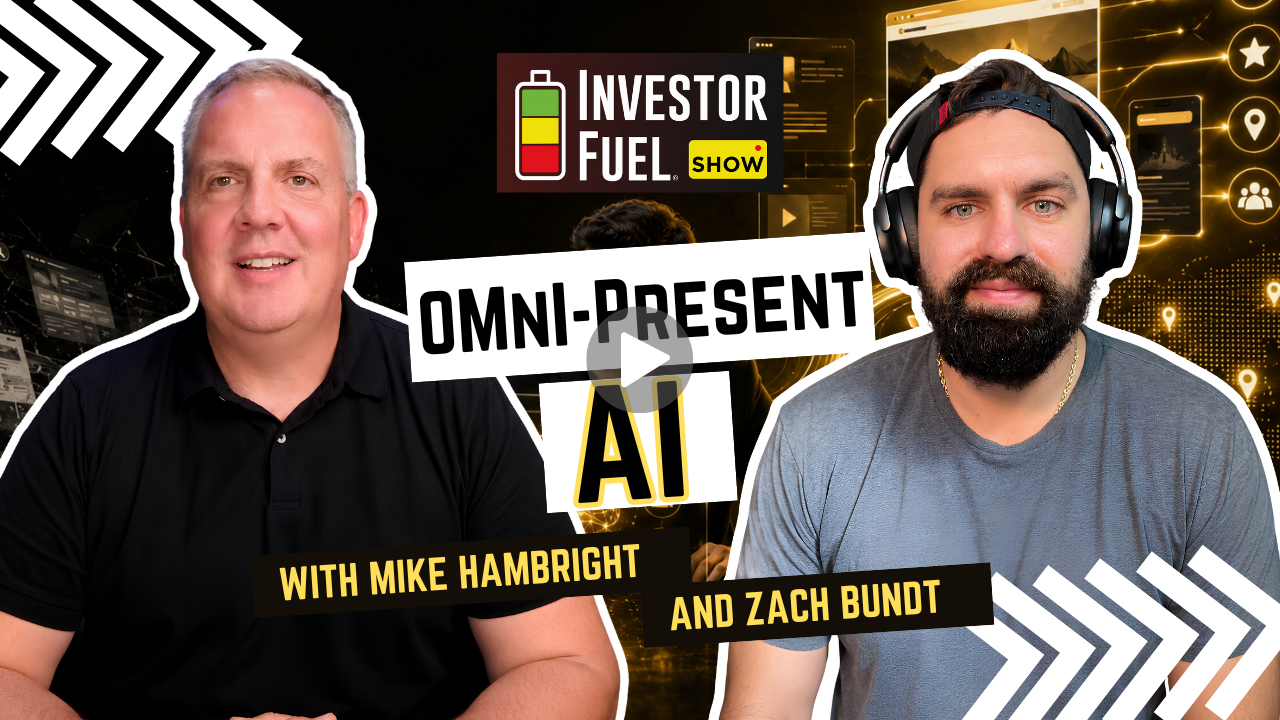
In this episode, Zach Bundt and Mike Hambright explore how AI is transforming SEO, content creation, and digital marketing strategies. They discuss practical ways to leverage AI tools effectively while maintaining authenticity and building trust with your audience.

Professional Real Estate Investors – How we can help you:
Investor Fuel Mastermind:
Learn more about the Investor Fuel Mastermind, including 100% deal financing, massive discounts from vendors and sponsors you’re already using, our world class community of over 150 members, and SO much more here: http://www.investorfuel.com/apply
Investor Machine Marketing Partnership:
Are you looking for consistent, high quality lead generation? Investor Machine is America’s #1 lead generation service professional investors. Investor Machine provides true ‘white glove’ support to help you build the perfect marketing plan, then we’ll execute it for you…talking and working together on an ongoing basis to help you hit YOUR goals! Learn more here: http://www.investormachine.com
Coaching with Mike Hambright:
Interested in 1 on 1 coaching with Mike Hambright? Mike coaches entrepreneurs looking to level up, build coaching or service based businesses (Mike runs multiple 7 and 8 figure a year businesses), building a coaching program and more. Learn more here: https://investorfuel.com/coachingwithmike
Attend a Vacation/Mastermind Retreat with Mike Hambright:
Interested in joining a “mini-mastermind” with Mike and his private clients on an upcoming “Retreat”, either at locations like Cabo San Lucas, Napa, Park City ski trip, Yellowstone, or even at Mike’s East Texas “Big H Ranch”? Learn more here: http://www.investorfuel.com/retreat
Property Insurance:
Join the largest and most investor friendly property insurance provider in 2 minutes. Free to join, and insure all your flips and rentals within minutes! There is NO easier insurance provider on the planet (turn insurance on or off in 1 minute without talking to anyone!), and there’s no 15-30% agent mark up through this platform! Register here: https://myinvestorinsurance.com/
New Real Estate Investors – How we can work together:
Investor Fuel Club (Coaching and Deal Partner Community):
Looking to kickstart your real estate investing career? Join our one of a kind Coaching Community, Investor Fuel Club, where you’ll get trained by some of the best real estate investors in America, and partner with them on deals! You don’t need $ for deals…we’ll partner with you and hold your hand along the way! Learn More here: http://www.investorfuel.com/club
———————–
🎧 Subscribe to the Podcast
Apple → https://podcasts.apple.com/us/podcast/investor-fuel-real-estate-investing-show/id943707421
https://open.spotify.com/show/0yjlEMMn52BRrrlhfxCn4S?si=48f4b577276246e6
YouTube →
https://www.youtube.com/@investorfuel
🤝 Stay Connected with Mike
Follow on Facebook → https://www.facebook.com/realmikehambright
Follow on Instagram → https://www.instagram.com/realmikehambright/
Follow on Linkedin →
https://www.linkedin.com/in/mikehambright
📈Free Training and Resources for Professional Real Estate Investors
Acquisitions Manager Hiring Guide → https://my.investorfuel.com/if-lm-optin-acquisitions-guide
COO Hiring Guide → https://my.investorfuel.com/mm-lm-coo-hiring-guide
Executive Assistant Hiring Guide → https://my.investorfuel.com/mm-lm-ea-hiring-guide
Fuel 5 → https://my.investorfuel.com/mm-lm-fuel5
Triple Your Profits Masterclass → https://go.investorfuel.com/triple-your-profits
🏠Free Training and Resources for New Real Estate Investors
Rehab Live → https://my.investorfuel.com/rehab
Find Your First Deal in 5 Days challenge → https://go.investorfuel.com/find-your-first-deal-5-day-challenge
Join My next 4 Day Live Training Event (Virtual)
https://investorlaunchpad.com/
Resources and Links from this show:
Listen to the Audio Version of this Episode
Investor Fuel Show Transcript:
Mike Hambright (00:33)
Everybody, welcome back to the show. Really excited to have Zach Bundt here with me today. We’re going to talking about AI as a tool. Like a lot of people are trying to use AI to do everything for them, but it’s a tool that can be a resource. Can’t quite do everything. And you lose a lot of the value if you try to make it do everything. We’re going to talk today about, you know, how to use AI to help with SEO, lead generation, and lead conversion ultimately and a few things, just kind of what’s going on in the world of AI because the game has absolutely changed. So, Zach, welcome to the show.
Zach (00:59)
Good to be here, Mike. I appreciate the invite and it’s good to see you again, man.
Mike Hambright (01:01)
Yeah, yeah.
Yeah, absolutely. So so let’s talk about kind of where things well before we get started. Hey, tell us a little bit about your your background. you’ve historically been ⁓ you probably have a lot of titles like me. Like, what do you do? Ask me that now. I’m like, do you want the short version or the long version? Usually go with the short version, but you have a lot of experience with SEO and that game has changed a lot with kind of AI, obviously. But before we jump into, I guess, the topic of the day, tell us a little bit a little bit about your background.
Zach (01:12)
Yeah.
All right.
Yeah, so I I came out of college chasing roofs, learned sales, knocking doors, and then started a roofing company and then ⁓ saw an opportunity to to own online assets, online real estate, and jumped at it. So I dove in twenty eighteen learning SEO. and you know, sold the roofing company and haven’t looked back on the SEO journey since. So definitely bits of different iterations. ⁓ about a year, year and a half ago we
⁓ change the entire structure of our company and and ⁓ replace some people with some higher level guys. So it’s not just my big brain or small brain at the top. We got we got a couple other guys that are there you know bouncing ideas off each other and helps to helps to to get things done higher quality, faster, more duplicatable across markets.
Mike Hambright (02:08)
Yeah. And and a lot of people are, you know, I’d say that if you were to pull up the sea of entrepreneurs out there that at least that I kind of touch, there’s some people that haven’t really done anything yet and they feel super behind. There’s some people that are using the heck out of AI, but it may or may not really be helping them as much as they think. Because it’s easy to create a bunch of it’s easy to create a bunch of junk. Like let’s be obvious. Let’s let’s be honest, right? And and I think if you use it as a tool, I think a lot of people need to just keep
Zach (02:23)
Yeah.
Yeah.
Mike Hambright (02:32)
the goal in mind. Like what is your goal? Is it to grow your business? Cause for a lot of people, I think AI is a huge distraction. Like it’s just taking them down some rabbit holes that they’re losing focus on the business. And so today we’re going to maybe talk about some things to help people get laser focused on the business, right? Like how they can utilize it in their business to help grow. So let’s talk a little bit about how kind of, you know, I guess SEO, AI, AEO, all these acronyms that are out there, like how how the game has changed a bit.
Zach (02:59)
Yeah, so you know, two, three, five years ago, SEO was rank on rank on Google, right? we ⁓ well if you look back fifteen years ago, it was just the website. And then we added the the map pack, which is now called the G BP or Google Business Profile. you got ads on there and now you have the the AI sections, you have the people also ask. you’re essentially just seeing a crowded search page, a start result search result page.
Google’s trying to monetize their asset, right? Their product. And ⁓ they’re they’re rolling with the changes that the AI is is bringing. so essentially what that’s done, right, is that that’s allowed everyone to create more content and just dump this AI content out into the world. So the last like two years or so, Google’s been rolling out updates that they’ve been calling heat, experience, expertise, authority, and trustworthiness. and they just keep doubling and tripling, quadrupling down on these.
So a lot of guys are like, I don’t know what’s gonna happen. It’s like, ⁓ I think I do. Google wants to match the best possible company with the searcher. And they want to sift through all the AI slop to find the people that are actually producing content, actually offering value, actually, you know, providing that quality service to their customer. so when we look at this now, it’s not just you know, blog, backlink, website.
rank, get all the traffic. You have to pull up, you have to have a consistent brand voice across, you know, Facebook, Instagram, YouTube, LinkedIn, website, you know, content strategy on your website, GBP, all these different places. If you show up consistently saying the same thing and you have all your I’s dotted, your Ts crossed, ⁓ that’s that’s a lot of what what the LLMs are wanting to see. So SEO has really turned into this, you know, it’s not just the website anymore. It is this whole entire package of
If you get all these things right, then you’ll show up all over the place. And then you know, you might not get eighty percent of the leads just from SEO. You might only get sixty percent of your leads might come directly from Google, but then thirty percent might come from Chat GPT. So it’s not that you’re getting less, it’s just that you have to do different things to pull up in different spots to get to to get the same quality and and amount of leapflow that that you could have got a few years ago.
Mike Hambright (05:03)
Yeah. And and would would you agree with this? Like a lot of people that think that they miss the boat on SEO. Like I have to create content for years and years and years. They feel like there’s no way I can catch up. Like the playing field has been leveled again now, right?
Zach (05:16)
Yeah, it’s so I try to communicate this to people and
Do you remember when Google came around? It was just it was just
Mike Hambright (05:22)
Yeah. Yeah. I remember
exactly why I was still in corporate America. I remember a guy telling me about this thing called Google. I was like, What the heck? But I I literally remember the day that I heard about it, which is kind weird.
Zach (05:32)
And for
years it was a wild wild wild That’s right. Nobody knew it was working, but there’s just opportunity and the people that got in and did it for years they were they were you know, just taking advantage of that. This is this has legitimately this is the only other thing that that I’ve seen that compares to that moment where it’s like almost like we’re wiping the not not entirely right, but it there’s been a reset and it’s like if you can figure out how to rank on these LLMs right now in the next
six, twelve, twenty-four months, you’re just gonna get more and more and more traffic from them. They’re just gonna continue to to take market share. So it’s like can you can you rank on it right now and get instant lead flow at this second? You are you are hedging that this is this is where we’re headed and it’s very clear that this is where we’re headed. But if if the other guys aren’t doing that, and you are, then you you get that reset.
Mike Hambright (06:18)
Yeah. I’ve often thought of it as like a brick wall, like you you’re just putting bricks in place and you know, initially somebody can step right over your wall ’cause you’ve got two bricks laying on the ground, but over time you build up something that’s that’s defensible and and then eventually it’ll change the game again and you’ll have to figure it out. But if you do a good job of building that wall now, you don’t necessarily have to start from scratch. So
Zach (06:38)
No, that’s right. We ⁓ we started working with a guy that has been doing SEO for fifteen years, a few months ago, and his rankings had slipped. and but he had he had built a wall, right? To to what you had said. He had he had spent thousands and years building that building that wall. when we came in, did you know, fixed some of the stuff, updated some of the SEO to to what’s working today, within thirty days he had gained top three keywords and
three different markets that are that are large markets you know within 30 days and that’s because he had that that foundation set. now that’s not to discourage someone that’s new and doesn’t have that. Like we we also have ranked a brand new website in four days. and it most of these websites out there aren’t aren’t aren’t dialed. so they they look good but when you get underneath the hood there’s there’s a lot of Frankenstein SEO there’s a lot of guessio and there’s a lot of
⁓ just people doing yes you know man. It’s we we we say we gotta shoot Frankenstein all the time and tear in in in our team where we get these monster websites and it’s like we just gotta tear this thing down and redo it, right?
Mike Hambright (07:39)
Yeah. Well let’s talk about a little bit about, you know, using AI as a tool because it can’t do everything. And I could the truth is is I could go out on Claude right now and I could literally in about five, ten minutes, create a hundred blogs, right? And I could give it some context for that. But it’s it’s not great content. Like it might read well, but it’s not great from a search standpoint. So let’s just talk about the balance between AI being a tool and you know still having to do some stuff that makes sense.
Zach (08:07)
Yeah, we we definitely use AI while we’re writing our content. But it’s instead of going to it and being like, Hey, I need this blog, we’re we’re piecing it out. So we have, you know, five or ten different prompts throughout the blog process where it’s prompt it, get the get the f ⁓ the the output, next prompt, add more, next prompt, add more, human touch in it throughout the entire so I haven’t figured out a way to get the human touch out of it, which I think is a good thing ’cause if I could figure it out then other people could figure it out. But since we’re not
able to right now. Like I I see that the 100% AI stuff. And it it in my opinion a lot of it is just AI slop. There there’s another component to that where if you don’t have a personal, you know, what’s your what’s your what’s your USP? What’s your what’s your message? What’s your brand? What what makes you tick? Like we can feed things like that into these blog articles that change the tone and change the change the voice.
So I can even train the AI to speak. I can give it stuff that you’ve said that I’ve recorded, feed it to the AI, and then it’s gonna create a slightly different voice. So it’s just like little, little things like that where we’re not just going to it and asking it to spit something out, but we’re prompting it, you know, five or ten different times and then it’s everything’s going through QC. so it’s like you have to then make sure that it gets through our QC as well, where it where it is adding value. i and the the the kind of tertiary component to that is
The ⁓ content strategy has certainly changed. We used to see go a mile wide and an inch deep. So just right about everything. And now we see an inch wide and a mile deep. So we have content clusters where this one this one URL is where we’re trying to drive all the traffic. And then once you get underneath it, you’ll see four or five, six different splinters off of that that have splinters off of that.
So it’s like if you know how to structure the content, then then you’re telling L LMs, you’re telling Google, Hey, we’re a we’re a authority expert, versus if somebody just has a thousand blogs. It’s like that might be similar content, but it doesn’t read the same when Google’s sitting there reading the website. I don’t know if that makes sense or not. But
Mike Hambright (10:08)
Yeah,
and I think I think too, I’m I’m not I’m not you’re you’re definitely more of an expert in this space than me, but I I know enough to I know enough in a lot of things to be kind of dangerous. But AI is largely using it like unless you provide personal touches and your voice and all all these things, it’s basically going out to find the best of the web, right? So when it creates content natively by itself, it you’re it’s not creating anything unique. It’s just summarizing other things that are out there and using that for context. And Google knows that. Google knows like this there’s nothing
Zach (10:16)
Right.
Sure.
Mike Hambright (10:37)
You haven’t added any value that’s not already out there. So it’s looking for unique perspectives, unique answers to problems and things like that, right?
Zach (10:44)
Yeah. if you can put personal touches, you know, case studies, details, specifics, ties up to specific neighborhoods, tag pictures from specific neighborhoods that are geotagged on the back end when you take the photo. It’s just little things like that, that when I say like dot the I’s and cross the T’s, a lot of things that people don’t think about. But if I take a picture in a location and then put that on the location page for that specific city with some case study stuff, and some, you know.
trickery on the back end for the SEO. Now Google’s starting to see all these signs and they see intention.
Mike Hambright (11:14)
Yeah. So let’s talk about kind of what what you were calling kind of multi-channel, the multi-channel approach. Like it’s not just about what’s on the web anymore. It’s about intertwining with social media and all and there’s a million social media, even though there’s ⁓ a lot of us use like two or three different platforms, there’s there’s a million of them, but you know, let’s just talk about that kind of interplay with social media and the web because that’s what a that’s how that’s what AI is reading.
Zach (11:38)
Yeah. So just to kinda hit on that first, the LLMs what they’re essentially doing is they’re pulling from multiple places to get their sources. Right. So Google would pull from like Google, like from websites. LLMs are pulling from Facebook, Reddit, LinkedIn, YouTube, Google, all these different places. So just, you know, common sense says
the LLMs are starting to take more market share. They’re pulling from all these different entities. Let’s go to a multi-channel approach where we’re ranking, producing, creating on multi-channels. And then as they start to see that, they’re seeing this one company has six different reference points, and this company has one reference point. Which one are you going to trust more? Well, the one that has a consistent message across multi-channels. so that’s like the immediate of that.
if you get into the next, you know, six, twelve, you know, year or two, whatever it is,
It’s also taking mark like Chat GPT specifically is taking market share from Google. Like you see Google investing in AI, you see them trying to get this search, the AI search onto a lot of their search pages. And that’s because they’re trying not to lose out on that traffic to to Facebook who’s investing a lot, Chat GPT, Claude, all these different people that are investing into this these spaces. I personally think that people are going to continue to go to like Chat GPT or Claude or whatever because it’s novel and it’s new.
and they want to go play with a new toy versus just sitting on Google and doing the same thing. Like it’s fun to pull up a chat GPT and talk to a computer and have it like like my wife likes it. You know what I’m saying? Like the the normal person just likes to do that. so I think that it’s gonna continue to take market share. so I don’t think that this is gonna kill Google. Like some people are like, SEO is dead. Like SEO isn’t dead. Like we’ve heard that a thousand times. SEO has changed for sure. ⁓ but it’s
Mike Hambright (13:17)
Yeah.
But I think c one of the clear winners in the AI race is gonna be Gemini. Like there’s specific things that I use it for versus Claude. I don’t really use Chat GPT at all. but ⁓ but Gemini the interesting thing is for me as a company, I have about fifty I have about forty, forty some employees. And like when I’m talking to my team about using AI, I was just like, We we pay for we pay a lot for Google email addresses and stuff like that, which we have
Zach (13:28)
I don’t either.
Mike Hambright (13:42)
Gemini built into that. So my whole team has access to Gemini. So for most of my team, unless they have a reason, I’m like, well, the AI that you get to use for the company is Gemini, because we’re already paying for it. Right. And I’ve even found myself now, I really use Claude for writing and thinking and strategy and stuff like that. But if I’m out of my phone, I usually just use Gemini because it’s right there. And so I’ll just do like an AI, AI mode search in Google. Like a Google search I would have done, but I hit AI mode anyway. And I’ve heard that.
Zach (13:51)
Sure.
Right.
Mike Hambright (14:09)
Google is pulling more and more from YouTube transcripts and even YouTube shorts. So for people that are not creating content on YouTube, if you are, you’re gonna have a leg up over other folks because Google is even broadened out. Instead of it just being the best of the web, they’re pulling from social media sources right now. And they happen to own the second largest search engine, which is YouTube, right?
Zach (14:26)
Right.
So the the I I completely get what you’re saying on the Gemini. I would I from my perspective, I think that ⁓ a normal consumer has a different perspective than than a business owner who we’re looking for optimization and efficiency. and and you know, I I might come back and six months and be Hey, you were right about Gemini, I was wrong about Chat GPT. It doesn’t to me it doesn’t really matter which one takes off. Like we’re trying to rank in all of them, right? So if if Google does figure out Gemini and and it ranks, it’s like
Okay, I thought it was gonna be Chat GPT. I don’t really care if I was right or wrong about that. it’s the principle that I that I think is gonna be there. when you look at like a YouTube, it’s it’s funny. Google’s been pulling from YouTube for about two to three years. Like we saw we saw the we jumped on that trend about six months before they released their first update that was that was speaking to that. Cause it was like, what is Google like? Well, Google’s a narcissist. Google likes Google.
So feed Google as much Google as Google can stomach, right? And I still stand on that. So it’s like we when when we’re pushing YouTube videos, when we’re pushing you know, the G V P stuff, when we’re we’re pushing all these things, people are like, Does it really matter? It’s like, Well it’s not gonna necessarily generate two leads, but it is gonna help you build trust with Google. Which is gonna then put you in where you wanna be and drive the traffic.
Mike Hambright (15:41)
Yeah. Yeah. Yeah. They just have such a head start. And the other thing is is they’re hugely profitable compared to all of the AI out there. So they’ve got a leg up in that in that regard for sure. Yeah. Yeah. Yeah. Yeah. So let’s talk about you know how to use AI to probably for to create content in terms of it building trust. And you and I were talking about this before we even started recording today, is like a lot of entrepreneurs want
Zach (15:44)
For sure, for sure.
For sure. You might be right. You might be right.
Mike Hambright (16:06)
everything they do, they want it to be for lead gen. But there’s a case for creating this content to help with lead conversion. So it might help you generate leads, but also it might help you convert a lead that was already generated that just went out to like research you.
Zach (16:21)
That’s right. Yeah. ⁓
So when we when we look at the market today, the the market has certainly changed. We were talking about this before. ⁓ but when a buyer becomes aware of the sales process, that increases the sales resistance a hundred X becomes much, much harder to sell. So what we have to try to do is we have to try to figure out how to either reposition or put different makeup on or whatever, however you wanna say it, right?
re redress our offer in a way that gets around that sales resistance and doesn’t trigger any of that. and that’s to me a lot of what this is doing. so if we can have if we can if we can have a lead that that we then while they’re on Gemini or GPT or whatever it is, they’re still seeing our stuff pull up.
We’re building trust. They’re reading our content. They’re they’re seeing that brand recognition versus the the old way of it just being like, hey, let’s do a Google search and and click on a website or whatever. they might see a mailer and then go to Google some generic term and then pull up you know, Gemini search or chat GPT search or whatever, and then see, see that hey, that’s the same company they sent me the mailer. ultimately what it’s trying to do is we’re trying to ⁓ raise a floor of
all the different marketing channels. and if you can be that omnipresent, ⁓ omni channel and and have that that voice across all the different channels, it’s going to increase the conversion. it’s going to decrease the resistance. Ultimately it’s going to push them down the funnel and make the make it easier for sales guys to close more.
Mike Hambright (17:45)
Yeah, I think it helps the sale it makes the sales pro like the dance between marketing and sales is the more of the weight that your marketing care carries, the less your sales have to do it. Right. So we’ve probably all bought things, like high ticket things even from people that we knew we were gonna work with them before we ever talked to them. Like I just I’ve already made a decision, I’ve already done my research, I’ve already known who I want to work with or what company I want to work with.
And like literally, I just bought something yesterday. I I went to research it and I knew exactly what I wanted. And I just called and bought something. Yeah, I bought a zero turn lawnmower for like nine grand. I literally never I literally talked to the guy for five minutes. I just knew what I wanted. I knew who I wanted to work with because of proximity to my ranch, for example. And it’s just like I, you know, I had three or four options and I was like, I’m calling this place and whoever I talk to, I’m gonna put my order and buy it. And and that without me going to do research online, that wouldn’t have been possible. And so I think there’s a lot of people that
use whether it’s SEO or AI or social media or whatever, like at this point, I think most people, I won’t even say most sophisticated people, I think most people go online to research major decisions, irregardless if they generate if the if the lead if they found you on TV or direct mail or some paid lead channel. Like a lot of people just go search around the web or search around social media or search around AI to learn more. And if you’re not there
They’re not gonna find you. If you are there, then you make the decision easier.
Zach (19:07)
That’s right. Yeah, and that’s to to just kinda tie what you just said to the original question, how to how to use AI to build that trust. It it really is a it’s a simple answer in my mind that that isn’t necessarily the the easiest to implement. if you have if you have you know ⁓ a USP, you have messaging around your brand, you have
different differentiators that that separate you from the market. If you can if you have experience in specific areas, if you can tie all of that into the content creation, then that’s where once you you know it’s ⁓ garbage in, garbage out, right? Whatever inputs you put in is the the quality that you’re gonna get on the other side. So the more that we can control the the the front end of that and really increase that quality on the front end, that’s gonna
drastically increase the the output on the back end. And then as a consumer reads that on the back end, they might not even know why. Like I like this company better than the well it’s like, well if you have a marketer that’s touching this and it’s not just AI slop, it’s like, well we can we can spin this case study in a certain way that I know is more likely to get somebody to read it than if it’s just this, you know, AI case study or whatever. so I just I wanted to add that ’cause you said that and that was perfect. And
Mike Hambright (20:05)
Right. Yeah.
Zach (20:23)
thought it kind of tied back to that original question.
Mike Hambright (20:25)
Yeah, I think I’ll give you a couple of examples. Like I I when I go out and look at people like I I s I cyber stalk people that I might hire for my team because I just want to know like what do they look like? What are they posting about, if anything, what do they believe in? Sometimes I’m trying to hire people and they don’t they’re not even on social media, which is interesting by itself, right? That’s ⁓ relatively rare. But sometimes if if I see what they’re posting and I’m like, that just doesn’t fit our you know, our core values here or whatever, then I I weed out, right? And
So yesterday I was looking for I was looking at for some keynote speakers, was doing some research, and this one popped up. It sounded really interesting. And then I saw the guy and I was like, just the look of him, it just was like, you know, ⁓ just just I could just tell by the look of him. I was like, yeah, this guy’s not like I literally am I’m done with this search because of just the way the guy looked. He just, you know, I didn’t even want to say what I thought about it, but it just turned me off ⁓ right or wrong. And it was just like, okay, and that’s how that’s how people make decisions. They’re like,
Zach (20:51)
Uh-huh.
Yeah.
Mike Hambright (21:19)
Do I it’s not necessarily do I like how this person looks? I’m not that shallow, but this guy looks so unique that I was like, this is gonna be weird at my event. But it’s just like, what do they say? What do they believe in? Are they disheveled? Do they look like somebody that I could trust? They look like they’re responsible. And people make impressions based off of a few seconds of just seeing somebody and just hearing the first words that come out of their mouth. And you have a chance with social media, with with AI and content that you create to control that.
Zach (21:26)
Yeah.
Nah, for sure. ⁓ there’s that old saying people buy from people that they know like and trust, right? So it’s like if if you if someone if somebody’s looking at a website and they see you with your your wife and your kid and you know, when they call they talk they know who’s gonna answer the phone, that builds trust. And then when they call and that person actually answered the phone, it’s like that’s just another it’s a micro one. It’s just another thing that’s pushing them further down that funnel. Then your sales guy shows up on
Just do what you say you’re gonna do. ⁓ it’s like you can you can win those deals without being the the the you know the guy that I would that we that I was talking about earlier. ⁓ he said that about seventy five percent of the time he’s not the the highest offer.
Because he has so much authority and so much trust and so much so much momentum in that area. He doesn’t have to be he doesn’t have to offer the most money. He can actually help people people believe that and they’re willing to take less because they know that that that I’ll be able to help him.
Mike Hambright (22:38)
Yeah. And and people are different too, right? There was a time where I would always like probably a lot of people, I would look for like, well, what’s the cheapest option that I could find? And I’m just at a point in my life now where that it’s a consideration, but I’m like, who’s gonna I I know on some level I get what I pay for too, right? And so there’s a balance there, but ⁓ my first priority is who do I believe can actually get the job done right in instead of ’cause quite frankly
the cheapest option often costs you way more than you thought it would, right? In anything. and so, it’s the truth, right? So let’s talk just real fast, like, what do you see the future of this going and maybe share a little context for people that are like they feel like they’re behind and they’re not, you know, they’re they’re either out of the gate or they’re not even out of the gate yet. Like what can they do to start moving in this direction to ⁓ kind of optimize or get started?
Zach (23:07)
Yeah. Yes, sir.
Yeah, I would I would say learn how to use the tools. Like as as simple as that sounds, if you just go to it and just expect it to put like spit something out, it’s like w you you really do have to piece out a lot of things. And if you can piece out different parts of a process and then put an SOP together and then piece it out from there and then connect a bunch of stuff, like that’s that’s when you can start to get some some cool stuff to to come out of that. I ⁓ if you if you start learning
And start doing stuff now. Like you can you can find lower you can find easier things to to automate with AI that helps you get familiar with it. And then you can start to add more and more and more. and as you get more comfortable, or you can outsource it or or however you want to do it. but it ⁓ I I would say if you if you can figure out how to create quality with it and not just dump out a bunch of AI slop. ⁓ if you want the negative side of that, which is unfortunately sometimes
Fortunately, sometimes where my brain goes, in in six months or so, a bunch of people are gonna have a a bunch of website URLs de indexed because it’s all labeled as AI, you know, AI slop. It’s all it’s all regurgitated content. and a lot of people are gonna sit there and and sit on their hands and be like, I was doing the right things. It’s like, well, you were just dumping out a bunch of stuff. and it it chicken came home to roost and and now you’re gonna have to pay the pr pay the price.
and we’ve seen that pattern before, right? Like this, this isn’t a new. We’ve seen that happen about two years ago at a pretty good scale. and ⁓ that’s that’s why I suspect’s gonna happen again. So I would say talk about talk about your community, talk about your company, talk about, speak to the seller, add value to the seller, and and speak to situations that they’re going through. ⁓ and you can have that personal touch while you’re
Using AI to create that content, that’s gonna help you to avoid those mass de indexes as well as to build that trust.
Mike Hambright (25:09)
Yeah. Yeah, that’s great. Zach, if folks wanna you you have an agency as well where you help people with ⁓ SEO and search and stuff like that. If folks wanna learn more about you or your company, like where are some places they can go?
Zach (25:19)
Yeah, so ⁓ you can check me out on Facebook, Zach Bundt B U N D T or our website is RE Investor SEO dot com. So reinvestorseo.com.
Mike Hambright (25:32)
Awesome. we’ll add these links in the show notes for anybody that’s listening right now. So thanks for joining me today. This it’s kind of fascinating to see where we’re gonna go. It’s a little bit of a gold rush right now, right? And that’s how it feels a little bit. So but the important thing is to just follow people that know what they’re talking about and are you have kind of seen this before, right? There it wasn’t that long ago where the
Zach (25:43)
Yeah.
Mike Hambright (25:52)
Like the best thing to do for SEO was just write a bunch of junk and stuff it full of keywords because that’s how SEO works. Like and that then obviously that does that hasn’t that’s not how it’s worked for a long time. So I think there’s lessons to learn now to make this kind of future proof. And I think the key, just like everything, is put out content you’re proud of and not just a bunch of junk and filler.
Zach (25:56)
Yeah. Yeah.
Yeah.
I would d just one one parting thought on that. ⁓ if somebody’s trying to sell shiny objects, every week there’s this new thing, you know, it’s this and now it’s this and now it’s this and now it’s this. It’s like be you know, that that puts my spidey senses up where it’s like, All right, you’re probably really good at marketing, but that doesn’t always mean that they’re great at fulfillment. So when somebody’s always like, Hey new new new new new no, I’m like, Okay, you
There there might be something off here. So i I would just warn people if there if there’s that that FOMO of like missing out, it’s like just start. Like take the action, take the imperfect action and and learn and start. Don’t move based on what some guru said because you’re scared that you didn’t move six months ago and now you’re behind. It’s like start today, like eat the frog, chop the tree, and you’ll you’ll be alright.
Mike Hambright (26:59)
Yeah. Yeah. Yeah.
Awesome. Well, thanks again for joining me today, sharing your insights.
Zach (27:03)
Thanks, Mike. I appreciate ya.
Mike Hambright (27:04)
Yeah, everybody we’ve got we actually are putting out a lot of ⁓ we have a lot of folks that are coming on these days to talk about A AI and kind of cutting edge stuff. And so make sure you keep following our shows here. Make sure you go learn more from ⁓ Zach as well. I’ve known him for a while and he’s doing some great things. So appreciate you joining us on today’s show. We’ll see you next time.