Subscribe via:



Show Summary
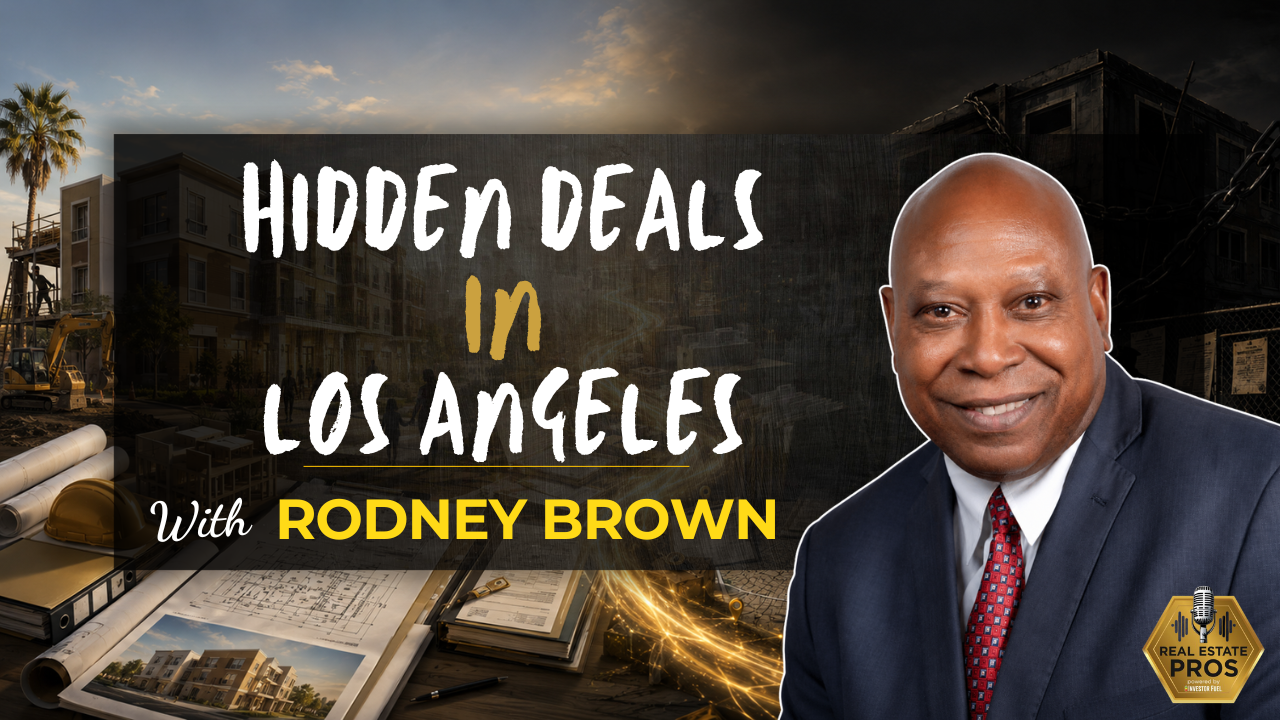
Rodney Brown of New Life Global Development shares his extensive experience in real estate development, focusing on distressed assets, community revitalization, and innovative solutions for affordable housing in Los Angeles. Discover how his family legacy, engineering background, and strategic partnerships are shaping the future of community development and homelessness solutions.

Resources and Links from this show:
-
-
- Investor Fuel Real Estate Mastermind
- Investor Machine Real Estate Lead Generation
- Mike on Facebook
- Mike on Instagram
- Mike on LinkedIn
- New Life Global Development’s Website
- Project New Life’s Website
- Rodney Brown on LinkedIn
- Rodney Brown on Facebook
- New Life Global Development on Facebook
- Rodney Brown on Youtube
- Rodney Brown’s Phone Number: (310)351-4631
-
Listen to the Audio Version of this Episode
Investor Fuel Show Transcript:
Rodney Brown (00:00)
However, this administration currently is now forwarding
these code compliance, non-compliance orders to the city attorney’s office for criminal prosecution. So if you find yourself with orders to comply and you haven’t paid the fines or the penalties and the fees and don’t have a plan to develop these properties, the city attorney may now file criminal charges and you can find yourself
prosecuted just for not developing a property that you own that’s blighted in the community and the fines that the city require have not been paid.
Freddie Steen (02:21)
Hey everyone, welcome to the Real Estate Pros Podcast, Investor Fuel. My name is Freddie. I am here today with someone who I’ve been looking forward to speaking with, Rodney Brown of New Life Global Real Estate Consulting. And he is making serious moves, not just in the space of helping on the transaction coordinator side, but also
being able to acknowledge and express clearly to distressed home buyers how he might be able to change the needle for them because of his rich experience as a legacy in this industry. So, Rodney, I’m glad to have you here. But I think our listeners are really going to take something away from how you’re a legacy, like many of our real estate investor pros. I mean, you have engineers and real estate for three generations
in your family, but you’re also attacking a piece of the market that is white hot, and that is distressed homes. Let’s dive in. So, first off, for people who may not be familiar with your world, give us the short version for our real estate pros. What’s your main focus these days? What problem are you solving? And what markets are you operating in?
Rodney Brown (03:40)
Well, thank you, Freddie. And thank you for having me. My name is Rodney Brown. My company is New Life Global Development. New Life Global Development, we’re based here in Los Angeles, California. I’ve been in real estate for 32 years, based out of Chicago. Been here since 1995. And our focus is distressed assets for existing
real estate investors or investors that are looking to build a real estate portfolio here in Los Angeles where most speculators will tell you it’s tapped out. We specialize in finding gems in this in this market here in Los Angeles. So we find properties where people see no opportunities, whether it’s trustee sales, tax liens,
pre-foreclosures, REO properties, and we go after those properties. And our biggest focus would be the pain points. You know, what’s your biggest headache? If you own real estate assets, primarily multifamily properties, you know, is it tenant solutions? Is it the bureaucracy of the Los Angeles, you know, zoning and that sort of thing? We have relationships from the city
mayor’s office all the way down to building and safety, and the city attorney’s office where we can come up with solutions and paths to success for those that want to build in this Los Angeles market.
Freddie Steen (06:04)
Wow, the Los Angeles market, our real estate pros are salivating to know. Rodney, do you operate within the fifteen district city council?
Rodney Brown (06:14)
Yes, primarily that’s those are our sweet spots in the fifteen city council districts of Los Angeles. I mean, we do do some business in the county where we get those that are focused and ready, you know, to build in the county side, but we primarily focus on the fifteen city council districts of Los Angeles. And the main focus there is the Los Angeles Department of Building and Safety’s pain point
of properties that’s been vacant and abandoned for some time and have penalties and fines that they’re looking to find a solution and to remediate those biggest headaches and pain points so they can develop their property.
Freddie Steen (06:59)
Well, tell our audience more about that trend that you’re seeing going into twenty twenty-seven.
Rodney Brown (07:04)
Well, you know, in the past, property owners were able to sort of ignore the code compliance orders that they get about their properties as long as they fence it off, board it up, keep it clean. The city had primarily allowed them to ignore it.
However, this administration currently is now forwarding
these code compliance, non-compliance orders to the city attorney’s office for criminal prosecution. So if you find yourself with orders to comply and you haven’t paid the fines or the penalties and the fees and don’t have a plan to develop these properties, the city attorney may now file criminal charges and you can find yourself
prosecuted just for not developing a property that you own that’s blighted in the community and the fines that the city require have not been paid.
Freddie Steen (08:11)
Rodney, for our real estate pros that are listening now, Investor Fuel Podcast loves these moments that you’re about to share with us. Have you been able to stand elbow to elbow because of your vast experience with other politicians and be able to speak to the community at large about your niche in real estate and how you might be able to help? Have you ever stood with any mayors?
Rodney Brown (08:36)
Absolutely. That’s part of our secret sauce. We start at the mayor’s office. We’ve been support, you know, we not any particular politician, so to speak. However, once that those politicians are seated in their office, we like to partner with them. Currently, we have Mayor Karen Bass who has been doing her job to
house the unhoused and to beautify the community with a lot of these properties that are nuisance property properties that’s been vacant and abated. So we partner, we first partner at the top at the mayor’s office, and then we go and we partner and work alongside the city council members. So all the 15 city council members
we would partner with within their district if we find a property that an investor either owns or interested in. And then we start from there. Planning Los Angeles Building and Safety. Finding out exactly what the what the fines are. There may be liens on the property. They may owe tens of thousands of dollars on that property, but we have ways
to remediate those properties and come up with solutions that work for the city and work for the community and work for the investor as well. So there are gems out there where a person would think that the property would normally be upwards of a million, five, two million dollars that we’ve been able to get at 65% of fair market value
if it’s done correctly and if we have the right plan to solve the pain points of the city and the community.
Freddie Steen (11:12)
Rodney, I love that you mentioned the word gem. For our real estate pros that are listening, can you tell us as well, in your experience, why it is so important to have that marriage between the town and the gown, working hand in hand, not with politicians in a manipulative way, but literally being a real estate investor that’s invested in the real estate that’s in the community. Has that been a part of your secret sauce?
And why is that so important?
Rodney Brown (11:42)
Well, LA is a strange creature. This market is much is unlike any other market in this country. And everything is so niche-based. Everybody has their own little clique. And the city council and the mayor’s office, this city is a extremely tenant-friendly city. And
investors, property owners often don’t get much love when they when it comes to trying to deal with multifamily, which is our primary niche. So we check with the powers that be to understand exactly what that office has in view and in vision for that community, for that district. We then engage the offices of the city councilmen, city councilpersons
because we have some very powerful and very super she-roes in the city council that are women led, that are women led as well. So I say city council persons. So once we understand what their goals are for their district, we then look at the pain points that they have. What properties, you know, that they have that they’ve been trying to get the owners to move forward with. We go in and we find out.
What is it that these property owners find that are huge barriers to developing their product, their properties? And then we find a pathway and a solution to remediate the pain. So we like to consider ourselves as the painkillers because we like to ask potential pro investors or property owners, what’s your biggest pain point?
Freddie Steen (13:35)
I love it, Rodney. I mean, what caught my attention about you was the way that you’ve been able to pivot as a legacy in the real estate industry, like many of our real estate pros right now. Not just your father, but your grandfather also was an engineer. And then you’ve been able to glean that knowledge and that family legacy and grow it to managing multiple markets. My research team told me something.
Did you also have a footprint in Hyde Park, Chicago, a legacy community that includes a former president’s residence? Is that true?
Rodney Brown (14:57)
Yes, yes, thank you, Freddie. You know, I my grandfather, my uncle, and my dad were all involved in some point in real estate. And my my grandfather was the chief engineer of a large hospital in Jackson, Michigan. And my uncle had 300 units in Evanston area, Mount Prospect, Des Plaines.
And my dad was working in malls. So I grew up carrying their toolbox, crying all the way, but I thank them today for what they used to, you know, drag me before daylight in the morning to help them. And my very first engineering project, which I was a very strong mechanical engineer,
and wow Hyde Park was my very first project at in the Hyde Park area of 55th Street. That’s right. In the Hyde Park community where currently where the Obamas are in that area. And Flamingo Hotel was a 22 story, 60 something unit, 65 unit property.
And I started there as a chief engineer right on Lakeshore Drive. And from there, I was hired by a development company that was building a 310-unit apartment complex at 33rd and Cottage Grove, now called Woodland Park Apartments, right behind Lake Meadows. And they asked if
I was interested in partnering with them as a chief engineer while they were just digging the hole in the ground. So they hired me during construction and development. This is where I became a very strong mechanical engineer, structural engineer, building those luxury apartments at Woodland Park Apartments.
Freddie Steen (17:07)
I love it. I love it. And you’ve been able to do this. I mean, you’ve gone from Bronzeville, 33rd and Cottage Grove here in Chicago, the West Side. You’ve even made it out to Hyde Park in a in a neighborhood that you humbly have mentioned a former president has a residence in, but also for our real estate pros, Muhammad Ali used to live over there too as well. But you’ve been able to manage multiple markets and still keep your margin strong. That’s not as easy.
Especially in this climate. Rodney, for our real estate pros audience, what’s been keeping that machine running smoothly for you?
Rodney Brown (17:43)
That foundation based on the
the fact that my grandfather and my uncle always taught me, find a way to help people. Find a way. When I followed my uncle around, it wasn’t just him going fixing somebody’s faucet or or something like that. He was looking at the resident. You know, how can I help them be comfortable in their unit? Find a way to help people. And it, you know, my foundation is always how can I help.
The real estate investor stabilize their real estate portfolio by helping them and helping their residents be good tenants. And how can I, you know, help the tenants in their properties stabilize themselves by making them comfortable? Not all tenants are bad tenants. Life happens to everyone. You know, you might have a lady, a single mom that’s living with five kids
in a two, three bedroom unit and wreaking havoc, you know, to the other tenants and the landlord. So we find a way to help her either find a better place to move to where she can have space and where her children can run around. So it’s all about solutions. You know, I observe what the
what the property owner and the landlords are going through. And then I assess what the family is going through. They may be in a property that’s not conducive for their lifestyle. Maybe when they first moved there, life was different. But then life changed and they’re still in that unit and they don’t know how to move on, move up. And that causes, you know, biggest issues
with the landlords trying to maintain their properties, trying to, you know, find solutions. So often helping the property owner or landlord is also finding solutions for the families that live in their properties. So it’s always based in how do I help the landlord help the residents help this community?
Freddie Steen (20:02)
Absolutely. I love it. Now, Rodney, every operator I know has a moment where things got real. Maybe a deal that went sideways or a time that you had to pivot fast. You mind sharing one of those moments for you?
Rodney Brown (20:18)
Wow. Thank you for that question. Excellent question. Thank you. 810 Beacon Avenue. I was driving from one project to another and I kept passing this three-story 8,000-square-feet, 29-rooms, nine-bathroom property that was abated and vacant in the city of Los Angeles, Council District One.
And you know, my spirit when when when Father gives me a focus on something and it doesn’t leave me alone, you know, I parked in front of that building several times and tried to find the owner. I found out it was it had gone back to the bank. It was a former transitional housing facility for re-entry persons.
Sure. And the director passed away without a key man structure. So the organization folded and didn’t have a pathway to pass the baton. So I couldn’t get the I found out the which bank that owned it. It was an REO. So I had to gain entry on my own. And once I did, we were actually
fixing and flipping high-end properties at the time. So I went back to my investment group. I said, listen, you know, this is a commercial transitional, previously transitional housing facility. It’s not in our, you know, wheelhouse, our preferred high-end fix and flip models because we were in Beverly Hills at the top of Beverly Hills at Kittridge and Summitridge
fixing and flipping properties, overlooking Jay Leno’s property and that sort of thing.
Freddie Steen (22:14)
Too far from Mr. Chow.
Rodney Brown (22:15)
Exactly. And right across the street from an an old property that Sammy Davis Jr. owned at the at the top up there, Kittridge and Summitridge. So they said, “Well, well, Rodney, why are you focusing on this one?” I said, “I believe I can get a high double-digit return off of this property.” So once I gained entry and and videoed and did the pre the feasibility study
and the broker price opinion it came back and probably 1.2 million dollars in its current distress condition and the bank had it on their A-list for about 950. So I said, “Let’s let’s look at this is something that…” So they go, “Okay, that’s an eyebrow raiser. Let me look at that one. What’s your strategy?” So
once we engaged the bank and was able to get them to come off and break the chains, because the city had come out and put their chain around it because they had left 70 previously homeless and mentally challenged people, 70 in that property for three months with no medication and no supervision. Wow. So one of the the members of that house
passed away and the city went and shut it down. So a third of them went back out into the street homeless. A third of them went into other transitional facilities. And the other third of them went back to incarceration. So there was two chains. The city had a chain on it and the bank had their chain on it. I had to find a way to gain entry so I can assess the interior to find out the condition and what it would take.
Once I saw the condition was in reach, we put together a 10-man crew from a local transitional facility, which was only a few blocks away from there, and with our general contractor to supervise them. And these guys, they had been sober for 20 years or so with
decades of experience in painting, electrical, plumbing, that sort of thing. So we put a crew together and had them supervised by our general contractor. It cost us about a hundred and fifty thousand to rehab it, took us about three months. And we were able to sell that property at a 23% return on investment. And now and then it was sold to a nonprofit that named it
Beacon of Hope since it was on Beacon Avenue at 810 Beacon Avenue, the nonprofit called it Beacon of Hope. And since then, thousands of previously homeless citizens of Los Angeles have been housed in transition and gone on to permanent supportive housing.
Freddie Steen (25:23)
That is an incredible pivot. And I know that’s the kind of stuff that people just don’t talk about enough, Rodney. I mean, honestly, it’s what separates the folks like you who’ve been in it long term from the folks who just dabble. Let me ask you this. What are you most focused on solving or scaling next? I mean, what’s the next real goal for you?
Rodney Brown (25:49)
Well, we have begun a campaign called Break the Chains of Homelessness. Wow. And and this is focusing on those hundreds of properties that already exist. You know, the the current market in this LA area and the council districts have hundreds of properties that’s chained up, vacant,
and abandoned. Some of the the previous property owners have all maybe passed away, or some are in between a rock and a hard place and just don’t have the funding to develop the property. So the city had given code of code enforcement orders and notice to comply to these hundreds of properties that already exist. So instead of building ground up,
we decided that we were going to focus on reaching out to those property owners and those banks that own those properties and come up with a solution to either demo the property, first of all, working with the city and the city council members to remediate, reduce, or eliminate the fines and penalties
to make it conducive and get the numbers to where we can get the equity from the property in some cases. And there are also lenders that would be involved in creating a capital stack where we could use our licensed and insured contractors to go in and drop prefab or modular housing. So it wouldn’t take us but about three months to drop a property,
a prefab house or an existing improvement on that property or gut it down to the bones and then rehab that property and have it ready for housing, beautify the community, create housing for the unhoused, get the blight out of the community. So this is working also with the LA Department of Building and Safety,
which is having a hard time getting this list broken down. So we like to engage the city council members to say, get us in the hands of the owners that have these liens on these properties that are being referred to the city attorney’s office for prosecution and allow us to work with them to bring our own investment capital and our own workforce
right here in the city of Los Angeles to create solutions for these abandoned and vacant properties here in Los Angeles. So let me break the chains of homelessness and create housing for the unhoused. That’s what we’re doing here at New Life Global Development. That’s our next focus.
Freddie Steen (28:56)
Big. I mean, especially when you’ve already got this rich legacy in your family of engineering. You already have this legacy as a mechanical engineer. And then you marry that with your true investment as a real estate investor and New Life Global Development, of you bringing these communities to life and just not
Rodney Brown (29:16)
No lie.
Freddie Steen (29:24)
getting your profit out of there and leaving, but staying in the community. The next move can either compound things or create chaos depending on how you play it. So I have to ask you this for our real estate pros, Rodney, what are three trends that you’re seeing right now as far as solutions to house the houseless going into 2027?
Rodney Brown (29:47)
Well, it’s basically like I say, focusing on the infrastructure of what’s already built. It takes so long to develop, even with the progressive development and what’s called the Executive Directive 1 from the mayor’s office. The city is working diligently to come up with solutions to code variances and set exceptions, opportunity zones,
and all of those things that are great tools to help developers to build. However, these properties that have long-term liens on them have built up such large penalties and fines that the owners are stuck between a rock and a hard place. And there are hundreds and hundreds of properties that already exist that we can drop
prefab and modular housing on right now to participate in creating housing, we can put we can put a great dent into this homeless housing model. Now, I’ll be honest, there’s no such thing as ending homelessness in my opinion, because there are so many variables to why people are homeless and on the street.
And there are just some people that aren’t ready to be housed. There are some people that don’t want to be housed. There are some people that need other services like drug and alcohol addiction treatment before they’re ready for permanent supportive housing. So there’s a lot of different variances and challenges to homelessness, especially here in Los Angeles. However,
there are people that are out there with Section 8 vouchers, VASH vouchers, if they’re veterans, that have been ready for permanent supportive housing for years. And we can produce those assets and opportunities based on going after these properties on the Los Angeles Department of Building and Safety’s list of vacant and abandoned properties once we get into the hand of the owners.
We’re not looking to buy the property at a fire sale. We’re looking to empower these owners if this is what their vision is, to keep their property, or we can joint venture with them with our investment group. If that’s not their cup of tea and they’re just looking to produce their own legacy wealth for their families and get these properties up and running so they can lease them out,
create tax revenues for the city and beautify their communities. That’s what we’re focusing on right now with New Life Global Development.
Freddie Steen (32:41)
That’s awesome, Rodney. I want to make a quick pivot before we wrap. There’s an area of expertise that our research team told me at New Life Global Development you all have. And I think it’s a white hot industry. Some of the largest landowners in this country have always been the churches. Can you tell me some of the solutions you’re offering to churches who have large parcels of land that they own that are looking for solutions to develop that
and make it profitable. What are you all doing at New Life Global Development to solve that problem?
Rodney Brown (33:18)
Great, great question. So when it comes to faith-based organizations, we have what’s called the 100 Church Initiative. So we’re going around from church to church, talking to the pastors and their congregation, and just giving them a vision based on what they can do by right, based on the square footage and the zoning in the area
Freddie Steen (33:20)
Thank you.
Rodney Brown (33:48)
of what type of opportunities there are for the church to be able to build huge amounts of wealth if they look into developing their property into three to five story buildings for low-income, low-income housing. Right now we’re we have built thousands of units
through different developers. One particular developer has gone from eight units to several hundred units, and some of these churches just don’t understand what they have in hand. So we have a meeting with them to show them what the potential is with their properties. There are so many ways to put a capital stack because the number one reason why
they’re reluctant to have this conversation, is they think that they have to come up with money. And it’s not always that case. If you have the deed to a property that the church owns, there’s equity. That equity is powerful. You bring that property to New Life Global Development. We will assess it. There are so many ways to put together a capital stack.
The money is already there. The church doesn’t have to have a hard push trying to get a boulder up a hill to raise money to develop these sites. We can come up with a strategy where the city is involved, Metro is involved if they’re in a Tier 1, Tier 2, or 3 area where if they’re in
the proximity of a bus line or a train line, there’s funding there. HUD, the low-income housing tax credit market. There is funding, venture capital firms, and they don’t have to worry about the pain of managing the property themselves. They could either hire a management company to manage it, or they could roll that property
into a real estate investment trust or a syndication where all they need to do is house everyone that’s in their congregation and those that need to be housed in the community and just drive by and point at that brand new, beautiful three-to-five-story building that we could build with New Life Global Development and have these churches to build equity in their own community and generate
legacy wealth.
Freddie Steen (36:34)
Rodney, I love it. Now I know a lot of people listening are either early in their journey or looking to level up like you are at New Life Global Development. And I think they benefit from hearing this, particularly with from you as a real estate development consultant. When it comes to building relationships and growing your network, what’s made the biggest difference for you?
Rodney Brown (37:03)
Engaging the community. You know, the I think the biggest hurdle in when it comes to development is the lack of knowledge. And you know, there’s a scripture that says that we perish by the lack of knowledge. So we just want to educate the community of what it could be—a person with a 12,000-square-foot vacant lot
with their grandma’s house on it. We’ve been able to raise that house to the ground and build up to eight units, one-bedroom units, or transitional facilities where we built two structures, three stories each, and every room, instead of them just being transitional rooms, we built a private bath
in every room. So they could either use it as Airbnb, they could use it for more it’s, you know, it’s more attractive to transitional housing when those that are being housed have their own private bath. A nice three-story swanky style property with rooftop decks and gardens with solar on top and battery backups,
wow, with tankless water heaters that’s very affordable. So it’s education, you know, to people that own real estate and wanting to find out what’s the best and highest use for these properties, for this asset. “I don’t want to let it go. It’s a legacy property, but it’s a single family house, three-bed, two-bath, built in the fifties or the forties.
And we just want to know what we should do with it.” Depending on the square footage of some of these properties, there’s an ordinance called SB 9. We could split that property into two and build two structures on that property three stories high and put units in those properties, and then they could manage that themselves for legacy wealth. So it’s education.
It’s information that we want to give and empower these property owners so they can find the pathway to legacy wealth.
Freddie Steen (39:37)
Rodney, you can’t fake that. I mean, taking the asset and returning it to someone that can live in dignity, those are the type of relationships that are everything in this space. All right, before we wrap, someone wanted to reach out and connect with you, maybe collaborate or learn more about what you’re doing. What’s the best way for them to reach New Life Development?
Rodney Brown (40:03)
So they can reach us at newlifeglobaldevelopment.com, which is our website, newlifeglobaldevelopment.com. We also have a nonprofit service agency called projectnewlife.us. projectnewlife.us. You can either you can find me on LinkedIn, Rodney Brown, New Life Global Development.
You can see us on Facebook. You can go to YouTube, Rodney Brown, or hashtag #rescuerodney. And that’s a whole another story about the Rescue Rodney thing. I’ve been on the American Red Cross disaster rescue team and disaster action team—we call it that—
for more than 15 years. I’ve been a community ambassador for the American Red Cross, responding to house fires, floods, and that sort of thing. So that’s where the Rescue Rodney thing comes into play. We do have a YouTube channel, Rescue Rodney @rescuerodney, or you can just Google my name, Rodney Brown, on YouTube and find platforms like
this super platform here, Investor Fuel. So I would say the very first way: look at the portfolio on LinkedIn, go to our website at newlifeglobaldevelopment.com, my number is there as well, 310-351-4631, you can reach me directly.
Freddie Steen (41:24)
Thank you.
Well, Rodney, New Life Global Development is definitely a player in this space. And this podcast, we have learned so much and you have chock full with many, many new gems of information that we did not know. So I wanna thank you for that, Rodney.
Rodney Brown (41:59)
Thank you so much, Freddie, for having me. It’s been a pleasure. I was looking forward to coming because there’s been some superstars on this podcast, on this platform. So it’s been an honor to be one of those that’s looking to help the community and build legacy wealth. Thanks again.
Freddie Steen (42:19)
Well, you have done your legacy proud in real estate and engineering, as well as positioned New Life Global Development in a great way. Perfect. Well, listen, I appreciate your time, Rodney, your story and your perspective. We need more people in this space who are doing it the right way. So thanks again for being here, Rodney.
Rodney Brown (42:41)
Thank you so much. Give God all the glory.
Freddie Steen (42:44)
And for those of you tuning in, if you got value from this, make sure you’re subscribed. We’ve got more conversations coming with operators just like Rodney Brown at New Life Global Development, who are out there building real businesses just like you. We’ll see you on the next episode. Thank you, Rodney.
Rodney Brown (43:06)
Thank you and God bless.