Subscribe via:



Show Summary
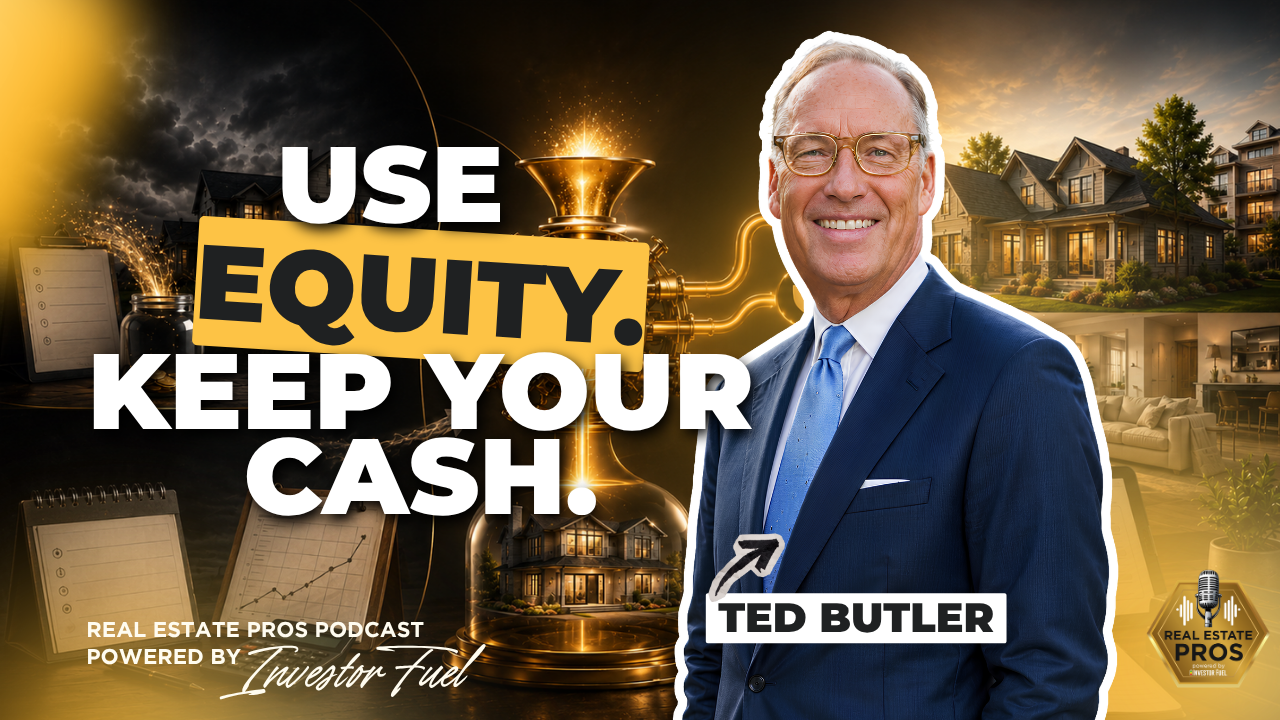
In this episode, Ted Butler, a seasoned mortgage professional, shares insights on the innovative use of reverse mortgages, particularly the lifestyle home loan, to enhance retirement planning and real estate investment strategies. Discover how this often misunderstood financial tool can be a game-changer for both older and younger homeowners.

Resources and Links from this show:
Listen to the Audio Version of this Episode
Investor Fuel Show Transcript:
Ted Butler (00:00)
It’s interesting because so much of it is based on perception, right? And we don’t know what we don’t know. and but there’s something worse than not knowing what you know, and that is thinking that you know. And I’ll just give you a little bit of history. Okay. Yeah, I’ve been around for a while. I tell people I’m a bit of a dinosaur in our industry. Twenty five years is a long time in our industry. But once upon a time I was a financial advisor and I really thought I knew a lot.
Back then. It’s amazing the perspective that age helps you with.
Meghan Escobar (01:59)
Hello everyone. Welcome back to the Real Estate Pros Podcast. I am your host, Meghan Escobar, and today I have the pleasure of sitting down with a gentleman who wears many, many hats. But he goes by the name of Ted Butler. His title is Loan Originator for Mutual of Omaha Mortgage. However, during the discovery that I’ve had I had the opportunity to sit down with Ted and learn more about him.
I soon quickly realized that he’s got much more going on than just being a lone originator. And I’m really, really excited for him to tell you guys more about the Lifestyle Home Loan that he has really mastered and has great great experience and is an expert in this field. So I am so happy to have him on the show. It’s something a little bit different than what we normally talk about and
I truly believe that our audience is gonna walk away with really great insight from his journey and the way that he’s built his business. So again, thank you, Ted, for being here on the show today. We’re so happy to have you.
Ted Butler (03:06)
My absolute pleasure, Meghan, and hello to everybody out there listening. Thanks for the opportunity to bring some light to a subject that may be tangential in a way, but I really do believe has some strong connections to what it is that we talk about on this on this show. But yeah, thanks so much for having me.
Meghan Escobar (03:23)
Absolutely. Let’s get into it. So first and foremost, for the people who might not be familiar with your name or what a Lifestyle Home Loan is, give us a 30,000 foot view of what your focus is these days and what markets you’re operating in.
Ted Butler (03:39)
You bet. So again, my name is Ted Butler, and I am a licensed mortgage loan originator for a company called Mutual of Omaha Mortgage. We just happen to be not only a company that’s been around for 117 years, but the largest provider of the modern reverse mortgage in the United States. And there is a component of the modern reverse mortgage that is the fastest growing use of our program.
And that is to purchase a home, either a single family residence or a condominium or a duplex, a triplex, or a four-plex. And I spend a tremendous amount of my time today educating realtors on how this program works and how it might impact their business. We’ve seen we’ve seen a monumental shift in the real estate market today, particularly residential real estate.
Where the new number one home buyer demographic is me and maybe some of you out there, and that is baby boomers and older. That’s quite a change. First time homebuyers have… well, they haven’t gone away completely, but they’re a fraction of what they used to be. And we are the demographic that holds the majority of housing wealth in the United States. And we’re the ones that tend to do the most amount of investing. I also work
closely with financial planners. I’ve been doing reverse mortgages now for 25 years. Prior to that, I was a financial advisor. Meghan and I were comparing notes. We both have some similar experience in that area. And money mechanics are money mechanics and how money can be used and where it comes from has a great impact on somebody’s overall not only survivability, particularly in retirement, but, you know, why why just survive if you can thrive?
And we help people learn about those options. But when it comes to real estate and purchase, there’s a a way for that older home buyer to move into maybe their last home
and have it be their best home ever and use a program that literally is a combination of the best of what a cash purchase would be, which is simply no monthly mortgage payment,
with what the best of a conventional purchase would be, which is simply not having to put all of their cash into that purchase, allowing them to keep liquidity for lifestyle or investments. And when you put the two of them together, you come up with what Mutual of Omaha calls the Lifestyle Home Loan. And and yeah, so that’s that’s kind of what I do. I spend half my time originating and then I spent half my time educating. I get to go all around the country
teaching realtors and financial planners about incorporating housing wealth in what we call the distribution phase of retirement. But I’m especially keen on how utilizing this tool can create investment opportunities for professionals and investors and end users. So just really happy to be here, Meghan.
Meghan Escobar (07:32)
Yeah, absolutely. I I love it, Ted. And, you know, this is someone, folks, who is is not green to this world. He’s, you know, got the the the wisdom. He’s got the experience with me learning that he’s coached over twenty five hundred agents, says something about, you know, his expertise in this field. And I’ve definitely learned a lot about reverse mortgage, if you will, that I was unaware of and and and I think a lot of folks are
as well. And so what caught my attention the most is the way that you pivoted the perception of what a reverse mortgage… what what how many benefits a reverse mortgage can be, not just for somebody who is entering the exit stages of their life, but also somebody who is, you know, younger and might have a lot of equity in their in their homes. So
talk to us a little bit more about how someone would be able to navigate or benefit from, you know, applying a reverse mortgage to a current home.
Ted Butler (08:36)
Well, it you know, it’s interesting because so much of it is based on perception, right? And we don’t know what we don’t know. And but there’s something worse than not knowing what you know, and that is thinking that you know. And I’ll just give you a little bit of history. Okay. Yeah, I’ve been around for a while. I tell people I’m a bit of a dinosaur in our industry. Twenty five years is a long time in our industry. But once upon a time I was a financial advisor and I really thought I knew a lot
back then. It’s amazing the perspective that age helps you with.
I now know today that I know far less than I don’t know. But back then I was pretty sure I knew a lot about a lot, especially when it came to things financial, and especially when it came to this thing called a reverse mortgage. And right away, you know, it was like hands up, no, I’m not good. But a lot of my clients were engineers, and engineers are very fact based, and they would ask me why.
Just like my children at some point would ask me, “Why, Dad?” my clients would ask me, “Why, Ted? Why not a reverse mortgage?” I didn’t have a good answer for them. So I decided that I was going to create a white paper and define definitively what the reasons were not to use this program. I thought it would be one of the easiest things that I would ever do. So I like I like doing my diligence. I’m what they call a wonk. I’m not really group…
great in sales, so I compensate for that for being a subject matter expert. And so I do my research. So I went to HUD, the Department of Housing and Urban Development, because quite interestingly, they’re the entity that created the modern reverse mortgage. And then I went to the FHA because they’re the department of HUD that administers and insures the modern reverse mortgage. So I thought, let’s just go straight to the mountaintop. And then I also went to the largest reverse mortgage lender at the time because I wanted to see it from more of an application perspective.
And what I found was quite shocking because as a paid financial professional,
I was misquoting misinformation on a continuous basis. Why? Because it was just boom. Why? Because I did what many people still do today, and that is rely on the opinion of others to create my own opinion. It’s easy
to ask somebody what they think about something instead of taking the time to actually open up a book or do some research. But what I found was this: number one, I had been told that reverse mortgages were expensive. Nope, they’re no more expensive than the most commonly used mortgages today—FHA mortgages, as an example. Interesting, we’re just another FHA mortgage. So that was that was a misnomer. Yes,
federal mortgages have different cost components than non-federal mortgages, but they’re still very popular and very commonly used. Number two, I was told that there was nothing left at the end. No, HUD is very conservative with how much they allow a borrower access to, and the majority of people today end up with as much, if not more, equity in their home than the day this started. As long as we have modest home appreciation, that will be the case for most. So that was a fallacy.
I was told it was for folks that were desperate and they had no other options. Now, granted, when I got into the business 25 years ago, a very typical client of mine would be a 75-year-old widow trying to make ends meet in a paid-for house, and yes, it was the only way for them to keep the house. Today, most of my clients are early 60-year-old couples, many of them still working, looking to maximize the assets that they have,
and they’re simply looking at housing wealth as yet another asset that they want to take advantage of. So a big shift in in who’s using the program today. So that was that was different. And then I was told that this was… how smug the financial planning community could be, was that our clients wouldn’t need a reverse mortgage because we took such good care of them financially. I can show you unequivocally that even with the smartest, most sophisticated, well-off clients,
that incorporating housing wealth can not only dramatically extend guaranteed income in retirement, but can increase overall net worth as well, simply by the judicious use of applying housing wealth in the spend-down in retirement. And yes, boom, it really changed my thinking and it forced me to make a career change. I wanted to add it to what I was doing as a financial advisor.
They wouldn’t let us be duly licensed, and probably for good reason. But at that point, you know, they say once a bell has been rung, I couldn’t unring it. And I knew that not only did my clients need to take advantage of this financial tool, but I also knew that there was a real gap in the knowledge base in the financial planning community. So I’ve dedicated myself the last 25 years to spending time educating financial planners, financial advisors,
and today a growing number of realtors about how this program works. And it’s marvelous to see others in the industry have taken their time to do their diligence. And now we have real pillars in the financial planning community and real estate community and estate law planning community really coming around this program and supporting it. And it’s really been edifying. But yeah, I wasn’t… I’m not here because I wanted to be a reverse mortgage professional,
Meghan Escobar (14:31)
Love that.
Ted Butler (14:36)
but I wanted to serve my clients the best way possible. And this is a brilliant financial planning tool. It’s also the safest mortgage in America, not only for the consumer—they don’t have a mortgage payment that they can fall behind on and run the risk of foreclosure—but it’s also the safest for the lender, because the modern reverse mortgage carries with it a very unique type of mortgage insurance that makes all of these loans what’s called non-recourse.
Non-recourse means that the home will always stand for the debt. What does that look like? Well, many of us realized during the last housing crash that many people’s equity vanished as home values collapsed below what they owed on their mortgages. Now, for those people with a conventional mortgage, tough:
you still owe the bank what you owe them regardless of what you sell the house at. But if you’re in a reverse mortgage, that home seller is protected, their heirs are protected, and the lender is protected
by a very special mortgage insurance component that will make up that shortfall. So while the equity has been destroyed by the drop in the housing market, that consumer is not responsible for that shortfall. The house will always stand for the debt. And for the lender, they will regain whatever is due to them through that insurance component. That’s just one of the staggering facts about the modern reverse mortgage that many people find surprising,
that it is the safest mortgage in America today. And then it comes down to leverage. And Meghan and I, we were talking earlier about who uses this program today. Well, Mutual of Omaha provides more FHA reverse mortgages than any other lender in the country. We are by far the number one provider of the modern reverse mortgage. But what’s interesting is that we provide even more of what’s called the proprietary or jumbo reverse mortgage than we do FHA reverse mortgages.
And that jumbo or proprietary reverse mortgage is designed for people who have home values greater than $1.2 million, particularly people that are looking at duplex, triplex, fourplex type purchases, which is one of my favorite applications of the modern reverse mortgage, and we can loan up to four million dollars. And it’s that demographic, that more affluent, higher value home consumer that understands leverage
better than maybe an average consumer. And they’re the ones that are very eager to use some of their underutilized housing wealth in other more creative ways, whether it’s to buy investment properties or create other opportunities for them to grow their overall net worth. So it’s… it’s really fun.
Meghan Escobar (17:56)
You you guys get your pens out. He’s dropping gems. And, you know, Ted, thank you for sharing all of that information. I think the the audience will will gain some new knowledge here on the benefits that hide behind the verbiage of reverse mortgage and start to see some, you know, benefits of the the Lifestyle Home Loan perspective. So with that being said, we’re gonna move on and I’m I’m curious to know…
I’ve had the opportunity to sit down with many individuals, many operators, and one thing I’m always curious to know is a moment where things got real, a moment where you had to pivot really fast. I mean, I feel like it goes hand in hand with certain levels of success, but it’s also something that’s not talked about enough. So would you mind, Ted, sharing a moment for us,
early on in your career, throughout your career, where you realized you’ve got to make different moves or different decisions?
Ted Butler (18:55)
That’s a great question, Meghan. So for me, I have worked for myself and by myself for the vast majority of my career in this industry, my previous industry, and the one before that. I am fortunate to be around some of the smartest, most generous people in the financial world. And a few years ago, when I was kind of bumping the ceiling on what I could do personally,
volume-wise and income-wise, a very important person in my life sent me a book called Who Not How. And it was a book designed to allow somebody such as myself the opportunity to look at how you can leverage your own value. There’s only going to be so much that that physics
and time and space can allow me to do myself. But if I truly want to grow my business, I can only do so through leverage. And so finding a way to create other opportunities for me to extend my reach, mainly by growing my base and growing my team, was monumental for me. I I’ve I’ve worn, like you said, a lot of hats. I’ve been an originator, a manager,
a vice president, a director, an owner in this industry. I like trying to keep things a little bit simple, especially when it when it comes to certain areas of business, but that lesson in learning how to leverage my own value by building out a team that allows me to do what I do best, and that’s educate and facilitate, and then have a team that comes around me that can help with executionables…
you know, I love teaching. Ask anybody at at my company. I’m an open book. I love helping other professionals be successful. But at the end of the day, I have a market capacity that I could take advantage of, and so, yeah, Who Not How was was one of the most pivotal points in my career development.
Meghan Escobar (21:00)
Wow. Thank you for that recommendation. It’s I’ve I’ve jotted it down, so I will definitely be adding that to my Audible. And, you know, that’s the kind of stuff that I feel like people just don’t talk about enough, as I mentioned before I asked, you know. And it truly does separate the folks who are here to, you know, gain just a quick commission check versus the ones who are staying in the game five, ten, fifteen, twenty-plus years. So your experiences speak in volume for yourself. Now
I’m curious to know: what’s the next problem you’re looking to solve or where are you looking to scale up next?
Ted Butler (21:35)
So it… you know, it it’s interesting. We were talking about education before, and I am finding that education in a general or broad sense is great, but I like investing my time and effort in the people that are the real doers. So right now I’m shifting from a basic education-based platform
to more of a coaching-type platform. And so I am bringing on high-performing realtors that can truly benefit of the hands-on experience that I’m going to share with them. And so that’s something that I’m finding really interesting, is going a little bit narrower and a little bit deeper. You know, honestly, it’s something that I can monetize where my general education, because of compliance constraints,
you know, it basically is a minimal fee for the continuing education that I I provide in the real estate or financial planning community. But a coaching platform allows me to go deeper and create a secondary revenue stream. Not that that’s really what I’m looking to do, but it kind of goes hand in hand. And I think people pay more attention to something that they’re investing in.
And it also helps separate the wheat from the chaff. You know, if a realtor can’t afford the training package, then that probably indicates that they’re not doing enough business right now to really support that career choice, yeah. And I want people to be successful. I want to equip them with what they need to be able to take certain steps and strides, but you need a certain amount of base in order to do that.
Meghan Escobar (23:21)
One hundred percent, and I can’t agree with that more. I’ve definitely learned that in my journey, you know, the more you invest in yourself, the the the more you learn, the more you earn, right? Or there’s a that’s a a better one that goes, “People who pay pay attention.”
Ted Butler (23:35)
Yes, I like I like that very much. I certainly pay attention. And it’s… you know, it’s it it’s interesting. I love to learn, but I love to share what I learned with others. And, you know, this career has given me a tremendous opportunity to do so. And I tend to be a bit of a contrarian. I I find that if everybody’s headed this direction, it might be smart to think about
something that might be a little bit counter to that. You know, there’s something about herd mentality that is good, and there’s something about herd mentality that isn’t that great. So I’m always looking for the nuances. I’m always looking for, “Well, if everybody’s headed this direction, what are they missing? What what areas of opportunity are out there that I might be able to make greater use of?” And so, you know, I find that the majority of people today
use conventional products to make their purchases. That that makes it very easy for me to show who we are and what our product is as a contrast. We’re not just another one of the herd. No, we are we are we are contrary to what a lot of that traditional thinking is. I mean, the reverse mortgage has come so far in its…
Meghan Escobar (24:33)
Sure, thanks.
Ted Butler (24:53)
in its use from its early conception in the early ’60s in the United States until the mid-’80s when the federal government stepped in and put an end to old-style reverse mortgages. And then they created their own version, the federal reverse mortgage, the Home Equity Conversion Mortgage, with all this safety and protection and benefit in it, to where we are today with the Lifestyle Home Loan and more and more sophisticated uses of housing wealth. It’s exciting to have a unique voice
in the marketplace. Sometimes it’s a little more than exciting. Sometimes it’s, you know, like you said, there’s, you know, there can be negative connotations. It’s okay. I was one of those people. Literally, I was one of those people in a training room with my arms folded, sitting in the back of the room listening to somebody talk to me, telling myself, “I don’t need to listen to what they’re saying because I think I know already.” Somebody asked me a very interesting question the other day, and that was,
“What’s my greatest challenge in what I do?” And I have to say it’s pride. Okay? Pride and ego. It’s that person who believes that they’re right. I think it was Mark Twain that said the most dangerous individual is a man who believes that they’re right.
I hope that people will take away today the idea that education and knowledge is ever growing and we are constantly updating, replacing what we think we know with new forms of information or getting rid of outdated information. And as long as we can approach things with an open mind and we’re comfortable with the fact that it’s okay to be wrong about something in order to be right about something… I always ask some of my clients, “If there’s something that you think
that you know that’s wrong, when would you like to know that it’s wrong?” Sooner rather than later, right? Continuing to operate under false assumptions does nobody any good. So hopefully today we’ve given people, Meghan, thank you very much, yeah, opportunity to think about growing their knowledge. For sure. If I can help them in any way, I’d love to have a conversation with you and and share with you some insight and learn about, you know, what might be impacting your business in your life.
So again, thanks, Meghan. I’ve really absolutely enjoyed the opportunity.
Meghan Escobar (27:05)
Absolutely.
Thank you so much, Ted. I really appreciate that and have enjoyed the conversation as well. And so before we wrap up, if there was somebody who wanted to reach you and connect with you, what would be the best way for them to do that? Is that through a personal social? Do you have a a a website or, you know, a a phone number?
Ted Butler (27:28)
Sure. I I love talking on the phone. The best number to reach me is my direct number, and that’s 425-891-6644. Again, 425-891-6644. I have a Bellevue office number, I have a Southern California office number. But if you want to see me, if you want to take a look at at who I am online, go to my website, and it’s simply
www.thevoiceofreversemortgage.com. You’ll see my videos, my links, get an idea of my approach to education. Whether you’re a realtor, an investor, a financial advisor, an attorney, you’ll find resources there that you’ll be able to relate to and hopefully hopefully stimulate some thought on, you know, how I might be able to help you
in your business. One of my greatest joys is helping other professionals be successful. So…
Meghan Escobar (28:28)
Perfect. Well, you guys heard it here. You you you’ve got a direct number to reach him, a direct website, and we’ll also be dropping it in the blog, so that way you guys can just click and it’ll bring you right over to Ted. And again, I appreciate your time, your story, more importantly, the perspective and the gems that you dropped here today for the audience. I think it’s gonna be super insightful. And, you know, we need more people in this space that are doing things the right way. So I wanna thank you again for being here.
Ted Butler (28:55)
My pleasure.
Meghan Escobar (28:56)
And for those of you that are tuning in, if you got any value from this and you want to hear more, please be sure to hit like and subscribe. We’ve got more conversations coming in with owners and operators, just like Ted Butler here, who are building real businesses with real people in real time. We’ll see you on the next episode.