Subscribe via:



Show Summary
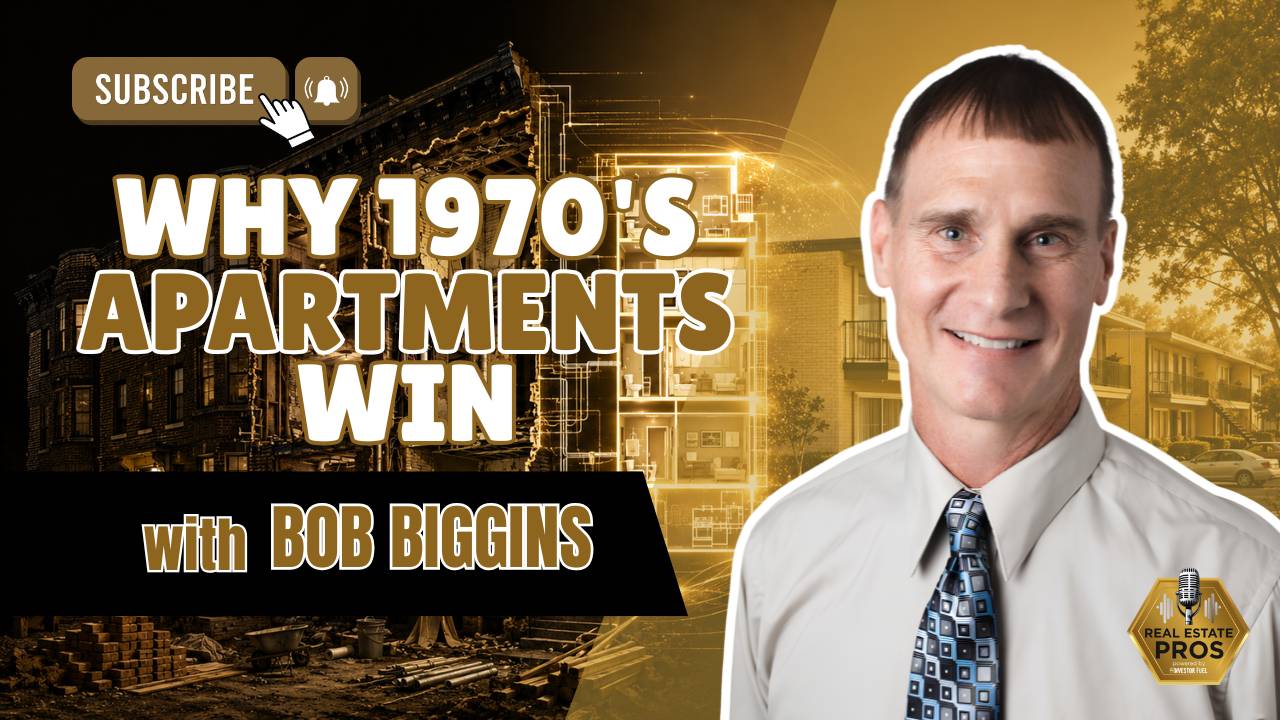
In this episode, Bob Biggins shares his extensive experience in multifamily real estate, focusing on value-add properties, scaling strategies, and operational excellence. Discover practical insights on market trends, building a strong team, and leveraging technology to grow a successful real estate business.

Resources and Links from this show:
Listen to the Audio Version of this Episode
Investor Fuel Show Transcript:
Bob Biggins (00:00)
Something that went south really fast was about two winters ago I had a nine-unit complex and I had a pipe burst in the second week of January and I had a unit filling up with water and I had nine people in minus ten degree weather with no water and I literally had to drive over there, grab every plumbing supply I had ’cause it was about nine o’clock at night of course.
And this doesn’t happen often. I mean this is like worst of the worst. And finally got the water shut off and I did the fix, the emergency fix, which turned out to be the permanent fix, ’til midnight, got the water back on for everybody,
Joseph Crooms (02:06)
Hey everyone. Welcome to Investor Fuel Real Estate Pros Podcast. And I’m your host, Joseph Crooms. And today I’m joined by someone I’ve been looking forward to chatting with. And his name is Bob Biggins. And he’s been making some serious moves.
In the real estate industry, he’s been a long-timer. He’s been in it for quite a while. So I’m gonna say, hey Bob, glad to have you here. Won’t you say hello?
Bob Biggins (02:32)
Hi Joe. Great to be with you guys.
Joseph Crooms (02:34)
Thank you so very much. I think our listeners are really going to take something away from what you’re approaching. Especially those 70s buildings that you talk like that you like to invest in. So let’s start there. So let’s dive in. But let me ask you this question first. For people who may not be familiar with your world, give us the short version. What’s your main focus these days and what markets are you in?
Bob Biggins (02:58)
Thanks for having me, Joe. My market is Southwest Michigan, which is east of Chicago by about an hour and a half and north of South Bend, Indiana by about a half hour, forty-five minutes. And it’s an old area. It’s where Whirlpool Corporation was developed in the nineteen early nineteen hundreds. And the buildings were landlocked. So the buildings if you want to scale any multifamily in there, they’re nineteen hundred, nineteen twenty, nineteen thirty buildings.
I’m branching out to other areas within the county where now I’m focusing on nineteen seventies, nineteen eighties built. And to me that’s newer construction because you don’t have to open up walls to bring things up to code. So that’s my market previous and now in doing this for about thirty years, I was buying older assets and as I’ve grown and scaled the business, I’m working into a little newer assets.
Joseph Crooms (03:50)
Let me ask question. How has it been since you’ve identified that investing in older buildings, seventies, eighties, how has that changed your business?
Bob Biggins (04:00)
Well actually the older buildings were the nineteen hundred, nineteen ten. The newer types are the nineteen seventies, nineteen eighties, ’cause there’s not a lot of new construction in our small area here. So that is the newer construction. So I do that just because really they’re just they’re easier. They’re already up to code, wiring standards, plumbing standards, they’re already up to code and you don’t have to
go into walls and bring things up to code, which makes the renovations much less costly and the turns are less expensive and quite frankly easier ’cause we do all our own turns in-house.
Joseph Crooms (05:21)
When you use the term turns, can you explain that in layman terms for me?
Bob Biggins (05:25)
It
it’s a move out when you a tenant is in a in a unit and they move out and you’ve gotta do whatever you have to do, new vanities, toilets, countertops, carpet, flooring, whatever you gotta do, to make it rent-ready again, to a pretty high level. We’ve got a pretty boutique business I run and they’re very nice units. And so that’s that’s what I mean by a turn. make-ready for a resident.
Joseph Crooms (05:50)
What is the average size of your buildings?
Bob Biggins (05:53)
I started out buying duplexes in the nineties and then up to three and four and I got a couple of sixes and more recently I bought a ten and a fourteen and an eight and but I’m working on put offers in on forties and sixties in the last year. Haven’t taken any of down yet. I was down to best and final on a few, but I haven’t gotten there yet, so I am scaling up and still working on my
tens and fourteen units, but definitely working to scale to that next level of a goal of five hundred doors.
Joseph Crooms (06:23)
Mm-hmm. And this new diversity in in your market, ’cause that’s what you’re diversifying now as far as scaling up more. What is the challenges in in in approaching those larger complexes?
Bob Biggins (06:35)
Well, approach to large co-complexes is probably in most markets, they they don’t change hands much. They’ve been sometimes in generational families because they’re they’re good assets and they just they don’t change. Now a a bit of a change to our market is the rest of the the bigger cities and the bigger operators, they’re seeing that our market is quite a good healthy market.
good good good rents relative to maybe other smaller towns because we’re we’re on Lake Michigan. We’re a we’re a a summer beach town and we’ve got other larger players from Indianapolis and South Bend Indiana, Fort Wayne, Chicago that are coming in and making moves to build larger several hundred unit complexes in our area. And that could definitely
compress some rents and hurt margins, but competition makes us better. so that’s definitely a a potential problem for our area for me personally, but I mean good for the overall market.
Joseph Crooms (07:34)
What caught my attention about what you were doing was your focus on on staying in your niche. And how has that benefited you? Were you like deciding early like should I do this, should I do that? But you seem to be concentrating on your niche and what has that done for you?
Bob Biggins (07:50)
Well I’ve done flips and I’ve done short-term rentals, none of which have done a whole lot. I’ve done okay with flips, but it’s a lot of effort for not a big enough payday. I’m finding to stay in my lane of rentals is just to make them very nice, very modern for older buildings. And generally once I have very modernized and brought up to
good level. I’ll have tenants to stay in for three to five years just because it’s got the new carpet, it’s got the new flooring and at which point they’ve locked in a price and and we we keep up with market but maybe new newer things on the market are even much more expensive for way lower quality. So that’s been our our niche again very boutique, very nice, very get very good solid sound residence in there and they tend to stay and and
really enjoy their their stay with us.
Joseph Crooms (08:41)
In your book of business, what would you say your volume is now, Bob?
Bob Biggins (08:44)
We’re eighty-six doors, over seven figures in sales and looking to scale up.
Joseph Crooms (08:51)
I know that’s not easy in this climate. Let me ask you this question. What’s been the key that’s that’s keeping your machine running smoothly?
Bob Biggins (08:58)
We’ve got a very good team.
of the house or in the house literally is my wife. She does all of the CRM, all of the tenant communications and I’m my lane is boots on the ground.
Con-construction, rehabs, emergencies and working with our subs to get those taken care of in short order. When we have things we address them very quickly. And I think that really helps the resident retention by addressing maintenance issues, billing issues, complaints with other residents, complaints with neighbors.
We try to stay on our game and be very accommodative to to the residents.
Joseph Crooms (09:37)
Do you have a property managing team?
Bob Biggins (09:39)
Yes, Biggins Property Management, which is myself, my wife, my twenty-one-year-old son, and we’ve got some daughters that are coming up and some other gals in our office that are helping out. Sounds great. I’m Robert Biggins, it’s Biggins Property Management, so we we self-manage all of our LLC properties through the Biggins Property Management arm.
Joseph Crooms (09:59)
Now every operator I know has a moment when things got real. Maybe a deal that went sideways or a time that they had to pivot fast. Do you mind Robert sharing one of those with with our audience?
Bob Biggins (10:45)
probably Something that went south really fast was about two winters ago and I had a nine-unit complex and I had a pipe burst in the second week of January and I had a unit filling up with water and I had nine people in minus ten degree weather with no water and I literally had to drive over there, grab every plumbing supply I had ’cause it was about nine o’clock at night of course.
And this doesn’t happen often. I mean this is like worst of the worst. And finally got the water shut off and I did the fix, the emergency fix, which turned out to be the permanent fix, ’til midnight, got the water back on for everybody, but
it—it wasn’t a deal gone south, but it was an asset gone south. And it was it was copper plumbing but was on an outside wall and somebody had turned a heater heater off and the cold co-concrete wall and the
And the copper pipe just didn’t meld well and when things defrosted a little bit, all heck broke loose.
Joseph Crooms (11:42)
What did you learn from that, Robert?
Bob Biggins (11:43)
Prevention. I I know it that it is is especially in the summer times, I I look at every asset, every failure mode as much as I can. Being in an engineering background, automotive engineering, you’re always looking at failure modes, trying to prevent failures. So I’ve just doubled down and and and focused my team on just and even my residents on if you see anything that it could be a potential problem, let me know ahead of time so we can address it. It’s a lot easier to address it in the sunshine right now than it is at minus ten.
be it a an electrical issue, a plumbing issue, a a sinkhole, a I mean any physical a roof problem, anything like that is to be proactive and and and as opposed to reactive.
Joseph Crooms (12:25)
You know, I’m curious because of your engineering background, do you call do you have like annual or property inspections?
Bob Biggins (12:32)
We do, we do. We go through usually every fall or spring rather and we’ll check out the roofs and the gutters and and spray for ants, spray for for weeds around the pr-perimeter. We got a check sheet, we’ll go around and and just evaluate the the siding, the windows, does it need pressure wash, is there algae growing? I mean just we’ll go through every every property and by probably the end of April,
We have a checklist full of things that are are summer to-dos. And actually, I I have a YouTube channel and one of my YouTube channel episodes was on this, the exact same thing you’re talking about. We went to the check sheet and explained just what we do every every usually April, mid to late April.
Joseph Crooms (13:17)
You know, that’s the kind of stuff people don’t really talk about and I thank you for bringing that to our audience. That’s why we like to talk—people talk from experience. So it’s but it also it’s what separates the folks who just dabble to the ones who are staying in the game long term. So let me ask you this. What are you focusing on scaling next and what’s your next real goal?
Bob Biggins (13:39)
My big audacious goal is is five hundred units. To close my career with five hundred units and maybe leave to family or however that works out ten or more years from now.
Next real goal is to probably take down something fifty or more. Because I’ve taken down a fourteen and it was a value add and a lot of work there, but it was five buildings. So I think I would have note with garages. So I I think it wouldn’t be any too much of a stretch to take down a fifty or more. And that is the next goal and I have I’ve put offers in on some, LOIs and it came real close quite a few times. And so I think
Some of my off-market deals are gonna hit and that is the next goal is to to to take that next level and it’s it’s a little worrisome, but I think once I take that down a year later, once it’s stabilized, I’ll be ready for the next one.
Joseph Crooms (14:29)
With that in mind, the next move can either compound or create chaos depending on how you play it. Now I know a lot of our listeners are early in their journey, Bob, and they’re looking to level up, and I think that they’ll benefit from hearing this. When it comes to building relationships and growing your network, what’s made the biggest difference for you?
Bob Biggins (15:30)
Probably the biggest thing which changed my mindset was I did I met and worked with a mentor. Crazy enough, our daughters just danced together at a at a dance studio and I got to know this gentleman and come to find out we’re in the same business and he has he had thousand or few thousand doors and we started talking and he and basically I was learning from his scale. He says you need to
Work on your systems and he just gave me a series of things to to work on and address and I took it to heart and and scaling and so working with him really, really helped matters in addition to listening more to podcasts and really just self educating. I I really just self educated immersed myself in the last four or five years and trying to become a a a definite real estate professional
at a larger scale than I had been in the last twenty years.
Joseph Crooms (16:23)
And real estate relationships are everything in this space. All right, Bob. Before we wrap up, if someone wanted to reach out to you, then this is the time you can plug and tell everything that you do, tell us how to get in touch with you, collaborate and learn more about what you’re doing, what’s the best ways to get in reach to reach out to you?
Bob Biggins (16:41)
You can reach out at BigginsTeam.com. That gets my wife and I. Or over my back here is my YouTube channel, Multifamily Investing with Bob Biggins. I started about a year ago because I’m a licensed real estate agent and so is my wife in Michigan and I’ve had so many young investors ask, Well, how do you do this? How do you do that? How do you do this for years and and eventually my son who’s a techie said, Just start your own channel, Dad. It’s easy.
So with his help I I started my own channel and now we’re addressing a lot of things that these newer investors, of which I represent oftentimes in buying a deal or even seasoned investors selling deals, I I use the my channel and my platform to help them and be their mentor, where my mentor helped me so much at a different level, I’m helping them on the on the come-up.
Joseph Crooms (17:32)
Tell us one more time. If somebody was flipping for their pen, Bob, looking for it and they couldn’t get the paper down. So tell one more time.
Bob Biggins (17:37)
It’s a big one.
Joseph Crooms (17:39)
Yep, tell tell one more time everyone, please, how to get in touch.
Bob Biggins (17:41)
yeah, BigginsTeam.com, BigginsTeam.com, B I G G I N S Team dot com and that will get you to our website and that has all our information and that’s our that’s our main portal.
Joseph Crooms (17:54)
And your YouTube channel?
Bob Biggins (17:55)
Multifamily Investing with Bob Biggins. Multifamily Investing with Bob Biggins, about one year old and I use that to help young investors on the come-up when I would represent them as being a a real estate agent for them, being a licensed agent in Michigan.
Joseph Crooms (18:11)
Perfect. Well listen, I appreciate your time, your story, your philosophy, your attitude and your approach. And I’m glad that you found your niche and you’re capitalizing. We need more people in spaces who are doing it the right way. Thanks again for being here, Bob. I really appreciate you.
Bob Biggins (18:27)
Joe, it’s been a pleasure. I really appreciate appreciate you inviting me onto your channel.
Joseph Crooms (18:31)
And for those of you tuning in, I know you got some value from Bob. Make sure you subscribe. We got more conversations coming with operators just like Mr. Biggins here, who are in this doing real business, helping real people and communities. So we’ll see you on the next episode of Investor Fuel Real Estate Pros Podcast.