Subscribe via:



Show Summary
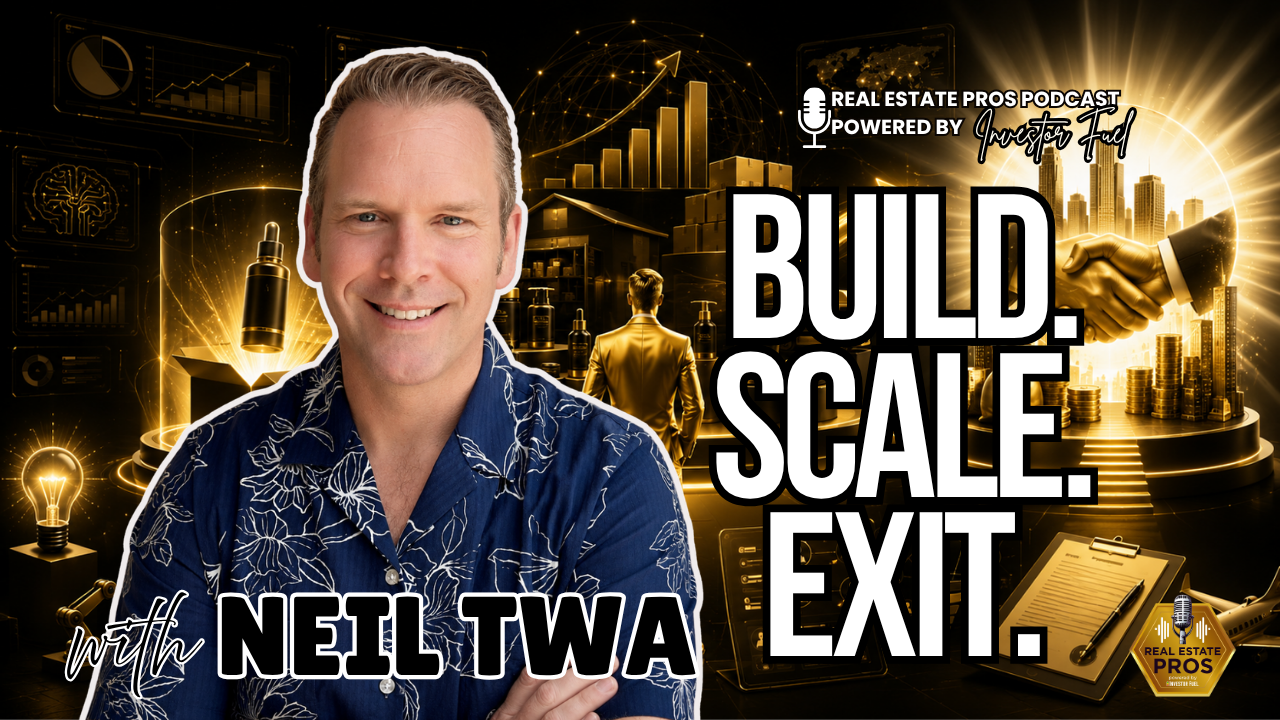
In this episode, Neil Twa shares his journey from leaving a corporate executive role at IBM to building and scaling multiple e-commerce brands through Voltage Holdings. He discusses the similarities between real estate investing and e-commerce, emphasizing cash flow, asset creation, and strategic exits. Neil explains how AI is transforming product development, marketing, and business operations while providing insights into building scalable, profitable brands that can eventually be sold as valuable assets.

Resources and Links from this show:
Listen to the Audio Version of this Episode
Investor Fuel Show Transcript:
Neil Twa (00:00)
So I have quite a few people who’ve come from the real estate world that have been very successful in this because they simply translate that into a, of a virtual door, I have virtual products. I have physical products instead of doorways and they look at it very similar to that. So.
I would say for people who getting started, know, under capitalization is a big problem, both in real estate and e-commerce. People tend to think, well, I can start with a few thousand dollars. And in some cases, that’s true. It takes you a lot longer. The competition will move a lot faster. If not, sometimes, you know, we’d like to say we’re allergic to debt, but there is a specific usage of debt, as I mentioned earlier, when it’s capitalizing opportunity. I think people don’t quite utilize debt the right way.
Michelle Kesil (01:32)
Hey everybody, welcome to the Real Estate Pros Podcast. I’m your host, Michelle Kesil Today I’m joined by someone I’m looking forward to chatting with, Neil Twa who is the founder of Voltage Holdings, where he specializes in launching, scaling, and acquiring e-commerce brands. So excited to have you here today, Neil.
Neil Twa (01:53)
Thanks for having me on, Michelle.
Michelle Kesil (01:54)
Sure. So let’s dive in. First off for those new to your work, can you share what your main focus is?
Neil Twa (02:01)
Yeah, well, as I like to tell people in the real estate world, we’re in the virtual real estate world. So we’re building buildings of brands, we’re building products, and we’re building out our, know, carving our niche in the online space, in the virtual real estate space for those brands, physical product brands, brands we’ve either created, built up or acquired that are across a multitude of areas of investment.
in those different brands and different physical products that we take out across multiple platforms online and offline in big box retail as well. So we’ve been at this for about 13 years now in this space, started on Amazon and then moved out into multiple channels like TikTok shop and Shopify, walmart.com, Target Plus and then other retailers offline as well to expand those brands and to grow up there.
ability to be sold, creating a saleable asset. That’s the other connection to anybody in the real estate world is you like to build sometimes exit. Sometimes you’re in the buying mode and we are in the build to grow to an exit. So everything we do is to create maximum value in that brand for itself, its shareholders and stakeholders, and then move that out to a large exit, increasing its value and its multiples along the way, similar to building a house that you’re gonna sell.
Michelle Kesil (03:14)
Awesome, and how did you get into this industry?
Neil Twa (03:18)
Yeah, I left my corporate gig and fired the man in about 2007. I was at an IBM exec and I was working in ⁓ knowledge and information, mobile technologies and high tech and got really bored and done with that. And so I left to start my own series of businesses, both online and offline.
I mentioned we built a number of businesses in the offline and online world. I got into the more of the internet marketing around 2008, 2010. That process of building up online traffic was for other people, as it turned out, as I was doing lead generation, mobile lead generation and stuff for businesses online and realized I didn’t actually own the business. Whenever the offer changed, I was having to shift momentum and by 2011, so.
realized I should get into creation of the actual product itself, not just affiliating or promoting other people’s products or businesses, and actually build something real for myself. And that’s when I launched my first series of products, started flipping some products and then learning how to brand those products. We really latched on to a couple of really great ideas in the home and kitchen space, and by 2015 we hit our first seven figures in sales.
Once we reached that ⁓ revenue growth potential, a lot of things opened up for the understanding, the business, the metrics, standard processes and how to make it profitable and how to grow it to a scale and scalable asset. And since then, we’ve gone on to launch more than 30 different brands. We have 20 different companies now that we control across multiple different channels. So it’s been a fun ride. It’s been extremely quick and it seems like it’s moving and changing every day, especially with AI and the technologies and processes we implement with that now.
But kind of found my way into it as I was looking for a way to really create a sustainable long-term business that had great profitability and good upside. And I stumbled into the physical product econ world and kind of have never looked back, just continuing to grow and go and just take up more of that online virtual real estate.
Michelle Kesil (06:28)
Awesome. And what do you feel are some of the main keys that have allowed your business to grow and run successfully?
Neil Twa (06:35)
Yeah. One of the things we focus on predominantly is the cashflow of our operations. Like any good business, obviously cashflow drives purpose and value. Profit is sanity. Revenue is just vanity. So at the end of the day, it really gets down to making sure we have good net profit in our businesses, pay our people, our operators, pay for our marketing and expenses, and be able to keep our cashflow turning in such a way where we can turn it over four times a year in our inventory. If we see a
a product or business opportunity where they might be turning one to two. Our goal is to get it to three to four turns a year. And that’s one of the things we really focused on was the movement of that product, both profitably and effectively in the marketplace and doing that, turning that cash on cash value quarter by quarter and obviously into an annual run rate and then seeing the growth trajectory of that business include the multiples of it. So looking at the EBITDA or seller discretionary earnings, we’re always
looking at ways we can add more value, client value, product value, market value. And ⁓ it’s just one of those things that’s never evolving and growing opportunity with different product types, but it certainly has shifted and changed in the way we manage it with AI in the last few years to be able to see more data, have more interconnected data across platforms we sell on, be able to use our processes, what we call our green light methodology that we established about seven years ago that really helps us determine product profitability, upside and trends.
And then product launch and management processes that have really helped us stay profitable, fighting certain market conditions like we’ve all had. Real estate had obviously different conditions in 2008. We’ve faced a couple of different conditions with saleability and movement of products since the 2020 years. We had the tariff kind of things that kicked up. We had a bit of an economic downturn before that. So there’s point in these ebbs and flows.
We’re actually, believe it or not, in a very big market upturn. I know it doesn’t feel like that way for everybody, but we kind of see it on the ground level. People are actually spending more on products now than they have in the past. The opportunities actually become greater, and our ability to get to market is faster with AI than it ever has been. And the ability to manage and control operations in Clashflow using AI processes that we adapted to our existing processes.
have been able to expedite our workflow, create more powerful operators within our brands, and really allow us to take over more market share faster.
Michelle Kesil (08:46)
What have been some of the obstacles or challenges that you’ve had to overcome in this role?
Neil Twa (09:27)
Yeah, well, when I first started and fired the man, I did not really have a business plan. So I went out into the market and just said, I’m going to figure out what to do and kind of fumbled around with that in my first year. I got married in the same year and we found out we were pregnant with my first daughter in the same year we started the business. So not highly recommended you give that a shot. But if you’re going to, then that’s certainly going to be something that drives your tenacity and perseverance. Ran into some, you know,
Practical business problems later on had a great opportunity in a business at Oklahoma invested a little bit too much time energy attention and money Did not see the force through the trees and learned a very hard lesson as I went bankrupt in that process Also exposing some very bad business practices inside of that that I had to step away from which also caused the problem and that you know just reshifted my focus and helped me really understand where the boundaries of business and the law and you know, just the
adaptation of business, what’s a guideline, what’s a hard and fast rule until you’ve pushed boundaries far enough you don’t always understand what those look like and you know have you if you’ve not gone bankrupt that’s just one of the ways to figure that out. So that was a bit of a hardship I had to pull back on and then just trying to figure out what you know what my opportunity would look like as I move forward. Business is basically a never-ending series of solving problems whether you’re trying to solve problems at the real estate level
Contractor level, house building level, condos, whatever it is, multi doors, Airbnb has had challenges with them shutting down. The councils and city councils go in and say, well, you can’t have them in our city anymore. And I’ve a number of people that got stuck with houses in that business that they had to offload as quickly as possible because they could no longer host them as Airbnb homes. So there’s every business has its series of challenges. We’ve had those series as well. Tariffs was kind of a bit of a speed bump here recently.
But because we have very strong operations in manufacturing, we have very strong operations in the movement of products, we were able to overcome that, stay in business, actually take over more market share because our competition was falling out. We had good processes. We’ve run very frugal, very lean. We are debt free and all, but one of our businesses, which is really in a hyper growth mode. So the only way for us to really take on that hyper growth, add those new channels, add those new customers was to take on debt. But very strategically, that’s always a challenge.
Obviously, and how you take on debt. I know that in the real estate world, that’s one of the major ways to grow your real estate portfolio is to take on debt and obviously collateralize it against an asset. We do similar things on the inventory side. Our warehouse in Temecula, California is stocked up with over $3 million in inventory right now. So we’re collateralizing that through the sell through rate of that product. But there’s always risks with that. And sometimes it doesn’t sell as fast as you want. And we’ve had those challenges in the past.
And those are just some of the things with economic, geopolitical, manufacturing, and then just low level challenges with any kind of business that we’ve had to solve over the years, personally and professionally, to kind of get where we’re at.
Michelle Kesil (12:09)
Yeah, absolutely. And what are you most focused on solving or scaling to next?
Neil Twa (12:17)
I am most focused on bringing up all of our small to mid-sized portfolios up ⁓ to an exitable state within the next five to seven years to bring our entire portfolio within the 50 to $100 million range and then exit. Exit at all is one giant portfolio. So as an aggregator of brands, we’ve collected brands, we’ve built them, acquired them. Ultimately, our goal is not to run them for the rest of our lives. Our goal is to ultimately package them up into a really great looking
portfolio and kind of sell them out. Figure out what to do next at that point.
Michelle Kesil (12:47)
Yeah, absolutely. And what are you most excited about or have as an opportunity that you are focused on?
Neil Twa (12:56)
Yeah, I am most excited about the changes we’re seeing in our economy that we’re seeing in the use of AI technologies at many different levels. I’m pragmatic about what it can do. And honestly, I hope it doesn’t turn into some sort of Terminator situation for us and take over the world, that kind of nonsense. But I do see that it is creating a lot of efficiencies and opportunities. It’s creating ⁓ the ability for
new people to get involved in business even faster by using AI and technology to create and do things at exponential rates we have not been able to do before. We are able to move product even faster to market through image creation and generation, copy generation and listing, product evaluation. We even use AI to analyze all of our marketing campaigns to give us directions and insights. I really think that I’m excited about the opportunity to continue.
Being a strong operator in the kind of business we run and allowing others to see how that works through our community that we put together that allows other people to come in and see and grow and build with us in that community. I’m excited about that because we’ve had a lot of great wins in that community. We have a number people who’ve done extremely well in their business between $30 to $1 million a month in sales and I’m excited about the growth of that community. We have a couple of them getting ready for exit. We’re consulting with one of our clients right now that by the fourth quarter or so should be exiting.
He’s about 10 million a year in top line revenue and we’re excited to see that package up. So there’s a number of wins I’m looking for in myself and my clients, a number of good things that are optimistic about in terms of the movement of products and opportunities with products. The last thing to talk about there is just the movement of information through agentic protocols like ChatGDP and Perplexity and these kinds of systems that people are using a lot more to ask questions about.
You know, what’s the value of real estate in my area? How much is price per square acre? How many doors are in my area? You know, we’re talking about kinds of product use cases. You know, I’m going camping this weekend. Do I need this product? Or, hey, I love music. What’s the best, you know, vinyl record player out there? And we’re seeing a lot of that now pick up inside of those engines. So I’m excited to see what kind of new revenue and new opportunities for exposure to people are going to come through those engines at the speed at which they’re happening right now.
which is basically people picking up their phone and talking to these engines and asking questions. And so it’s a really new area, a new frontier that most people don’t understand and don’t know anything about. And I really feel like we’re on the cutting edge of that. So I’m excited to be right at the forefront of what’s coming.
Michelle Kesil (15:13)
Yeah, absolutely. Is there advice you would give to someone that’s wanting to also jump into this industry?
Neil Twa (16:02)
I would be very pragmatic and I like to talk to my real estate folks because they understand the capitalization needs and requirements of growth in this kind of market. They understand debt utilization. They understand cashflow, cash on cash value. They understand the trends and fundamentals of business. They don’t always understand the Ecom side of it, which is how do you apply those understandings, those fundamentals to moving a physical product to a, you know, from a manufacturer through a customer and direct consumer channel.
which is just understanding how that metric changes compared to the metric of moving a house, selling a house, getting a door, running a reed or whatever, or syndication. And it really is a lot of similarities in business.
So I have quite a few people who’ve come from the real estate world that have been very successful in this because they simply translate that into a, of a virtual door, I have virtual products. I have physical products instead of doorways and they look at it very similar to that. So.
I would say for people who getting started, know, under capitalization is a big problem, both in real estate and e-commerce. People tend to think, well, I can start with a few thousand dollars. And in some cases, that’s true. It takes you a lot longer. The competition will move a lot faster. If not, sometimes, you know, we’d like to say we’re allergic to debt, but there is a specific usage of debt, as I mentioned earlier, when it’s capitalizing opportunity. I think people don’t quite utilize debt the right way. So I would say, you know, be careful how you utilize debt to capitalize.
your business.
We’ve had a number of people who use like whole life policies or real estate portfolios to actually build up their income and grow it. So that’s a great opportunity for those who get involved. know, time and energy and attention are the other factors beyond money that people need to be very aware of. These businesses don’t have to overtake your life. You know, I run this company out of my house on 60 acres in the country, work on Starlink. I have, you know, three operators who are very dedicated. I got a team of about 15 people total.
who are involved and run at every different level of actions and only one of them is actually a W-2 employee. The rest are contracts or people we train to grow and so that allows that flexibility in the business model. time and energy and attention to the very beginning is something that needs to be dedicated even if it’s just 15 to 20 hours a week. So I people to be aware that if this model is something they’re serious about, they will take whatever time is required to get it done. But also realize that with the right processes, with the utilization of AI now, with the right
procedures and even with the right mentorship, they can spend 15 hours a week running a multi-seven figure business online, tossing off, you know, 18, 20 % net profit every year. I love that model for that reason. That’s why I got involved. That’s why I’ve so heavily doubled down on it, because in terms of capacity of growth, the internet is your limitation. So there’s a lot of internet out there, a lot of traffic. Don’t get blocked into local, you know,
situations with local contractors or even groups or how many doors there are in an area or what the price point is going to be in this neighborhood versus another, can, you the price for my market will be whatever the market bears. So I have an opportunity to brand build and to create that value. So if someone’s like, well, I only want a $20 product. Well, if I can sell it for 99 and the market bears 99, that’s my opportunity. that
It’s an unrestricted branding opportunity that I want people to understand is what I found so fascinating about this business model and jumped into it. Because if I can create that value, if I can see what the market wants to take and I can give them a great product that they love and they’re willing to pay more for a better product than my competition, then I win. And I’m not really restricted in that way. From a competitive perspective, I’m more constricted in a brand perspective. So that’s one of the things I found that I enjoyed and I want people to be aware of that.
Because sometimes that limitation in real estate is frustrating when you have comparables and you can’t go up a certain point You can’t raise, you know rent to a certain point you have to stay within a certain area I don’t have those limitations. So in terms of growth of cash flow in terms of growth of product opportunity There’s really a blue sky opportunity to create and go as big as you want Daniel figured that out his wife and him had done some real estate and stuff in the past He was a golf course manager for a little bit started six years ago and is running about 17 million a year now
So in terms of the growth and upside potential, it is extremely fast due to really the unlimited aspect of the internet and how many people could buy your product from the US and everywhere else. They now become your forefront. So people should consider all of those things when they’re thinking about it. They should consider the time, energy, attention and money to dedicate to a real business and realizing that everything they’re building, everything I’m explaining to you, everything we’re doing within our brands is a saleable asset. It’s an intrinsic value that increases over time.
In three, five, six years, you could be selling those businesses between 10 and $50 million out to the market, which creates a huge opportunity, a wealth creation moment. You just have to be smart about the capitalization and you have to be smart about the movement of product. And those are all things that I’ve taught, you know, stay at home moms and 76 year old grandmas how to do. And business investors and real estate brokers. It really just gets down to whether or not you think it’s a fun business model and you enjoy doing it.
Michelle Kesil (20:44)
Amazing. Thank you so much for sharing all of that. So before we wrap up here, if someone wants to reach out, connect, learn more, where can people find you?
Neil Twa (20:46)
Absolutely.
They can go over to voltagedm.com check out what we’re doing, check out my podcast. I have a daily podcast that talks about this business and the models. We have guest case studies on there and other podcasts you can check out. There’s a book on there as well as a blueprint system they can check out. If they’re interested in learning the actual steps and processes and understanding more about what’s going on. If they do reach out, it’s an invite only community membership. Everybody chats with me. I want to chat with them, see if they’re a good fit and really help them understand what’s pragmatic about the business and where the opportunities really lie.
Michelle Kesil (21:19)
Okay, perfect. Well, appreciate your time and your story. Thank you for being here.
Neil Twa (21:23)
Thanks for having me on, Michelle.
Michelle Kesil (21:24)
And for those tuning into the show, you got value, make sure you have subscribed. We have more conversations with operators like Neil who are building real businesses and we’ll see you on the next episode.