Subscribe via:



Show Summary
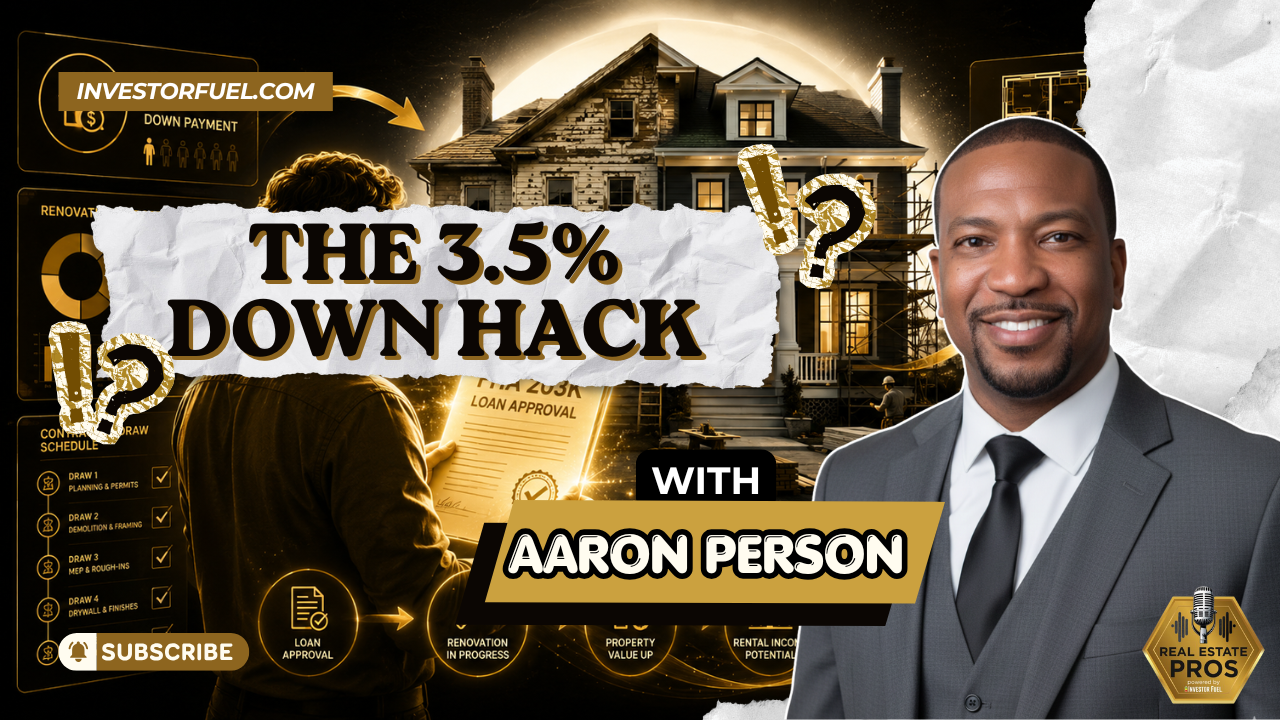
In this episode, we explore the FHA 203K loan, a powerful yet underutilized tool for real estate investors and homeowners. Guest Aaron Person shares insights on how this loan can facilitate property renovations, investment strategies, and aging in place, demystifying the process and highlighting its potential to transform real estate opportunities.

Resources and Links from this show:
-
-
- Investor Fuel Real Estate Mastermind
- Investor Machine Real Estate Lead Generation
- Mike on Facebook
- Mike on Instagram
- Mike on LinkedIn
- The 203k Done YOUR Way Program’s Website
- The 203k Done YOUR Way Program on Facebook
- The 203k Done YOUR Way Program on Instagram
- Aaron Person on LinkedIn
- The 203k Done YOUR Way Program on Youtube
-
Listen to the Audio Version of this Episode
Investor Fuel Show Transcript:
Aaron Person (00:00)
at the end of the day, this product is,
is great for anyone who’s looking to backdoor their way into real estate investing. Anyone who is in need of a property where they’re tired of fighting for those turnkey properties. you can backdoor your way into a turnkey property by going to get that ugly duckling on the pretty block, on the swan block and turning that duckling into a swan.
Dylan Silver (01:58)
Hey folks, welcome back to the show. Today’s guest, Aaron Person, is the founder of 203K Done Your Way, where he helps homeowners and investors use FHA 203K loans to purchase and renovate residential and multifamily properties. His mission is to educate people on how this often overlooked loan product can create opportunities for renovations, aging in place, preserving family homes, and real estate investing.
Aaron, welcome to the show.
Aaron Person (02:30)
Thanks Dylan, glad to be here.
Dylan Silver (02:31)
Great to meet you, Aaron. And why do you think these loans, FHA 203K loans, remain somewhat underutilized as real estate tools, even though they can completely change someone’s financial future or the way that they’re approaching a real estate deal?
Aaron Person (02:50)
That’s a great question. So first and foremost, what people need to know is the 203K loan gets its name from the section of the National Housing Act that is written in. Traditional loan that we’re familiar with, FHA loan is actually written in section ⁓ 203B as in Bravo. Go down just a little bit, ⁓ 203K as in Kite. That’s where you’ll find this loan, which is still an FHA loan, but it allows you to not only purchase and renovate, but also if you…
if you are an existing owner to refinance and renovate. But to answer your question, it’s a government loan, right? And the government’s not good at advertising. So that’s one. In addition to that, when it first came out, it was it was a mess. Again, the government was primarily handling things and until it was revamped. That’s when things started to become a little more streamlined. But initially, the folks who did try to try out the loan with their clients
It was such a mess that everyone was just kind of shunned. And so the word got out, hey, you don’t want to use that. And, you know, it just kind of kept going from there.
Dylan Silver (03:56)
How long have these loans been around for? You mentioned that there’s been some changes in the way that it’s been processed. How long have they been around for?
Aaron Person (04:05)
It’s been quite a while. So FHA itself originated after the Great Depression, right? The government stepped in to help people out to be able to get those homes and really to get the economy going again. But it got revamped in 78. And from there, that’s when, you know, it started to really do the heavy lifting as far as the renovation aspect of things. But the purpose of it is to just rebuild the current infrastructure in the United States and allow
neighborhoods to beautify themselves basically and just not have that blight and dilapidation lingering.
Dylan Silver (04:42)
Now, when you’re looking at properties that may be a good fit for this, what’s the degree of distress that makes sense? Can it be something that’s like a roof to studs rehab or does it have to be something which is maybe less complex?
Aaron Person (05:45)
the gamut. So there’s two different versions of the loan. You have the limited version, which is anything they just increased the the maximum amount it once it didn’t really. It’s now seventy five thousand. It was much lower before where you really couldn’t get a lot done with the loan. But limited is the version that allows you to renovate a property for non-structural repairs. So anything that’s just basically, you know, as they say, lipstick on the pig. But anything that you just basically replacing your not
altering the footprint of the property. You’re not trying to do any additions. That is the limited loan. Now, the full 203K or what we will call the consultant K because you need a third party HUD consultant to come in and basically hold your hand on that side of the on that version of the loan. That one has no limit as long as you’re spending at least five thousand dollars. You can do whatever your budget and appraisal and or appraisal because it is a mixture, but.
Whatever your budget and or appraisal will allow you to
Dylan Silver (06:46)
Now for folks who are looking at this as an investment vehicle, can they use this for fix and flip or does it have to be something where they’re going to be living in at least for some time period?
Aaron Person (06:57)
So again, FHA loan, which is strictly for owner occupants, they actually barred investors from using this loan because if you can save a dollar, you’re gonna save a dollar, Right. And with FHA only requiring 3.5 % down compared to a typical investor loan where you’re putting down more than 3.5%, it was very attractive to investors. So they kind of blocked that, not kind of, they blocked it because they wanted
to focus on owner occupants. Now that being said, people can use this to backdoor their way into real estate investing, right? And if you think about an old game that we played a lot growing up, well, most people, Monopoly. If you think about that concept and really break it down, when you play the game, of course you go around, go get your paycheck, but the purpose is to acquire property or acquire real estate. you initially, you acquire land.
Right, each one of those Baltic Avenue, Park Place, that is land, raw land. And then you develop that land by adding one greenhouse, two greenhouses, three greenhouses up to four. And so residential real estate allows you to purchase up to four units and still be considered residential. So with this loan, you could in theory go purchase a four unit building, renovate it to your specifications, live in one unit, rent the other three. And after 12 months,
you know, because that’s a requirement that you stay in the property for 12 months after 12 months, rent that other unit and then rinse, recycle and repeat.
Dylan Silver (08:28)
So staying in for 12 months, one year, I mean that’s definitely feasible for a lot of people who are on that on ramp into real estate investing, especially hey, if you need a place to stay. If we can get a little bit granular here, maybe give away some of the gold but not the whole bar here and talk about what the.
you know, process of gaining access to those funds look like. If you’re doing a rehab loan, I’m not imagining, although I could be wrong, that they’re just depositing a bunch of cash into an account and saying, you know, use this for what you may. Does each line item have to be budgeted and then you kind of get it trickled into the account at a certain point in time? How does it work in practice?
Aaron Person (09:10)
Great question. So you have your scope of work. So if you have a full 203K loan, the standard or consultant K, at the beginning, you and the consultant will walk through the property. The consultant’s job is to make sure that everything that FHA requires is included in the renovation budget. Now you have your wants and you have your needs. If you can get what you want, excuse me, if you can get what you need in the form of what you want, that’s a great thing. So
I need a new kitchen. Okay, well, what do you want in your kitchen? You can pick those things, right? I need a new bathroom. Well, what do you want in your bathroom? I need railing. Okay, well, what type of railing do you want? So they’re gonna create a scope of work for you. And then they’re gonna give you a blank one in order to give to three contractors and allow them to bid on the job. So everyone’s singing from the same sheet of music versus contractor A comes in, you have a conversation with them, you guys.
tour the property, start talking about things, and then other items start to be brought into the conversation. You meet contractor B, he’s not privy to that previous conversation, but you’re bringing in other items with this contractor. So each of those bids that you receive are not gonna be apples comparing to apples, right? But with the scope of work that comes from the consultant, now you work those contractors, now you’re comparing apples to apples, you can figure out who’s the best person for you to work with based off of.
their experience, the projects you’ve seen, the past clients you’ve spoken to, and of course, you know, the amount that they’re charging you for the actual work.
Dylan Silver (11:14)
And then so once someone goes through with this, is there the funds basically being channeled to the contractor and they’re in charge of the the full rehab? Is that how that generally works?
Aaron Person (11:25)
So the consultant again will come out and check the benchmarks, right? So we had to do the trash out, we got to do the gut and we got to do some waterproofing in the basement, things of that nature. Whatever is slated on the scope of work, once those things are done, the consultant will come out, check, make sure they’re done and then they’ll submit a request for a funding to the bank. The bank will release funds.
check will come out and it was a check or wire, but the check will come out and it’ll have both the contractor and the owner’s name on there. The owner signs the check over, gives it to the contractor, the contractor continues on to the next phase. One thing I will mention, it’s extremely important that the contractor you use is somebody who is a solvent, you know, because they have to float part of the job. They don’t actually get paid until the end of the job. And even with each draw, there’s a 10 % hold back.
from what they’re going to receive from that particular draw. the contract issues, you just got to make sure that they’re, you know, they’re well off enough to be able to handle the job and wait until the end where they actually get paid versus the typical contractor. They want to deposit upfront.
Dylan Silver (12:31)
front.
Pivoting here, Aaron, you mentioned the consultant, right? If folks are looking for someone who can work with them through this process, is that typically going to be someone who is a traditional loan originator? Or is this 203k process something that’s relatively niche that someone would really have to specialize in order to facilitate these types of deals?
Aaron Person (12:53)
So the reference I like to use, once was a basketball coach, still in my heart, but not doing it at the moment due to my schedule. I say you’re starting lineup, right? You’re starting five. So that point guard is going to be your realtor, the person that is facilitating everything and making sure the team is all doing what they’re supposed to do. That two position, shooting guard is your lender. That person’s job is to score the buckets for you, right? To get you those funds.
three position, that small Ford is that swing person, that swing man or woman that is the consultant. Their job is to go between you and the contractor and the bank and the contractor. That four position that power Ford is your contractor. And I’m not talking about today’s stretch for talking about old school, getting the paint, getting the work done, swinging the hammers, everything. So that person, of course, is the one that’s helping to bring your dream into reality. And then the fifth person
The center protecting things is the title company. Their job of course is to facilitate the term for the contract and just to make sure that the owner can actually legally sell you the property and nobody’s gonna come after you later. So the thing is you wanna make sure that the members of your team are as strong as possible because one week link can actually cause you to lose some money, time, stress you out, things of that nature. So you wanna have a stronger team as possible.
Dylan Silver (14:19)
Where have you seen this go awry? I’m thinking about this, you know, if someone, if the realtor, if the lender isn’t familiar with this process and someone is trying to do it themselves, maybe without a consultant, where have you seen these things go off the rails?
Aaron Person (14:34)
The couple of things. One, the the budget. So a lot of times folks will just go crazy with the budget about what they want, what they want, what they want. Right. Not realizing that you have to stay within your budget so you can get what you want, but just make sure that it fits within your budget. And typically the gridlock that most people will say is dealing with the contractors, working with the contractors, making sure
that they know what they’re doing, making sure that you pick the right one. You got to vet them very well because what you don’t want is as you’re going through the project, you have to change contractors because that’s going to cost you more money. So that is probably the number one area that people will talk about. Just that contractor piece not being the contractor that they thought they would be.
Dylan Silver (16:06)
Yeah, I mean, that’s huge. I think we deal with that in all segments of the real estate space, whether it’s fix and flip, you know, buy and hold. If you’re doing it for yourself as your ⁓ property, your homestead. When folks are looking at these ⁓ loans and they’re maybe comparing it to some of the other ways where they can gain access to capital, do you feel like this product really stands alone? Because it’s intended for homeowners, right? But is also
some of the sentiment at least that, we should be comparing this to maybe a hard money loan, for instance. I know that’s intended for investors, but do you ever see that kind of competition between lending segments?
Aaron Person (16:49)
You may see that on the owner-occupied side. You don’t see it as much on the investor side, again, because this loan is not for investors. That would be the cousin, which would be the homestyle by Fannie and Freddie. So that would be more so an investor-friendly loan. It allows you to do other things that $2 $3K doesn’t allow you to do, such as luxury items if you want to do a pool or something like that. And it’s not restricted to owner-occupants.
So that would be more so suited to someone who’s looking to invest and not necessarily go the hard money route versus the 203k where it is strictly for owner occupants.
Dylan Silver (17:27)
Bonus question here for you. We’re now seeing a trend really where.
there’s a lot of new homes being built in the sunbelt. I’m in Texas, right? One of the things that has come about with this is I’ve seen fewer fix and flips happening just as a whole because everyone wants new and there’s so many new subdivisions and new homes being built that it does eat into the margins. There’s no, no two ways about it. It does eat into the margins of flippers. I mean, if I could buy a brand new home for $240,000 or I’m buying a pre-owned home for 190,
I’m going to be thinking, let me just spend the extra money and a little bit more and get a brand new home. When people are running through that arithmetic in their head and they’re deciding to go pre-owned versus new, especially in some of these markets where they may be closer in price point, are you seeing more adoption of these 203K loans or are you seeing maybe less adoption of people just going straight to new?
Aaron Person (18:27)
It so it’s definitely going to, you know, differ per market. Here I’m in the D.C. metro area. We do have a lot of flips going on here and we do have equally a good amount of new construction as well. What I found is that once people understand. The value and the opportunity of the 203K loan, the fact that even though it’s not a new loan or new new structure, you know, in general,
that you can go in and do the same thing that you will do with the builders. You can go customize the home that you want. know, again, you can go pick up that countertop. You can go get the elongated toilet. You can go get the ceiling fan. That’s, you know, whatever, right? You can do the same things as far as the I mean, you don’t have the design room. So that part’s missing, but everything as far as picking out what you want. And let me back up.
When you go to new construction, they give you packages, right? You have a few choices, but you don’t have all of the choices. So with this loan, it allows you to really just walk into your local hardware store and say, I want that, I want that, that, that, that versus, okay, this is what I can have. Okay, I’ll choose this off of what you’re offering. But I would say it’s probably, you know, in the ballpark, maybe a 50-50 range, or take.
Well, no, no, it’s probably leaning more towards new construction because again, people really still don’t understand the value of this. But yeah, what I can to change that.
Dylan Silver (19:57)
It’s interesting that you mention not understanding because there is this knowledge gap and I’ve seen this with other segments of real estate as well where people have this idea, well, maybe it’s almost too good to be true type of thing. so, especially if they don’t personally know anybody who’s gone through this process, they don’t want to necessarily feel like they’re the first person to do it. That’s why it’s so important to have someone like yourself, you know, on their team. If you’re going to be attempting to do one of these
one of these loans. We are coming up on time here though, Aaron. Any new projects that you’re working on or anything you’d like to push out to our audience?
Aaron Person (20:34)
Well, I will say that if you have not heard of the 203K Loan, do some research. You can go online and just Google 203K. There’s plenty of people talking about it, myself as well. I do have a YouTube channel called 203K Done Your Way, where you can see some past interviews of folks who have gone through the process and hear their stories, not just me telling you, but actually,
Here the people who’ve gone through the process. Now, I’ll forewarn you, all of them have some type of, know, slight horror story involved with their process, but I’ll also let you know that at the end of the interview, they’re gonna tell you, I do it again, you know, and I recommend this loan to other people in spite of the things that they may have gone through in, you know, throughout the process. So
at the end of the day, this product is,
is great for anyone who’s looking to backdoor their way into real estate investing. Anyone who is in need of a property where they’re tired of fighting for those turnkey properties. you can backdoor your way into a turnkey property by going to get that ugly duckling on the pretty block, on the swan block and turning that duckling into a swan.
And for those, which I feel is a high passion for me, for those who are looking to age in place.
Right now, the cost of living is not going down, right? And it probably never will. But more importantly, for assisted living, had 55, 10,000 people turn 55 every year in America. 10,000 people, over 10,000, turn 65 every day, excuse me, in America, both 55 and 65 every day. The cost of living for assisted living is over $5,000 a month. If you currently have a home,
and you need to make that living space more pleasant, right? More accessible for you to live in while you’re still here on the planet. Use this loan to do that. You can create that main suite on the main level so you no longer have to deal with those stairs. Some people are looking to consolidate because again, the prices are going up. So families need to come back together, come back home.
You can also look at doing the ADU, Accessory Dwelling Unit, where you’re building a separate unit outside. Now, of course, with the 203K, it does have to connect to the properties, but that connects with a little breezeway. You don’t even have to have a full structure connecting your new ADU home to the existing home with the property. I mean, it’s just, for me, this is pound for pound the best loan product out there for what it allows you to do for only asking 3.5 % down.
Dylan Silver (23:15)
Aaron, thank you so much for joining us today. Thank you for your time.
Aaron Person (23:18)
Thanks for having me.