Subscribe via:



Show Summary
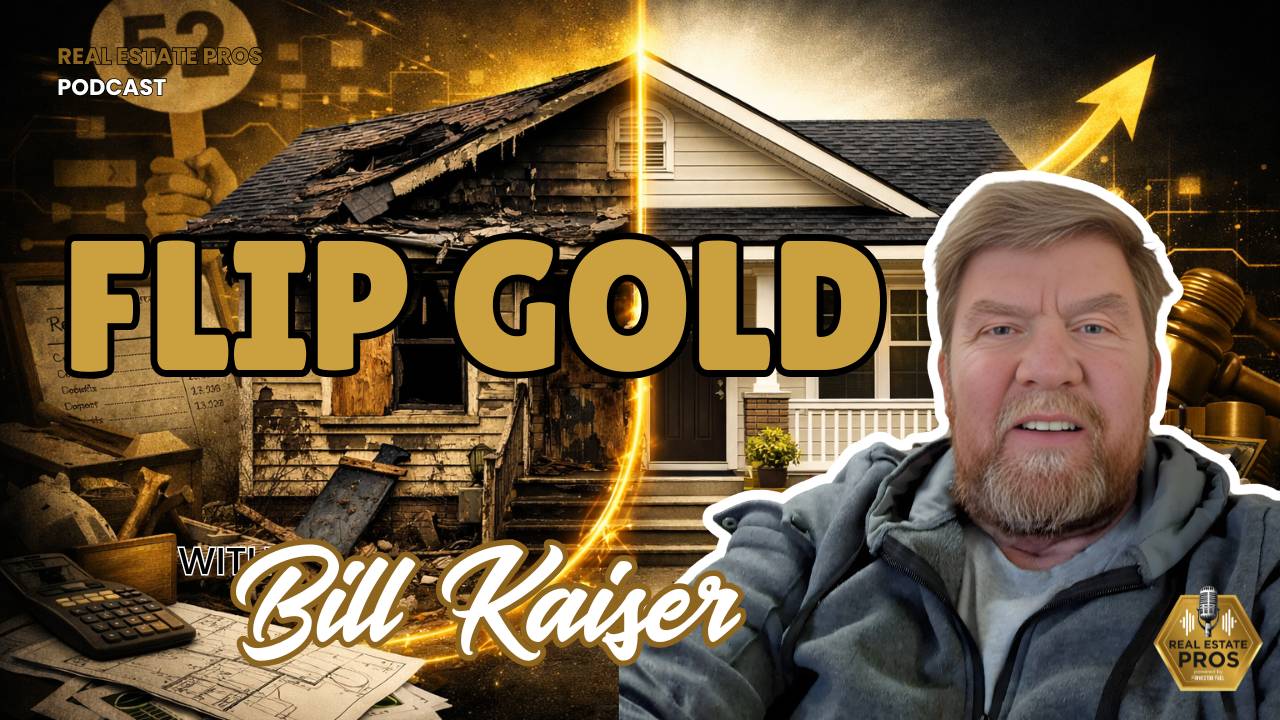
In this episode, Bill Kaiser shares his extensive experience in real estate investing, trades, and public service. He discusses the importance of trades knowledge for investors, strategies for property acquisition, and insights into new construction and flipping houses.

Resources and Links from this show:
Listen to the Audio Version of this Episode
Investor Fuel Show Transcript:
Bill Kaiser (00:00)
I had one that was on the foreclosure. I walked in, there was a squirrel melted.
in the living room on the carpet. I mean, it literally was deteriorated. I had holes in the roof. The kitchen is really bad. And I walks out. It took me five minutes to walk through and walk back out. And I sat on the sidewalk out front and I watched people walk in and walk back out. I says, isn’t this house beautiful?
Dylan Silver (00:18)
Yeah.
Hey folks, welcome back to the show. Today’s guest, Bill Kaiser, is an Army veteran, small business owner, real estate investor, and candidate for Michigan State Representative in the 76th District. He’s built his career through hands-on work in business and real estate with a focus on single-family properties. With more than 35 years of experience in construction and HVAC industries, he understands the realities of hard work, payroll, and government regulation.
He believes strongly in understanding the trades, financial literacy, and real world skills as the foundation for economic success. Now he’s taking that same mindset into public service, running for office to bring practical experience, accountability, and opportunity focused leadership to his community. Bill, thanks for taking the time today.
Bill Kaiser (02:45)
you’re welcome. I appreciate the opportunity.
Dylan Silver (02:49)
Now, I’d like to start off at the top by asking you why a strong understanding of the trades is so essential for real estate investors today.
Bill Kaiser (02:59)
It’s essential in all aspects because it’s not only a job, but it could lead to a career and it’s a good paying career. Whether it’s electric, electricity, plumbing, HVAC, building, whatnot. People still need all of that because of we’re moving towards AI. AI can’t build you a house. AI can’t change your toilet.
AI can’t change your circuit breakers. AI can’t ⁓ install a furnace. So you need the hands-on on any aspect and real estate or not just real estate but the trades in general ⁓ are essential. And to be in the trades, you need to be educated. You need knowledge and wisdom to go forward in life.
Dylan Silver (03:54)
Now with the trades specifically, you mentioned there’s the ability to have this be a career for you, but also too, if you’re a flipper, if you’re doing any kind of value add rehab to single family, you’re going to either have to do it yourself or hire someone else to do it. And you’re typically,
going to being kind of outgunned and outmanned if you don’t understand the full scope of work yourself, right? So could we talk a little bit about that? How important it is for investors to be able to self-diagnose really the scope of work that goes on in a single family project that they may be embarking on.
Bill Kaiser (04:35)
Well, that’s a good point because before you begin, you need to educate yourself on all the trades, electrical, plumbing, ⁓ HVAC, the whole nine yards because you could eventually be taken ⁓ to the road to it. mean, you’d be taken because you don’t have that knowledge and you’re relying on somebody else’s expertise instead of…
Dylan Silver (04:54)
to the cleaners.
Bill Kaiser (05:02)
Knowing the basics of all of these trades is the key fundamental aspect of getting into real estate.
Dylan Silver (05:11)
We were talking in the green room, Bill, about your journey into real estate investing. You mentioned around 2010. How did that look for you getting into real estate?
Bill Kaiser (06:08)
Oh, that was, it was the best chance and opportunity I had to not only take my investments or my, and turn it into, well, in an investment where I could get 18 % return on my money versus 4%. So I’ll take 18 % return on that house versus, well.
18 at the time but it’s more now because they’re all bought and paid for. So that’s the key in real estate. We want X amount of houses all paid for producing X amount of dollars to fit our lifestyle. And that was the key is ⁓ you know starting out we needed the goals. You know the number one ⁓ aspect of real estate is how many ⁓
Dylan Silver (06:39)
Yeah.
Bill Kaiser (07:03)
does it or how many houses does it take or how many apartments or how many doors does it take to give you sustainability in your life or your to for your lifestyle. With that, with that, you know, you got to figure out that X amount that you need. And then you have to have a target market. Target markets are essential because you don’t want just anyone in your home or apartment or building or behind that door.
Dylan Silver (07:16)
Yeah.
Bill Kaiser (07:33)
That’s just going to trash your place. And I found that here in Lansing, by minimizing the amount or the number that I have, gives me the responsibility or gives me the accountability when I can set the standards to my home for that particular customer. And they’re held accountable as well as myself. And when something goes wrong, there again, back to the trades, I know how to do it.
So they call me instead of a management company. And most of my customer, I call them customers because I don’t call them tenants. ⁓ They appreciate that because they call me, text me, whatnot, say, hey, we got a problem with this. All right, no problem. be there. XYZ.
Dylan Silver (08:23)
Now I’d like to get granular here and discuss the acquisition side of those properties. So where’d you find the bulk of your rentals? Were these on market? Were they off market? Direct to seller? And what’s your strategy as far as acquisitions?
Bill Kaiser (08:36)
Go ahead.
Well, the acquisition was the foreclosures for one back in the day when in 2008, 2010, when the housing market crashed, everybody wanted three and four bedroom. All the investors wanted three and four bedroom. They weren’t forward looking. Whereas where I wanted the two bedroom, two bedroom, one bath because of my target market. So they were readily available.
So I got them on foreclosure market. got them on open market. like this, the first one that I was telling you about, had a re I was working with a realtor to do their HVAC and water heaters. And when I found this house or she sent me to this house to give her a bid, it was a done deal. I, I, I. Dickered and deals with her. And I said, yep, this is, this is mine. want, you know, whatever cost it was.
And it was minimal cost back then because back then the prices were great. I just wish I had more money back then to invest. anyway, that’s.
Dylan Silver (09:48)
I’m a big fan of those foreclosure auctions and they’re very interesting especially if you can go in person. Were these in person auctions or were they online?
Bill Kaiser (10:31)
No, they were in person. Well, we went down to the city or whatever they had their auctions. But they gave us a list of those auctions and we drove, I drove by ⁓ some, some of them we were able to get into. Some of them we weren’t be able to get into. Some of them they had open houses. ⁓ I’ll tell you a story about one.
I had one that was on the foreclosure. I walked in, there was a squirrel melted.
in the living room on the carpet. I mean, it literally was deteriorated. I had holes in the roof. The kitchen is really bad. And I walks out. It took me five minutes to walk through and walk back out. And I sat on the sidewalk out front and I watched people walk in and walk back out. I says, isn’t this house beautiful?
Dylan Silver (11:12)
Yeah.
Bill Kaiser (11:25)
Look at this thing. This is this is great.
They looked at me, he says, you’re crazy. You’re insane. How could you say that? I says, yeah, but it’s beautiful. So anyway, from that point, I actually ended up bidding the high bidder on that. I put, I think, 40,000 into it. So I was all in for 60,000, let’s say. I sold it for 126 months later. So good profit, right? So yeah, it was beautiful.
Dylan Silver (11:56)
Yeah.
Bill Kaiser (11:59)
That was one of those things where if I didn’t have the trade, what’s that?
Dylan Silver (12:01)
Flip gold.
Flip gold.
Bill Kaiser (12:05)
Flip goal, yeah, it was good. It was good, yeah. That was…
Dylan Silver (12:09)
Now those foreclosure auctions
can be interesting. They can also be tricky because you don’t always have access to the home. You don’t know what else other people are going to be bidding. So you have to have your max allowable offer on there. But then also too, are thinking, okay, well, this is cash. So we have to have everything lined up beforehand, or this may just be our own capital. And so there’s a lot that goes into just preparing for a foreclosure auction. And so
I’d like to get your mindset going to the foreclosure auction. Obviously, you had walked many of these properties, but what was the mindset like heading into the foreclosure auction?
Bill Kaiser (12:50)
You definitely had to have your price that you’re willing to pay and don’t go above that price. You had to set your standards that this is the price I’m willing to pay. If I lose it, well, next. ⁓ And because most auctions, you can get into that bidding war or you could just be outbid and set your… ⁓
Limits, I guess, you know what you’re willing to pay for it and you know some of them in the foreclosure business here in Lansing back in 2010 1112 they were Shoddy places. I mean they were run down. They had holes in the roof. They had you know everything imaginable ⁓ But that’s the price you got to pay, you know, if you want to cheap houses or whatnot you got to remember
what you need, being able to do this, having the trades behind you, made it a lot simpler for me because I knew how to do all this stuff. That made it beautiful.
Dylan Silver (14:04)
No question.
What’s one deal, bonus question here for you Bill, what’s one deal that taught you the most out of all the deals that you’ve done? What’s one deal that sticks out that taught you the most?
Bill Kaiser (14:19)
It was my, I had one for, I think I paid $1,500 for this house on auction. I had it tore down and totally redone. I put a new basement in. So I think I was all in for 150,000, which was nice because it made a brand new house. Yeah, I made a hundred thousand off of it because I sold it.
three years later for 250, but that was one of those things where I just eliminated the problem by building new. And, you know, most of them, I did that to a couple of houses. I tore them down, kept the foundation built on top of it, et cetera. So the new builds are where it’s at these days because of regulation and, you know, regulation is…
Questionable.
Dylan Silver (16:01)
I would like to pivot here and get into new builds because I’m in Texas. What I see from being in Texas, but also across the country is there does seem to be wherever there is available land, more new construction than really ever. You have corporate builders, national builders who are basically building properties all over the place. And so especially for flippers in particular, that provides level of competition because now, you know, if you had intended
on selling your flip for X dollars and there’s a new bill that’s only 20,000 more or maybe even the same price, well now of course people are going to gravitate towards the new bill. So there does seem to be a lot of momentum in new construction.
Bill Kaiser (16:41)
The new build, right.
Yes, yes, I believe that because it’s simpler, it’s easier, we don’t have to deal with regulations. Yeah, we have to do with code compliance and all the other stuff, but not as much in the new build sector as in rehabs, only because of the EPA in 1978’s limit on lead-based paint and asbestos, et cetera.
Dylan Silver (17:12)
Right.
What’s the biggest misconception that people have about flipping houses in your experience?
Bill Kaiser (17:24)
that they think that $10 is going to cure a hundred dollar problem. You know, that’s, that’s as simplest as I could put it, but they, they don’t know the prices when they go into it or, know, like an HVAC system. If, if the HVAC is out of date and 30 years old, well, you can’t just put a bandaid on it. You know, you have to replace it. And most, most
Dylan Silver (17:29)
Ha ha ha.
Bill Kaiser (17:53)
investors that try to invest without the knowledge that they’re getting into, you know, you put a…
paint on a pig, it’s still a pig.
Dylan Silver (18:02)
It’s still a pig. Yeah.
Bill Kaiser (18:04)
You know and and
and most most of the investors here where I’m at they they they questioned me when I first got in I Had my goal set I needed 10 single-family homes all producing a thousand to twelve hundred dollars a month for the next 30 years, right so My goal was that I had my target market set and they said well, why are you putting so much money into this?
What’s it to you? It’s my money, right? I can put however much money I wanted to it. ⁓ But what they don’t understand is by rehabbing the thing completely, I am hands off. I am literally hands free for five, 10 years because the appliances for one, I equipped all my houses with appliances. If an appliance.
has only a life expectancy of six years. Well, I have to budget that into my thing and say, well, after them paying me thousand, $1,200 a month for five years, I’ll go buy a new, I’ll go buy a new appliance. No problem. Right. Right.
Dylan Silver (19:17)
It was a plan. Yeah.
You don’t have to budget it in, no question. And
to your point, the scope of work is the biggest thing, I think, for a lot of especially newer investors because you might be trying to save a dollar, but what happens if you’ve got a renter in there and now something goes wrong? Well, now you’ve got a fiduciary responsibility to fix it immediately. So now you don’t have the luxury of time. You’ve got a renter in there. If there’s a plumbing problem, you know.
you’re up a creek without a paddle, you’ve got to fix it then. So that scope of work is so critical and not just putting a bandaid over a water hose.
But we are coming up on time here, Bill, and I know you’re running for Michigan State Representative, but any new projects that you’re working on and then as well, what’s the best way for folks to reach out to you or your team?
Bill Kaiser (19:55)
Well, alright.
Well, ⁓ kaiser4michigan.com is my website, ⁓ www.kaiser, K-A-I-S-E-R-4, the number four, Michigan, M-I-C-H-I-G-A-N dot com. ⁓ The new project that I have, I have a lake house up north that I’ve been working on for three years now. ⁓ It’s going to be, ⁓
I want to turn it into my personal house and then build across the street because I acquired properties up there ⁓ so that I could build that house across the street and then once I get that built then I would be able to transition or live across the street and then rent the one that I just rehabbed out as an Airbnb or what rental income ⁓ right across the street. I bought it to
check the neighborhood or control the neighborhood, so to speak. And that was the whole… Exactly. Yeah. Well, you know, the whole concept with the real estate is I have all my houses within 20 minutes of my home base. And that’s the key to most of it. you know, it takes me 15 to 20 minutes to get to each one of my homes. ⁓ So…
Dylan Silver (21:10)
Yeah, you have your own mini HOA. You’ve got everything within your purview. I like that. I like that.
Right.
Bill Kaiser (21:35)
But yeah, running for state rep, I retired six years ago in 2020. I do a victory garden. I fed up to 20 people of my victory garden. So I grow vegetables in the summertime as well. ⁓ But I think the financial literacy in the government needs to be reined in. ⁓ We’ve got to stop this bleed. ⁓
as far as taxes and stuff like that. But yeah, anyway, that’s my story and I’m sticking to it.
Dylan Silver (22:13)
Bill, thank you so much for joining us today. Thanks for your time.
Bill Kaiser (22:16)
⁓
you’re welcome. Appreciate it.