Subscribe via:



Show Summary
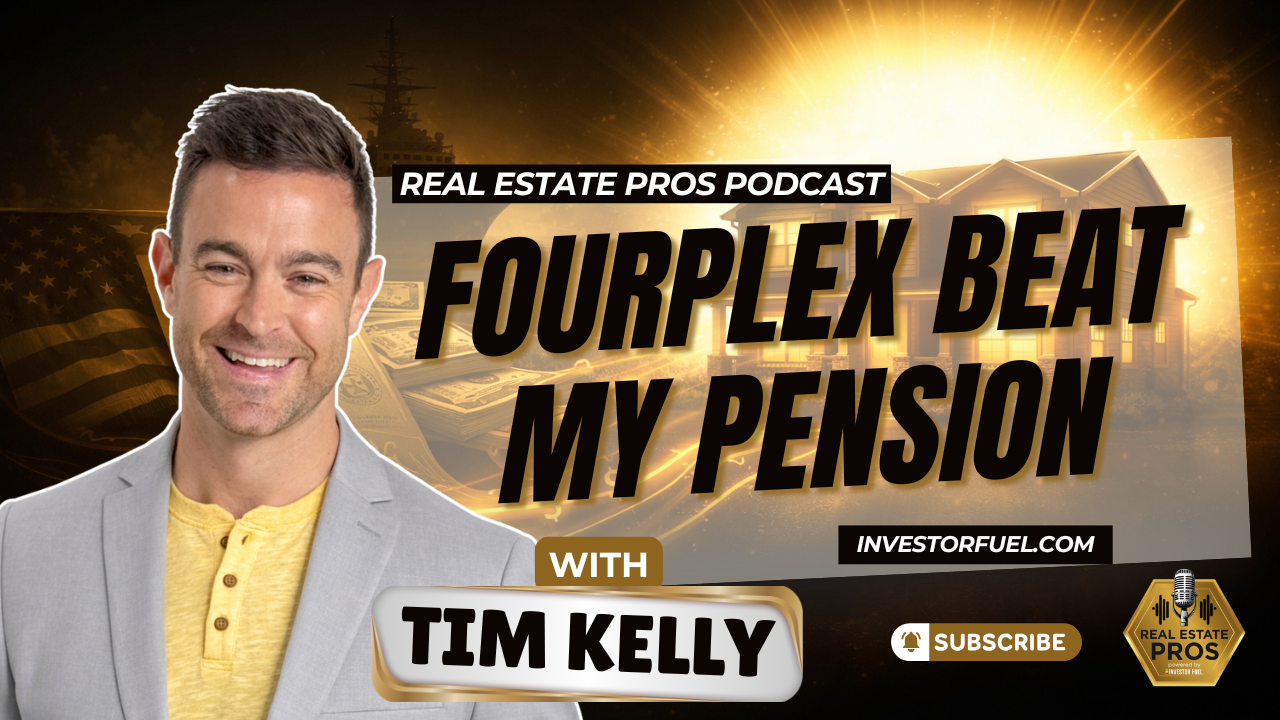
In this episode, Tim Kelly shares his journey from Navy veteran to successful multifamily real estate investor. He discusses strategies for deal-making, building a strong network, overcoming self-doubt, and scaling a legacy business in a shifting market.
Resources and Links from this show:
-
-
- Investor Fuel Real Estate Mastermind
- Investor Machine Real Estate Lead Generation
- Mike on Facebook
- Mike on Instagram
- Mike on LinkedIn
- Tim Kelly’s Phone Number: (847)910-9161
- Tim Kelly’s Email: [email protected]
- Tim Kelly’s Website
- Tim Kelly on LinkedIn
- Tim Kelly on Facebook
- Tim Kelly on Instagram
- Tim Kelly on Youtube
- Tim Kelly on Tiktok
- Tim Kelly on X
-
Listen to the Audio Version of this Episode
Investor Fuel Show Transcript:
Tim Kelly (00:00)
It takes courage to think big and act on it. takes courage to dream, a vision of going from where you are, whether you’re, you know, like I was at E six in the Navy living paycheck to paycheck and
I had this desire to go partner on these large, multi-million dollar apartment complex deals. I was held back by imposter syndrome because it resulted in FUD, F-U-D, fear, uncertainty, and doubt.
Scott Bursey (02:04)
Hi everyone and welcome to the Real Estate Pros podcast. I’m your host, Scott Bursey. And today I’m joined by someone we’ve been really looking forward to chatting with. Tim Kelly, who’s been making serious moves in the large multifamily investing space. Tim is someone that has truly mastered the art of the deal and the science of the scale. He’s the powerhouse behind the Kelly Housing Group. He’s here to show us how to cut through the noise and cut through
all of the red tape to build a legacy in this business. Tim, welcome to the show.
Tim Kelly (02:35)
Scott, it’s a pleasure, man. I’ve been looking forward to this conversation as well, man. You’ve built something special and I’m honored to be part of it. So let’s do this,
Scott Bursey (02:44)
Awesome. Awesome. You built an incredible legacy with the Kelly Housing Group. Please tell us how your career began and what you’ve been focused on here recently.
Tim Kelly (02:54)
Yeah, happy to kind of dive in. was, God led me into the Navy and I dropped out of college. Just didn’t make sense for me. I failed right out. to college right after high school. I had a couple jobs, thought I was going to be a musician. I was playing music. I’ve been playing drums all my life and that didn’t work out either. And then God led me into the Navy. I was in the Navy for about 10.
years and I had just got off a deployment and I realized I didn’t want to do any more deployments. I was trying to start a family and I just, I just wanted to figure something else out. That’s what led me into real estate investing. And I got the bug while I was active duty and I immersed myself in education and coaching and got some mentorship and spent time with the individuals who did what I was trying to do.
And I went right into commercial multifamily investing while I was active duty. ended up partnering with other service members to buy apartment buildings and mobile home parks. And, that kind of did a couple years of doing that. realized I’m not doing any more deployments. I’m not reenlisting. And I got out at 15 and a half years. Got a lot of funny looks cause I could have done a couple more years at 20 and you know, got a glorified pension, but it didn’t make sense for me. I ended up getting out.
Not only because it was more fun, more lucrative to buy apartment buildings, but I had also joined a mission to help three million military families also achieve financial freedom ⁓ with real estate by owning more of America and both residential and commercial through the active duty, passive income education community. ⁓
And so, yeah, I’ve just been focusing on commercial multifamily investing ever since, and then kind of just pouring into other service members trying to learn it alongside of me. And we built an incredible community, but right now I’m focused on apartment buildings and mobile home parks throughout the different parts of the Southeast and Midwest. Right now we’re looking hard at the Indianapolis market, have a whole pipeline that deals with my team in the Indianapolis market.
Scott Bursey (05:01)
I find your mission extremely fascinating. Tim, the landscape is shifting faster than most people can keep up with. Let’s start with the hard truth. What are the pros doing right now that the amateurs may be missing?
Tim Kelly (06:05)
think the number one thing is that they’re continuing to look at, evaluate, and submit offers on deals. Regardless of the market, regardless of the market, regardless of the interest rate, regardless of what’s happening in the White House, regardless of all the wars that are taking place, there are always deals.
Scott Bursey (06:13)
Sure, sure, makes sense.
Absolutely, Yes. What caught my attention about you was the way you’ve been able to maintain such a high level of consistency with the Kelly Group, even when the broader market feels like it’s shifting every week. You seem to see the moves before they happen, Tim. That’s a towel order, especially with the current market headwinds we’re facing.
What’s been the anchor for your business that allows you to stay consistent and predictable in an industry that usually feels like a roller coaster?
Tim Kelly (07:03)
something that we talked about in a previous conversation, Scott, is that nothing dictates our success more than the people we spend time with, right? And so I’ve, since I was active duty and I realized that a lot of the people I was spending time with weren’t accomplishing the things that I wanted to accomplish. I’ve had to be very intentional about putting myself into the rooms full of individuals who had already
Scott Bursey (07:15)
Absolutely. Absolutely.
Tim Kelly (07:32)
done what I was trying to do. so because unintentionally in those rooms, I see all the time what the pros are doing. I see, you know, how the pros are handling challenges when there are market challenges, when there seems to be a lack of
of volume of deals being closed. It’s just being around the people. I’ll never take credit for me just knowing or doing my own isolated research and figuring it out because you can’t succeed in isolation.
Scott Bursey (08:07)
Hey, I’m with you on that, Tim. And Tim, every elite operator has a defining moment where the strategy met the reality of the market. You know, I’m talking about a deal that hit the wall or a pivot you had to make in real time. Do you have a battle story that shaped how you operate today?
Tim Kelly (08:29)
I think I was fortunate to have it be the very first apartment complex deal that I did.
At the time I was active duty and it was a 42 unit apartment complex. I was like, oh sweet, the thing I, the deal I did before that was a four unit. So I’m like going from four units to 42 units. like, yo, this is great. I’m set, you know? And then we closed the deal. We realized we did not have enough.
revenue to pay a full time property manager. And I emphasize a full time property manager. And so luckily, the manager that we did hire part time, you know, we had enough revenue to hire a part time property manager, but that was it. And she was a rock star. So we figured it out. It was myself and two other active duty guys. And
That deal ended up being fine. It actually ended up delivering higher returns than we expected, but I learned a lot of lessons. And these are the biggest lessons. Number one, I did not do a deal after that unless it was big enough and we had enough revenue to pay a full-time professional property management team. And so I learned through that deal and through evaluating other deals.
that the bigger you go, the easier they are to finance, the easier they are to manage and the less work they are. And so ever since that one deal I’ve done deals, usually at least over 80 to a hundred units and up. because it, it, they truly are easier to finance, easier to manage and easier and all, all overall less work.
Scott Bursey (10:53)
It’s fascinating how the…
infection points that feel like a total collapse in the moment actually end up being, you know, the blueprint for the next decade of scaling. And honestly, Tim, that’s really the dividing line between those playing the short game and the operators who build generational portfolios. Let me ask you this. What are the most focused things on your plate right now for your business? What are you planning on scaling next?
Tim Kelly (11:23)
Yeah. As I mentioned on the deal acquisition side, focusing on Indianapolis. Have a whole pipeline of deals, some with the same sellers with whom we’ve worked with before.
And it’s just been a mission of mine since I left the Navy to help as many other people also achieve financial freedom in real estate and commercial real estate. through that time, I realized how important like mindset and personal and professional development were, right?
And so I became a student and sort of obsessed with personal growth. I learned a lot through that time. I became a certified high performance coach. And then I started working one-on-one with individuals who are seeking more clarity, seeking more courage, more productivity, higher levels of energy in their lives. just looking for breakthroughs, knowing that there’s like a next level, but they just don’t.
quite know how to get there and usually it’s doing less. Usually it’s letting go of what no longer serves them. And so I am for the rest of this year looking only to work with a couple individuals one on one who kind of check those boxes, whether they’re in real estate, C level executives, CEOs.
who just feel like there’s a next level but they can’t quite figure out how to get there. They know there’s like a glass ceiling but they’re not really sure how to get to the breakthrough. then one of my partners and I also another certified high performance coach, also a retired army guy, also in real estate. We are leading people through very hard, challenging physical experiences who are also looking for breakthrough in a small cohort group.
We just got back from summoning Mount Kilimanjaro, the tallest freestanding mountain in the world in Africa and had a lot of personal breakthroughs. There was a lot of breakthroughs on that mountain. We all left something on the mountain that was no longer serving us. And now we’re still having these reintegration sessions. So we’re also kind of putting together that next experience and that next adventure for a very small select group of individuals.
And that’s something I’m super excited about as well.
Scott Bursey (13:54)
absolutely. And I’m excited for you. That’s big, Tim. Your next move will either be the catalyst or the bottleneck that breaks your system. The outcome isn’t luck. It’s a direct reflection of the strategy you built. Now, I know a lot of our audiences either earlier in their journey or looking to level up, Tim. And I think they benefit hearing this from you.
When it comes to building relationships and growing your network, what’s made the biggest difference for you?
Tim Kelly (15:10)
A lot of man a lot of people think that they have to do it alone and like initiate those connections Build their own internal team like internal team like you have you know for deals you have you know the the deal acquisition
guide the deal analyzer the capital razor the asset manager your internal team they and then people think you have to build your external team your tax professionals your legal professionals your lenders your brokers and then people think they have to find all their own partners right investors.
this entire network, internal team, external team, partners, investors is likely already built for you. It’s just a matter of being intentional about finding it. And will that require some funding, some of your own personal investment? Probably. So you can either show up to local
Meetups the local REIA the local RIAs the real estate investment associations all over the US like in your market You probably have one you can show up to those ⁓ Talk to every single person there let every single person know exactly who you are what you do and I highly recommend you do that
But relying on that, relying on going to conferences to just build your entire network, relying on going to Zoom sessions that are free or tapping into free webinars, ⁓ it’s gonna take a lot longer to build the internal team, external team, investors, partners. Then if you look for the one that’s already built,
and invest in yourself to level up. Cause that’s typically the fast track. And I recommend doing both.
because you want to show up to those networking events. You want to show up to conferences where it’s a whole room full of real estate investors that are full of potential partners, potential investors, lenders, brokers. ⁓ And some people could do that solely and become successful. But if you don’t have people who are going to be around you that you can learn from, who’ve already done what you’re trying to do, that can like literally lay out path for you and ensure you don’t fail, it’s going to take a lot.
longer to succeed and you’re going to spend a lot more money because it’s going to be a lot more expensive through failures and lessons learned. Then if you just invest some of your own resources upfront, put yourself in the right rooms where all those partners, potential investors, internal external teams already there. And then you just go connect with people, get very specific about what you bring to the table and get very specific.
on where the gaps are, what you need in partnerships that’ll complete a team. As soon as you have that absolute clarity and you know exactly what you bring to the table, you know exactly what you need brought to the table, and you share that with people, you’re in a room full of individuals, that is the next level.
Scott Bursey (18:16)
That’s executive clarity. And that’s not just good karma. That’s bulletproof business strategy. Tim, interested to know, in your experience, what is the one expensive mistake you see most intermediate investors make that the pros have completely outsourced from their operating system?
Tim Kelly (18:39)
Hmm.
It takes courage to think big and act on it. ⁓ it takes courage to dream, have a vision of of going from where you are, whether you’re, you know, like I was at E six in the Navy living paycheck to paycheck and
I had this desire to go partner on these large, multi-million dollar apartment complex deals. I was held back by imposter syndrome because it resulted in FUD, F-U-D, fear, uncertainty, and doubt.
Okay? It takes a lot of courage to break through that imposter syndrome, break through those fears, uncertainties, and doubts to accomplish.
a life changing path.
I
people are mostly mostly held back by their own self talk, their own self doubt.
And the cost of inaction is a lot more expensive than getting after it and making a couple thousand dollar mistake on a deal because you’re going to learn a lot more lessons and be able to know what not to do than if you just did nothing.
Scott Bursey (20:03)
love that. And clearly the way you’ve structured your operations is the gold standard for that, Let me ask you this. What’s the one part of your story you hope really sticks out to our listeners today?
Tim Kelly (20:18)
I got the real estate bug while I was about 10 or 11 years in and
At this point I was already a senior enlisted leader in the Navy. So anybody who understands…
Navy or Marine Corps vernacular. It’s, I was a chief petty officer. So I was like in the, in the, in the chief’s mess. I was an E seven, right. And for a chief with 10 or 11 years in to just get out.
It sounds absolutely just bananas to most people, right? Like I, and then I, not only did I like want to get out at that point when I had already got up into the ranks so quick, but then I was pursuing commercial investing and I, and I didn’t actually get out until I was 15 and a half years in and being in the military, if you’re 15 and a half years in,
as a senior enlisted leader and you just get out, people look at you like you have three heads.
Because they’re like, you only have to do four more years to get a pension for life.
And what did I have to sacrifice in order to achieve that? I would have had to go on at least one, if not two more long deployments where I was on a big ship floating in the middle of the Persian Gulf in a war zone.
Or I could look at my current situation and realize I was already doing these large commercial multifamily deals, seeing six figure paydays, knowing that I was building seven figure wealth and the pension I would have gotten was less cashflow than I was making on my fourplex at the time.
And so it did not make sense for me to stay in, sacrifice my time, sacrifice my life, sacrifice my family in order to get this glorified pension for life when I was building what I was building and I was a lot more passionate about it and I was helping other service members walk the same path. And so, and that took some courage.
to just leave the Navy at 15 and a half years, when I could have done, you know. And I have all these people around me looking at me like I was crazy, telling me I was crazy. What are you doing? It’s free money. I’m like, free money? What are you sacrificing for your pension? Meanwhile, they’re all unhappy, they’re all overweight, their marriages are struggling.
Scott Bursey (22:40)
Yes it did.
Tim Kelly (23:00)
And so, ⁓ I don’t know, that’s probably, but now I’m sitting here and if I did not do that, I wouldn’t be sitting here. I would probably still be in the Navy right now on a deployment. I wouldn’t be able to share my lessons learned. You know, I’ll be tied up somewhere out. I’ll be detained elsewhere.
Scott Bursey (23:18)
That is a remarkable story and thank you for sharing. All right, before we wrap, if someone wanted to reach out to you, connect with you, maybe collaborate or learn more about what you’re doing, what’s the best way for them to reach you?
Tim Kelly (23:32)
Yeah, you could start, you know, all my socials, LinkedIn is the strongest. And then Instagram and Facebook, I’m at the Timothy Kelly.
My website is thetimothykelly.com.
if you’re serious and you like just want to connect, and if you, you think that like a 20, 30 minute conversation could help you in any single way, just shoot me a personal text message. and my personal cell phone number is 847-910-9161. Just shoot me a text. Let me know you heard me on Scott’s show.
And then we’ll just book a call, based on your schedule, based on my schedule. And we’ll kind get into your biggest challenges to see what is required for you to break through those challenges.
Scott Bursey (24:19)
Perfect. Well, listen, Tim, I appreciate your time, your story, and your perspective. We need more people in this space who are doing it the right way. Thanks again for being here.
and for those of you tuning in, we truly appreciate you. If you found a gold nugget or two in today’s conversation, make sure you’re subscribed. We’re committed to bringing this level of executive clarity on every episode to help you stay out of the curve. We’ll see you on the next episode, everybody.