Subscribe via:



Show Summary
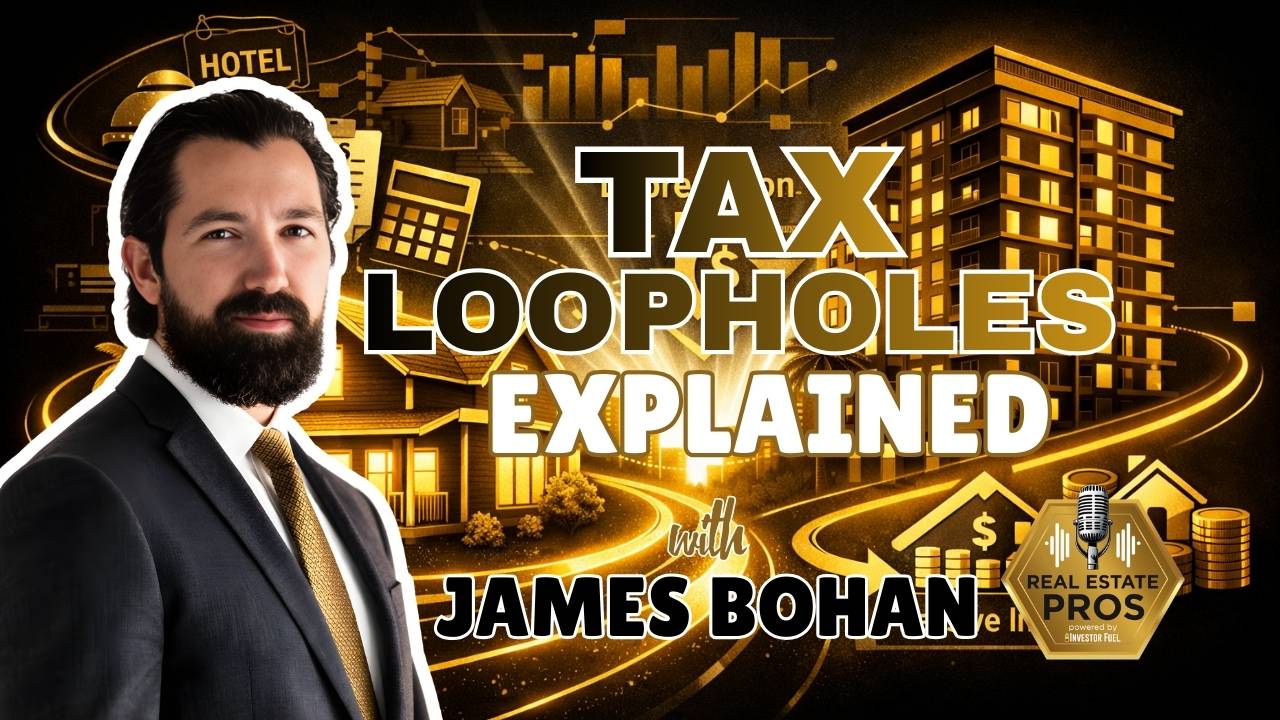
In this episode of the Real Estate Pros Podcast, host Michelle Kesil talks with James Bohan, a CPA specializing in tax optimization for real estate professionals and investors. James shares insights from his experience running a CPA practice, working with large funds, and managing his own diverse real estate portfolio. The conversation explores common tax misconceptions, strategies for optimizing real estate investments, the short-term rental loophole, and lessons James has learned as both an investor and a tax professional.

Resources and Links from this show:
-
Listen to the Audio Version of this Episode
Investor Fuel Show Transcript:
James Bohan (00:00)
Yeah, the biggest loophole I’d say is the short-term rental loophole. That’s where the IRS says like, hey, you’re not really running an apartment. You’re actually running a hotel, even if it’s just like a single family Airbnb. And so what that does is allows you to not have to qualify as a real estate professional ⁓ to be able to unlock all the depreciation benefits of owning real estate by now operating like a hotel motel.Michelle Kesil (01:59)
Hey everybody. Welcome to the Real Estate Pros Podcast. I’m your host, Michelle Kesil. Today I’m joined by someone I’m looking forward to chatting with, James Bohan, who is a CPA helping optimize taxes for real estate professionals and investors. And he is also an investor himself. So excited to have you here today, James.James Bohan (02:22)
Yeah, thanks for having me on, Michelle.Michelle Kesil (02:26)
Absolutely. So let’s dive in. First off, for those not familiar with you and your work yet, can you share what your main focus is these days?James Bohan (02:37)
Yeah, ⁓ so I have a CPA practice I started about five or six years ago now, and we really focused on helping out the real estate investor community. That means both kind of your LP investors or people that just own a couple properties, all the way up to your fund managers having, you know, 50 to $100 million in a fund, kind of everyone in between that. And we really help with both the investors and the GPs of these funds to get everything.set up and structured with their entities in a way that optimizes taxes for both the investors and the GP. We also help get K1s out. That’s a really ⁓ busy time of the year for us right now for March for getting all the K1s out to the investors, getting that done timely. And it’s really an expertise I’ve built up over the past 15 years working for big firms like KPMG and working in-house as a CFO for a private debt fund where we had over 1,400 LPs.
Did over a billion dollars of loans while I was there.
Michelle Kesil (03:57)
Awesome. And which markets do you operate in or do you serve the nation?James Bohan (04:03)
So yeah, we serve clients nationwide. ⁓ I’m seeing a lot of activity in the Southeast, ⁓ also in Phoenix. And then myself personally, I moved to Coeur d’Alene, Idaho from Los Angeles five years ago. And I’ve been buying all sorts of different asset types up here in North Idaho. A farm, a single family rental, two duplexes, a 13 key boutique hotel. And we also bought a 26 key motel that we converted to workforce housing. So.a little bit across the board. I like to say if it makes dollars, it makes sense.
Michelle Kesil (05:09)
Awesome. And what do you feel have been some of the main keys that have allowed your business to be able to grow and run smoothly?James Bohan (05:19)
I think for me, the biggest thing has been ⁓ bringing on employees and bringing on personnel. You know, it’s something I was always resistant to, you know, starting my firm five or six years ago, I always wanted to find a way to be a one-man operator. ⁓ But I’ve really come to enjoy both the responsibilities of having employees. And then also it’s really the only way to scale because just as a one-man firm, you’re really limited by your time. So.Over the past three, four years, it’s really been my mission to build out a team to help make sure client deliveries are successful. ⁓ Things are streamlined and there’s not everything relying on me as a bottleneck to get stuff done.
Michelle Kesil (06:25)
Absolutely. And as your background in both investing and taxes, what do you feel some real estate professionals and investors, like what is like the gap that you see when it comes to the way that they’re maybe not utilizing all the tax advantages?James Bohan (06:46)
Yeah, I think when a lot of people start out in real estate investing, they hear a bunch of stuff either at a networking event or at the country club cocktail hour. And whether that’s about taxes or certain legal structuring, they kind of sometimes take that as gospel and get ideas into their head, you whether it’s from those in-person places or what we like to say, TikTok tax advice. And there’s just a lot of bad intel going out. ⁓from non-professionals to kind of our ⁓ investor and industry base. So kind of the biggest thing we do is really coach people to let them know like, hey, these are the actual facts. Here’s how you qualify as a real estate professional. Here’s how your carried interest works. Here’s how all these different entities interact. Everyone here is S-Corp, they’re here LLC or LP. And so our jobs as CPAs and CFOs is to help
to kind of untangle the web of lies they might have heard from other people and let them know what the actual reality is so they don’t, you know, do something wrong and get into trouble.
Michelle Kesil (07:57)
And what do you see as like some of those common web of lies that maybe get people in trouble?James Bohan (08:05)
boy. Okay. Where do I start? One is an S corp will always save you in taxes. ⁓ S corps are great for kind of, ⁓ operating or active income. ⁓ and we do still use them in our structure is mostly for like the manager of funds. ⁓ so when you’re doing a syndication or you’re a property manager or you’re doing anything that generates fee income, you generally want to run that through an S corporation. So long as you’re not in New York.not New Jersey, and you have over about 60K of net income. That’s where it starts to make sense between the extra cost to do an S Corp and ⁓ the administrative burden. ⁓ The other thing is when you’re doing a fund is you could really separate the manager from the general partner or carried interest member. And this is something that really helps unlock the best of both worlds because with an S corporation, you generally don’t want to hold real estate through an S corporation. ⁓
for two main reasons. One is if you ever want to move it out of it, you can trigger some built-in gains tax. If you’re doing some estate restructuring or doing a dynasty trust, getting stuff out of an S-Corp can be difficult. The other reason is an S-Corp will block your debt attribution basis from the underlying properties from flowing to yourself personally. So with S-Corporations, they have another kind of S-Corp basis where you’re able to take losses through an S-Corp up to that S-Corp basis.
But the additional debt you get allocated to you doesn’t pass through to yourself personally like it would through a LLC or pure partnership. So kind of untangling some of these webs or getting them set up right from the jump is something that I really like to help clients ⁓ understand and implement so they can have the best optimized tax structure.
Michelle Kesil (10:06)
Yeah, definitely. That’s important. What is something that you preach to all investors that maybe that like could really save them in their taxes?James Bohan (10:21)
Yeah.I think kind of get your stuff together is the biggest thing. You know, if you’re doing, know, million dollar, two million dollar property acquisitions, that really justifies getting a proper accounting software, like a QuickBooks or a Wave or there’s a lot of new ones out there like Kik, but just do something to make sure your accounting and your books is accurate. Because without that, we can’t do proper tax planning.
and then it leads to a huge mess around this time of year when you’re scrambling to get everything together to do your taxes. Have good systems in place. Make sure you’re doing your accounting monthly, whether it’s you’re still bootstrapping doing it yourself or you hire an outsourced accountant. Just really make sure your financial house is in order.
Michelle Kesil (11:21)
Absolutely. And when it comes to like your own investments, what have you learned that you didn’t know before as just like sitting in the seat of the accountant?James Bohan (11:35)
Yeah, real estate requires a lot of patience is one thing I’ve learned. know, things often take longer than you project or expect, whether that be the renovations or waiting for a refinance to come together. You know, make sure you don’t count on money till it’s actually sitting in your bank account. I’ve had multiple lenders or capital partners kind of retrade me even up until like the week of closing. And so making sure you’re you’re not really100 % dependent on that happening and having backup plans is important. Also make sure you’re doing a lot of, you know, due diligence and analysis on the front end. For example, that 13 key hotel I bought, we were gonna tear it down and build something else there.
James Bohan (12:01)
But our plans changed during ownership and we had decided to add, you know, more rooms to the assets. We went from seven to 13 keys. And as a part of that, we realized that thesewer wasn’t actually completely functioning. It looked like someone had even stolen the copper wires from the electrical outlet to the pump station. So we had to spend about $100,000 to re-excavate, put in new pump stations, and completely fix the sewer there. So that was an expensive lesson, but overall worth it for the asset in the long run.
Michelle Kesil (12:31)
Yeah, absolutely. It sounds like there’s all those details of what can happen in the real world of owning real estate.James Bohan (12:42)
Yep.Michelle Kesil (12:43)
Awesome. So what are you most focused on solving or scaling to next for your business? ⁓James Bohan (12:51)
The next thing for me is onboarding a COO. I just hired a woman to start after tax season after 4-15 and really working with her to further streamline all the operations, ⁓ put in more employee accountability procedures and help to take a lot of things off of my plate and put it onto her plate so I can continue to focus on growing the business, meeting new clients and working on tax strategy, which is really what I love to do.Michelle Kesil (13:18)
Yeah, and what is your favorite part about the tax strategy?James Bohan (13:22)
⁓ my favorite part is that I really don’t like the government. I don’t like the way they waste our money on these wars or, ⁓ social programs that end up just being trillions of dollars of fraud. Like you saw with the quality leering center in Minnesota, you know, that’s just not a Minnesota issue. They’re, taking federal dollars and, passing it out. ⁓ and so I just really don’t like the way the government spends people’s money.And it’s always moral victories and a moral win whenever I can help my clients just, you know, shave a couple thousand bucks off or, you know, hundreds of thousand dollars off their tax bill, depending on their scale. Like every, every small win and big win is an overall win to me to make sure that people aren’t paying into this immoral government as much as they don’t have to.
Michelle Kesil (14:08)
Yeah, amazing. I feel that most people can agree with that.James Bohan (14:13)
Yeah.Michelle Kesil (14:14)
So how can someone who’s in the real estate industry start to minimize the amount that they’re spending on taxes?James Bohan (14:26)
⁓ First and foremost, you’re already in the real estate game. So to me, that’s probably one of the top three strategies of how to set your life up to minimize your taxes. You the tax code is really set up to award real estate professionals, developers, real estate owners. So make sure you’re working with the CPA to make sure you’re setting yourself up in a way so you can qualify as that real estate professional.I’ll go over it, the technicalities of it really quickly. So to be a real estate professional, you need to work over 750 hours in a real estate trader business. Think ⁓ developers, property managers, contractors, architects, brokers. Those are generally the real estate trades or businesses. You can’t use employee hours unless you own over 5 % of the business to qualify for that. ⁓ So that’s one threshold and then no more time doing personal services than anything else. So for example,
Myself, if I work 750 hours doing real estate stuff, but work a thousand hours in my CPA business, I don’t qualify as a real estate professional. Well, luckily for me, my wife does, because that’s all she does is real estate. So that’s one threshold. Two is ⁓ then to unlock your depreciation or cost seg losses from your properties. You need to actually be materially participating in the rental activities. So.
Even if you’re real estate agent, you qualify the 750 hours. If you make an LP investment into real estate, that gives you like a hundred thousand dollars of losses. Unless you’re really martyri or participating in that, which you probably aren’t as an LP. You still can’t take those losses because you have that material participation threshold. So I always like to coach people, you know, kind of build up a portfolio of two to three to five assets on your own that can really justify the material participation perspective.
And then you can start to make more passive investments and group all of those together, your own portfolio and the LP investments you make to meet this 500-hour safe harbor of material participation. And, you know, this is where a lot of people kind of trip things up or they hear something at a cocktail party, like I said, and they think, oh, I’m a real estate professional, I’ll invest in this deal and get my losses. It doesn’t quite work like that. You really need to be materially participating in rental real estate activity.
And usually that means owning a couple doors or a small portfolio yourself to really justify that 500 hours.
Michelle Kesil (17:29)
So if someone’s more of a passive investor, how would like the tax codes change for them?James Bohan (17:36)
If you’re a passive investor with a W-2, you’re not really going to get many benefits. But if you’re someone where all of your activities are passive, let’s say you’re retired or all you do is make passive investments, then all your income is passive and all your losses are going to be passive too. So your passive losses will offset your passive income. It’s the kind of general thinking you want everything to be active or everything to be passive.Or you have certain passive investments that get offset by passive losses. One great thing I like to say is if you pair a debt fund investment, ⁓ so long as they’re doing it right and reporting it as line one ordinary income, which they should, then you can offset a lot of your income from a debt fund investment with an equity fund investment because the debt fund will give you positive income. The equity fund will generally give you losses and depreciation.
And you can kind of offset that to get to a net tax of zero on your total passive investments by having your debt fund income, which is positive, be offset by your depreciation.
Michelle Kesil (18:37)
Awesome. And are there specific types of real estate investors that maybe don’t necessarily, like these laws don’t apply or yeah, is there any like loophole for that?James Bohan (18:52)
Yeah, the biggest loophole I’d say is the short-term rental loophole. That’s where the IRS says like, hey, you’re not really running an apartment. You’re actually running a hotel, even if it’s just like a single family Airbnb. And so what that does is allows you to not have to qualify as a real estate professional ⁓ to be able to unlock all the depreciation benefits of owning real estate by now operating like a hotel motel.Michelle Kesil (18:56)
Mm-hmm.James Bohan (19:19)
Airbnb, that’s how you’re able to take kind an investment in real estate without having to meet the 750 hours. You still do have to materially or participate in the short-term rental. And generally what people do is they the safe harbor they go with for that one is working over a hundred hours in your short-term rental and no one works more hours than you. That includes all the cleaners. You know, that means you don’t hire a property management company at least for the first year.when you’re gonna get a lot of these depreciation benefits. And so the short-term rental loophole is a way to take advantage of these large cost segregation bonus depreciation deductions without having to go through the whole material participation, real estate professional hoops.
Michelle Kesil (20:03)
Yeah, that’s super interesting because I’m sure there is a lot of people that have just a few Airbnbs out there.James Bohan (20:09)
Yeah, yeah, it’s a great ⁓ tax strategy, especially for people with like W-2s who don’t have a larger real estate portfolio where they can qualify for the other ⁓ great tax benefits.Michelle Kesil (20:22)
Yeah, absolutely. So thank you for sharing all of that. I think that is extremely helpful information. And before we begin to wrap up here, if someone wants to reach out, connect and learn more about what you’re up to and how to work with you, where can people find you and connect?James Bohan (20:42)
the best way would be to find me on LinkedIn. That’s where I’m the most active James Bohan, CPA, MRED is my handle there. I’m building up my Instagram as well. That’s James Bohan CFO. And then people can visit my website to learn more about our services, www.stonehan.com. That’s stone like a rock, han like Han Solo And that’s the best way to get in touch with me.Michelle Kesil (21:03)
Perfect. Well, I appreciate your time and your story. Thank you so much for being here.James Bohan (21:08)
Yeah, thanks for having me on, Michelle.Michelle Kesil (21:09)
And for the listeners tuning in, if you got value, make sure you’ve subscribed. We’ve got more conversations with operators like James who are building real businesses and we’ll see you on our next episode.