Subscribe via:



Show Summary
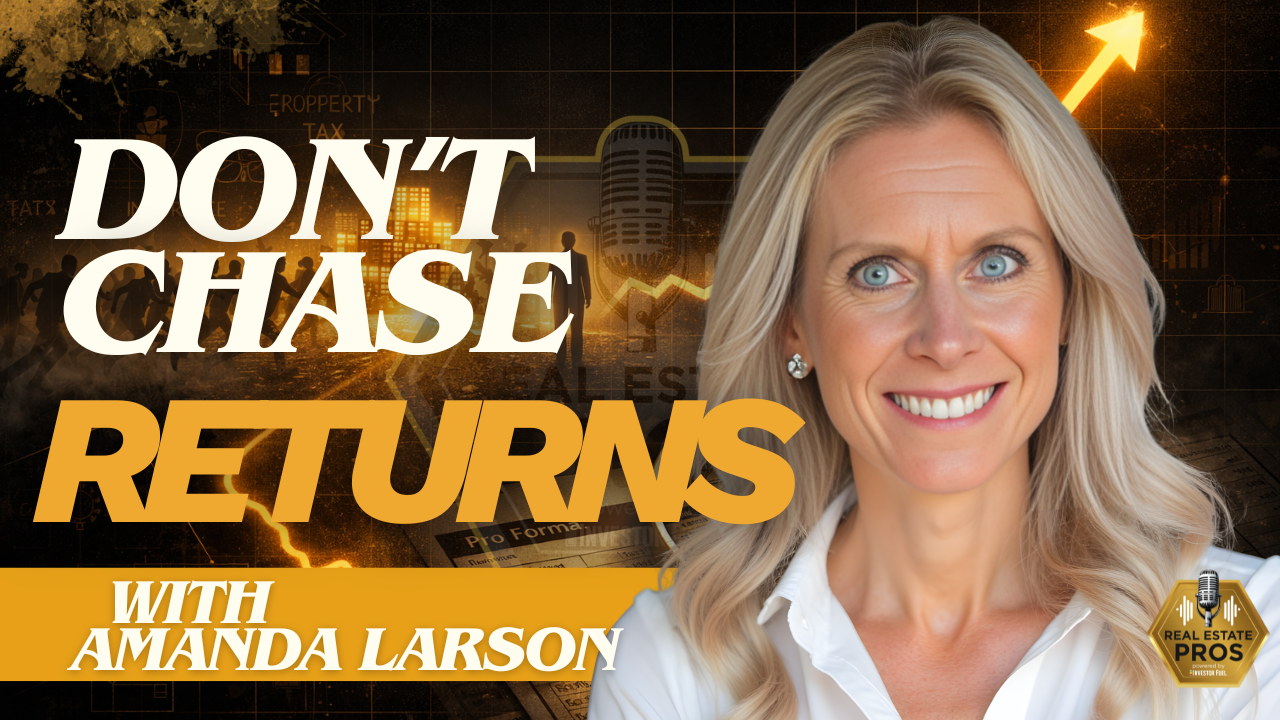
In this episode of the Real Estate Pros Podcast, host Michelle Kesil speaks with Amanda Larson, a multifamily syndication expert. Amanda shares her journey from a background in engineering to becoming a successful real estate investor. She discusses the importance of analytical skills in real estate, the current market cycle, and common mistakes new investors make. Amanda emphasizes the need for strategic investment opportunities and the significance of building relationships with investors. The conversation concludes with Amanda offering insights on how to connect with her for further learning.

Resources and Links from this show:
-
Listen to the Audio Version of this Episode
Investor Fuel Show Transcript:
Amanda Larson (00:00)
I’d say the biggest one is just chasing returns. And so if new investors see just a handful of opportunities to invest in.they look first at what the returns look like and they’re gonna go on IRR or cash on cash or whatever metric they choose to look at and there’s so much more to the story. think that you need to look at who’s behind that, who’s operating the property, what’s their track record,
Michelle Kesil (02:06)
Hey everybody, welcome to the Real Estate Pros Podcast. I’m your host, Michelle Kesil, and today I’m joined by someone I’m looking forward to chatting with, Amanda Larson, who is a real estate investor focusing on multifamily syndications. So, excited to have you here today, Amanda.Amanda Larson (02:23)
Thank you, Michelle. It’s great to be here.Michelle Kesil (02:26)
Awesome, so let’s dive in. First off, for those not yet familiar with you and your work, can you share what your main focus is?Amanda Larson (02:34)
Sure, so right, I guess for the last few years, five, six years, I’ve been focusing exclusively on multifamily and in the syndication space. So if people aren’t familiar with that, that’s investors pooling money together to go buy something bigger than they could on their own. And so that allows, ⁓people who are busy with their life, with their work, with their family to invest in real estate and get some of that exposure without dealing with the tenants and the landlording and the maintenance and things like that.
Michelle Kesil (03:12)
Awesome. And what markets do you operate in?Amanda Larson (03:15)
Right now I’m exclusively in Texas. I’m starting to look more into the Midwest as well as an option. I think there’s some opportunity there, but for now it’s Texas.Michelle Kesil (03:29)
And how did you get started in real estate?Amanda Larson (03:33)
I grew up in a real estate family so growing up my family owned single-family rentals and they did some fix and flips and some farmland and so I’d always been in that environment and it was it was justalways talked about that that was one of the most stable investments you can make and why wouldn’t you buy house and have somebody else pay your mortgage for you and so I always understood it from a basic level and then in 2010 I bought my first single-family rental it was after the financial crisis so I bought it on foreclosure and did really well with it and
dove more into the single family space, at the same time I was working as a really busy, I was an engineer at the time, so very busy with my career and focused on that. ⁓ So through that I stumbled on investing in multi-family as a passive investor. And so that’s I did for a couple of years ⁓ before diving into the GP side.
Michelle Kesil (04:39)
Awesome. And so how did you transition into that new side of the business? Yeah.Amanda Larson (04:45)
from the LP to the GP.It’s a journey. So I think a lot of people think that you can just go take a course or somebody is just gonna bring you in as a GP, but really it’s a long ride. was, I joined a mastermind and really spent a lot of time underwriting, analyzing, touring properties, putting in offers, finding partners.
And it’s…
It’s a ⁓ challenging space to get into because a lot of people want to get into it, but you really have to bring something to the table. so at the time, what I brought to the table was being able to underwrite really well and very experienced and meeting with brokers and building those relationships to get something under contract and bring some investors in with me.
Michelle Kesil (06:28)
Awesome. What would you say are some of the main keys that have allowed your business to be able to grow and to run smoothly?Amanda Larson (06:38)
So I come from, when I speak with a lot of other people who work with investors, a lot of them, I guess I come at it from more of an analytical space, and I think that gives me a bit of an edge. I work with a lot of engineers, ⁓ primarily in oil and gas, which is my background.I come from a very rigorous data analytics perspective, which I don’t feel not everyone comes from that position. And so that gives me lot of opportunity to speak to those who do appreciate the numbers, do appreciate the forecasting and going at it from that point of view. so I think there’s a lot of opportunity there for me. And that’s where I’m spending a lot of my time right now. I think there was a gap in that.
in that market for somebody with my approach.
Michelle Kesil (07:37)
Yeah, absolutely. That’s awesome that you’re using like the skills that you had and converted them into the real estate world.Amanda Larson (07:39)
Yeah. ⁓Yeah,
I’m naturally a numbers person and so I could spend more time in an Excel spreadsheet than most people would like to. So I enjoy it and I think it gives me an advantage over some who don’t appreciate that side of the business so much.
Michelle Kesil (08:06)
Absolutely. So what would you say you’re most focused on solving or scaling to next in your business?Amanda Larson (08:16)
My focus, well, I would think it’s twofold. I think there’s a lot of opportunity right now in this part of the cycle. it’s finding deals or investment opportunities that are priced well. think there’s, from the cycle that we’ve been through, there’s a lot of things that are quote on sale, ⁓ the price reduction, but.as you dig in, not all of those are opportunities. Sometimes they have a reduced price for a reason. So finding really strategic investment opportunities. And then on the same side or at the same time, really doing a lot of investor outreach and building those relationships and giving the people the same opportunity that I found that I didn’t even know was there when I was working full time. ⁓ most people I meet don’t know that
a syndication or passive investment is even possible. They still think of real estate as I’m going to be a landlord, I’m going to fix and flip, or I’m very involved. And so I’m doing a lot of outreach just to educate people on that opportunity.
Michelle Kesil (09:32)
Absolutely. Can you expand on what some of those educational points are?Amanda Larson (09:37)
So I spend a lot of time, my outr- I guess the points would be…you know, just the opportunities of real estate, you know, the cashflow depreciation, the tax advantages. But then I guess the avenues that I take are some social media, my newsletters, podcasting, and then I find just, there’s nothing better than in person.
So I attend a lot of events and get to know people and just walk them through that process and share my experience really in my journey and what it’s allowed me to do with my life and where
I thought my career was going into where it is now. people appreciate that, you know, I guess life story or the journey that I’ve had personally.
Michelle Kesil (11:01)
Absolutely. What are some obstacles or like big pivots that you’ve had to experience as an investor? And now looking back, you can see the bigger lesson.Amanda Larson (11:18)
Well, I’d say I think in multifamily, the last few years have been challenging. The market was pretty hot in 2021, 2022. And a lot of investors, myself included, took on some bridge loans and some floating rate debt. And at the time, everyone was doing it. And it seemed like the thing to do. But in hindsight, it was probablygoing back to conservative underwriting would have been the smarter choice. So experiencing that full cycle from peak to trough has definitely been a learning experience and learning how operationally, how important it is to really buckle down and control your expenses, have liquidity at the ready, ⁓ because I’ve found that the deals that have done well in the last couple years have really had
plenty of liquidity to get through tough times and you never know, you can’t tell what that is gonna be, you don’t know what that next challenge is gonna be, but you can be pretty sure that there will be one and so it’s just a reminder to stay true to your underwriting requirements and don’t get too rushed into getting into a deal just to do another deal.
Michelle Kesil (12:46)
Yeah, absolutely.Amanda Larson (12:48)
Hopefully that makes sense. ⁓ I think people in this space will be familiar with the cycle that we’ve been through.Michelle Kesil (12:57)
Yeah. And what kind of like cycle do you feel that the market is in now?Amanda Larson (13:05)
I think we’re coming, I’ve, mean, we’re at, prices are about 20 % from their peak a couple years ago, so I think that’s a really, an opportunity for buyers, but I think, like I said earlier, there’s, we need to be careful at the same time, because I think,there’s still a lot of distress in the market and just because things are priced less than they once were doesn’t make it an opportunity. So it’s really digging into what’s happening with the tenant base because you know at the same time we’ve seen an influx of supply and some dampening of demand and so it’s really just digging in finding out what’s going on with the property. Where’s their deferred maintenance? Where are their collections at? If something is
Is 80 or 90 % occupied? Is everyone paying? ⁓ So it’s really, it’s taking a lot more peeling back of the layers than it did a few years ago. I think things were a lot more stable a few years ago and it’s a different time right now where…
The operators who really dive deep into the details are going to be the ones that succeed, I think, in this part of the cycle.
Michelle Kesil (14:29)
Yeah, definitely that makes sense. What are some common mistakes that you see newer investors making?Amanda Larson (14:39)
say the biggest one is just chasing returns. And so if new investors see just a handful of opportunities to invest in.they look first at what the returns look like and they’re gonna go on IRR or cash on cash or whatever metric they choose to look at and there’s
much more to the story. think that you need to look at who’s behind that, who’s operating the property, what’s their track record,
how defensive are they in their underwriting because I think there’s gonna be more challenges just in terms of
I think there’s a lot of uncertainty in the job market, so you do need to take a defensive position if collections go down or rents stay flat. so chasing a return, I think, can be one of the biggest mistakes because it can go from, this could be, looks like a home run deal, looks like it’s gonna do really well, but it could also.
turn the other direction and maybe being a little bit more conservative and taking something that’s more certain but maybe less optimistic could be a better decision. And along with that, I would say look at the operator. think operations right now, if the last couple years have shown us anything, it’s operators who can really control expenses.
find every opportunity for reducing their property taxes, reducing insurance. ⁓ That wasn’t always the case and I think it’s been the case for sure in the last couple years and it’s gonna be the position moving forward.
Michelle Kesil (17:10)
Yeah, that makes sense. It’s a different kind of season of investing.Amanda Larson (17:15)
It is, yeah.I think there was a time when, well I know there was definitely a time when if you bought something just because of cap rate compression, you did really well. ⁓ Regardless, and you didn’t have to necessarily improve the property or spend that much time or much effort with your property management or looking at your expensive, negotiating your contracts. And it’s just a whole different.
an entirely different business right now.
Michelle Kesil (17:48)
Right.Amanda Larson (17:50)
Which is good, I think it’s going to allow the best operators to come to the top and flush out some of the people that were in the business ⁓ who either weren’t serious about it or didn’t take it as serious as they should for their investors. Which for me is always priority number one. This is hard-earned money that we’re taking from investors and to protect it as best we can is pretty critical.Michelle Kesil (18:19)
Absolutely. What do you think like investors that are just about to get started or wanting to get started should know?Amanda Larson (18:32)
I don’t know if it’s what they should know or I say the best way to get started is find somebody who’s been doing it andJust pick their brain. Ask a lot of questions. Everyone starts from the same place and just ask what they’ve learned in the last few years. Ask what they would do and almost find somebody that will give you time. Maybe not necessarily the biggest player that you can find, but somebody who will actually devote their time and energy into showing you what to look for. Just because you’re a passive investor doesn’t mean you’re passive in the decision making.
And a mistake that investors can make in addition to just choosing the best returns is choosing the best someone with the best social media presence or with the biggest website or the most deals done because that’s not always the best due diligence as a passive investor. ⁓ Your one job is to
select your investments and then let them work for you.
Michelle Kesil (19:45)
Yeah, definitely. So what are you like most looking forward to as far as any opportunities that you see in the market, whether that’s for yourself or for others?Amanda Larson (19:58)
⁓ well, I guess a similar message is I think we’re in a part of the cycle where there’s a lot of opportunities if you’re selective. think competition is…or I know competition, there’s not nearly as much as there were a couple years ago. So finding those really great opportunities at a discounted price and really good markets that have a diverse employment base, ⁓ give it a few years and I think those investments will have done very well.
Michelle Kesil (20:33)
Yeah, absolutely. And when it comes to like the multifamily space, how do you think that that market is shifting?Amanda Larson (20:41)
Mm-hmm.I think, well, shifting, you know, we’re at that turning of the cycle. And so I don’t know if it’s necessarily a shift in the space or just a shift in what the circumstances are in terms of pricing and people in the space and competition and what people are doing in terms of with.
their debt and selective property management. ⁓ I think there’s, like I said, there’s opportunity there for people who are serious and who can really find ⁓ those nuggets in the strong markets.
Michelle Kesil (21:31)
Yeah, absolutely. Thank you for sharing that. So before we begin to wrap up here, if somebody wants to reach out, connect, and learn more about what you’re up to, where can people find you and connect with you?Amanda Larson (21:46)
That’s great. So I’m most active on LinkedIn. You can just find me under Amanda Larson. ⁓ Pretty active there every day. And then just send me an email. It’s [email protected]. So it’s a-m-a-x-equity.com. And I respond to everyone. So shoot me an email and let’s connect.Michelle Kesil (22:10)
Perfect. Appreciate your time, your story, your perspective. Thank you so much for being here.Amanda Larson (22:15)
No, thank you Michelle, it was a pleasure.Michelle Kesil (22:18)
Great. And for those listeners that are tuning into the show, if you got value, make sure you have subscribed. We’ve got more conversations with operators like Amanda who are building real businesses and we will see you on the next episode.