Subscribe via:



Show Summary
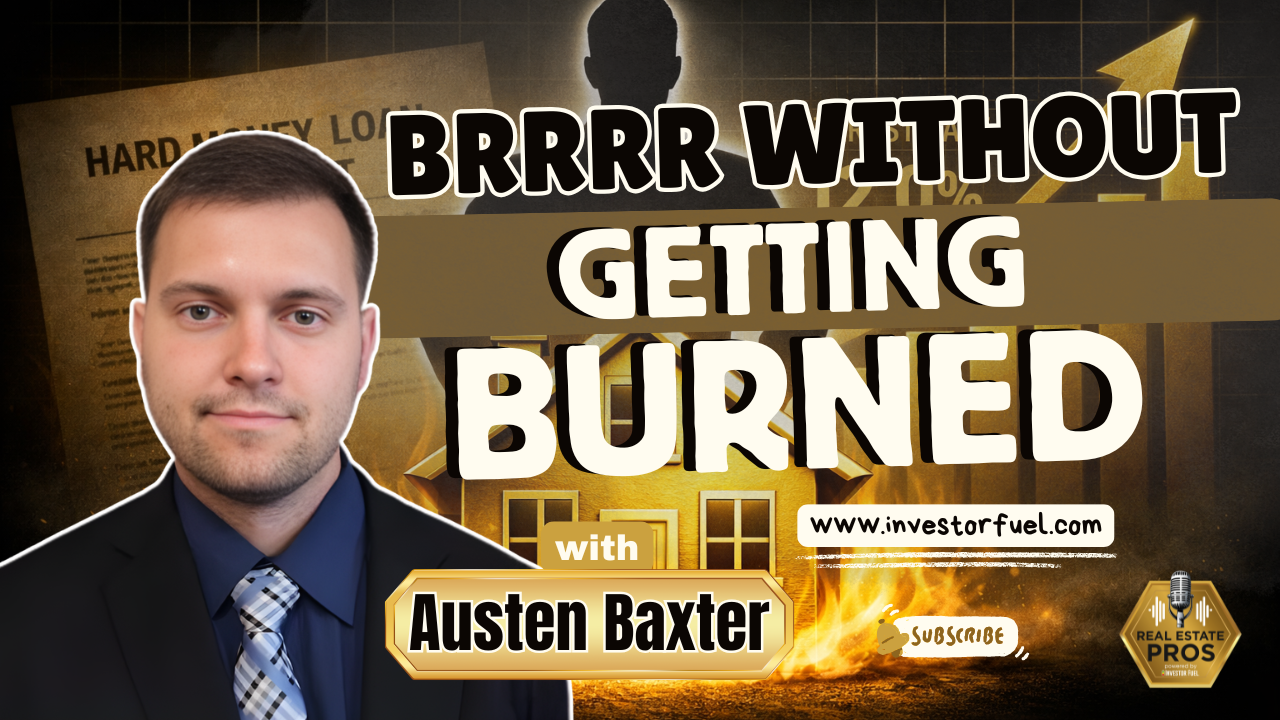
In this episode of the Real Estate Pros Podcast, host Micah Johnson interviews Austen Baxter, a successful real estate investor who shares his journey into the industry, focusing on the BRRRR method and market selection. Austen discusses the importance of understanding numbers, risk management, and building a reliable team. He emphasizes the value of mentorship and continuous learning in real estate investing, providing insights for new investors on how to navigate the complexities of the market.

Resources and Links from this show:
-
Listen to the Audio Version of this Episode
Investor Fuel Show Transcript:
Baxter’s Rentals (00:00)
So the first thing that I found that most people really have a hard time with is understanding that a lot of the guys you see on Instagram, Facebook, TikTok, when they’re telling you, go to this website, this website’s gonna tell you exactly what you’re gonna rent for it. Then here, go to this calculator, this calculator’s gonna tell you exactly what your cost is, right? Oh, you’re gonna be making $1,000 a month on this property. And they’re looking at some property in the middle of Ohio and it’s like $50,000, great. That doesn’t really show you all the details.It doesn’t really show you the true facts of what those numbers are going to really be. They’re just showing what you can find online. And online feels like a trusted source, but not everything online is.
Micah Johnson (02:07)
Hey everyone, welcome to the Real Estate Pros Podcast. I’m your host, Micah Johnson. And today I’m joined by Austen Baxter, who’s been making some serious moves in real estate investing for the last four years now. Austen, welcome in, man. Glad to have you.Baxter’s Rentals (02:07)
Okay.Hey, great to be here. Appreciate it.
Micah Johnson (02:21)
Absolutely, man. I think our listeners are really gonna take some value away from today’s conversation based on our pre-recording call. Just your story through real estate, how you focus on it, the help you give back to other people. I love it, man. It’s something I find very common in the highest performers in this industry. They’re willing to share what they’ve learned along the way to help other folks out. let’s dive in there, man. For people who may not know you yet, what’s your main focus right now and what markets are you operating in?Baxter’s Rentals (02:45)
Sir.⁓ so right now my main focus is, single family homes, and that’s going to be in, Arizona, Missouri and Alabama. I’m also focusing on, commercial residential property. like RV parks, mobile home parks, building and expand them, but, mostly focusing on the BRRRR method. So that way I can pretty much reclaim most of the capital that I spend in each deal or that I get from a bank in each deal. and I pretty much continue with that in a couple of different cities in those states.
Micah Johnson (03:17)
Okay, love that. So take us back. How’d you get into real estate? What brought you to this industry?Baxter’s Rentals (03:22)
So I actually was trying to find a way out of working too much. I was working a couple different W-2s. I had my own business. had so many different failed businesses before this, I was working overnight job for DOT. I was also working during the day doing tree work and doing residential gas work, all on top of trying to run my own business. And it was exhausting. was working five to six days a week, almost 19, 20 hours a day, had a newborn. I did this for like three years. It was, I…Got to the point when I was in a tree I almost cut my leg off. But put it bluntly, that’s where I thought, okay, time to stop. I need to figure something else out. So I thought the stock market would be a good way out. Kind of unrealistic, unreliable. I made some money, yes. I lost some money, but I made enough money to at least stop one of the jobs that I was working, give myself a break, which was nice. And I started trying to find other solutions, because this was not doing what I needed to do. It was taking too long, it was too risky.
So I found real estate through a family friend, they do the same thing, similar to what I do just in a more expensive market. And they kind of gave me the rundown of what they do, how they do it. And so I tried to take that and copy it to a cheaper market, something else that would be more affordable for me, struggling with an infant at the time. And there was no way for me to afford 200, $300,000 houses. So I wanted to scale this down to 50 to $100,000, which there was plenty of markets that could.
supply that. I started taking some of the money I made from the stock market, started getting into a massive amount of credit card debt and I used that to kind of jumpstart my real estate. I tried to use hard money loans, tried to do turnkey properties, just burnt up too much money. So started using the Burr method to buy properties using credit stacking, using hard money lenders and basically would take those properties, make them turnkey, refinance them at new value and then take the money back out and
put it into the next deal and just kept repeating that over and over again.
Micah Johnson (06:04)
love that, man. it’s, what I find interesting is you went to a market outside your backyard out of the gate. That’s not something most people are willing to do upfront, but you kind of have a history and you’re a serial entrepreneur, man. So it’s willing to take action in those risks that a lot of folks won’t think about upfront to go find that market. Cause like you said, we all don’t really control where we’re living in a sense when we start getting into real estate, but we can definitely control where we’re going to invest that.And for someone that could be going through that same situation, what are some things that you need to think about when looking at markets outside their backyard?
Baxter’s Rentals (06:41)
Don’t get me wrong. I wanted so badly to do it where I lived in. I just figured out it wasn’t possible. It was not within my budget. It didn’t make sense financially and it would have taken so much longer for me to be able to actually succeed in that market. And when I was looking at the margins for profit, this is when I lived in Texas. So there was nothing there. It would have been worth it, right? I would have been absolutely struggling to make any money. So I started looking what is within my price range, what cities.I work for Section 8, what cities have cheap enough prices, high enough rents to create the cash flow, but also be able to turn over between the cost to value gap that I need to refinance and get my money back. And so I started looking at Alabama first, I looked at Mississippi, I looked at Georgia, looked at Ohio, I looked at so many different places. And the next step was, once I’ve identified these markets, how easy can I set up an infrastructure, right? Who can I trust in that area?
I tried to see who was the most friendly. I talked to a couple agents and some of them turned me off of a market entirely. That was Ohio and Georgia. Immediately did not work out. Alabama, the agent was awesome. More than willing to share any information about the market, do’s and don’ts, where to go. I talked to a property manager company out there. They literally gave me a map of like, hey, these are the best areas and these are not. So that was my, okay, let’s go there. Let’s start there. And started setting things up, setting up the LLC. So when you are…
making this decision whether you wanna be local or not. First look at your local market and see if it’s even possible. If you’re in a market where it’s possible, that’s great, you got the benefit of being there. But you gotta think, is you being there going to actually make an impact? Are you gonna go manage the property yourself? Are you gonna go fix the property yourself? If not, then you need to start building up your network because you’re gonna need the people that you can trust and rely on that are gonna do those things for you for those properties.
Micah Johnson (08:34)
It’s completely true there. Like real estate is relationship business. It is a team sport. It’s not something we can do on our own. We can’t even buy a house by ourselves. Like we need multiple people to pull that off. So you’re nailing it there. Let me ask you this. How have those past failed businesses helped you be successful in the real estate business you started?Baxter’s Rentals (08:54)
So one, understanding how taxes work, almost near getting audited. So that was one of the first things. Do not over-deduct and do not ⁓ under-submit income. That is a big no-no. So obviously make sure you have a CPA or good bookkeeper or understand enough about tax law or how to submit your own taxes to not do that. ⁓ Secondly, know when to take risks, know when not to take risks. Like with the stock market, that taught me a huge thing aboutdiversity, day trading, ⁓ trading stock options that taught me a lot about long-term risk, short-term risk. And then, residentially, I used to do some contracting. I used to do residential handyman work. I used to do residential gas work. And so, when looking at a lot of these houses, looking through the pictures, I can kind of identify certain things. Like, there’s two prong plugs throughout the house. It’s all right, the wiring’s outdated. ⁓ hey, look, that’s probably CPBC or cast iron. So that plumbing isn’t updated. Or I can tell when a furnace or a condenser is old.
You know, so those little things just being in so many houses and seeing so many places and let’s me quickly identify just looking through Zillow if it’s even worth sending a contractor and then when I do have an agent or contractor go there and send further pictures I can kind of identify things that maybe the contractor didn’t catch or I can kind of self-check to make sure okay can I trust this contractor? They’re telling me something’s wrong. Is it really wrong? Does it really need to be fixed? And by looking at I can agree with them. Yeah, this is pretty bad. This is probably gonna need to be done. It’s not, you know, overdoing it. So
Those few different skills joined together kind of helped me be a little bit more successful because it helped me avoid some early pitfalls that could have been detrimental. I could have lost all my money in the very beginning just from screwing up on one of those ends.
Micah Johnson (11:06)
Right, right. it, man, it goes into, upfront, education is very important in this business, wherever you can get it from, because there’s two parts. There’s the math part, and then there’s the people part. And you gotta be good at both to really understand this game. And I tell folks, you wanna learn the math part first. The people part, your whole life experience plays into how do you relate to people, especially in real estate, because you’re dealing with a house, right? So it’s a, from that standpoint, we can interact.But if you don’t know your numbers, and you were saying this a little bit pre-recording how new investors not knowing their numbers in these markets where section eight happens is getting them taken advantage of because without knowing them, you put yourself into an area where you did not mitigate risk at all. You’ve set yourself up to fail. I say this all the time, I hear it all the time. You make your money on the buy. If you need a bunch of stuff to go right to make it make sense later,
you are messing with failure all over the place. mean, the more things that need to go right, the more things that can go wrong. And the more that can go wrong, the higher the chances are they’re going to go wrong. Like that’s just the way it goes. So for somebody that’s looking into similar markets like you’re in and what do they need to pay attention to? What’s the best way for them to educate themselves about those numbers to make sure they’re not getting taken advantage of?
Baxter’s Rentals (12:31)
So the first thing that I found that most people really have a hard time with is understanding that a lot of the guys you see on Instagram, Facebook, TikTok, when they’re telling you, go to this website, this website’s gonna tell you exactly what you’re gonna rent for it. Then here, go to this calculator, this calculator’s gonna tell you exactly what your cost is, right? Oh, you’re gonna be making $1,000 a month on this property. And they’re looking at some property in the middle of Ohio and it’s like $50,000, great. That doesn’t really show you all the details.It doesn’t really show you the true facts of what those numbers are going to really be. They’re just showing what you can find online. And online feels like a trusted source, but not everything online is.
Yeah, it might be a starting point, but it is not the end point. So when you are looking at these properties, you need to one, understand that to begin with, the area is even worth putting a property together because it may not have the demand. You might put a house there and nobody wants to live there. You have the hardest time getting anyone to
anyone to basically want to live in or move into the property. And that’s a huge problem. That’s an issue where you’re going to eventually be stuck chasing the property or trying to flip it.
the primary problem is making sure that you have an area where the property is going to have demand. It’s going to be something where you are going to be able to rent quickly. Two, it’s going to be a property that is going to be worth actually setting up as a rental. You’re going to want to make sure that you are going to be able to buy the property for say 50,000, put 20 into it, so $70,000 total cost. And then you’re going to be able to refinance it at hundred grand. The second pitfall is not understanding
how to determine value if you go through and you try to ⁓ assume that it’s gonna be worth 100 grand and you don’t know how to fact check to see if it is and you get to closing day and you need to get the appraisal done. And once that appraisal happens, you are now at a point where, ⁓ it only appraised for 80 grand, you need 100 grand, now you’re short. Now you have money stuck in that deal. And at that point, there’s nothing you can do. You have to wait for…
either being able to sell it for appreciation to take effect and then from there you’re able to kind of jump out and salvage the deal but it takes time and now you’re shut down for that period while waiting to fix that problem.
Micah Johnson (15:22)
Yeah. Yeah, exactly, man. It is it. It’s where the most get into trouble, right? It’s writing an offer and buying the properties like step 10. There’s so many steps before you get to that point, because the reality is most deals don’t work for us. Most don’t. Like you take a look. Most of them aren’t going to work. So being super, it’s not that not that positivity is a negative thing, butBeing overly positive about a property out of the gate can get you in lot of trouble. gotta, it’s like going to look at a new car. Don’t fall in love with the car on the lot. My buddy calls it naming the puppy. You can’t name the puppy. You have to look at it objectively. Is this actually something I can do? In my own career, I realized there’s a lot of properties in America you just can’t buy in these little places. They couldn’t give you the property and there’d still be a good deal there. So knowing those numbers is so important. Cause like you said,
great. You found a deal for a house, does anybody want to live there? Does anybody actually want to be in that area? Because they’re most likely not. If it’s super far out and there’s like, there’s all these little reasons that go around it as to why you can get it under contract. Where for us, it’s true motivators. Why does the seller actually need to sell that property? What’s driving them to do it for us to get it at the discount we need? And then is it in a place where we can capitalize on it? Because if it’s not, like you’re saying,
know, time fixes all bad deals for the most part, but if time is something that you’re working against, leaving money in a deal, especially if it’s hard money, that’s not cheap money. Anything you got to leave behind in there and keep paying on, it’s just eating your life.
Baxter’s Rentals (17:07)
It’s painful. It sucks, especially with hard money because they don’t care. If you screw up, if you take too long, they are brutal and they will call the loan due. And then at that point you are suffering, especially if you sign a personal guarantee. It’s going to be very painful and it could prevent you from being able to get a new rental. could prevent you from buying a house for yourself. could destroy your credit. So you have to be very cautious with those things. It could cause a lot of damage to you personally and financially.Micah Johnson (17:35)
Yeah. And well, this always led you to open it up a group that we were talking about pre-recording where now you help with this very thing. What’s something that you’re teaching inside the group to help folks understand what to look for, the process to follow, anything you can share for our audience on just some of those startup steps. What do they need to pay attention to?Baxter’s Rentals (17:56)
So one of the primary things, I’ve tried to start with building blocks from the ground up. So very first thing, identifying your market. What market is gonna work for you? Your method that you wanna go for. You want turnkey properties or do you wanna go with the BRRRR method or do you wanna flip? What is your method? Then identify the market that best suits you for that and for your budget. ⁓ Whatever means you have to invest, you need to make sure that the market suits your budget. Then.setting up the LLC from the very beginning, making sure it’s correct, making sure it’s not going to inhibit you from getting business funds and loans down the road and make sure it’s not gonna stop you from getting business lines of credit or getting approvals because you set the LLC up wrong or having issues with tax reporting down the road. So you wanna make sure all those are set up properly.
Then once you finally get through with that, saying the bank account properly, making sure you understand how to move funds from the bank and through the LLC and back to you back and forth correctly so you don’t end up getting yourself audited or piercing the veil of liability that an LLC comes with. That’s the point. It’s supposed to protect you. ⁓ Then finally, now we’re getting into the deals. How do I identify a good deal? Where within that market is good? What’s an A market? What’s a B market? What does that mean? ⁓ What should your price point be for purchase? What should your price point be for renovations? What are you looking for for profit?
All those play into a factor of making sure you’re picking the right area, the right property, and then you gotta pick the right team. You gotta understand how to pick the right contractor, the right agent, the right property manager. I help with all that. I help provide the teams for my students to use, but you just wanna make sure for yourself. You don’t wanna trust anyone blindly. I give you the steps. Talk to these people. See, I have like 10 different contractors. Who’s the best contractor for you out of those 10 based on these steps, right? Then from there,
You’re moving into the realm of getting a tenant, screening for tenants, and then trying to determine whether or not you want that ideal person or if you’re gonna make an exception for someone just to get the house filled because there’s not as much demand. And then finally, doing through refinancing. You wanna make sure now that you’ve gotten the right area, the right property, the right team, the right tenant, you gotta have the right lender to help you pull it all together, refinance, take your money out, and go back to the next deal.
Micah Johnson (19:58)
which is, man, if you just heard that or saw that on here, I mean, it’s a roadmap. Austen literally just laid out the roadmap to how you do this. And one thing I wanna point out is it’s simple. It’s not like you’re saying things that are incredibly difficult. They just have to be done. That you can’t skip steps. You have to walk through it. Simple doesn’t mean easy. And that’s something a lot of folks struggle with in real estate is it’s not that it’s quote unquote hard. It’s simple. You just can’t skip steps.And that’s what we like to do. We like that. We build our processes out. Then like you’re saying, do you want to make that exception for the tenant just because you want it filled? You know, where anytime you’re thinking about violating your process, you need red flags going up everywhere because it there’s a reason why it exists. People have been investing in real estate for a long time. It’s not a mystery how to build a real estate investment company. It’s just a machine. Do you understand all the parts of the machine? Do you know how to put them together?
Right. It’s like building an engine. Well done. Well, you’ve built a machine that trades in real estate. That’s what you’ve done. Well, it’s not hope. It’s an actual strategy and taking that time to set those things up is what sets the best apart. That is what I’ve noticed. Everybody gets to the point where they realize, you you got started, you’re going through the confusion. You don’t even know what you don’t know. Then you start to learn. And the ones that stay dedicated through that annoying phase.
are the ones that come out with that real estate, that professional investment company that can be in any market that can take that strategy. And like you said, let’s identify strategy. Let’s identify market. Let’s identify team. Now that we have our things in place, boom, now let’s go identify property, make the offer. And that’s the part I want folks to really gather in is I know we all want to just go make the offer. I know it’s so fun. It’s so fun to do. However, there is
more steps beforehand that prep you not to lose everything. Cause that’s the game of real estate, not get knocked out. As long as you’re still in the game, you have a chance. So those singles and doubles become super important. That’s what I try to focus on. If you hit a lot of singles and doubles, you’re going to hit home runs guaranteed. That’s how you do it. If you’re only trying to hit home runs, man, your batting average is going to be terrible. You’re going to take that swing that knocks you out of the game. And that’s the
Baxter’s Rentals (22:18)
It’s take forever.Micah Johnson (22:25)
That’s the mentality like you were talking about earlier. So many gurus and things share this business as a get rich quick thing. It is not. Can you make a lot of money fast? Sometimes, but this is not a get rich quick scheme. It’s a very methodical build wealth over the long-term method. As long as you take the time to understand what you’re doing, working with people like yourself, finding other coaches. You were self-taught and then started helping others.What would you say to somebody that was in that same position? How beneficial was it for you to find help as you did? And then how beneficial is it for your students that they’re finding this help?
Baxter’s Rentals (23:05)
So it makes a big difference, at least for me, to avoid those pitfalls. If I would have had the help from the beginning, I would have saved tens of thousands of dollars. Between bad contractors, bad deals, I would have saved a lot of money. And fortunately enough for me, I got lucky in the beginning, where the houses either appraised high enough or…burnt down and then I did not have to worry about trying to struggle to recoup and force that deal or just calling it quits because I was out of funds, I was maxed out on debt, there was no way to resolve it. So if you’re in that position where you don’t know what to do, first see how much you can do on your own, not paper trade it, Practice like you’re investing in the stock market. Learn how to run the numbers, extremely important. Know what your debt is gonna be, know what your operating expenses are gonna be, know what your actual rent is gonna be. See if you can find deals that make sense.
Don’t send anybody to walk anything. Just look at it on paper. If you can underwrite a deal, then at that point, you can try to find someone that’s reliable enough to go check that deal out for you to see if you were correct on your estimated cost of repair, on your rent, whatever. You just want to confirm. ⁓ And if you’re having trouble getting through any of those steps and you just are stuck, at that point, don’t force it. You should probably get someone to help you or just ask for free advice. There’s so many people in so many communities that you don’t have to pay for it to say, hey,
I don’t know how to do this. you tell me how to do this real quick? They’re not gonna charge you a premium for quick advice. At least I believe no one should, that’s unfair. If you just need help understanding how to calculate rent or find an ARV, that should be free. That should be absolutely free.
Micah Johnson (24:36)
Love that, man. And for those that are listening, that are interested in learning more about this, because one thing I love is that mentality. One thing I’ve learned in real estate, the best at it are have an abundance mindset. Like you just said, they’re willing to share that information with you if you’re willing to ask for it, right? Like we all, that’s the key. Ask. If you’re stuck in a position, even if you feel dumb, ask. It doesn’t matter.All of us feel the same way when we learn new stuff. That was so obvious. Why didn’t I see it? Just don’t worry about that part. It doesn’t matter. Ask the questions, learn, because if you’re stuck, you’re not going to think your way out of it if you don’t know what you’re doing. You’re just going to dig a deeper hole and get yourself in more trouble. So awesome, man. I really appreciated our time today. And for those that are listening and watching in that would be interested in learning more from you, possibly having a call with you with their questions. What’s the best way for them to find you?
Baxter’s Rentals (25:32)
So through my website, baxtersrentals, I have a couple different ways to contact me, but at the very top there’s a button that says schedule intro meeting. That’s just, like I said, for friendly advice, or if you have questions about the community, or if you want assistance with your deal that you’re working on or anything, you just click schedule intro meeting, book a call with me, and I’m happy to answer any questions you have. That’s what it’s there for. If you want further assistance, if you want to jump on a video call, if you want to just schedule a phone call to go over your investments, your portfolio, or your market, whatever you’re looking for, you can click on consulting the book.multiple calls or book a video call if you want me to physically go through and analyze things with you. But friendly advice is always free. So schedule an intro meeting and I’m happy to help.
Micah Johnson (26:09)
Love that. And if you’re listening or watching and make sure you check our show notes, we’ll have Austen’s website there, Baxter’srentals.com. Make sure you check it out. Like I always say, take advantage of working with professionals. When we have folks on this show who know what they’re doing, they’ve been battle tested and understand and they’re willing to teach you, reach out to them. Those are the kind of folks you want to book with and learn from because they’re out there doing this business. Learn from people that are actively doing this. Real estate is a constantly changing environment.It is not one you just learn and you’re done. So if you’re going to learn from somebody, learn from somebody doing the business on a daily basis, because that’s what’s going to protect you. They’re up to date on the rules, up to date on all the regulations and the markets. And this is an environment where lifelong learning is a requirement. So again, awesome. Thank you for sharing that for those out there that are watching along. If you got value out of today’s episode, please like this episode, share it with someone else. You could think could get value out of it.
As always, please don’t forget to subscribe to our podcast. We appreciate every single one of you that follows along with us out there. We’ve got more conversations coming up with operators just like Austen out there building a real business in the industry. Thanks again for joining us today. We’ll see everybody on the next episode.