Subscribe via:



Show Summary
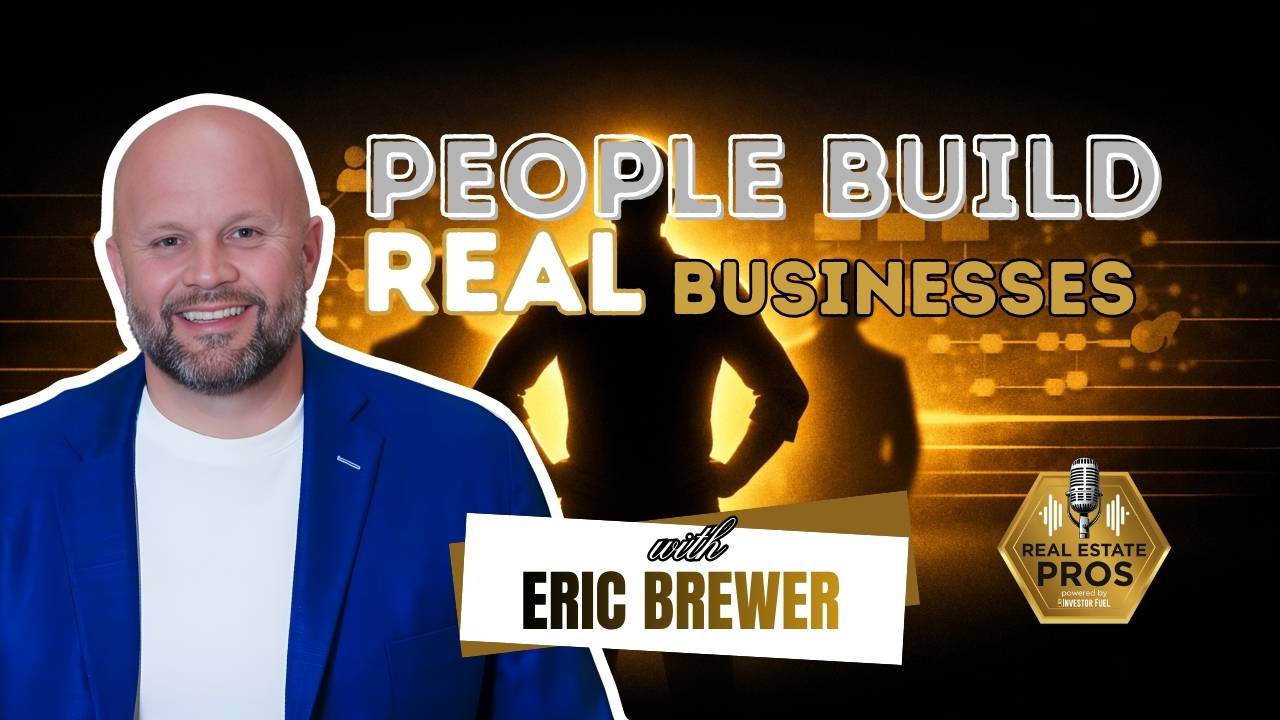
In this episode of the Real Estate Pros podcast, host Michelle Kesil interviews Eric Brewer, a seasoned real estate investor specializing in wholesaling, fix and flips, and commercial multifamily development. Eric shares his journey from the automobile industry to real estate, discussing the keys to his business growth, the importance of leadership and mentorship, and the strategies he employs in wholesaling and marketing. He emphasizes the significance of adapting to market changes and the value of continuous learning and training for his team.
Resources and Links from this show:
-
Listen to the Audio Version of this Episode
Investor Fuel Show Transcript:
Eric C Brewer (00:00)
In my experience, the hardest part about running a small business is people. And the most important thing about running a big business is people. So we see this a lot in our coaching business that people come to us and want to scale. And most people’s definition of that is leverage and getting some freedom back and making more money.The only way I know to do that, that I’ve ever seen be successful is through people.
Michelle Kesil (02:03)
Hey everybody, welcome to the Real Estate Pros podcast. I’m your host, Michelle Kesil, and today I’m joined by someone that I’m looking forward to chat with, Eric Brewer, who is a real estate investor focusing on wholesaling, fix and flips, and commercial multifamily development. So, excited to have you here today, Eric.Eric C Brewer (02:23)
Thanks for having me.Michelle Kesil (02:24)
Yeah, of course, I think our listeners are going to take a lot away from how you have developed and scaled as an investor. So let’s dive in.First off, for those who are not yet familiar with you and your work, can you share what your main focus is?
Eric C Brewer (02:38)
Yeah, sure. I’m in South Central Pennsylvania. We operate in most of the entire state of PA in Northern Baltimore County in Maryland. We do about 400 wholesale and fix and flip transactions a year. And I’m currently working on two multifamily development projects that we are in the process of early stages of a fundraise and starting construction in the next Q2 of this year.Michelle Kesil (03:06)
Awesome. That is some exciting opportunities coming up. How did you start your journey as an investor?Eric C Brewer (03:14)
Yeah, I a background in the automobile industry and spent eight years in sales and management there. Sort of got burned out of working some of the long hours that that came with. And my mentor from the automobile industry got into real estate and a few years after he left the car dealership, we had connected and got into flipping houses in 2006.Michelle Kesil (03:38)
Awesome. And are you only operating within Pennsylvania?Eric C Brewer (03:43)
No, we operate in ⁓ one of our development projects is in Reynoldsburg, Ohio. That’s a 163 ground up construction multifamily project. And we also wholesale and flip in Baltimore, Maryland.Michelle Kesil (03:55)
Awesome. What do you feel have been some of the main keys that have allowed your business to be able to grow and to run smoothly?Eric C Brewer (04:04)
Yeah, I think over the last 19 years, it’s been different things. Early on, it was just sort of grit and determination and hustle. ⁓ As we’ve seen from COVID to a high interest rate environment to recently, a lot of legislation changes around wholesaling and real estate as a whole. It’s been a willingness to continuously learn, innovate, and when needed, sort of reinvent yourself.what works today didn’t necessarily work three years ago and it almost certainly won’t work three years from now. So a balance of discipline and focus while still being mindful of the need to innovate.
Michelle Kesil (05:25)
Yeah, absolutely. There’s always different changes to pivot to. ⁓ So yeah, you mentioned that there’s always like those innovations and different levels to rise into what have been some of those pivots or different challenges that you have risen to over the years.Eric C Brewer (05:49)
Yeah, I think early on, I got the business in 2006. And in 2008, the world collapsed. So everything that was true about real estate in 2007 and 2008 unraveled. So we pivoted from a fix and flip model to a installment sales agreement. I was doing a ton of seller finance and installment sales agreements during the early parts of the recession.And as we started to see the market slowly stabilized between 2012 and 2015, we started doing more wholesaling. And then that model was super profitable. I was very fortunate that my business partner back then was very liquid. as liquidity markets dried up in 2008, nine and 10 and short sales and foreclosures took over the world, we were able to operate and we were buying 300 flips a year just right off the MLS.
Around 2016 and 17, as the market started to recover, flipping and wholesaling became more competitive. So we went out and had to really drastically improve our direct to seller, joined a few masterminds, and really learned how to market and run successful lead management, acquisitions, dispositions, departments. So between 2015 and 2019 or 2020, really became good at that. Then we learned turnkey.
because flipping was super duper competitive. And we learned how to do turnkey, which was buying and renovating and selling to ⁓ landlords across the country. And that was a slightly different model, everything from like the properties we acquired to the style of renovations. And then we were selling to people that were outside of our market, mostly ⁓ outside of this area. So that was a little bit different than the rates in 2022.
changed turnkey, got completely out of that business. And now we function almost exclusively about 75 % of our business is wholesale innovation. And we still do maybe 50 or 60 flips a year. So we wholesale about 350 deals a year and fix and flip 50 to 75 deals a year.
Michelle Kesil (07:54)
Yeah, awesome. What a nice trajectory to land into what it is that you’re most passionate and works for your business.And so what are you most focusing on now? Like what are you solving or scaling to next?
Eric C Brewer (08:10)
yeah, I think what’s happened is that, you know, I have about 40 employees. have a ⁓ full executive team with a COO, a director of marketing operations, HR, and that’s taken a lot of trial and error. mean, ⁓ when I initially started to grow my business, I wasn’t the best manager or leader. So I either hired the wrong people and that didn’t work out or I would hire good people. And because of not having good management or leadership processes.in place I would lose good people. So my focus became about seven years ago, just becoming a better leader, ⁓ being a leader that would attract top talent, create a culture that would retain that top talent, and then have a process in place that would help people develop inside the organization as long as they worked here. So I’ve basically been very blessed to be able to create a business that doesn’t require me much in the day to day. probably
you know, work 15 hours a week in this core business. And that’s freed up some freedom and availability to start working on development projects. I also have a coaching and education business where I’ve had people that have grown up inside of this organization that after six to 15 years have moved into becoming real estate coaches. So I have a company called Ramp REI where we coach real estate investors on everything from best practices and marketing.
management, leadership, acquisitions, dispositions, and everything in between.
So I was just gone for full five days doing some planning with the team in that business. So it’s allowed me to expand into some different verticals that are very nicely paired with our fix and flip real estate business, which keeps it new and exciting for me. It’s cool to, I love building stuff. And after.
almost 20 years of doing the same thing every day. And it was nice to be able to step away and watch this business flourish and grow without me and go out and create some new stuff.
Michelle Kesil (10:45)
Yeah, absolutely. That’s an exciting place to be to get to the point where you can expand your horizons and focus on other aspects and facets of what real estate could look like for you.what have been some challenges or big obstacles that you have overcome as an investor. Now looking back, you can see more of the lesson.
Eric C Brewer (11:11)
Yeah, I think developing as a leader was probably the biggest one.In my experience, the hardest part about running a small business is people. And the most important thing about running a big business is people. So we see this a lot in our coaching business that people come to us and want to scale. And most people’s definition of that is leverage and getting some freedom back and making more money.
The only way I know to do that, that I’ve ever seen be successful is through people.
Acquiring good people, giving them enough clarity of the vision and expectations that they can go out and perform without a ton of oversight. But it’s hard. People are not machines. They’re not always black and white. They have emotions. They have personal lives. They have dreams and aspirations. And it’s difficult sometimes to get
You know, ⁓ we have 40 people in our organization just in our house buying business. you know, it’s a full-time job just orchestrating an environment where everybody’s rowing in the same direction and speaking the same language and having common goals. So yeah, just being a, if I could do one thing over again, I would have started learning about systems, processes, and the development, leadership, and management of people earlier.
I think generally speaking, a lot of small businesses, particularly in this niche of real estate, we’re sort of fly by the seat of our pants, gunslingers that are really good at making deals and making money. But the consistency of our businesses might not be super solid. We have roller coaster ride revenue. ⁓
So I’ve worked really hard to try and become a better manager, leader, and an operator so that we have more consistency. It’s less stressful. I get more freedom back. And I think generally that’s just, when you do that as a leader, owner of the company, it’s a more enjoyable place to work. But it’s hard. It’s hard leading people. It’s hard not responding emotional or emotionally to.
the pitfalls of real estate, know, deals fall apart, construction goes over budget, appraisals don’t always work the way that we want. just, ⁓ it’s been a big lesson to understand the significance of people and our ability to lead people. And the better I get at that, the other stuff seems to take care of itself. So I would have probably made that a focus for myself earlier and now it’s a focal point for everything I do is I’m very people-centric.
Michelle Kesil (13:52)
Yeah, absolutely. think that’s something people don’t talk about enough ⁓ is that leadership aspect and yeah, everything that you mentioned with knowing how to manage all of those moving parts and different types of people in different situations. So that’s very important.What advice would you give to an investor that’s just starting out or early on in their journey?
Eric C Brewer (15:04)
I benefited early from having a mentor. I think for me to get started the ability for me to learn quickly, fail quickly, and scale quickly was with a mentor. So I think one of the things particularly is entrepreneurial spirited people, believe everything has to be done on our own. That’s just not necessarily the case.So I would say just getting started rather than trying to figure it out on your own. Find a mentor or a coach or a partner, someone that has experience and can shorten the learning curve. And I think that happens at each phase of business. Like you need a mentor to start, a mentor to grow, a mentor to scale, and a mentor that can really help you ⁓ with a succession plan. Because eventually everybody gets, I think, to my age. I’ve just turned 50. ⁓
I’m not looking to hustle or grind anymore. I want to start to create leverage so that I can do more of the things that I enjoy doing that might not necessarily involve work without jeopardizing the success of the business, again, which comes back to people. So I think in every phase, whether I did it early or I did it maybe almost too late, finding the right mentor or coach that has been able to encourage me, hold me accountable.
and help me push through those different phases of growth and scale and expansion is something I valuable quite a bit and would be, I think, a good piece of advice to give to someone else.
Michelle Kesil (16:31)
Yeah, absolutely. That’s helpful to have someone that’s walked those paths before and can shorten the time for you.Eric C Brewer (16:40)
Absolutely.Michelle Kesil (16:41)
So you mentioned that wholesaling is your main focus now of the business. Why specifically is that like the asset class that you’re diving into?Eric C Brewer (16:51)
Yeah, it’s a construct, know, fix and flipping construction is sort of hard. You know, the market that I’m in, a lot of our houses are 50 to 100 years old and doing construction, major renovation projects on those properties is tough. You know, you’re trying to bolt on brand new materials to a hundred year old home andYou know, sometimes there’s foundation issues or, ⁓ you know, just problems or renovations that come along with homes that age that can really present a challenge. So with construction, like good quality, staying on budget and getting it done in a reasonable amount of time is hard. Not the background that I come from. didn’t grow up as a contractor or someone that was exposed to construction. I grew up in the car business. I got really good at sales and marketing.
And when I look at all the different niches of real estate, me, wholesale is the one where it highlights your strengths and marketing and sales the most.
Michelle Kesil (17:54)
As far as marketing and sales, there specific strategies that you like to lean on?Eric C Brewer (17:59)
⁓ Yeah, I I think for us marketing, ⁓ it’s the basic stuff. You know, I think one thing is we’ve realized the business scale. We try and move away from what’s cheap and move into maybe ⁓ more higher barrier of entry. we do, we’ve moved mostly from outbound years ago to inbound. So instead of cold calling and texting and all of this.inexpensive but high labor lead sources we do exclusively almost now TV billboards direct mail ⁓ So we’re really really focused on inbound marketing and Some you know the bigger platforms there and just staying consistent When it comes to sales, I don’t think again. There’s no secret But one thing we really do a good job of here. I think that makes this unique as we train We train 30 minutes a day
no less than 30 minutes a day for all of our salespeople. And I think that really gives us an advantage and we’re committed to that, non-negotiable when it comes to training. So those two things I would say is high level of focus on marketing and sticking to what works ⁓ and being more focused on the total return, not the cost of the return. And then we’re just super focused on ⁓ training, always ongoing training for our salespeople.
Michelle Kesil (19:21)
Yeah, absolutely. That is awesome that you’re focusing on continuing to train and grow in the field. So before we wrap up here, if someone wants to reach out, connect, learn more about what you’re up to, where can people find you and connect with you?Eric C Brewer (19:36)
Yeah, two places either Facebook or Instagram. I’m pretty active on social media. I put out a good bit of content and Yeah, I’m easy to get a hold of there. I respond often to DMs And messages or comments so pretty readily available on Facebook and InstagramMichelle Kesil (19:54)
Perfect, well I appreciate your time and your story. Thank you so much for coming on here.Eric C Brewer (20:00)
Appreciate it.Michelle Kesil (20:00)
Of course. And for the listeners that are tuning in, if you got value, make sure you have subscribed. We’ve got more conversations with operators like Eric who are building real businesses, and we’ll see you on our next episode.