Subscribe via:



Show Summary
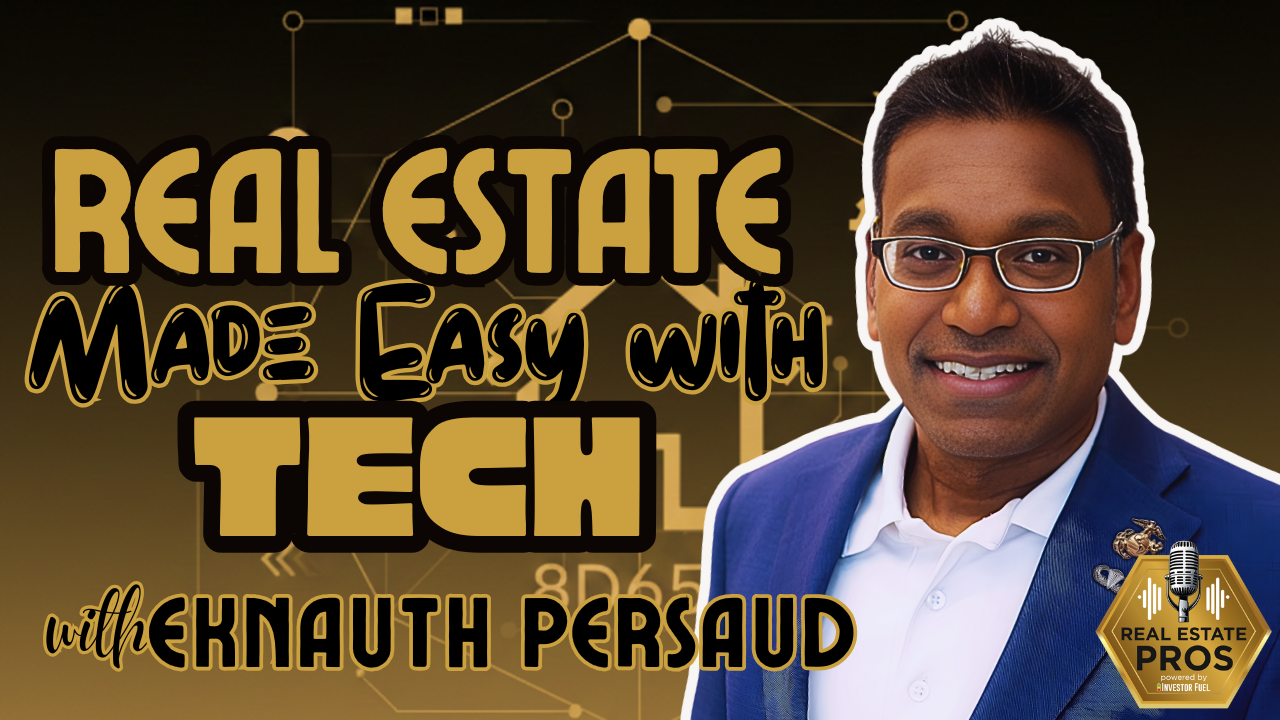
In this conversation, Eknauth Persaud shares his journey from being laid off to becoming a successful entrepreneur and real estate investor. He discusses the importance of optimism and faith in entrepreneurship, his experiences in real estate syndication, and the challenges faced in the current market. Eknauth emphasizes the role of technology in enhancing real estate investments, particularly through custom software solutions that can help manage projects and improve forecasting. He also highlights the significance of collaboration and community in the real estate space, encouraging a mindset of sharing and supporting one another.

Resources and Links from this show:
-
Listen to the Audio Version of this Episode
Investor Fuel Show Transcript:
Eknauth Persaud (00:00)
And so that’s what really kind of brought me to it was one of my, was, like I said, one of my marine buddies reached out to me on a deal. Sadly, we did not do well in that deal. You know, it was one of the things, it’s one of those lessons learned, but then again, I went to college and you know, I spent plenty over there learning lessons. And I think to me, this game has been fantastic because once you start getting intoDylan Silver (00:17)
Yeah.Eknauth Persaud (00:21)
real estate, realize how incredibly, how incredibly creative it is. And there are just so many different ways that you can approach something. You’re, really searching for that win-win. You’re searching for that higher purpose.that the real estate entrepreneur is doing.
Dylan Silver (02:11)
Hey folks, welcome back to the show. Today’s guest, Eknauth Persaud, is an investor in real estate and also technology who’s developed an investment tracker app that gives you all your metrics at a glance. He’s based out of the DFW Metro, Arlington in Texas. Eknauth, welcome to the show.Eknauth Persaud (02:31)
Hey, thanks for having me. appreciate it. And thanks for nailing my name. It’s sometimes difficult when people look at the spelling of it, but it’s Eknauth like no pain. So if you didn’t run today or work out, then you hopefully Eknauth.Dylan Silver (02:44)
Amen. Amen. Well, it’s great to have you on the show here today. And I always like to start off at the top of the show by asking guests how they got into real estate. But you’re involved in so much. Where did the entrepreneurial bone come from? Did you always have it?Eknauth Persaud (03:01)
No, I, it’s interesting. I, I love business tremendously, right? I love business. love operations. love, companies, but I did not start this. got laid off and so I needed something to do. And so I started consulting and then, ⁓ kind of one gig led to the next. And then pretty soon I want to, you know, hiring some people.And I think today we have about 30 folks, but yeah, it was my very first thing I thought I would do. I thought I would take over a business, not start one from scratch, because I realized it would be kind of difficult to start something from scratch. But thankfully, I underestimated the level of difficulty it takes to start something.
Dylan Silver (03:46)
I heard the CEO of NVIDIA talk about that, that if I had to do it all over again, I’m not necessarily certain that that is worth the mountain that you have to climb. But some of that is helpful. mean, you don’t want to have to be faced with that entrepreneurial pain every step of the journey. You want to go into it with ⁓ some level of ⁓ maybe focused belief that, this is all going to work out come hell or high water.Eknauth Persaud (04:14)
That’s absolutely it. You got to have a little, you got to be an optimist. and you have to be naive, but very importantly, you got to have faith. And I think that through having the business, if your faith, wasn’t developed, you certainly learn to do a lot of praying.Dylan Silver (04:32)
No question. When we talk about the software space, oftentimes people are thinking, okay, well that’s in a segment into its own, but you’re also a real estate investor. Was that happening simultaneously? Did that happen along the way? When did real estate come into play?Eknauth Persaud (05:35)
You know, it’s funny. So taking a step back, I was in the Marine Corps.And I enlisted in 1990, I was there in 1993, 97. And one of the things we always talk about in the Marine Corps is commanders intent. And the concept is if you really want to, like if I wanted to piss you off, I would do it, you tell me. But if I want it to serve you well, I would try to discern what you need and hopefully anticipate it. And so this concept of commanders intent always kind of played in my head. I felt that was the right way to build systems, to build software.
And so that’s kind of, we built the company around that, but what happened is one of my marine buddies reached out to me and he said, Hey, we’re, there’s a multifamily deal. you interested in getting involved with it? And so he sent me the PPM, that private placement memorandum. it’s pretty lengthy document and I didn’t understand any of it. And it actually excited me because I wanted to dig into it. I wanted to learn more about it. And so as I started learning more,
more
about how the model is set up. I realized that there was a system at play as well.
And so that’s what really kind of brought me to it was one of my, was, like I said, one of my marine buddies reached out to me on a deal. Sadly, we did not do well in that deal. You know, it was one of the things, it’s one of those lessons learned, but then again, I went to college and you know, I spent plenty over there learning lessons. And I think to me, this game has been fantastic because once you start getting into
Dylan Silver (07:00)
Yeah.Eknauth Persaud (07:04)
real estate, realize how incredibly, how incredibly creative it is. And there are just so many different ways that you can approach something. You’re, really searching for that win-win. You’re searching for that higher purpose.that the real estate entrepreneur is doing.
And when you’re backing that real estate entrepreneur, when you’re joining them, you’re trying to understand what their commanders intend is, where are they going with this? And what kind of role can I play in helping them meet their higher purpose?
Dylan Silver (07:34)
Sure, sure. Now, when you said PPM, I’m familiar with that in the syndication space. So was that a syndication that you were invested in?Eknauth Persaud (07:42)
It wasa syndication and I was merely a limited partner, so I didn’t have a whole lot of…
I didn’t have any pull in that, right? wasn’t a general partner. I wasn’t really on the cap table for this particular deal. ⁓ But, you know, it didn’t, you know, I think what happened is we got in and we got in a little bit too late. And as interest rates climbed, as the operating expenses went up, as insurance increased, you know, we just started, it started to erode what those projections could look like. And then ultimately it was a failure. So ⁓ as a business,
didn’t work out. But from the…
Dylan Silver (08:19)
You know that that thing thatsame thing is is happening right now to a lot of syndicators. So folks who purchase these properties not forecasting in their proformance for the worst case scenario where every like specifically in Texas you’re in DFW right. There’s multifamily properties going up and all the four majors you know DFW Austin Houston San Antonio all over the place and it starts out with these low rates but then as a
country interest rates go up and so they have these arm rate loans that some cases have doubled while also there’s more multifamily properties available. So rents are not rising at the pace that they thought in some cases going down. And then on top of this things are just more expensive. There’s just in general the cost for labor and repairs ⁓ basically became cost prohibitive in many cases to be conducting business. And so
We’re seeing the same thing right now in the multifamily space where there’s there’s distress with syndicators themselves, not necessarily with their properties, but with their actual funds.
Eknauth Persaud (09:58)
You know, and it happens with fix and flips too, right? So we do a fair amount since then, you know, we’ve gotten involved in a number of private money lending deals. We’ve probably done about 20 or so private money lending deals to some people that are involved in fix and flip and things like that. I’ll tell you one of the things that now some of these go sideways. Okay. So I can give you another bit of advice is don’t invest in a Ponzi scheme. So not a good thing.⁓ So, but ⁓ on the real estate side, one of the things I’ve observed is exactly what you just said. You mentioned the word forecast and being able to help kind of come up with what does that worst case scenario look like and how do you kind of model what that’s going to be? And I realized that, you know, a lot of the entrepreneurs who may come to you as a capital partner looking for a private money loan, they come to you and they have their projections and their spreadsheets and they have a deck and they want to walk you
you
through what could happen and even their ideas of here’s worst case scenario and here’s not. think I’ve learned to just do, I guess two things. I guess the first is ⁓ really come up with my own model. So in a way I’m doing a little bit of their homework for them by trying to forecast and build out a robust forecast of what could happen and what could go wrong.
And then I think the second thing is to really consider more deeply what their exit plan is. so if going back, you know, to my service in the Marine Corps and this concept of commanders intent, it’s really being able to understand if their purpose is to exit or if their purpose is to turn this into a rental property, then what activities are they either doing now
or will be doing shortly after they’re capitalized to start working toward that exit event. And if that exit event is I’m gonna bring in some renters, what are you doing actively to solicit, to do business development, to market your property so that you almost have pressure from the renter to move into your property. They’re almost pressuring you to finish your renovation work so that they can move in or you have pressure from the buyer
Dylan Silver (12:09)
Right.Eknauth Persaud (12:14)
who is saying, I’m excited by the property, I see where you’re going and I’m ready, right? I just need you to hurry up and do construction. And what I found is a lot of people who are actually very good at construction, those operators are really focused on that. They come into the business because they’re really good operators. They don’t necessarily think of themselves as, I’m selling this property.Dylan Silver (12:37)
Investors.Yeah.
Eknauth Persaud (12:39)
And so they don’t put enough treatment on that. And I think it’s almost the other way around. It would be better if they focused more on, hey, I’m lining up my buyers, I’m lining up my renters. And by the way, I need to go get this thing renovated.Dylan Silver (12:50)
You know, it’s a great point because so many times businesses are not vertically integrated with the contractor, with the marketing, with the acquisitions, you know, with the property management. Right. And so some of these things it’s more difficult to do, but in a lot of cases, and I would also ⁓ bet, although I’m not a betting man, but if I was,that there were syndicators who probably saw this gold rush, right, from like 2016 timeframe to 2020, seeing people hit their exits two years earlier than predicted. So they wanted to get in on it. They get into the top of the market with maybe, maybe they’re a little bit green and they’re thinking, okay, this is going well so far, but then things change. And then what do you do? And especially with syndications,
⁓ you have quite a bit of responsibility, right? So it’s not just as simple as, well, we’re gonna change our exit strategy. Your investors are banking on you to give them the returns in that timeframe. So I’ve even spoken with a syndication attorney who was a guest on the show about the upsides and the downsides in syndications. And one of those things is that when you do have to pivot, there’s a whole bunch of people that are riding on you and that
comes with a lot of liability. So some of these younger syndicators too had to traverse those waters recognizing that, okay, things are not going well and that’s incredibly difficult.
Eknauth Persaud (14:17)
Yeah, you really want to try to, here’s my thing. I want to step in the help in any way I can. Can I step in the help? Can I be involved? Can I help with the forecast and can I ask good questions? Can I help you exit the property? And I think to me, like, so, and you’d mentioned earlier thatyou know, I’m kind of, I guess maybe I, even though my name is Eknauth pronounced like no pain, maybe I do like a lot of pain because I’m involved in three different businesses now, right? And one of them is definitely on the investment side, but one of the investments I do is a little bit with technology venture capital, right? And so when you’re putting your funds into a technology venture capital fund, it is very similar to putting it into a syndication, right? You don’t have a lot of influence. You don’t have any, you know, operational
⁓
You have limitations for your operational value at, but here’s the thing we can do because of the type of businesses that we try to provide some capital toward. They oftentimes have a technology need. And so my favorite deals are ones where we can bring in not just capital, but technology. And so how do we now help those businesses operate either more cost effectively, maybe we can consolidate some of the software that they have together. Maybe we can lower their operating expenses by
⁓ enabling them to, you we have a model, the rent custom software so you can get, know, your software highly personalized your operations at a fraction of the cost of building it. And so now we can come in and say, okay, we are not just a capital partner, but can we help on the operating side? Can we lower those operating expenses? Can we make the business more effective through something else we bring to the table? And that,
Dylan Silver (15:52)
Sure.Eknauth Persaud (16:01)
that to me, those are my favorite deals. If I can kind of bring those worlds together, then I feel like I’m adding some value to, know, as a partner, as a participant in the deal beyond just capital.Dylan Silver (16:55)
I want to, if we can, get a little bit granular here and talk about some of the ways where you’re able to add value through technology. I can imagine that on a multifamily deal or acquisitions, there’s so many moving pieces involved there. Can you give us an idea of what some of the ways where you’re able to add value through technology?Eknauth Persaud (17:15)
Sure, think, you know, our world is whip, all right? So work in process, right? So what is work in process, right? So imagine… ⁓So imagine for some customers you’ve got ⁓ like a stack of purchase orders, right? The set of things that you’re about to do. And then you have some activities that you carry out and then you’re hoping that you get to this end state. And so if you ask a lot of businesses, particularly I’ll pick on ones in construction or field services. A lot of times they’re projecting what it will cost to do a particular renovation activity. And so all along the way things happen. And so are you updating your forecast
Are you doing a recast? Are you making adjustments to be able to see where am I going to land when this gets done? And I think what happens is for a lot of people, they might put together a game plan that says, I think if I do these activities, I’m going to land here. But what happens is along the way, things happen. And here’s the key.
People talk about real time as if it’s like a thing that you should have and I would argue you don’t want, you do not want real time information, you want on time information.
Because if you get real time information, you’re inundated, you’re flooded, it’s way too much stuff. It’s like going in the chat GPT and you get this really long response and like, please, I’m getting tired. I need chat GPT to read my chat GPT response. So if you get overwhelmed with real time information, that’s not what you want. What you want is information early enough that you can take corrective action on.
And so to us, when we look at sort of things like how can we help on a construction side is that work and process management. it’s, you know, if it’s an industrial company, like a distribution company or a manufacturer, they certainly have a set of work activities that it is really the set of work activities that happen from the day you kind of start working to the time when you either get paid or figure out what something costs. It’s all of that icky part in the middle that
Dylan Silver (18:46)
Absolutely.Eknauth Persaud (19:14)
not only you want visibility on, but you want the right time to get enough, to get information just ahead of when you can course correct. And that I think I saw lot in the multifamily was that as we were starting to get new information about what insurance is gonna go up to, about are we running into a scarcity of labor because people are not, they say,workforce wasn’t available to us before. And so these recasts are very important. A lot of times what they were doing is they would just kind of, they would just input on their spreadsheets a little bit about
you know, what things did cost. And so you’re looking backwards, but you’re not looking forward. And that to me really where software kind of can help people out is being able to do these projections going forward. So you can do the recast and say, are we going to land where we expect to land? What’s the consequence of us not selling this property in eight months after we’re finished the renovation? What are the carrying costs going to be and can I afford it?
Dylan Silver (20:02)
Yeah.So and.
Help me see the, and for our audience, the scope of this. let’s just use an idea, hey, there’s someone who’s doing multifamily syndication, several hundred doors. They may be acquiring or they may be doing a new build. There’s so much going on there. You could potentially build a custom solution for them to manage the project, but also manage their projections all under one roof tailored to them rather than some one size fits all software solution.
Eknauth Persaud (20:50)
Perfect, that’s exactly it. Tailor to them. Here’s the best part about it, is every one of these entrepreneurs who are doing these things, they have a strategy. They have something very specific that they do that they do really well. There’s a reason people choose them instead of someone else. So if you can kind of drill into that and you build something around their excellence, that’s really what we’re trying to do. And that’s the part that we love the most. And so when we built RetMySoftware.com, the entire idea was to create something soflexible that we could wrap it around someone’s strategy and build it exactly tailored to how they’re going to execute on their game plan.
Dylan Silver (21:29)
So this is some pretty cutting edge conversation that we’re having here. I mean, I can think of once you get to a certain size, you’re gonna wanna have every advantage and metric tracked that you can, like what you don’t measure, you can’t manage, right? So when you’re looking at deals that are hundreds of doors and projects that are like, ⁓ year and a half, two years or more of construction time plus permitting, is this something that there’s tremendous?Eknauth Persaud (21:42)
Right.Dylan Silver (21:57)
demand for a custom solution or are you bringing something to the market that is really fresh that even the developers and syndicators and fund managers themselves may be using some antiquated strategies like you mentioned a spreadsheet which only shows you what you already know.Eknauth Persaud (22:14)
Right, right. think there’s, you know, I look at it and say there’s, there’s two ways to get software to run your operations, right? So the number one thing is what’s your game plan? What’s your intent? Where are you going? That’s number one. And then how do you get there? What’s going to help you get there? Well, you can either buy software products and you know, historically we’ve told people if you can’t buy a system, we can build it.But now we can say, if you can’t buy a system, we can build it. If you can’t afford to have it built, we can rent it. So we believe this is the third way of acquiring custom software. And it’s custom software at a fraction of the price of having to build it from scratch. And what has kept people away from really creating a system that follows their strategy, as well as the way they want to execute. What’s kept people away from that.
is the expense of building something from scratch because they will take a collection of products, they will try to string them together. You’ll use spreadsheets, like you said, to glue the different products together. But it’s never quite what they want. And here’s the funny part, it’s actually more expensive to do that than to build it or to rent custom. Because once you rent custom, then you can have it the way you want. The way we deliver our software is there are no per-seat charges. So it’s unlimited.
unlimited users, unlimited sites, unlimited locations. There’s no limitations on it. What we’re trying to do is figure out where, what is it?
What is an element of your strategy that we can execute on right now, build it small, and then we can grow because it is programmable. It is customizable. You could start with a small solution and solve a specific problem and then grow. And so an example of kind of growing would be, now that we are doing this multifamily and we are staging out units, some of these doors are starting to cashflow. Some will not. And so now imagine that
that spreadsheet gets pretty complicated, right? Where you’ve got some cash flow coming in, you got some cash and cash returns, you’re maybe wanting to exit, you want to do a what if analysis. What if I brought in a private money lender such as ourselves, you know a private money lender like our family office is gonna be at a higher interest rate than an institutional lender. And so you’ll say, okay, how do I exit those people? How do I get rid of Ake-Not?
And how do I kind of move things around to be able to exit him? And what would that look like? And so those are the kind of fun things that you want to be able to do. And that’s a more sophisticated ask. But in the beginning, it could be a simple enough system where you’re keeping track of all your subcontractors, the materials, the parts. Did things arrive? Am I tracking my daily work reports? Am I getting visibility as to did they break something while they’re on the job site? ⁓
Are
they kind of, you know, am I paying all my suppliers on time? Things like that. Those are the mundane tasks you can begin with. But as you get more sophisticated with financial projections, now we can have all sorts of fun. At least I think it’s fun.
Dylan Silver (25:21)
I’ve got a granularquestion from the single family side. I know this isn’t necessarily the use case for this, do you know if there’s anyone in the single family space or could you use what you’re doing with Rent My Software here in this instance where you’re a single family investor, you’re doing let’s say 50 plus flips a year and you’re wanting to conduct management of…
those flips, you’re wanting to do outreach, maybe incorporate AI into that. But you’re also wanting to see, hey, where are the deals coming from and be able to analyze which lead sources work the best? I think right now there’s a lot of people in the single family space who are just kind of not throwing paint at the wall, but they’re using like the shotgun method. Let’s spray out and figure out what works and then we’re going to go attack there. But without this
project management mindset in many cases too. Do you think that there’s a solution there that could benefit people to handle some of these spinning plates?
Eknauth Persaud (26:24)
I agree, there is, there is. And in fact, if you’re doing 10 or so, I think that’s about the point where you really should start looking. I mean, this is where I think we can start helping in my opinion, right? Like I think if you’re doing 10 or more a year, then I think we’re a candidate solution. Because the interesting thing is your problems are still the same whether you have 10 or 50, right?It doesn’t, it’s the same concept. It’s just, it does become more complicated and it’s harder to keep track of, you know, I’ll pick on something on just a personal problem, right? Like that we had was, I was trying to use spreadsheets to track who owed us how much money and when, because I mentioned that we do some private money lending. so, you know, so I was doing spreadsheets, you know, who owes us how much and when.
And it got a little overwhelming after, you know, I have like maybe, you know, maybe eight or nine of these.
And so then I realized, wait, I own a software company. I should ask these guys if they can build something. So I go to a guy, I go to James and I’m like, Hey man, here’s kind of what I’m running into. do you think? And so, ⁓ you know, he put together a team here and we’re, like I said, we’re all kind of made in USA. So I can just go into the room down there, down the conference room and show him what I’m dealing with and say, can you help? And he’s like, well, yeah, I mean that we built software. could do this.
And it allows us to kind of figure out who owes us how much and when. then so, you know, we put the notifications and the reminders and we get all sorts of different data. We get tax related data. It’s a small thing, but it allows us to solve a piece of that problem. And it’s scalable so that if we do go from, you know, we have, you know, probably about less than 25 deals active right now.
Dylan Silver (28:01)
Yeah, that’s right.Eknauth Persaud (28:09)
And you know, if we grow, we can just add more. And now we are. And the greatness about AI is that as you start getting more active, people send you deals all the time. And so I was at a conference in Orlando the other day. ⁓ if you’re familiar with, private money club and Chris Noglin, those guys, had an event in Orlando. Someone went, it was proposing a deal. They put it up on the projector. I just grabbed my phone and took a picture of it and uploaded it to AI and said, Hey, you know, can you calculate theinternal rate of return, return on investment, determine all that. So it all the math for me, which is great, because I don’t have to type it into a spreadsheet and figure it out. And so I could take a bunch of prospective deals and just take pictures and then file upload to our AI, and then it figures it out.
Dylan Silver (28:39)
Yeah.I mean, the ways that people can not just save themselves time, but also consider risks that maybe they are intentionally avoiding. Like what probably happened going back to the top of the show with some of these multifamily deals, maybe even in that first one, right? If Ret My Software was around in 1995, right? We might have been having a different discussion about that first deal.
But it’s interesting because oftentimes, especially as investors and folks who work with investors, we fall into this idea that I’m gonna do this. I’m gonna stay in this box. I’m only gonna look at off market properties. I’m only gonna make offers, cash offers, or I’m only gonna do seller finance. And I tend to think that that’s where people can run into trouble really is when markets shift, your strategy that worked for the last three years might stop working right now.
And that’s where these tools can really help accelerate and help you avoid some of those black swan events and things that could potentially take out your business. No, let’s pivot here. Maybe it’s not the exact same offers that we’re making. Maybe we’re not in the exact same vertical, but we can take this skill set here and pivot over here.
Eknauth Persaud (30:12)
That’s fantastic. That what if analysis is incredibly important.If you can look at something and say, these are different options, these are different ways I can pursue it. I love the way people put together notes and the creative way in which sometimes people will sell off part of a note, do parcels and things like that. There are so many creative ways to put together a win-win situation. And I think a lot, like I said, a lot of it comes down to your strategy. Like how can I put this deal together that
I can be a successful participant and I can most importantly, whoever’s team I’m part of, right? Because I look at ourselves very much as an investor, we’re part of a team. So where are they trying to go? What’s their end game? And how do we help?
And so if we can kind of find ways to help them out and say, can we help you model this better? Can we look at a different scenario and maybe not better, but just different ideas. Can we trade ideas? And what I love about this space and I love about your community is that you have a lot of people that they ask questions and they’re open to learning.
Dylan Silver (31:20)
Yeah, very true.Eknauth Persaud (31:21)
And that’s what I love is that everyone, you know, there’s a natural curiosity that comes in the community and there’s a willingness to help each other out because I know that sometimes if I run into a really good opportunity that I cannot participate because everything we have is deployed. You know, I’ll talk to a friend about it and say, hey, here’s something that I’m looking at. You know, this is kind of my criteria. Let’s talk about your criteria. ⁓it and if you want to kind of dig into it together, we can, but I want to help them because they’re in a position at that time to be able to take advantage of something. And there’s, that’s a lot of what your community is, right? That’s a lot of investor field is just that helping each other out to just find good deals and be successful because there’s almost this, there’s this idea of it’s not a fixed pie. It’s like an infinite pie. There’s many slices as you want in the pie.
Dylan Silver (32:17)
Right, right, yeah.Eknauth Persaud (32:18)
And that mentality is so baked into the culture.Dylan Silver (32:21)
It’s about being a go giver. think, you know, what’s interesting about real estate is for the most part, although you have some people who are W2 in real estate, it’s filled with many people who are trying to find deals because that’s how they’re surviving, right? And so whether you’re a realtor, whether you’re an investor, whether you’re a lender, everyone’s looking for deals. So if you just decide, hey, I’m not going to share any information with anybody, you’re also going to not have to talk to anybody. You’re you’re you’re limiting your lead sources. SoYou know, it’s one of these businesses where you have to be able and capable of reaching out to people and sharing, because if you don’t do that, you’re shutting yourself off. We are coming up on time here though, Eknauth. ⁓ I know you’re involved in so much. Where can our audience go if they’re interested in reaching out to you about a deal ⁓ or a technology solution that they may have a question about?
would like to reach out to you or your team.
Eknauth Persaud (33:20)
Thank you. Yeah, I’ll tell you the easiest way.is rentmysoftware.com, R-E-N-T, mysoftware.com. That’s the quickest way, hit that contact form, you’ll find it. If you go on LinkedIn, my name is spelled somewhat uniquely, so you can just type in that too and find me on LinkedIn. But those are great ways to reach me. yeah, like I said, we’ve been through a couple of challenges over time and we’re gonna continue to have challenges going forward.
anything I’ve ever learned, would love to share so that people can, you know, hopefully it’s useful to them.
Dylan Silver (33:53)
Ake not, thank you so much for coming on the show here today.Eknauth Persaud (33:56)
Thank you, appreciate it.