Subscribe via:



Show Summary
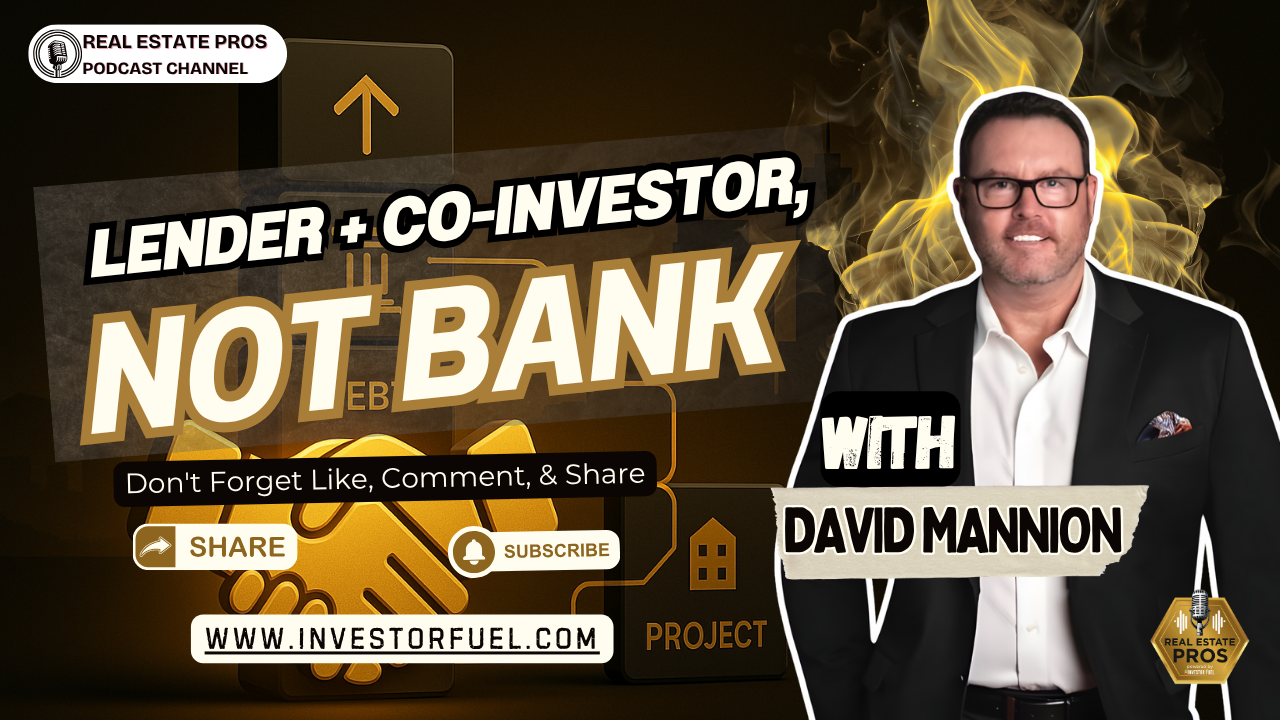
David Mannion, founder of Haven Growth Advisors, brings over 23 years of real estate experience ranging from institutional investing to private development. On this episode, he discusses how his firm provides much-needed liquidity to sponsors, developers, and investors at a time when capital is difficult to access. Based in Phoenix but with national relationships, David and his partners not only lend but also co-invest in projects, bridging financing gaps and fueling growth in markets with strong job and population growth. His projects span boutique hospitality, infill multifamily, mixed-use developments, and even a private airplane hangar. Above all, David emphasizes the power of relationships, adaptability, and technology—especially AI—in scaling a real estate business.”

Resources and Links from this show:
-
-
- Investor Fuel Real Estate Mastermind
- Investor Machine Real Estate Lead Generation
- Mike on Facebook
- Mike on Instagram
- Mike on LinkedIn
- David Mannion on Instagram
- David Mannion on LinkedIn
- David Mannion’s Email: [email protected]
- David Mannion’s Phone No: (858) 229-4770
Listen to the Audio Version of this Episode
Investor Fuel Show Transcript:
DAVID MANNION (00:00)
And we had a very strong balance sheet.As I mentioned before, we got on live, know, we have about a $100 million balance sheet where we’re leveraging that and we’re now deciding to lend that money out to other sponsors, developers and investors to help bridge them and help them access the liquidity they need to pull off an execution. And whether that’s buying an existing property or tying up land or maybe they need a little bit of gap financing to complete the capital stacks, they go ahead and finish their development projects.
Michelle Kesil (02:02)
Everybody, welcome to the Investor Fuel Podcast. I’m your host, Michelle Kesil. Today I’m joined by someone that I’m looking forward to chatting with, David Mannion, who has been making serious moves as an investor, developer, and money lender. So excited to have you here, David.DAVID MANNION (02:20)
Thanks, Michelle. It’s good to be here.Michelle Kesil (02:22)
Awesome, I think our listeners are going to take something away from how you’re structuring deals, doing your own development, helping people get private money. So let’s dive in. First off, for those not familiar with you and your world, can you give the short version of what your main focus is?DAVID MANNION (02:41)
Yeah, Michelle, I think our main focus today is providing liquidity where I think there is very little of it right now. think we’re seeing across the board investors and sponsors and developers finding it difficult to unearth money, whether it’s equity and even debt. And so our focus lately has just been serving our clients and making sure that we provide them the adequate liquidity to capitalize their projects, to have a successful execution.and to bridge them between refinancings or financings. So I think it’s just providing that liquidity and creating that value for client relationships.
Michelle Kesil (03:15)
Awesome. And what markets are you operating in?DAVID MANNION (03:18)
Well, my experience runs coast to coast. I’ve done a lot of deals nationally, but for this particular platform, we really just started here in the Phoenix market, and we’re kind of keeping our focus in Arizona right now, but we would love to expand into other markets. We have relationships in other markets, and so we’d like to bring that value and that liquidity to clients outside of the state of Arizona.Michelle Kesil (03:39)
Awesome. So what got you started in this business? How did you get to where you are now?DAVID MANNION (03:45)
Well, that’s a longer answer, but I’m to give you the truncated version of it. I’ve been in real estate for about 23 years now. I really just fell into it 23 years ago. My experience has predominantly been with large institutional investors, operators, think public REITs, private REITs, private funds, private equity. That’s really been my forte. I left that corporate space about three years ago, decided that I wanted to venture off andreally built something of my own and partnered up with some guys and we started to pursue deals. in the process of pursuing those deals, we came across a number of instances where the debt capital was very hard to come by, which historically was not the difficult piece. It was raising the equity, which has always been hard. But we were able to identify that there was really an opportunity in the marketplace to serve.
And we had a very strong balance sheet.
As I mentioned before, we got on live, know, we have about a $100 million balance sheet where we’re leveraging that and we’re now deciding to lend that money out to other sponsors, developers and investors to help bridge them and help them access the liquidity they need to pull off an execution. And whether that’s buying an existing property or tying up land or maybe they need a little bit of gap financing to complete the capital stacks, they go ahead and finish their development projects.
Michelle Kesil (05:56)
Awesome. So are you working with primarily investors? Are they like investors in the Arizona region? Who are you working with? Can you share and expand more on that?DAVID MANNION (06:07)
Yeah, think most of our clients tend to be sponsors. They’re not necessarily syndicating as much, but they are sponsors of deals, private investors. These are high net worth or ultra high net worth people. We are starting to work with more more developers, which is your more pure entrepreneur. You know, where they’re blazing a trail, they found a piece of land and they want to build something on it. And so we are starting to see a little bit more of that. It’s given us an opportunity as well to, in some cases, look atpotentially co-investing with these sponsors of deals and in other developers. So that’s been exciting. So instead of just being transactional with them and lending the money, we’re looking at a relationship now. It’s more relational where we’re in some cases evaluating the merit of putting our money alongside theirs as a co-invest partner.
Michelle Kesil (06:52)
So, what are you most focused on solving or scaling to right now in your business?DAVID MANNION (06:59)
I think just market exposure, ⁓ we are, you we have been focused predominantly in the Phoenix metro area. It is, you know, I think the fifth largest metro area in the country. So there’s plenty of business here, but I think vision is for us to expand outside of the Phoenix area into other markets to include outside of Arizona, whether that’s, you know, Texas and the smile states of the Southeast.⁓ We like to invest in states and markets where it’s pro-business. We don’t necessarily want to go too far away. We’re not necessarily going international right now, but we want to go into markets where there’s growth and it’s pro-business.
Michelle Kesil (07:38)
Awesome. So what kind of markets would you say are the right fit?DAVID MANNION (07:42)
Well, think you just typically we look at where people are moving and where jobs are being created as a growth market, right? So if you have those two dynamics at play, you’ll have demand on housing. You’re going to have demand on infrastructure. You’re going to have demands on, you know, amenities, whether that’s retail and shopping or mixed use or hospitality. So where people are moving and where people are getting jobs is really what we consider a growth market. There are a lot of them.across the country, think historically. Phoenix being one of the top 10 in the country, obviously you have the big Dallas and Houston, the Texas markets in Austin, and then of course areas of the southeast, whether that’s Raleigh, Durham, Charlotte, even Savannah, Georgia, where the port is, that’s seen some tremendous growth. Florida was a big boon.
But we’re starting to see a little bit of change in Florida only because the cost for insurance right now is so cost prohibitive. It’s making it very difficult to put deals together and underwrite something that’s accretive. But then there are other markets out west too. I mean, I Denver’s starting to show a little bit more of a resurgence and there are other markets out this way that we’re keeping an eye on. ⁓ I think Vegas is about to turn and…
probably reinvent itself. Casinos, I think, are not necessarily going to be the mainstay for that economy. And I think we’re starting to see more businesses move into Las Vegas to allow for affordable housing for their employees. think keeping eyes on markets like that, where they’re kind of going through their own evolution, is key.
Michelle Kesil (09:15)
Yeah, absolutely. So what are some of the main things that are important for you to keep your business to run smoothly?DAVID MANNION (10:01)
Technology, I would love to say it’s people, but we’re a pretty small team and we want to, think, remain relatively small as a staff. I think we want to be able to be nimble and responsive to client needs. I think technology and I think investors and developers also need to keep their eyes on technology, ways to run their business, to manage projects.and to really just kind of be able to promote and brand and market whatever they’re trying to promote in their respective markets. I technology is kind of the big thing there.
Michelle Kesil (10:32)
Absolutely. Is there specific technology that you guys use and how does it support you and what are some of those ways that it…DAVID MANNION (10:39)
Well, you know what?Everybody’s talking AI, Michelle, so it’s sort of, you know, what is it in the AI space that can be used and leveraged to allow for optimization and automation? I think things like that where you’re trying to eliminate some of the administrative tasks of the business. I think that’s really key and ways to really kind of, think, keep your eyes on the brand. I think a lot of people miss the mark when it comes to branding their business.
Michelle Kesil (10:44)
ThankDAVID MANNION (11:06)
Because sometimes, know, lot of the investors, start out as a solopreneur and as they grow, they add staff and now you’re branding a business and just, you know, I think using technology to make sure that you’re communicating succinctly to the audience that you want to communicate to and I think technology helps us do that and AI is really coming on strong. I don’t have a specific software platform to speak to and…And I’m kind of glad I’m not thinking of one right now. Otherwise, I think we’d go down a rabbit hole. It might take us the rest of this podcast. But it’s technology. And I think AI is going to be a driving force in automation.
Michelle Kesil (11:39)
Absolutely. AI is really on the forefront of many conversations and technology right now. Absolutely. So you’ve mentioned that you guys have your own development side of your business. Can you expand on what kind of projects you guys do with that and what that entails?DAVID MANNION (11:55)
Correct.Yes, we’re a little bit more diverse, we’re not, we probably should be a little bit more narrow focus, but the opportunities that have come to us and the deals that we’re doing now include some boutique, bespoke, hospitality. So think luxury brand, think smaller number of keys. So not the four or five, 600 key hotel, more of that 140 to 190 key type of
bespoke luxury brand hotel. have a lot of inroads with large flag hotel operators through Hyatt and Marriott and Hilton and they all have their bespoke luxury brand. So we have great relationships with a lot of those companies. And so we’ve come across some deals where we’re actually evaluating putting up a boutique hotel right now. We’re also doing some infill downtown Phoenix looking at townhome.
development, know, smaller stuff, you under 50 units, again, higher end, but, ⁓ you know, really, you know, really well done. And downtown Phoenix is going through a renaissance in real estate right now. It’s been kind of a dormant area of the ⁓ metro area because everybody focused on, you know, Scottsdale being kind of the bevy of where real estate development is.
But we’re seeing a tremendous upwelling of demand for housing and amenities downtown. so great infill opportunities there. So townhomes, multifamily obviously as well. And right now, in fact, today or tomorrow, we’re closing on a piece of land in the Scottsdale Air Park where we’re going to build a 20,000 square foot private airplane hangar with some office, TI space as part of the whole.
Projects pretty exciting totally different totally outside of our wheelhouse But my you know all of our partners came together and one of them has a jet so it kind of made sense for us to build this and and for him to house his jet and You know, we’re all endeavoring this together first time. So that’s pretty exciting and then Mixed use stuff where we have, know amenities on the bottom floor whether that’s restaurants or bars or cafes or reach other retail and then
having a little bit more of a residential podium style on top of the ground floor amenities. So those are the primary focuses right now. I obviously I’ve done a lot of stuff in office. I’ve actually done development for large industrial. I’ve done triple net, kind of like your out parcel fast food type pads that we’ve developed.
We’re not doing any of that stuff right now. We’re really focused predominantly on the residential multi-unit stuff and mixed use and obviously this one-off deal for the airplane hangar.
Michelle Kesil (15:21)
Amazing, sounds like you guys have a lot of good projects in the works. Do you collaborate with investors on the development side as well?DAVID MANNION (15:29)
We do, both as a co-invest partner and a lender. In fact, we got into a lot of the infill projects that I’m just speaking to by being a lender to one of the premier developers downtown. And through that relationship, because things went so well, we were able to respond to his needs very quickly. We were able to fund the projects that he needed us to fund very quickly. And the process was so smooth for him.you know, he turned around and called us and said, hey, would you ever consider doing a joint venture and co-investing with me on some other projects? And he has a pretty robust pipeline of deal flow. And so that opened the door for us to consider doing that. And with that experience, we now offer that to other developers in some cases where, hey, you know, we’ll come in and we’ll provide the gap financing or the bridgy stuff. But if you’re looking for a partner on this, we would consider doing a co-invest. that’s really opened
the door for some really interesting conversations.
Michelle Kesil (16:22)
Yeah, absolutely, sounds like it, that’s awesome. So what are some of the goals that you guys have for your business, maybe in terms of expansion or where you see things heading?DAVID MANNION (16:36)
Yeah, we would like to see a lot more deal flow. So we’re really hoping that we start deploying a lot more money. I think we’re only averaging at this point somewhere around a million five or so a month. I think I’d like to see that triple over the course of the next year or so. So that just takes getting word out there that we’re doing private lending and that we’re very pro entrepreneurs. So we’re a little bit different kind of a lender from a culture.perspective, we’re not there to rip apart the deal, we’re looking for an opportunity, how do we make this happen? And what value can we bring to this client to help them do better and execute their plan even better? So I’d like to see our lending side grow, double or triple as I mentioned, here over the next 12 months. then I’d like to see us get a little bit more involved on the equity side on Co-Invest. I think there’s so much opportunity for…
us to contribute our experience and our background and our relationships and our network to entrepreneurs, whether it’s an investor sponsor of a deal or a developer, and be able to bring those relationships to the table and help them have an even more successful deal closing or project being built. So I’d like to see that the development arm grow quickly. And that means our equity
of our capital needs to grow too. We do have other investors who are looking to put money with us to help them deploy their money. So we’ve been talking about how we take our money and we lend it out. But we now have high net worth individuals who are coming to us saying, can I put five million with you guys to help lend out and make some money with my money? so I do expect our balance sheet to grow from where it is right now, let’s call it 100 million, to probably somewhere around 250, 300 million in the next 12, 13.
12 to 18 months.
Michelle Kesil (18:21)
Yeah, absolutely. That’s a really powerful goal. yeah, amazing. You mentioned when we chatted prior to recording about your lending platform. Is that something that you guys have created? Can you share a bit more about what that looks like?DAVID MANNION (18:37)
Yeah, there’s an evolution to that right now. It’s really started as word of mouth and very little marketing or promotion has been put into that. We’re in the process of building out a website where we can have some data capture field so people can literally inquire into our programs, maybe even ask us to reach out to them to see if their project would qualify. So we’re in process of doing all that right now. This has really been a very organic.Business it’s not like one day we said let’s start a business like I mentioned earlier this started with us pursuing deals ourselves and trying to find our own debt and equity capital and and Recognizing there was a liquidity problem And so that’s when we pivoted to to start helping other people and it really started out with people that we knew and that became more of a mouth and referral business and then now we’re at a point like if we’re gonna grow we need to take advantage of this opportunity with
with your podcast platform and to be able to get the word out there, need to have the tools and resources for people to actually contact us and reach out to us and be able to inquire to see if their project would qualify for our landing platform. So, I don’t know if that answers your question, but that’s kind where we are right now. We’re trying to kind of evolve that into a little bit more of a formal, structured platform where it’s tangible. People can go online and see the different types of.
lending programs that we offer, what our pricing might be, what our leverage might be, terms, things like that.
Michelle Kesil (20:00)
Yeah, absolutely. That makes a lot of sense. So when it comes to growing your business, expanding your network, what are some things that have made that big difference for you?DAVID MANNION (20:11)
Well, think think I Think real estate no matter what happens in technology. It’s still a human business and Your relationships are really a driver in this space. It’s very unique compared to other industries or verticals, I think There’s it just takes a village to close these deals you’ve got title and escrow and legal and acquisitions and your your capital side andsome of that’s debt and some of that’s equity and you got your operations and asset management, property management. So I just think relationships are really key. You know, we try to stay in front of a lot of our network. We try to make sure that people know that we looking to grow and expand and how we can serve them. How can we bring value to them and their clients? There are a lot of real estate brokers out there who are not going to collect a commission this week or this month because the deal couldn’t get financed for their client. But if the broker knows that we’re
Potentially a resource to their client it adds value and and the perceived value that they now have in the eyes of their client is even greater So just staying in front of them going to a lot I think you know I try to be selective on the industry and events and the networking events I go to I don’t want to go to you know every networking event that’s out there I don’t know if that’s the highest and best use of my time at this point but I do try to stay in front of them and that’s coffee meetings and lunches and and you know
We play golf, so there’s a lot of times where the brokers want to go out and play golf and we’ll catch up and talk about deals during a round of golf. I think just being active and people aren’t going to think about you if they don’t see you or hear from
Michelle Kesil (21:42)
Absolutely. Relationships are everything in this space.So before we wrap up here, if someone wants to reach out, connect, collaborate with you, where can people find you and connect with you?
DAVID MANNION (21:53)
Well, I don’t know there’s a way for you to post on the screen, but my email is David at HavenGrowthAdvisors.com. That’s H-A-V as in Victor, E-N, advice or GrowthAdvisors.com. So that’s my email. My cell phone, of course, is always an option and I’m happy to share that here at 858-229-4770. I would love to talk to anyone who needs help, whether it’s advice on how to put the deal together, maybe it’s the capital stack that needs to be enhanced and…⁓ Or there’s just a straight-up loan situation or scenario Yeah, open it help and serve your followers and your audience in any way I can
Michelle Kesil (22:29)
Well, I appreciate your time, your story, and your perspective. Thank you for being here.DAVID MANNION (22:34)
Thanks, Michelle. Appreciate the time and appreciate the opportunity to speak with you today.Michelle Kesil (22:37)
And for those listeners tuning in, you got value, make sure you’ve subscribed. We’ve got more conversations with operators just like David, who are building real businesses, and we’ll see you on our next episode. -