Subscribe via:



Show Summary
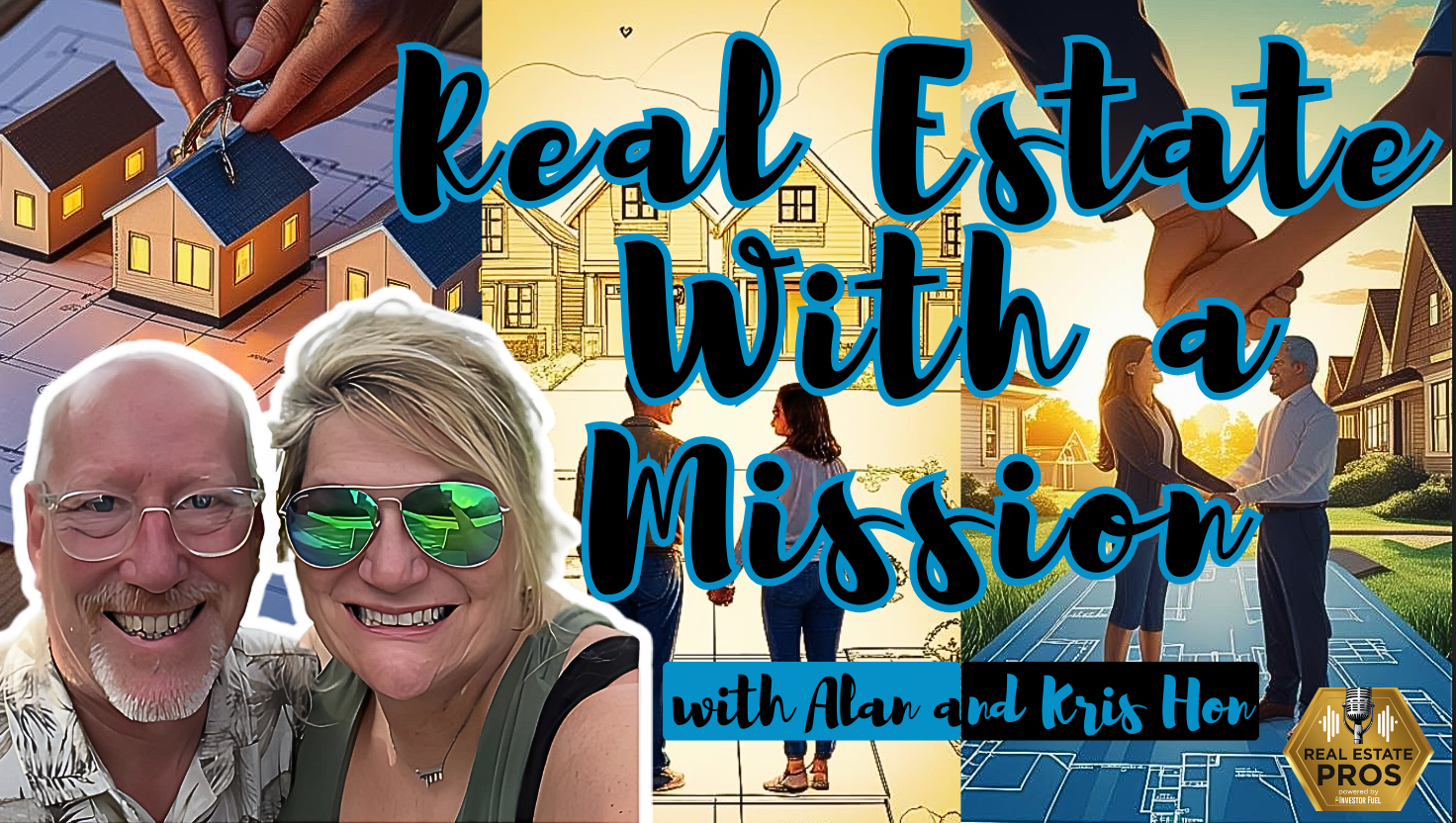
In this episode of the Real Estate Pros podcast, Kristen Knapp interviews Alan and Kris Hon, a dynamic couple in the real estate industry. They share their journey of developing a passion for helping others, particularly veterans and single parents, navigate the challenges of home ownership. The conversation delves into their nonprofit initiative aimed at providing affordable housing solutions and the systemic changes needed to support these underserved communities. They discuss various down payment assistance programs and their vision for creating a supportive community for veterans. The episode highlights the importance of compassion in real estate and the couple’s commitment to making a difference in people’s lives.
Resources and Links from this show:
Listen to the Audio Version of this Episode
Investor Fuel Show Transcript:
Alan and Kris Hon (00:00)
I come from a family of a long line of veterans and I knew that I would never serve on the front lines, but I wanted to find a way that I could help those that did because I’m incredibly grateful for my freedom and I’d like to pay back those who have protected it.
Kristen Knapp (01:48)
Welcome back to the Real Estate Pros podcast. I’m Kristen Knapp and I’m here with Alan and Kris Hon, a real estate power couple. Hon is a licensed realtor with nearly 20 years of experience as a designer, contractor, builder, and investor. And then Kris is a seasoned mortgage loan professional specializing in housing affordability and economic mobility programs.
Thank you for being here today, you guys.
Alan and Kris Hon (02:10)
Thanks for having us. super excited. Thank you, Kristen.
Kristen Knapp (02:13)
Wonderful. So let’s start at the beginning. How did you guys have developed such a passion for helping others?
Alan and Kris Hon (02:21)
About 20 years ago, I bought my first house with…
$5,000 down and I had six months to get my credit together and I bought it on a lease option purchase agreement and it made me realize that there’s probably a lot of people out there that could benefit from housing and I started doing flipping houses and buying distressed properties and fixing them up. And through that process, multiple times the neighbors would come up and thank me because I typically bought the cheapest house in the best neighborhood that may have been boarded up and maybe didn’t have a front
Kristen Knapp (02:38)
Okay.
Alan and Kris Hon (02:55)
on it, maybe raccoons were living in it, and I would buy these distressed properties and fix them up. And then when I met Kris, I found out that she had a similar passion for helping people as well.
I started in the mortgage industry not because I wanted to, but I kind of got strong-armed into it. ⁓ I actually operated a pre-foreclosure and short-sale negotiation company and helped individuals at the worst of times in their life. And as a result of ⁓ the work that I did there, a friend of mine suggested I think about getting licensed as a mortgage loan officer because once those individuals were able to purchase a home, who are they going to
Kristen Knapp (03:13)
Thank
Alan and Kris Hon (03:36)
go to this person that walked them through these dark times in their life to now help them in happier times. And once it happened that I did get my mortgage license and started financing people’s houses, I realized that was a whole lot more fun than helping people foreclose on their houses. So I ended up going the route of being a mortgage loan officer. And once I dug into it, what I found was individuals who had
Kristen Knapp (03:55)
us.
Alan and Kris Hon (04:05)
a little lower credit profile, a little less money to put down. Those individuals who needed compassion and someone to walk alongside them that other loan officers readily would kick to the curb were individuals that I could befriend and…
walk alongside and actually have very heartwarming stories at the end of it. And it made me feel good about what I could do. created a lending business with that concept. When I met my now husband, our very first conversation, we talked about our passions for real estate and for helping individuals finance and created this long term plan that was a business whether or not we stayed together dating.
And turns out we not only continue that process of that business concept, but are now married and can pour our passions into it together.
Kristen Knapp (04:56)
Really?
Alan and Kris Hon (04:57)
First date. Honestly, and
the truth is, a month into dating, he broke up with me. There’s a whole story behind that. we continued to talk about this business concept even after we had broken up.
And the very first property we purchased was along the model of doing this, which ultimately led us back together and ultimately to get married and move to Florida. But it was crazy how that passion to
Work in the real estate world and to help others is really what brought us back together Yeah, the goal then was to I first saw myself buying distressed properties fixing them up and then using that same lease option purchase agreement option She could we could put the person in there on a lease She could work with them for a year during during that lease to get their credit Worthiness up get their down payment saved up and then at the end of that year they could execute the purchase
option and purchase the home. So that was the vision to begin with.
Kristen Knapp (06:48)
I think it’s incredible that you guys both have such a shared vision on the industry, because I think a lot of people might look at real estate, particularly real estate investing, as maybe transactional or sterile. And you guys definitely have, you bring the humanity to it, and you’re really actually doing it to help people, which I think is fantastic.
Alan and Kris Hon (07:07)
Absolutely. That’s our goal.
Kristen Knapp (07:10)
And you guys focus on veterans and single parents. Can you talk about how these groups are left behind by traditional systems?
Alan and Kris Hon (07:18)
So personally, I come from a family of a long line of veterans and I knew that I would never serve on the front lines, but I wanted to find a way that I could help those that did because I’m incredibly grateful for my freedom and I’d like to pay back those who have protected it. So in addition to training two service dogs for combat wounded veterans, I did VA home loans and felt like that was a way that I could help them
to home ownership and frequently, not always, but frequently, veterans can have a lower credit profile and can use a little more handholding in the process to get credit ready to purchase a home. So that niche that I had fallen into in my mortgage business was awesome because I could pair that with veterans and then get the joy of celebrating their home ownership at the end of all of that. The single parent piece for
very similar reasons has come along.
But together, we both share a very strong passion for veterans and see the statistics of how many veterans are homeless.
on average, there’s about 30,000 homeless veterans right now that are sleeping underneath bridges or on streets. And these are people that took an oath to serve this country. sadly, my mom is not thankfully sleeping on the streets, but my mom was kind of a catalyst for me.
this push for veterans because although I’ve always had a heart for them and I always respected and honored the sacrifice they’re willing to make, I saw my mom looking for housing and living off of her VA benefits, she couldn’t even afford a decent place to live.
whether it be someone who’s grateful has a place to live, but
or all the way down to people who just can’t afford. There are so many people that are one utility bill away from being on the street. it just, over the last couple years, building on our desire to fix distressed properties or to help people, it’s just been an evolution of how can we either fix up distressed properties in a way that would get them qualified for a VA loan or start building our own properties and selling them to veterans.
So yeah, it’s truly not about how much revenue can we make, it’s how many people can we serve.
Kristen Knapp (09:40)
Absolutely, I love that.
Alan and Kris Hon (10:15)
a perfect example of what we want to do in the future. This gentleman came to me, he was a disabled veteran, he makes $1,200 a month from his VA disability benefit, his rent started out at $300, went to $400, became $500 and the landlord was going to kick him out unless he was willing to pay $900
a month rent because he could rent it to someone else for $900 a month, which I’m sure he can. But in the grand scheme of things, somebody who’s making $1,200 a month can’t pay $900 a month and still live their life. So he looked around for rental properties, wasn’t finding anything that he was qualifying for and thought, maybe it’s time for me, by the way, he’s 70. And maybe it’s time for me to now buy a house. And when I told him,
You can’t qualify for any house that’s available on the market that you can purchase with your income. And he was facing homelessness unless he found another rental space. And my heart just broke that I wasn’t able to assist him and that he’s someone who served our country as a disabled veteran in combat. And we’re just saying, sorry, I’m washing my hands of you and I can’t help.
Kristen Knapp (11:35)
Yeah, I mean, it breaks my heart to hear those stories and to hear the statistics of how many people are facing this reality. It’s just completely heartbreaking. And so when you work with people, could you kind of explain some of these down payment assistant programs or loan programs that people might not know about?
Alan and Kris Hon (11:52)
Sure, so as a mortgage loan officer.
I help to find individuals access to programs that are available right where they live. So in some cases, cities or regions will offer, say, there’s a city in Iowa that offers up to $35,000 for down payment assistance if they qualify. It’s usually a must purchase a home within a certain city or county limit and has a certain income level.
and has a certain credit score, where a lot of my borrower’s falter is the credit score capacity because they just don’t quite reach that threshold and get declined for said programs. Often I’m successful in helping them obtain those, but…
They’re either a flat amount of money, one program we work with is say $5,000 that they get just free of charge, or they can get up to 5 % of the purchase of the house as a forgivable loan over time. Some mortgage programs offer a silent second that just sits on the house and then when you go to sell it, you have to pay that particular amount of funds back. They’re modeled in a lot of different ways.
I’ve also partnered recently with the Habitat for Humanity which offers some amazing programs and in this case this young lady could get a loan that offered 0.07914 % interest on a house and she had to of course put in some sweat equity.
to help build the property, but she was able to get this financing to help her purchase the home. So there’s lots of models out there that we can follow and as a result of seeing what’s available, we were honestly inspired to think about what could we do to create our own program specifically designed around veterans so that we can hone in and help at least one population set and that’s the one that we’ve chosen.
Kristen Knapp (14:01)
Yeah, I mean, it’s so important. would love for you guys to get into this nonprofit that you’re building to kind of help, you know, fill in the gaps and help the people like, you you mentioned before.
Alan and Kris Hon (14:11)
Yeah, yeah, I mean another idea. So I’m a licensed realtor as well and I’ve got right now three veterans that have come to me through other friends, one of which was qualified for 110, one was qualified for 120, one was qualified for 150. And as I mentioned before, veteran VA loans have a…
process and an inspection process and they need to meet a certain standard and sadly you can’t find a house in that price point that’s going to meet that standard. So I’ve got three veterans that served our country right now that are pre-qualified but based on their income and other factors are only pre-qualified for amounts in Gainesville Florida the average seller price for the median sell price is $3.86. So that’s twice what this veteran is pre-qualified for. So the vision we have for our
nonprofit is to do some gap financing in that. So imagine our ability to build a home. if we can’t find a distressed property in a decent neighborhood, we can buy a lot, build a home, and let’s just say it costs us $200,000 to build that home.
that veteran who’s pre-qualified for 150, we would sell him the house for the 150. And then the other part of that would be a forgivable loan or some kind of credit to him. So let’s just say the standard is five years. So five years later, he can sell the house and not only have had the house, hopefully the house would have praised for more. So he’s got that equity, plus he would be able to capitalize on the gift that he was given through the down payment assistance or however we would structure that. But the vision is,
to build them affordably, make them energy efficient so they’re affordable to maintain, and then at the end of it provide gap financing to make sure that if they’re pre-qualified and they meet certain standards they can get the home.
Kristen Knapp (16:05)
That’s so incredible. I mean, that’s such important work you guys are doing.
Alan and Kris Hon (16:10)
Well, we feel like the clientele are important individuals, VIPs, that deserve to have this work done for them. And it’s truly our privilege to get to be the ones to serve them in that way.
Kristen Knapp (16:16)
Mm-hmm.
Absolutely, and you know when you’re thinking of kind of like the systemic changes that we need to make because you guys are doing such great work to fill in the gap,
what are some changes you would like to see systemically to you know help these this group of people?
Alan and Kris Hon (17:22)
Well, I would say for starters, we are aware of a few pockets that offer free land for purposes just like we’re discussing. There are areas that where cities or counties have some land that they have no purpose for, it’s going to sit vacant and they have no designs on building parks or maybe it’s in a place where they can’t do commercial buildings
or whatnot, and they’re just sitting on this land. So if cities or counties would assess the kind of land that they do have available to make available to nonprofits like ours, and then use that land for affordable housing and economic development for the individuals who have.
know, a profile of certain credit scores and can qualify to purchase homes. That would be a systemic change in our country that would initiate this kind of process. And I can’t believe that our idea is isolated to just us. I’m certain there are other people out there doing this. I’ve just not met them yet. But.
even if we were the only ones out there doing it, certainly other people would see that model and then start to do it as well because we’re only two people with the access to resources that we have and we can impact one person at a time. But if that were to be repeated and other individuals were to do the same thing, then we could impact more people in more places. Well, I can also tell you a roadblock that I did not foresee that is really not helping
is in some of areas that she’s talking about.
a lot of these lots are restricted in the size of the home that they will allow you to build. So the example would be this gentleman who’s qualified for $120,000. He has found several lots that are outside the city limits or even one that was inside city limits. And although he’s willing to live in a 400 square foot tiny house, the city will not allow them to build a house that small if it’s the primary resident on that lot. So you could do what’s called an accessory
dwelling unit in ADU and that could be that small but you’d have to have a primary residence on that same lot. So one of the challenges, one of the things that I’d like to see a change in is that cities and even counties would change that standard and be like as long as the house meets certain standards in terms of codes and you know that sort of stuff the size of the house shouldn’t necessarily matter.
Kristen Knapp (19:58)
I mean you guys know so much about, you guys cover the whole industry between the two of you which is like so impressive and you guys just know this sector so deeply which is just incredibly impressive. It must be so validating or just fulfilling to wake up every morning with such a passion.
Alan and Kris Hon (20:16)
Well, the passion is amazing, but if you keep hitting roadblocks, it could be very frustrating. So you just got to keep having the wherewithal to just keep pressing forward. And as you mentioned, maybe pressing for change. So I met with a local politician here in Knoxville, Tennessee recently who’s really going to start trying to spearhead some of these conversations in that community about changing some of those regulations. Because when I in my hometown of Moline, Illinois, I was on the planet.
and development council and these were the kinds of things that those councils could change. You could easily change the zoning or the restrictions of the zoning to be more accommodating for these kinds of things and it’s nice that they’re being more flexible on ADUs but that you have to have a primary residence for that so a veteran wouldn’t be he’d have to buy in essence two homes.
Well, you touched on the validating part and the reward part. To be perfectly honest, I cannot believe that I’ve been blessed to have a partner in life as well as business to be able to wake up and do this together every single day. You’d think we’d get sick of each other. We presently live in a van and are
are working on establishing our own residence where we feel God is leading us to do that. But we live in a van and we work together and we live together and you’d think we get tired of it, but it’s this kind of stuff that spearheads our desire to just keep looking for opportunities and problem solving and asking the right questions and networking and meeting people together. And man, when those doors start to open, we call them Godwinks and they
They just capitalize one upon the other and it’s like, yes, that was a win. And it starts to knock down those roadblocks one by one and start to see that vision realized for the individuals that in the end we hope are fortified.
Kristen Knapp (22:02)
Yeah.
Yeah, I mean, I can totally see both sides of it. can see how running into roadblocks, because real estate is tough no matter how you slice it. It’s not, I think a lot of people have a misconception about the real estate industry that it’s just like, you you can just buy property and flip it and everything’s fine and what you want to do, you can do. But there’s, mean, there’s so many roadblocks to doing this good work, but it’s that passion that drives you forward and keeps you guys together and working so wonderfully together, which is just so inspiring to see.
Alan and Kris Hon (22:42)
Yeah, ⁓
With the recent industry changes of availability of housing that’s out there, especially affordable housing and the interest rates, what they are from a mortgage lending standpoint that has put ⁓ a really big kibosh on the multitude of business that was there during COVID and the years when the heyday when people were offering 50, 60, $100,000 over asking price for houses. But the individuals we’re talking about are the ones that were left behind in all of that.
weren’t even able to put a bid on a house ⁓ because they didn’t qualify for the listing price, let alone having to volley for the increase in prices and standby and watch every offer they put in get denied. So now, as a country, we’re left with this residual of all of that. And we’re starting to see more and more
of opportunities for, like for example, the houses we’re looking to build are houses that we want to be able to repeat. They utilize a manufacturing system that is efficient and cost effective and we can build a model that’s customizable to a degree, but a model
sustainable for individuals that we can just repeat and my ultimate dream would be to create what’s called what I call a veterans village where we would purchase or have available to us a very large plot of land with a lodge in the center where
Programming and watching movies and socializing and playing cards and just the availability of lack of isolation is available to veterans and then around it are the individual plots of land they own with their own residence and can live in that community where people know and understand the life that they’ve lived and they can have comrades and their own private space all at the same time.
Kristen Knapp (24:23)
Yeah.
I mean, I think that’s a perfect goal. I love that. That sounds amazing. And can you tell people? Yeah. I mean, I see it. I see the vision for sure. I think it’s so necessary. It’s necessary. So how can people find you? How can people get involved with your mission?
Alan and Kris Hon (24:46)
Look at that someday, I’m sure of it.
Right now we are…
We’re working on the website because we’re working on the launch of the nonprofit, but we have ⁓ Facebook pages, Alan Hon and Kris Fish Kuhlmann. Mine is mostly centered on real estate investments opportunities, so this obviously would be one of them. Kris, hers is basically focused on lending. We are accessible through those mediums, Instagram, Facebook, those sort of things.
Kristen Knapp (25:05)
Mm-hmm.
Alan and Kris Hon (25:24)
Non-profit is going to be called veteran housing alliance. So hopefully I haven’t checked the domain even to see if we can get that dot com, but we’ll be pushing for that.
Kristen Knapp (25:35)
Amazing. Well, everyone, please look out for that. This is such important work you’re doing and thank you so much for being here today. It’s been wonderful.
Alan and Kris Hon (25:41)
Well,
thank you, Kristen. Thanks for having us, Kristen. Have a great day.
Kristen Knapp (25:43)
Thank you and thank you.
Thank you everyone for listening and we will see you next time. Bye.