Subscribe via:



Show Summary
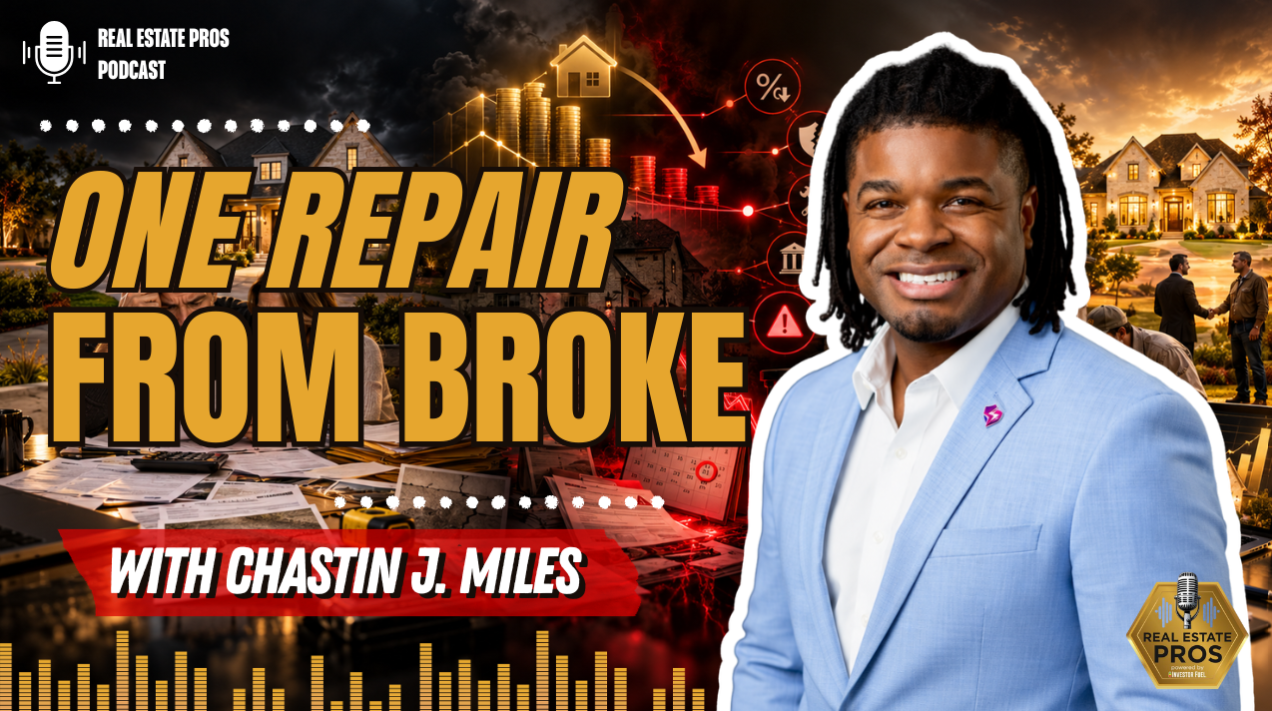
In this episode, Real estate entrepreneur and author Chastin J. Miles shares insights on the current market challenges, strategies for scaling real estate teams, and the importance of adaptability in a shifting economy. Tune in to learn how to navigate distressed seller situations, build a strong team, and leverage personal branding for success.

Chapters
00:00 Introduction
00:24 Distressed Sellers in North Texas
01:54 Why Buyers Are Sitting Out
04:37 One Repair Bill Away From Trouble
07:53 When Sellers Wait Too Long
09:19 Bought at the Peak & Now Upside Down
10:56 How Long Until Homeowners Have Equity?
13:53 Short Sales & Negotiating With Banks
17:10 Why DFW Is Still a Premium Market
20:58 Vacant Homes & Investor Opportunity
23:57 Rental Qualification Is Getting Tougher
27:45 Amenities Are Selling Communities
30:28 Chastin’s New Team & Upcoming Book
Resources and Links from this show:
Listen to the Audio Version of this Episode
Investor Fuel Show Transcript:
Chastin Miles (00:00)
So I am me personally am encountering sellers who have a desire to move due to some type of financial strain. So it’s not necessarily the leisure sellers like, I just want bigger home, or I don’t need all this space. It’s more so a I lost my job and we can’t afford this or
Look, taxes hit us. We bought new construction and we can’t afford it now because it’s just a lot. My escrow account is negative. The bank is saying that I need to supply it, So that type of situation. Insurance going up, insurance claims. we have horrible foundation issues here in North Texas and repairs, even, one repair bill. A lot of people are one repair bill away.
Dylan Silver (01:23)
Hey folks, welcome back to the show. Today we’re joined by Chastin J. Miles, a Dallas based real estate entrepreneur, licensed Texas agent, TEDx speaker, author, and CEO of Power Unit Coaching. Chastin, thanks for joining us here today.
Chastin Miles (01:38)
Thanks for having me. Excited to be here.
Dylan Silver (01:40)
What types of deals are coming across your desk these days?
Chastin Miles (01:44)
Great question. Actually, the types of deals that are coming across my desk aren’t my favorite type of deal. I’ll say that to start. But lots of deals where homeowners need to get out of their home. So on the listing side, prices have gone up, the economy has changed.
And we have a lot of homeowners who are in positions where they need to get out of their home and they would prefer to get out of their home quickly. However, we’re not in that type of market where homes are moving very quickly. And, a lot of them are kind of facing foreclosure. And so lots of pressure, lots of fast moving parts. But that’s what we’re seeing a lot these days here on my team specifically.
Dylan Silver (02:30)
you mentioned that prices are going up, and at the same time it’s more challenging to sell homes. And I’m seeing a similar thing. It’s interesting because you have so many builders, ground-up new construction happening that if you have a pre-owned home and you’re trying to sell that home, the a kind of good, reasonable expectation set is that there’s more competition for this home and that.
buyers can be pickier because there’s inventory out there right now. Are you saying the same thing?
Chastin Miles (03:02)
Yeah, that’s one advantage to the buyers, just the amount of inventory out there. But unfortunately, we don’t have a lot of buyers coming out the woodworks either. interest rates these days are not keeping people in such a favorable position when they’re considering buying a home and just sticker shock, someone seeing
a rate of seven percent, seven and a half, a quarter, whatever, is a turnoff for a lot of people. And so we have people who are saying still, I’m gonna wait till the market calms down. I’m gonna wait till interest rates lower. we have people who are hearing horror stories from a lot of consumers who did get into new construction homes maybe last year or the previous year and they’re getting their tax bills and
their taxes are insanely high because that wasn’t worked into the deal the right way. The lender didn’t prep them for what was to come when their taxes actually got generated because they’re buying a new construction home. And at the time they were just probably told or taxed on the land. So now that structure’s there, so we got a lot of horror stories going on.
For buyers, since this economy is affecting everybody in different ways, buyers aren’t really having they don’t really have that disposable income that they had before. they’re having to pay more for things outside of real estate. And it’s just trickling all across the board. And so, we have these sellers who want to sell, we have the buyers waiting around.
And it’s just not a great situation for anybody across the board.
Dylan Silver (04:42)
Yeah, you mentioned, a lifestyle I wouldn’t even say lifestyle creep. That’s what came comes to mind, but really just inflation in general. Now typically inflation is to the benefit of the homeowner, except when you’re trying to sell quickly and there’s not enough buyers, right? in this situation specifically, this is really where I cut my teeth. Before I was licensed, I was a wholesaler and finding people who had motivation
to sell. You mentioned, a pre-foreclosure scenario. walk me through without getting into the specifics, right, walk me through the various different levels of distress that you’re encountering sellers, right?
Chastin Miles (05:21)
Sure.
So I am me personally am encountering sellers who have a desire to move due to some type of financial strain. So it’s not necessarily the leisure sellers like, I just want bigger home, or I don’t need all this space. It’s more so a I lost my job and we can’t afford this or
Look, taxes hit us. We bought new construction and we can’t afford it now because it’s just a lot. My escrow account is negative. The bank is saying that I need to supply it, So that type of situation. Insurance going up, insurance claims. we have horrible foundation issues here in North Texas and repairs, even, one repair bill. A lot of people are one repair bill away.
from not having anything. And so, a lot of the banks, I’ve been speaking with a lot of bankers on behalf of my clients, trying to explain situations, explaining what’s going on with the home on the market. And the banks have been kind of unforgiving. I’m accustomed to banks working with you.
But these days, I guess it’s just so many of this situation going on or situations like this that the banks are running thin on forgiveness and just what they’re allowing to be done. And so, I don’t personally market for foreclosure listings, nor do I have a huge book of
homes that are in foreclosure that I’m trying to sell, I’m getting them typically a couple months away when they’re in that panic mode. But unfortunately, due to the market, our average days on market are not what they used to be. They’re creeping 70 to 80 days now for great quality homes, but since just the amount of inventory and everything that I explained before, homes are sitting a little longer. And so
The banks are kinda like, well, we’re not gonna hang on for much longer. so I would say those are the ones that I tend to get. And one other thing I’ll say is unfortunately they’re not at that point yet where they feel like they are ready to take an investor offer,
They’re still like, my home is worth this much. Look at the neighborhood, people are still moving here, this, that, and the other. And so they’re not looking for an offer of pennies on a dollar or they don’t feel like they need to get out next week until that time comes and then, they’re getting even less. But yeah, that’s what’s coming across my desk a lot lately.
Dylan Silver (08:05)
there’s such a thin line, right, between wanting to get the value of your home and denial. And that line typically starts to creep towards denial once you get closer to foreclosure. So you’re in pre foreclosure, you’re delinquent however many months, right? Now once you’ve got that foreclosure date set, you’ve got thirty days, your property is gonna be on the courthouse steps getting
auctioned off, it’s too late at that point, right? Because you mentioned 70 to 80 days. If you’re contacting a realtor and you say, hey, my house is scheduled to be auctioned off in 30 days, what can they even do in that in that time frame? So these people really have to have their ducks in a row, months in advance, once they start to sense that there is that distress that, hey, I don’t have any reserves left.
Everything is check to check. at that point in time, they’ve got to be looking at, hey, how do I sell this home? Not for, 60 70 cents on the dollar, but I can take, a 10% reduction off of top market value because I’m not in the same situation as those other folks that you mentioned in where they’re seeing their neighbor down the street and it’s selling for top market value because they had the ability to wait.
Chastin Miles (09:21)
Yes. And then something else to think about is when they purchased this home. anybody who purchased in the last five years, you purchased at a premium, probably above premium, especially here in North Texas, because we were having a huge surge where prices were higher than they probably should have been. And so even being in that position now where
you’re so still so relatively close to when you purchase to where you’re upside down. you’re not gonna make any type of profit. You’re probably gonna have to bring some money to the table. And so now we’re talking to your mortgage company about a short sale. when those people are getting right there on that line, a lot of the conversations that I’ve been having with their lenders are either short sale conversations
Or, can they get on some type of forbearance program or something like that? Because, the money just isn’t there. The money isn’t there, the value isn’t there, we were on a huge high for a while and now, things have kind of taken a turn.
Dylan Silver (11:06)
It’s all gonna depend, right? But if we just look at DFW Metroplex as a standalone area, how long does someone have to own a new construction home before they’re in an equitable position?
Chastin Miles (11:17)
Yeah, so that’s gonna depend on various factors such as their rate, the home price. I’ll say if you’re buying now, with where the prices are now, very competitive, you’re probably looking at maybe around three to five years to being in that good equitable state. If you purchase in anywhere from pretty much twenty to
twenty, four, twenty five, you’re on the other side of that because you purchased where you would like the home or where the home should be three to five years from now. And you owe more currently than what it’s worth. And when we talk about what it’s worth, I like to say just for ease of understanding, it’s worth what someone is willing to pay for.
Dylan Silver (12:01)
Yep,
just gonna say that.
Chastin Miles (12:03)
On
the real estate agent side, we determine the worth of the home based on the homes that have sold around them in the last six months or so. And so if the homes that have sold around you are selling for less than what you paid for it, less than what you think it’s worth, less than the value, technically that’s in line with what your home is valued at today, no matter what you paid for it. And
I don’t predict that this is gonna turn around anytime soon. Just we may get little breaks here and there, but this isn’t gonna turn around for at least the next couple of years. so with that being the case, you’re looking at more of like a five to seven year to where you’re probably in that equitable position, especially
If you’ve gotten any type of forbearances done or any type of refinances, for whatever reason you needed cash, any type of refinances, still we have a huge new construction boom here. That’s where a lot of our buyers are moving to, but new construction has been sold at a premium for the last few years. And there’s a lot of it. There is a lot of new construction inventory here.
the road is up ahead of you but it’s not gonna be anytime soon.
Dylan Silver (13:18)
Yeah,
and you mentioned short sales and I’m actually short sales certified through NAR, but being certified and then s actually taking a deal from the cradle to the grave and across the finish line are two different things. Short sales are tricky, right? and so for folks who are in that position, again, very, very thin line between something that can be a short sale and something that’s
ultimately gonna go into, foreclosure and get auctioned off.
Chastin Miles (13:45)
Yes, absolutely. And at the end of the day, it’s whether it’s what route the bank wants to take, there was a lot of buyers who have gotten loans through credit unions, just because of their attractive rates over the last couple of years. And the credit unions,
They’re kind of making their own decisions, as far as like, yes, we wanna allow this, no, we don’t want to allow this. it’s not like a set in stone, it can come down to the manager of the branch, the credit union, if they’re holding on to your loan. So unfortunately I haven’t been able to
say definitively to a seller, this is what’s gonna happen, this is what’s gonna take place, which is why I’ve been having lots of conversations with their lenders to try to work something out, which is not even my realm of expertise or role because it’s not something that I’ve had to do often over my tenure, but it’s moved me into a different
area of negotiation. I’m like me negotiating with banks and but unfortunately like I can’t tell anyone for certain what’s going to happen. a bank I can’t tell them that this home is going to be sold in the next 60 days because we have a seller who wants it priced here. The bank says we’re not going to take any less than this and they owe this much. So the best that I can do is
market it to the best of my abilities, try to get as many buyers in the home, get the home seen. We’ve been working with me personally and my team, we’ve been working with lenders who offer more creative and non-conventional financing to traditional buyers, such as like rent-to-own programs, taking lower credit scores, bank statement loans, things like that we would commonly see on the DSCR side.
happening on the in buyer consumer side, just to be able to make some deals happen, Yeah.
Dylan Silver (15:44)
I’m seeing a similar thing and I operating in a different space at a different level, right? And you’re seeing it in volume is that, folks who are looking for their on ramp into real estate home ownership. If we look at Texas in particular, we’re both licensed in Texas, you have more cost effective homes, but even still, on the average, you have to come up with that down payment, right? And then on top of the down payment, if you’re self employed
Right. You have to make sure that you’re not writing off so much in your taxes that you’re not showing enough income in order to qualify. So now you have more and more people who realize, hey, we’ve got some cost effective homes at and under 200 grand, depending on where you’re at in Texas. but how do I qualify? And so people are looking at, bank statement loans with 10% down and these types of non-QM loans in order to qualify for that first home.
Chastin Miles (16:34)
Yes, And more specifically in my market here in North Texas. if you look at any news headline about North Texas, Dallas, Fort Worth over the last few years, they’ve all been on the up and up booming home prices, rising, soaring. I like to say that DFW is a premium market in Texas. there used to be these
pockets where it was of course, more expensive to buy a home in Frisco or more expensive to buy a home here and there. But when it’s blanketed the city just because of the influx of people who have come to North Texas for work, for just this geographical location for the
home prices, this is cheaper than that area. That’s caused our prices across the board to increase in most areas here in North Texas. It’s hard to find a quality home in a lot of areas here. especially the more desirable areas are our average price point is around 400, 450 in most of the areas that people want to move to.
yeah, I can get you into the home, but are you okay with living in this area? And a lot of and not that they’re bad areas by any means. They’re just far. I think you had mentioned before we got on this podcast how one would talk about distances here and there and make it seem short, but no, you’re out there. And even the drive from
Dallas to an area like Denton or Anna to those areas, it’s a far drive. And a lot of people don’t take that into account. So when I show them around and they see the distance from maybe their job or from their, places that they like to hang out, it doesn’t stay so desirable to want to buy that home even at that price point. So what do they do? They just say, okay, I’m just gonna wait.
Dylan Silver (18:32)
What immediately comes to mind listening to this is and having lived in DFW is it feels like if you compare DFW Metro to the other majors in Texas, of course Austin, Houston, and San Antonio, and having lived in the greater Austin area and having lived in San Antonio, having lived in DFW, that DFW has, and again, this is just purely my own experience.
It feels like it has a stronger middle class presence, that there is more resilience to recession at the same point in time. you there’s the story that we’re both seeing of people who are realizing they bought too much home, that the repairs, insurance, taxes, the three forms of distress that you mentioned are causing.
the cost of homeownership to be beyond what they can comfortably do month in and month out. And so, what we’re seeing is while there is growth and there is a net positive migration to DFW, we’re also seeing that there’s a lot of people on the other side of that, right? there’s people who are having to leave, frankly, right?
Chastin Miles (20:15)
Yes, specifically on the investor side, which this may be good for investors, you mentioned that people are having to leave. We’re seeing a mass exodus out of North Texas right now of people who are doing just that, just leaving. who may have come here from another country and
They’re just saying, nope, I’m done with this. And they’re leaving everything and leaving the country. And interesting enough, we have thousands of just vacant homes, furnished homes, that were physically just left. Homes, cars, automobiles, their jobs, these people’s jobs ended up getting replaced.
for whatever reason or losing their job and instead of finding something else downsizing, trying to sell, it’s just, hey, America isn’t what I thought it was gonna be. It isn’t such a good deal. And they’re leaving. which is forcing, lots of foreclosures, sending these homes to auction, real estate agents trying to sell them. And
it’s very unfortunate, but I think that for investors, that may create a lot of opportunity. but it’s crazy that it’s happening.
Dylan Silver (21:29)
I can vouch for that. I know of this happening personally, having seen this and hearing now about this, even though I’m not in DFW any longer, which is you do have a huge and continue to have a huge population of foreign nationals who are working and living in DFW, but again, right as you mentioned, when there’s inflation in all things, not just homes.
it’s an interesting scenario, right? You have rents in many cases continuing to rise. some markets they’re dropping, like Austin, but in many markets, I imagine in DFW continuing to rise while at the same point in time homes are being harder to sell and harder to buy, you have more people renting and being put into what I would call,
Rent by necessity. That’s the term. Rent by necessity. They have no other option because for the time being at least, purchasing is out of the option. And so if you’re barely saving, if you’re barely getting by, if you’re seeing inflation happening and you’re also seeing wages not increase with that substantially as they haven’t been, yeah, people are gonna leave and people are gonna say, Hey, I’m heading back because this is tough.
Chastin Miles (22:35)
Yeah. I’m seeing it and it’s happening a lot. a lot of the multifamily property management companies have gotten extremely strict with qualifications these days, even on the rental side and for prospective tenants and it’s made things a little bit more difficult for
some tenants, we used to have a lot of communities who would take a blind eye to certain things, just like you have with anything. you can call a credit card company and ask for reconsideration for approval. So same things with apartment communities, but now we’re seeing less and less of that. And all in all, there’s a lot of creativity going on.
just across the board. obviously everything that we do is definitely by the book and i’m very resourceful when it comes to the people who i know and what types of programs lenders may offer and just management of different companies but there’s a lot of people out there doing a lot of
just interesting things to get into properties just because of how real estate is and what they’re projecting it to do and someone’s finances to do or tenant to do just based on what’s happening across the board. It’s a little unfortunate, but it is what it is.
Dylan Silver (23:55)
Yeah, that’s real estate, right? people have to always bear in mind and I think sometimes it goes underspoken to is that yes, when you’re buying a home, selling a home, when you’re investing, when you’re flipping, doing a short term rental, building apartment complex, right?
this is an investment, this is where you’re gonna live potentially, but you’re also building community, right? And you’re building community. And I think right now we’re seeing this across the country, not just in Texas, not just in the Sunbelt, but wherever you are, people want to feel like in their nucleus, in their apartment complex, in their, HOA, which is so big in Texas, right? That they have that community. And so what’s selling
these apartment complexes is the amenities and in many cases what’s selling the home is not just the home and the comps around it but what that community offers on top of that I see it I’m sure you see it lots of communities new communities being built by corporate builders that have more than simply a home and an entrance they’ve got the amenities they’ve got
a nice looking pool. They’ve got, right, an elementary school that’s being built around the corner. I remember living in San Marcos, outside of Austin and seeing something very, very similar, right? Where you have like a whole subdivision and a whole community, school go up, basketball courts, pickleball courts. I like the joke that if you see pickleball courts, that’s a sure sign that real estate’s coming over there. So it’s a community thing and
When you have people that are unable to continue living in that area, that does affect, if nothing else, morale, right? And we see it and it certainly it goes into the equation of, what’s really happening here in this neighborhood.
Chastin Miles (25:39)
Yes, you hit the nail on the head and I commonly educate people, when we’re talking about new construction or when we’re talking about apartment communities, I like to say we have a lot of mass production builders, so a lot of the homes are aren’t very unique.
For lack of better terms. similar floor plans, even in apartments, lots of apartment communities, the floor plans are the same. Lots of the homes are starting to look the same and have the same feel inside. However, it’s the amenities and the investment into these amenities that are swaying buyers and tenants one way or another. think I remember growing up,
We had maybe a swing set in our community, a swing set, possibly a pool. Now you have full-on water parks, you have community centers, you have communities with their own grocery stores and markets inside of them. you have apartment communities with full-on offices, so you don’t have to go and get that co-working membership somewhere else.
movie theaters, they’re going all out to provide these amenities and experiences for their residences. having food trucks come in once a week just for the communities. those are the types of investments going into some of our new construction just to attract buyers and just to make those communities flourish. Now whether they stick around, I can tell you firsthand experience
A lot of them don’t stick around as far as like, yeah, they used to do this at one time, but now they don’t anymore. But those are the lengths that a lot of the builders are and HOAs are going to get homes sold in their communities because it’s also not a good sign to drive around a community and see for sale signs everywhere. So you hit the nail right on the head with that one.
Dylan Silver (27:32)
there’s so much there, right? And so much that we’ve discussed on the show here today. but you’re involved in so much else, right? I mentioned TEDx speaker, you have a book that’s coming out. You also are a coach and have a coaching business. what new projects or activities are you working on, these days and anything that you’d like to mention directly to our audience before we wrap.
Chastin Miles (27:55)
Sure. Thanks for giving me this spotlight here. earlier this year partnered with a real estate team that’s been a longstanding real estate team out in Central Florida. And I partnered with them to bring their operations here to Texas. And so I am currently building out
this real estate team here in Texas. we’re in all of the major markets, Dallas, Fort Worth, Austin, San Antonio, Houston. We’re always looking for great talent. We have an amazing compensation structure and plan where I’m on the hunt and scouting for leaders and also agents because, like you mentioned, I’m releasing my next book, which
All through my journey, I’ve been in real estate around 15 years now. And all through my journey, I’ve documented publicly what I was going through. I started out in YouTube back in back in 2015 was when I created my YouTube channel. And for the first little while on my YouTube channel, I was talking about how this business was a struggle.
me building this business has been a struggle. I moved here from Georgia to Texas, not knowing anybody in real estate or anything about real estate. And I got into the business because everybody said you can make a whole bunch of money selling real estate. And that was my exposure to it. Once I got in, I lost a whole bunch of money and found myself broke. My electricity was off in my apartment, not knowing what to do, how to build. And so
This book that’s coming out is actually the second installment of the first version that I released, which was What I Wish I Knew before I got into real estate. And I told a lot of stories of just everything that nobody prepared me for. I got into this business to make money. I didn’t think about all the money that I was gonna lose trying to build the business. And so this next one, What I Wish I Knew Before,
I sold a hundred homes is what the working title is. And this one is really about my journey after getting into the business on that road of hey, I’ve been in for a couple of years, but I’m really looking to scale. I’m looking to build that big business. Maybe you’ve been selling, here and there for the last couple of years, but you don’t have a consistent real estate business. your income still isn’t predictable.
You want to grow a team and you’re still operating solo because you’re so busy that you don’t know how to do it. All of that is in this book and it was a lot of the trial and error that I went through. I like to tell people you read any one of my books and it’s either gonna make you decide to not move forward with that plan you had or you’re gonna go full steam. So this second book is no exception.
And if you’re looking to scale your residential real estate business, this is a great book for that.
Dylan Silver (30:54)
Chastin thank you so much for your time today. Thanks for joining us.
Chastin Miles (30:57)
Thank you for having me.