Subscribe via:



Show Summary
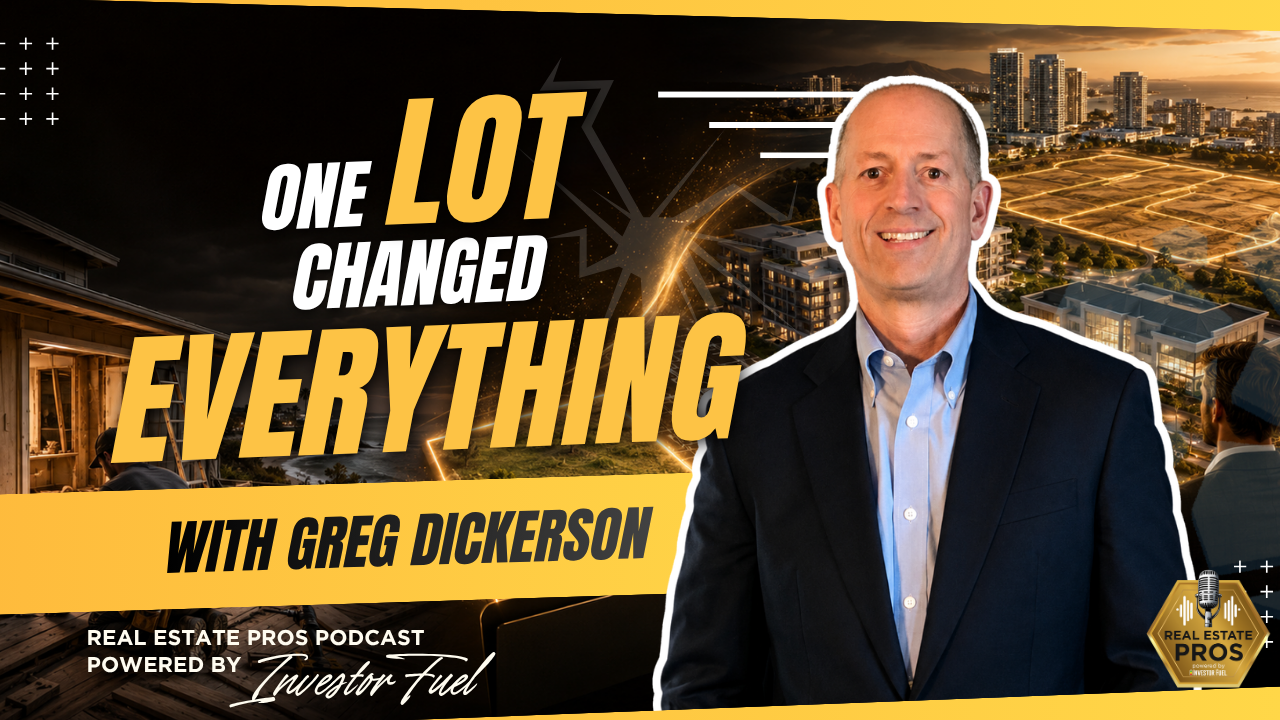
In this episode, Greg Dickerson shares his 30-year journey in real estate, from handyman to successful developer and mentor. He discusses opportunities in the market, the importance of education, building effective teams, and how to network effectively to grow your real estate business.

Resources and Links from this show:
-
-
- Investor Fuel Real Estate Mastermind
- Investor Machine Real Estate Lead Generation
- Mike on Facebook
- Mike on Instagram
- Mike on LinkedIn
- Greg Dickerson’s Website
- Greg Dickerson on Facebook
- Greg Dickerson on X(twitter)
- Greg Dickerson on Instagram
- Greg Dickerson on Youtube
- Greg Dickerson on Apple Podcast
- Greg Dickerson on LinkedIn
-
Listen to the Audio Version of this Episode
Investor Fuel Show Transcript:
Greg Dickerson (00:00)
I never built a house before I built a house. I didn’t know how to do it, didn’t know what I was doing. So I wanted to be one of the largest builders in the area. I wanted to be build million-dollar beach houses. I never built one. I had no clue.
I was changing screens and door locks and fixing decks and things like that. So what did I do? I went out and hired professionals that have been doing it for 20 years at the highest levels. And I brought them on board to run the business for me, and I coached them to success.
Issa Hanna (01:58)
Welcome back to another episode of the Real Estate Pros Podcast. I’m your host, Issa Hanna, and today I have Greg Dickerson, a huge wealth of knowledge in the real estate space, and I’m here to pick his brain. Greg, welcome.
Greg Dickerson (02:10)
Hey, thanks for having me.
Issa Hanna (02:12)
I am super excited to have you. You’ve been in the game since ninety-seven, so coming up on 30 years. You’ve seen it all. You’ve seen the Clinton days, you’ve seen the boom, you’ve seen the bust in ’08, the market catching back on fire after COVID, and then you’ve been able to mentor a lot of—a lot of big names in our space. So I’m super excited to have you. But with that, can you kind of run down your day-to-days today, what you’re mainly focused on right now and today?
Greg Dickerson (02:40)
Yeah, now I do fewer, bigger deals. Last few years, mostly land, just kind of serving the demand in the market. There’s huge demand for housing. There has been. We don’t have enough units. We can’t build our way out of the shortage of housing. So builders need lots, and developers need land and entitled land. So I’ve been working a lot with entitlements, but working a lot with land ground-up development, things like that. Background over
30-year history: I started out as an entrepreneur, remodeling handyman contractor, became a builder, then became a developer, started and exited a dozen different companies along the way, mostly ancillary to the construction industry. So now I’m on the board of a couple of companies, co-founder of a tech startup. So I’m still an entrepreneur by nature. I just landed in the real estate and construction space and spent the bulk of my career there. So now I’m a little bit more broad
in terms of what I do from a business perspective. With—with the mentoring I do, I’ve got people all over the—all over the world doing all kinds of different things. So I help people in the real estate industry and construction industry, but also outside of that in their different companies, helping people kind of grow and scale their companies with leadership, mentor scaling their business, things like that, preparing for exit. So a little bit of everything, that’s just me in a nutshell. I’ve kind of always been a multi-business kind of guy, multi-deal kind of guy, done
pretty much every type of real estate you can think of: commercial, residential, multifamily, land, industrial. So I like to stay busy and I like to do a lot of different things.
Issa Hanna (04:04)
I love that. And you described yourself as a serial entrepreneur in your bio that I read, which is something we all are when we get bit by the real estate bug. You guys—and I said that earlier when we were talking—you construction guys, you started as a handyman, you got into the construction, you learn the game from such a ground-up level that inside and out, literally, when you decide to get in and become an investor. So
the fact that you were able to be so successful over the 30 years, I definitely don’t doubt that. I myself an amateur investor, my father is a construction guy, and I know how valuable it is to have that knowledge. So—and I love that you’re mentoring people now. Once you reach a certain level in our industry, and it’s something we’re doing through this show, we like to give back to the industry. We like to tell people, “Hey,
you can make this money, you can do these deals, it’s possible.” And we like to share our information for the next generation in our industry coming up. So I love that you’ve decided to do that and take your knowledge, because it’s one-of-a-kind, and bring it to the masses.
Greg Dickerson (05:54)
Well, that’s how I learned. So I learned by doing projects for other investors that were buying houses, renovating them, renting them, selling them, building spec houses, things like that. So that’s how I got started.
And I’ve educated myself. I didn’t go to college. I went in the Navy right out of high school. So I learned the hard way, but I’m very highly self-educated. I’ve spent hundreds of thousands of dollars on my personal and professional development over the years, with different programs, different courses, different seminars. I brought consultants into my companies over the years to help us grow,
so it’s something you always have to do. And like I said, I mentor people, coach and mentor people all over the country. I’ve got several clients that are in your program, because you can—you can never stop learning, right? There’s always something you can glean, something you can gain from all these different environments. I do one-on-one; yours is a mastermind. So you’ve got all kinds of different—the collective group coming together, which there’s a lot of power and benefit in that. So that’s really the key. Without
the education component, not just in myself personally, but in the industry in general. And like you said, starting from the ground up, learning everything I could about the business, it’s all about education. It’s all about what you know and if you don’t know it, you gotta find the people that do and surround yourself with the people that do.
I never built a house before I built a house. I didn’t know how to do it, didn’t know what I was doing. So I wanted to be one of the largest builders in the area. I wanted to be build million-dollar beach houses. I never built one. I had no clue,
right. I was changing screens and door locks and fixing decks and things like that. So what did I do? I went out and hired professionals that have been doing it for 20 years at the highest levels, and I brought them on board to run the business for me, and I coached them to success.
So that’s really, at the end of the day, 30 years ago, that’s what I’ve been my whole career. I’ve been a coach, I’ve been a mentor in all of my businesses, and people started coming to me and asking me for help. So then I started doing that as a business
in addition to my other things. So that’s kind of how that evolved. But at the end of the day, you gotta surround yourself with people that know what you don’t, have the things that you don’t have, so that you can learn from them. You can bring those resources and opportunities together, and that’s where you can really scale and really grow exponentially.
Issa Hanna (08:06)
One hundred percent. You see it with the great teams in sports, right? Everybody has—fills in each other’s weakness. You’re moving as one cohesive unit. This is your business, real estate investors. We’re constantly dealing with the contractors, we’re dealing with all different kinds of professionals. If you have a good team, it makes things run so much smoother. So, Greg, you’re already dropping golden knowledge on the viewers and on me, so I’m over here all ears to this,
just ready to soak it up from you. I wanted to rewind it back, though. So you said ’97, you started as a handyman. And I did actually want to pull out one thing, too, before we get into that. Give me a guy who is like Greg and learned it from the ground up, I’ll take him a hundred times over a guy that went to school and just read about it on paper. When you learn it through the fire like that, the process,
nothing’s ever a big deal. You don’t freak out. I just wanted to kind of highlight that. But I wanted to get your “I got into real estate” story, because I kinda stumbled into it and realized I could make some money. So what’s yours?
Greg Dickerson (09:13)
Well, so like I said, I was working for some investors that were coming to my area. I was on the Outer Banks of North Carolina. It’s a short-term rental vacation market before Airbnb and VRBO and all that was a thing. So they were coming down, they were buying these million-dollar beach houses and hiring me to put additions on them and, closing the ground floors, put pools in, things like that. So I started learning from them about the business, what they were doing.
And along the way, I started making some money. I had a friend of mine who was a realtor. I didn’t have a real estate license back then at the time. And he came to me and he said—I’d owned some homes, but res—that I lived in, but my realtor friend came to me and said, “Hey, there’s a lot over here that we can buy. You put up the money, I’ll do everything else, and we can flip it, make some money.” And I’m like, “You could do that?” And he said, “Yeah.” I didn’t even know you could do that. I’m like—because it was like a 30-day period, right? And I’m like, “Okay, sure.” So
I know, it might have been a hundred-thousand-dollar lot. I can’t remember. So I put the money up, we took it down, and he sold it within 30 days to another client that he had. We made $30,000. We split that, $15,000 each. And I’m like, that was the quickest, easiest money that I’d ever made. So the light bulb kind of went off, and then I started going around and tying up land all over the place. And then I would flip the land to investors and then build them the house. And that’s kind of how that all started. And
and then I started buying some houses and kind of keeping them and renting them, and I’d build them, rent them for about a year. They were always worth more after a year than they were right away. Plus, it was a long-term capital gain situation. So I started doing a little bit of that. And then I started getting into doing some commercial development, and then I started getting into some multifamily, and it just kind of evolved from there. But yeah, it started with that one little lot flip. That was my first like real estate deal that I ever did.
Issa Hanna (10:57)
Definitely, we get bit by the bug, which is usually that nice big check, and we’re like, “Wow, I can do this.” And then over the years you get to scale, like you said, you got into commercial, all these different facets that you learn about and you get to be so knowledgeable. And now you’ve switched it to a mentorship program. So I want you to kind of tell us about the history, why you started it, what just made you want to give your knowledge to the masses.
Greg Dickerson (11:23)
Well, again, that’s what I’ve been—number one, because I can. I’ve got so much experience in so many different things, from scaling businesses, starting businesses, into all the different aspects of real estate and development and things like that. So I’ve got the skill set. I’ve been a coach and a mentor my entire career in all of my businesses, that’s really what I did. Once I evolved and I stepped out of the field and out of the day-to-day, all I did all day long was coach my team and mentor my employees.
I was involved in a lot of other things in the community as well. So it reached outside that, coached youth sports, all those types of things as my kids were growing up. But it really came from being that in my business and realizing that that’s really what I was. I love building people, I love growing organizations and teams and helping people reach their goals and be successful.
And along the way, I’d done some podcasts, people had interviewed me, and I had people reaching out wanting me to coach them. And I said, “Well, I really don’t do that.” And they’re like, “Well, I’ll pay you.” And I’m like, “Well, okay, maybe we’ll give it a shot, see how it goes.” Well, my first client was Joe Fairless, and a lot of people know Joe Fairless. He’s the Best Ever real estate apartment syndication book and show, and now he’s got the whole Best Ever organization and they do a lot of different things. He started out as a house flipper, and he wrote the Best Ever real estate investing book,
and then he got into multifamily and now they’ve—they have a commercial division. And when I met him, he had a few hundred million in assets, and we helped him get to a billion, helped him double his portfolio. But it started with guys like Joe Fairless. And then I’ve had people that have never done a deal that I’ve helped that are in your program now. I had a couple that were flipping houses, never made more than a couple hundred thousand dollars in a year, and
first year with me, they made over a million dollars flipping houses, because I showed them how to scale their business, put systems in place, and things like that. And they ended up joining your program, because again, you can always learn more and develop, things like that. But that’s kind of how it evolved. People were just reaching out, and then I really enjoy it. I get to work with people all over the world doing all kinds of different things. I’ve got people again flipping houses, doing land, doing big commercial multifamily syndication, doing
businesses. I’ve got some people I’m coaching that aren’t even in the real estate game. It’s just in their companies and helping them grow and scale their companies, because it’s all about becoming a leader, delegator, motivator, and building the right teams, the right butts in the right seats, and coaching them to success. And it’s just a skill set that I’ve always had that I’ve implemented in all my businesses, so that’s kind of how it evolved. And I just—I just love it. It just fills me like nothing else. Like doing that, I get more enjoyment out of coaching
people and watching people succeed than I do building businesses and doing real estate deals. It’s just—it’s just different.
Issa Hanna (13:56)
One hundred percent. It’s almost like a youth football coach, or a football coach in general, who gets the satisfaction out of seeing his players succeed and win the championships that he coaches them to.
Greg Dickerson (14:06)
Well,
on that, I had girls, so I coached all my—all my kids’ sports growing up. And on that note, when one of my daughters, my second daughter, was probably eight years old, she was on a basketball team. And the way it worked back then, you just kind of like, all your friends get together and you’re on the same team, and nobody wanted to coach it. And I didn’t know anything about basketball, really, from a coaching standpoint, so—but I said, “Yeah, eight-year-olds, I’ll do it.” Well, we didn’t have a very deep pool of talent. We lost every single game
until our last game. We won that last game, and you would have thought we won the NBA WNBA championship. It was—it was, the kids were just so excited. They finally won a game. And it wasn’t because I was a bad coach, which I didn’t know really what I was doing, but they’re little kids, and they just—we just didn’t win any games. Anyways, we win that last game, and the parents are all like, there’s this tournament coming up, right? And they’re like, “Do you—do you want to enter the tournament?” I’m like, “No, let’s go out on the win and let’s just leave it alone.”
And it was just—but that was like, I remember that for the rest of my life. That was like one of the greatest wins ever, and watching those kids and how excited they were, and yeah. There’s nothing beats being a coach, man. It’s just—it’s an incredible feeling.
Issa Hanna (15:16)
Definitely. You’re leading people to success. And in the real estate industry, you’ve had guys in our group, like you said, haven’t done a deal, and then you’ve scaled them up, you taught the ropes. There’s no shortcuts in the game, but having somebody like Greg, guys, can definitely give you such a leg up. You don’t have to make those mistakes where you lose thousands of dollars and
all this stress. You’re gonna hear those stories joining a mastermind, you’re gonna—you’re gonna hear the story from guys who’ve been there, done that, lost it. And if you could learn from other people’s mistakes in our business, it’s a great skill to have. Don’t go after the shiny objects, that’s something I’d like to throw in there, too. Sometimes make sure if it makes dollars, it makes sense. Greg, I wanted to get your advice now on
building business relationships, because our industry thrives and depends on growing your network. So if you had to tell a guy just getting into the game one piece of advice you had to give him on starting, getting the ball rolling on the business relationships, what would you tell him?
Greg Dickerson (16:16)
Yeah, you—you’ve got to be networking. You got to get out there, put yourself out there, meet people, be of service and help to other people, and—and network effectively. So, what by that is know the room that you’re gonna be in. So dress appropriately for the occasion, right? Introduce yourself. Don’t look for how much you can get from everybody you meet. Be more of, “How can I serve everybody I meet?” right? It’s all about being
valuable to other people, interested in other people, learning more about other people and their businesses. The more you listen, the more you learn, the more you gain. So you want to ask really good, deep questions. You want to ask follow-up questions. The biggest mistake a lot of people make is they’ll ask somebody about their business and then they don’t follow up. So you always want to, “Hey, tell me more about that. How did you do that? Well, how did that come about?” Like you said, “How did—how did that first deal happen?”
And then once you get in there, just keep drilling down. “Well, tell me more about that. Well, that’s interesting. How did that evolve? Well, what happened when you did this? Yeah, why are you in that market? Why are you on that street? Why did you do this type of deal?” You want to just ask those deeper questions. So look the part, ask good, informed, intelligent questions, make sure you understand what you’re asking and who you’re speaking to. Know your audience, know the environment, dress appropriately.
And make sure that you follow up, right? And here’s a big one: Never ask anybody if you can pick their brain, right, because that just—people don’t like that. It’s off-putting. It sounds exhausting. So never just walk up to somebody and say, “Hey, I’d love to pick your brain about this.” What you want to do is, if you have an opportunity or something like that, you want to say, “Hey, I’ve got this opportunity. Would you mind taking a look at it? I’d love to hear your feedback on it and see what you think.” If you want to learn something from somebody, “Hey, you’ve been really successful in your career.
Is there anything you could tell me? I want to be where you are. What would you tell somebody like me just getting started trying to achieve what you’ve achieved and trying to get where you are?” Those types of things. You want to show respect for the individual. You want to make sure that—that you understand who you—who it is you’re speaking to and just be a good listener, ask good questions, figure out how you can be of service to people.
And then just go put yourself in these rooms and these environments and then follow up. That’s the other thing that a lot of people drop the ball on, not only in the networking, but in the real estate business, right? How many people mail out 10,000 mailers and never follow up on anything, right? Follow-up and follow-through is the key, so make sure that after you go to a networking event, after you meet somebody, send a follow-up note. “Hey, it was really great to meet you the other day. I really enjoyed chatting with you. Thank you for your advice on XYZ. Would love to grab,
buy you lunch sometime, grab you coffee.” And that’s the other thing: If you ever invite anybody out to lunch or coffee, buy—pay for it, or dinner, whatever it is. Make sure that you treat. I can’t tell you how many people over the years have invited me out somewhere and they didn’t treat. Now, it doesn’t really matter to me, but it’s a huge social faux pas. Make sure that you understand that’s what by understand how to network effectively: Dress the part, speak the part, know your audience, know your room,
follow up, follow through, and if you’re the inviter, make sure you pick up the tab.
Issa Hanna (19:19)
Amazing golden advice. Spot on. In other words, guys, be pleasantly remembered from your first introduction. Ask questions. It’s not what they can do for you, it’s what you can do for them. And then the follow-up. I love it because we do get almost echoes of the same advice of the first part of what you said, but I love how you emphasize the follow-up. Follow-ups are key, guys.
When people are remembered, they remember you and like I said, they’re pleasantly reminded by your first introduction. You follow up with them, they’re gonna—that’s the guy I met last month at the real estate event. Yeah, let me—let me reply to him. That’s the first reply that you’ll get with is with the follow-up. So I love that advice, Greg, and thank you so much for sharing it with our viewers. I feel like it was one of the most eloquently put piece of advice is on growing your network.
You just said it so spot on, and I can see now why you’re a coach and you’re a mentor. I’m gonna start calling you Coach Greg. So how about the future? I look you up in five years: Are you—are you still doing the deals, are you more focused on mentoring, are—are you still kind of doing the same thing, or are you slide—sliding out and riding off into the sunset? What does it look like?
Greg Dickerson (20:32)
All of the above. So I just take it day by day. I don’t really look at what’s the one-year, three-year, five-year plan at this point in my life. I’ve—I’m 30 years down the road, I’ll be 60 next year, so I’m just enjoying life. I take the deals and opportunities as they come. As far as coaching and mentoring, as long as I can do it, I’m gonna keep doing it. It’s so much fun and it’s so fulfilling, and I just love helping people and
and we’ve had some very challenging environments over the years. We had—I wasn’t coaching as a business back in—back in the bust years. The first housing bust we had was ’95, right? ’95 through the early 2000s, and you had the dot-com bubble, and then you had the ’08, ’09—went through that—then we had the COVID thing. And now you’ve got interest rates skyrocketing again, and that’s putting people under a lot of pressure, and the housing market’s kind of been ebbing and flowing, and it’s
it’s very challenging in some markets, but it’s still very good in other markets. It’s—real estate’s hyperlocal. Every asset, every type, every area, they’re all different. So there’s opportunities and there’s challenges in every single market, every single market cycle. So it’s really fun and fulfilling for me to kind of stay on top of all that and just kind of navigate through. So what will I be doing next year? Well, it depends on what the opportunities are, what the market looks like, what the demand is, what the
challenges and opportunities are, and things like that. But I know that no matter what, I will be helping people as long as I can.
Issa Hanna (21:52)
And now if people wanted to get ahold of you and—and they did want to join your mentorship program or just check you out, where could they check you out at?
Greg Dickerson (22:41)
Yeah, gregdickerson.com. That’s where all my information lives. I’ve got a YouTube channel, podcast, all the social media handles—it’s all on gregdickerson.com. I’ve got tons of thousands of videos on YouTube all organized into playlists on all the different types of real estate, and on leadership, mindset, business acquisition and growth, and things like that. So valuable resource there, so it’s gregdickerson.com.
Issa Hanna (23:05)
Make sure to go check out gregdickerson.com. Just by talking to Greg here for about 20 minutes, he’s dropped some golden knowledge on us, so I’m sure that is a library full of great real estate knowledge to know, real great business knowledge to know. So make sure, gregdickerson.com, go check out the podcast, because like I said, you’re gonna gain a lot of knowledge, just like you’re gonna gain a lot of knowledge from our podcast. Greg, thank you so much for coming on the show.
You brought so much to the show. I’d like to invite you back on at a later date if you’d have us.
Greg Dickerson (23:40)
Yeah, absolutely. I appreciate you reaching out and I’d be happy to come back.
Issa Hanna (23:45)
Good. And to my viewers at home, if you enjoyed our conversation with Greg and want to see more like it, make sure to hit like and subscribe. I talk to people every day that can bring us different knowledge on every aspect of the real estate industry. Until next time, The Real Estate Pros are out.