Subscribe via:



Show Summary
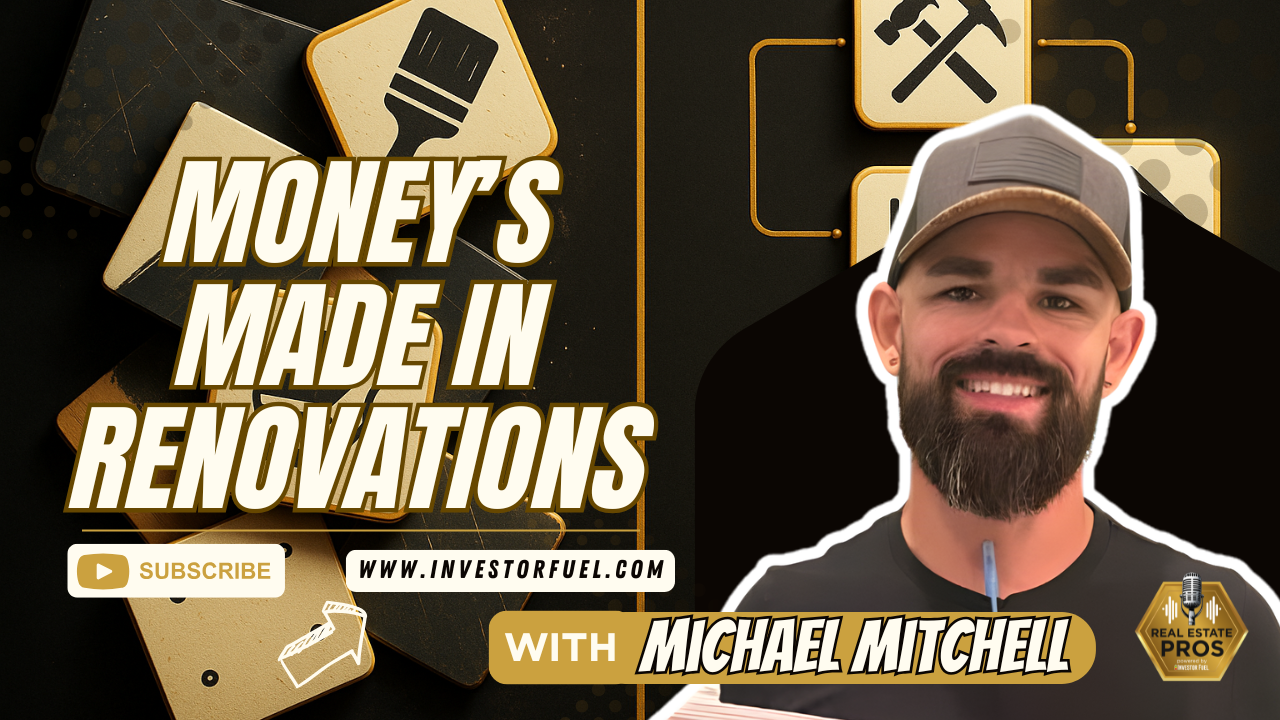
In this episode of the Real Estate Pros podcast, Michael Mitchell shares his journey from being a general contractor to a successful real estate investor. He discusses the challenges he faced in the renovation process, the importance of project planning, and the lessons learned while scaling his business. Michael also introduces his innovative software, Remodel Estimator Pro, designed to simplify the renovation process for investors, ensuring accurate project planning and budgeting. The conversation highlights the messy reality of real estate investing and the importance of perseverance and adaptability in achieving success.

Resources and Links from this show:
-
Listen to the Audio Version of this Episode
Investor Fuel Show Transcript:
Michael Mitchell (00:00)
Yes, absolutely. So what I notice a lot with investors is they really struggle in the renovation process. It’s the biggest lie that the money’s made when you buy, because that’s great. You might buy a great deal, but if you don’t know…anything about a renovation, you can go sideways real quick. can lose a lot more money on the renovation than you ever can. And so what I’ve noticed is that with a lot of the people I consult with is that they have no idea what a project plan is. They have no idea that a project, there’s like a sequential order demo framing.
really when you buy a house or renovate it, that’s like 15 jobs inside of one.
Kristen (02:06)
Welcome back to the Real Estate Pros podcast. I’m Kristen and I’m here with Michael Mitchell, who is a general contractor turned investor. And he has a really exciting software platform in the works called Remodel Estimator Pro. So we have a lot to get into today. Thank you for being here, Michael.Michael Mitchell (02:21)
Hey, thanks for having me.Kristen (02:22)
Amazing. So you have a really impressive story. You have been able to scale your doors really well. I mean, over the course of four years, you’ve been able to secure hundreds. walk us into, like, tell us about your background, how you got into this industry.Michael Mitchell (02:36)
Sure.many years ago, I always wanted to be in real estate investing. I took Robert Kiyosaki’s course, I it was like a thousand bucks. It was the last thousand dollars I had. And the only thing I got out of that was ROI. And I went to the smartest guy I knew and I was like, dude, what is ROI? It’s like return on investment. was like, make it simple. Like, what do you mean return on investment? And so that, that was my claim to fame is I took ROI and kind of ran with that to, to slowly get into real estate investing. But I absolutely
Kristen (02:46)
Yeah.Michael Mitchell (03:05)
absolutely feared renovations because I didn’t know how to do it. I had no idea. So 2013, I started a general contracting company working for real estate investors, helping them on their properties and, you know, watching them either flip or turn to rentals. Well, after a few years of that, well, first I got trapped as being a general contractor because that was my bread and butter. That’s how I’d made money. And I didn’t know how to come out of it. So now I created this business that II
felt trapped in, you a lot of times the entrepreneur occurs, you start a business because you want life freedom, you want to do the things you love to do.
And there I found myself in this Will House, dude. And it’s like we’re pumping out a lot of volume and we were running awards and all this stuff. And it was really cool. But I was losing my soul slowly because I knew it wasn’t on the path I was supposed to be on. But how do you take that next step whenever you have a family to feed, you got young kids? And I can’t say that business is perfect all the time because there was times we, you know, the first year we hit a million dollars, I end up losing like thirty eight thousand dollars and I just couldn’t make sense.
of it. So long story short, years went by, I kept working for investors, I seen them making money, but I also seen investors hiring other contractors and having major problems. And so I started going on Facebook pages and giving some real advice, like, I’d read through the comments and I’d see some problems that they’re having with the contractor. I’d read the comments, they’re like, ooh, that’s gonna get you sued if you do what that person says. So I’d get on there, give them some value. Well, after you do that for a few days,
the owner of the or the leader of the group reached out to me and said, hey, I want to actually have you on a podcast. I said, sure, let’s do it. And so at the time it was the best, most popular podcast at the time went viral. And through that, some guy from Abu Dhabi reached out to me on Facebook and said, Michael, I love what you had to say. Would you be interested in being a real estate investor?
Kristen (04:55)
youMichael Mitchell (04:55)
Andyou know, like it’s a good story all the way through, but dummy me, I was like, yeah, absolutely. Let’s do it. There’s no contract. This guy’s in a whole other country. And, and I, I accepted because I, there’s three parts to investing, right? It’s the FAR acronym. There’s a funding acquisition and renovation. Either you make up all three parts of those and you just run your own business. But a lot of times in the very beginning, you need to pick one, become really good at it, and then find the other two as partners bring in.
Kristen (05:00)
Of course, yeah.Michael Mitchell (05:25)
So in my case, I found a funding partner.He said he’d fund 100 % of everything if I found it and rehabbed it. No problem, say less. And so I went and found the house and that worked through with some realtors, found a pocket listing. We ended up flipping that deal. Then we did a few more together. Well, and then after I put some money in the bank account, I didn’t touch it. I didn’t go buy new shoes. I didn’t go on a cruise. I put it to the side and long story short with this guy, him and I are still good friends today, but I just told him, was like, look,
Kristen (06:19)
Wow. Yeah.Michael Mitchell (06:41)
I got the missing piece and so I’m going to go off on my own. was much longer conversation, but he was very excited for me. And so the moment I went off of my own, I met another contact where I could sell term key rentals to hedge funds. It was the easiest money in the world. It was so easy because I find a house and I’d say, Hey, Mr. hedge fund, you know, what, what will you pay for this? Give me 130,000. So as long as I was under those numbers, I could purchase it and rehab it and my holding costs.I knew I made money and so that that was really like the short story, but that’s how I got into investing And the start flipping
Kristen (07:10)
Mmm.Wow.
I mean, that’s such a great story. think like even in the beginning how you were very, didn’t, kind of ran into something you were unfamiliar with with renovations. That was like something you were unfamiliar with. So then you just ran head first into it. So impressive. And I think, you know, what you were saying about kind of being pigeonholed in your career, I think that’s something a lot of people feel and they’re, you know, how do you walk away from a paycheck? How do you walk away from something you’ve built? what, I mean, you kind of went through it, but like,
Michael Mitchell (07:44)
sure.Kristen (07:50)
What actually was your mindset? What was like the, I know that podcast changed your life, but what was really the final straw where you really kind of walked away?Michael Mitchell (07:58)
Hmm I You know they say the the treasure you seek is in the cave you fear to go into and Sometimes being a little dumb pays off because you you take some risk But even though you know in your your chest sometimes is a God-given dreamKristen (08:07)
Mm-hmm.Yeah.
Michael Mitchell (08:21)
You just gotta take that step just really out of faith and just know that everything’s gonna work out. You know, act as if it’s impossible to fail. It’s actually a really good book.As you start moving in the direction that you really want to go, things really do truly work out depending on how advanced you are in your skillset and how sharp your sword is will determine like how fast you get there. You know, some people are a little quicker. Someone like me takes many years of kind of going through the hoops and building that work and building connections and speaking as an investor. Really the truth is, is I said it so much. I’m a real estate investor. I’m a real estate investor that I believe that was my
identity. so, so naturally when I’m saying that and moving in that direction and the right person shows up and you know it’s the right opportunity, you got to take it. You got to take immediate action right then and, and go for it. You have to go for it. It’s very scary.
Kristen (08:58)
youYeah, and you made it.
Totally. And you make your own luck. think a lot of people might hear that story and be like, he got lucky. Someone reached out to him. But it was because he booked the podcast, because he put in the work, because you learned your skill, you know, thoroughly. So you put in so much work for that one thing to happen to really help you. So I think that’s also a really good lesson for people that you got to really be willing to work and go towards the path that you want to be on. And yeah, good things can happen for you and you take the opportunity.
Michael Mitchell (09:39)
to you.Kristen (09:44)
So tell everybody kind of where you’re at now in your investing journey. What happened after you went off on your own.Michael Mitchell (10:24)
Yeah, so in July of 23, I’m sorry, July of 22, I flipped all the way until July of 22. The market changed, the bank I was doing business with changed the way they were doing things. And they basically said that I had to go a different direction.that the people that I was flipping to just pulled out of the market because again, the market just shifted and people quit buying these turnkey rentals. So then had to go find another source and in July of 22, I was talking to a bank at the time I had seven flips. And so I ended up listing three on the market.
And one I made really good money on, better than selling to the hedge fund. The next one I broke even and the third one I lost like 10 grand. And then I had four hanging out that I couldn’t sell. Talked to a bank about like, what do I do with these? And they said, you can do a cash out refinance. Then a cash out refinance pulled out 30 grand, which was more money I was making on selling to the hedge funds. Like, wait a minute, I just cashed out refinance and I keep the property.
light bulb went off. I was like, why not? Why don’t I do this to all the properties? So I refinanced all of them, kept them as rentals. And then once I caught on to the generational wealth and the passive income, I kind of went,
a little too quick because we bought 30 properties in the first two months. And then by the end of the year, about 65. And then the next year, about another 50. And I just, it was the burr method. I still do the burr method. At first I was doing a lot of section eight.
I’m not sure if you want to get in some of the struggles and stuff I had in there come back to those Because I learned a lot during during scaling and it Came with the challenges for sure. So the first two years were Awesome, but rough, you know, cuz I didn’t have those systems. I had no processes I was just really fast at rehabbing houses and as long as I could pick them up we can rehab them and move on So leaves me in a day once once I built my
Kristen (11:57)
Alright.Michael Mitchell (12:19)
buy box. I’ve had the same buy box for three years now. I’ve never changed strategies. I’ve flipped maybe two houses in the last three years just because they’re pocket listings and made a lot of sense. But outside of that, I had no short-term rentals. I had no Airbnbs. It’s all long-term rentals. And then about a year and a half ago, I…ran into a guy who was talking about doing like lease options on properties. We give ownership to people, know, they pay the option to start buying the house. And I realized there was no maintenance and no management and there was a better return on your investment and you provide people with homes. I’ve literally had people come to the closing table crying that this is the first house that they’ve ever been able to buy. So there’s,
There’s some good feelings behind that. It gives your business a sense of purpose. And so the last three years, I scaled the first two years and then I pulled back quite a bit. And then I just focused on buying three, four at a time, focused on the family, travel a lot. And I trained for Ironman, triathlons. And honestly, I just keep it really, really simple. I keep it as simple as I possibly can.
Kristen (13:24)
Right. Yeah, I mean, there’s a lot of good lessons there. I would love for you to get more into kind of your, you said you had some problems or some lessons you learned while scaling.Michael Mitchell (13:35)
Yeah,so the very first thing I learned was when you get 30 properties done You it’s because we pretty much are all in the same kind of timeline. Next to my buy box is very specific and But we bought those 30 we finished about 20 of them at the exact same time And if you don’t have a system in place to fulfill those units You’re gonna start bleeding mortgages quickly because mortgage payments do come up and they don’t care about your feelings You know, they just want their money and so
I laugh now, but it was was quite difficult. So once we started finishing these units I just thought with section 8 that like they were just gonna send me people start filling up the units and it was gonna be like this like you finished unit here put somebody you move a family in Well, it didn’t work that way and so it was it was slowly getting people And also since we had some of the units like coming up and they were turning so quickly
I started like not really verifying too much on their rental application. So it’s like, you fog a mirror? If you can do that, then you’re in the house. Well, that was real dumb. That was real dumb. That was not the smartest thing I ever did in my life. I didn’t really realize the repercussions at the time. So I’m filling the units. I’m putting bodies in it. lot of them are section 8, 98 % were section
Kristen (15:25)
youMichael Mitchell (15:37)
Well, since the economy was a little messed up, they were holding Section 8 payments for months. So not only did get people in there,and didn’t verify like all the people. So within just like 30 days, here I am bleeding more mortgages. I’m now having maintenance issues. I’m trying to hire a property management company which that company was exploding, which I didn’t think about at the time. Like they were cool when they were small, but when they got bigger, they didn’t have the processes or systems. So now we have me and we have this property management company with no processes or systems. And I don’t know because…
That was my personality. I seem to go step into fire and I might step in it two, three more times before I realize something’s wrong. And so we’re bleeding mortgages, we’re doing renovations, we’re trying to get people in there.
Kristen (16:15)
Yeah.Michael Mitchell (16:21)
They’re messing up the units, there’s parties, I got stories for days. We don’t have enough time in the year for me to share all those with you. And then another problem was this is kind of going into winter time, so November, December, January, we had some really cold months.I had gas bills. I mean, we were paying 10,000 a month in just gas bills to keep the houses heated so the water lines didn’t freeze. Didn’t think about that either. And then I had a bright idea. I like, let’s save some money and not put AC units in. Like, we’ll wait till spring. Well.
Kristen (16:54)
Okay.Michael Mitchell (16:55)
Spring comes fast and it gets hot here fast and all of a you got to put in 20 AC units. had, I don’t know. It might’ve been closer to 30, 27, 28 AC units. Tenants call and scream and it’s hot. It’s hot. I was like, put window units in. And so we’re trying to put window units in. We’re trying to put AC units in. And I, for the first year, it was, it was an absolute madhouse. And so as that, as that year kind of progressed, kept buying houses.I mean I went from 65 down to 50 which I thought was slowing down and I was still having the same kind of problems. I found a leasing agent to start filling the houses. She realized how fast I was moving so she brought in a couple other people. Started filling units, started filling units and well those bad apples that I put in previously really…
Kristen (17:28)
Yes, my god.Michael Mitchell (17:47)
went rotten really really really quickly because I learned what an eviction was and the very first guy took me a year to get him out. It was probably my first viral video on social media. I mean there was guns pulled, one of my kids were there which was a big mistake I’ll never bring my kids to an eviction again. It was…It was something you see off of cops. I mean it was absolutely crazy but again it took me a whole year to get this guy out cuz I I Didn’t know when you buy a property with the tenants in there You have to like redo the leases you have to let them know that you bought the property You got to give this to him in writing. There was so much I learned out of that But I tell you he was the only guy that’s ever got over me that good I actually thanked him in court as I mean I just want to thank you but you taught me everything I needed to know you knew how to work the system so
I did, I thanked him, I shook his hand, even though he was a criminal, let’s just leave it at that. But yeah, was some of the major pain points I really learned. Eventually Section 8 started paying, they caught us up on a lot of back rents and stuff like that though, but it was…
Kristen (18:37)
youMichael Mitchell (18:52)
It wasn’t buy 10 properties and live the rest of your life happily and free because the maintenance and management is a whole other side of the business that I had to learn. Eventually I started my own property management company, not for hire, just for our own doors. And it was a lot better control, quarterly inspections, and we screen way better now. Matter of fact, if you don’t have an iPhone, we don’t take you. You got to have an iPhone.Kristen (19:15)
No green bubbles. ⁓Michael Mitchell (19:17)
youKristen (19:17)
That’s awesome. mean, but that’s reality. I think a lot of people have similar stories and people starting out, you know, see that you have so many doors and it’s, you know, feels like so seamless. But the reality is messy and the reality is you learn a lot on the job. So I’m so happy you shared that. We’re, you know, kind of at the end of our time here. I really want to talk about your app. I think it’s awesome. You’re in pre-launch right now, but tell us all about it so people can kind of follow along.Michael Mitchell (19:42)
Yes, absolutely. So what I notice a lot with investors is they really struggle in the renovation process. It’s the biggest lie that the money’s made when you buy, because that’s great. You might buy a great deal, but if you don’t know…anything about a renovation, you can go sideways real quick. can lose a lot more money on the renovation than you ever can. And so what I’ve noticed is that with a lot of the people I consult with is that they have no idea what a project plan is. They have no idea that a project, there’s like a sequential order demo framing.
rough in installation drywall, right? And so everybody sees this as one job and really when you buy a house or renovate it, that’s like 15 jobs inside of one.
Each trade is a new job and it has to go in a very specific order or you just don’t get a good product. But I see a lot of investors get happy. As long as there’s people in there working, they don’t care what’s going on. They could be painting drywall and putting in flooring all at the same time. And to them that feels good because they’re like, oh man, there’s movement. But it’s towards the end where
where the problems end up coming where after they patch that wall, now they gotta go paint it and then the paint flashes and then you wanna paint that wall, well the contractor’s out of money, you’re asking him to repaint the wall, he’s out of money, he’s not gonna do it. And so, once you start bumping heads with the contractor, things go sideways. so,
What I’ve noticed is that when people come in to do their scope of work, they’re not doing it to the detail that they need to do it in. And and mostly because it’s just so complicated. Like for me, like whenever I was doing it, while I was having so much success, is I would write out from my walkthrough to my estimate to my scope, and that whole process would take me three to four hours to really do a good project plan. And then we’d implement that, and then we’d run, that’s the plan we followed. And I…
man, I got burnt out on spending that much time. So I created a software where you can go from walkthrough to estimate to scope from walkthrough. Yeah. The estimate or scope of work to project plan and 15 minutes or less. And so with the, with this, with the software, it’s you’re, you’re asked simple questions. We take care of all the heavy lifting on the backend. It’s a 99 % accurate project plan. So by the time you’re done with this, you walk the house and come out of it. You have this plan for your project that details your labor.
your material, it has your scope of work, and then we have a project plan that you lay out, and so there’s milestones. And so you know when you start this project and you hand it to your contractor that everybody knows what’s going on. And for a contractor myself that was working with investors who knew what they were doing, it made my life easier. When I worked with investors who didn’t know what was going on, they were trying to control the process too much, which then made me not want to work with them. And so it’s like there’s an order of operations and there’s a way to
marry the contractor to the investor and have a plan where you both can see the finish line. And if it’s successful for both of you, then theoretically you both make money. You both save time, you make more money, you get through projects quicker. And so it’s like, well, how do I take a complicated process, simplify it down to where anybody can use it, where it’s so simple and eighth grader can use this. And I’ve verified this with my kid. And as long as your eighth grader understands what a living room is and what a bathroom is and what a tool it is,
whole point of that they can build a very detailed scope of work. We’ve built all the integrations on the backend. It’s hard money lender approved. They absolutely love the scope of work. No more bulky items. Just kitchen remodel, bathroom remodel. That’s a recipe for disaster. Because I guarantee you, you look at an estimate, it says the number looked good, the total looks good. But if they say kitchen remodel, if they start running out of money, they’re going to be like, hey boss, I hear this all the time.
Did you want countertops on your brand new cabinets?
Yeah, that’s included, right? And yeah, boss, you know, another couple thousand. Well, you do that a few times. You blown your budget. So this app breaks everything down, everything that you need in detail. And it’s so simple. It is so simple. If you can answer a few simple questions, choose the room that you’re in. You’ll be able to build a very successful scope of work. And in you as the investor, if you come in and have the scope of work, you can share this now with your contractors and you’re going to
Apples to apples actual estimates because if you ever gotten three estimates from three different contractors They’re all different and and then you’re like well does yours include flooring or does yours include the cabinet handles without painting exterior? Okay, so this guy includes this this guy. ⁓ dude It’s mentally gonna hurt your head, and you’re literally hoping you pick the right one and it works out So with this you hand them scope of work. This is what I want done This is gonna get you a c3 appraisal if you’re doing burr. know what that means if not That’s the minimum you want
Kristen (23:58)
right.Michael Mitchell (24:21)
on an appraisal to get your money back. Because if you don’t get that money back, you put money into a deal and then your return on investment is going to be a little bit lower over time. So here you can get apples to apples, like three different estimates on your templates, very clean cut. I mean, it’s so clean. It’s very easy to use. have templates that we’ve built out and putting in there. So you can just click. You want the gray and white theme, the black and gold theme. And it’s what we’ve personally used to get the best appraisal without blowing our budget.is you can get a little crazy and it’s unnecessary. So if you get too high of an appraisal, you did too much. If you did too low, you didn’t do enough. So there’s that perfect mix where we’re delivering that to you. So you know, when you click that material and it populates it, that is gonna get you right where you wanna be on your appraisal.
Kristen (25:09)
Yeah, well, mean, sounds like you kind of thought of everything. That’s such a great tool for people. When is that kind of scheduled to launch? Like, when about?Michael Mitchell (25:17)
Well, wejust went through about 20 beta testers and the feedback was phenomenal. And so that’s when I opened up my wallet and built a whole team that developers really all over the world now and a whole team. We are projecting to be out in two months or less.
And I think it’s gonna come faster than what I think. But so right now we’ve got a pre-launch. Anybody who signs up on a pre-launch gets a free month and we’re also going to cut in a ridiculous, almost dumb subscription deal. Almost to a point where we’re breaking even and then it quickly goes up over that. I know if this…
app will save you $1,000 over one project, it will pay for itself over 10 years. It’ll pay for itself for 10 years. And then we’re also working out some deals with Home Depot right now where we’re going to have special discounts and rebates that if you’re affiliated with us, you’ll get that on top of your pro. So if you’re a pro member on top of that, you’ll get that. if you’re not a pro member, then you’ll get a really good nice savings right then.
Kristen (26:00)
Right, absolutely.Awesome! Well that’s so exciting! In two months is very soon. So, I’m so impressed with that. think… Wow! wow, okay, yeah.
Michael Mitchell (26:26)
I’m excited. I’m so excited. I’ve been working on this seven years. It’sa very complicated process to simplify this is I almost feel like I did the impossible. I’ll be like real honest with you because no one’s ever done this.
Kristen (26:39)
I mean, I think it’s gonna be so helpful for people and save people a ton of money. So this is awesome. Tell people where to find you, how to follow you. You have a very active social media page and where people can kind of check out the pre-launch.Michael Mitchell (26:53)
Yeah, absolutely. So you can follow me on TikTok. I think we have like 22,000 followers or something there. So I flip houses. And then on Instagram, it’s lease mastermind.Kristen (26:58)
Bye.Michael Mitchell (27:05)
And then Facebook just Michael Mitchell, you’re probably not going to find me because there’s like 10 million Michael Mitchell’s. But if you find me in Instagram, that’s where I put most of my stuff anyways. Facebook I use for just outreach and marketing and find a lot of my properties on there. There’s a gold nugget for you guys. So, but yeah, least mastermind on Instagram and I flip houses on, on tick tock and there’d be, we’re starting, we’re starting to marketing pretty heavy now. We’ll, cut off the pre-launch and that deal. We got a specificnumber we’re going to hit and then once we hit that we’re cutting it because we can’t lose ⁓ money you know.
Kristen (27:37)
Yeah, can’tgive everything away. Well, that’s so awesome. Thank you so much for sharing such good inspiration and your experience and advice and all that. I think it’s been amazing. And I think that this app, I think it sounds killer. I think a lot of people will be interested in it. So thank you for being here, Michael.
Michael Mitchell (27:50)
Thank you.Awesome. I appreciate your time.
Kristen (27:58)
and thank you everybody for listening. I hope you got some good inspiration. Maybe look at your business a little bit differently. Definitely check out Remodel Estimator Pro and we will see you back next time. Bye.Michael Mitchell (28:09)
Awesome.Take care