

Subscribe via:



Show Summary
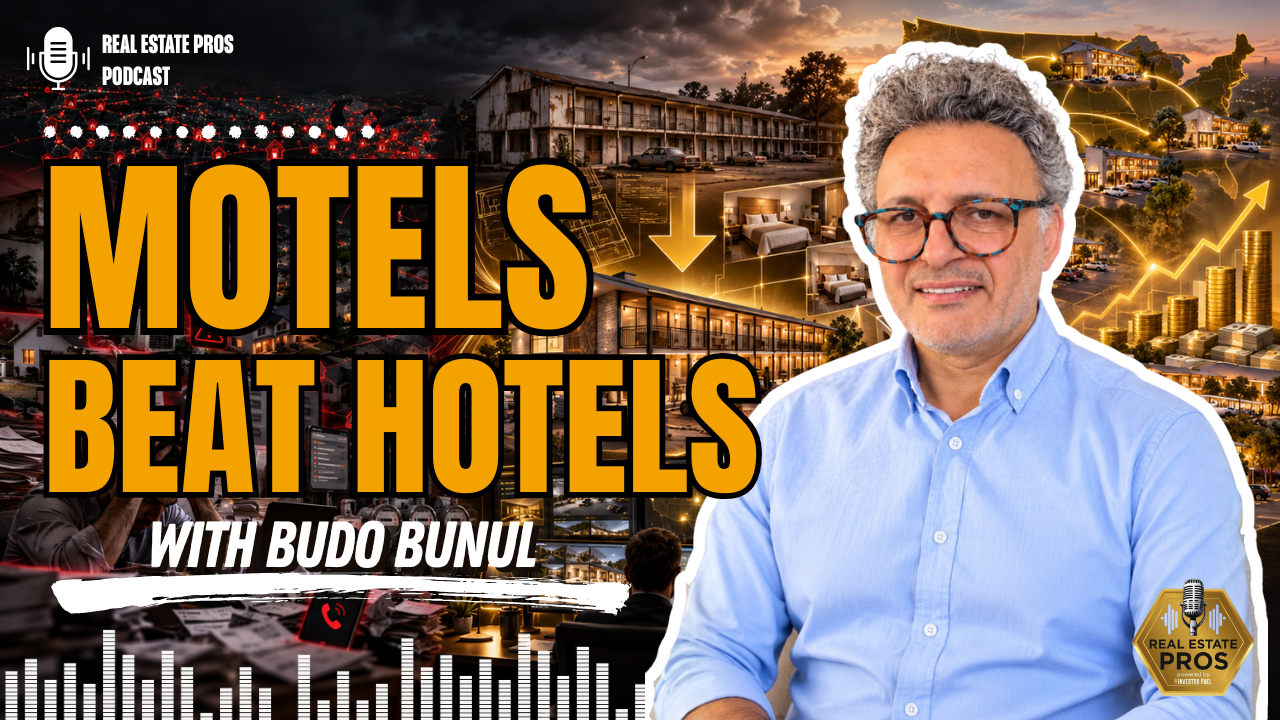
Budo Bunul is the founder of Kiteville, which acquires outdated, underperforming motels and turns them into flexible minimal-living spaces for people who want to stay a weekend, a month or longer. He tells host Meghan Escobar why motels beat full-service hotels, why converting one can cost $2–3 million against $10–15 million to build new, and how running 800 residential rentals taught him to pivot. He also explains the $33 million raise behind Kiteville’s cluster-by-cluster expansion, and why his first startup took knocking on 3,000 doors to raise $3 million.
Chapters
00:00 800 Properties Became a Scaling Problem
01:04 Introduction
02:25 Turning Old Motels Into Flexible Living
05:01 Why Budo Focuses on Motels
08:01 The ROI Advantage of Motel Conversions
09:22 Why 800 Residential Properties Didn’t Scale
11:54 Raising $33M to Acquire 11 Assets
13:21 Learning to Operate Through Chaos
14:04 Create Value for Every Stakeholder
15:44 Knocking 3,000 Doors to Raise $3M
17:38 How to Connect With Budo
Resources and Links from this show:
Listen to the Audio Version of this Episode
Investor Fuel Show Transcript:
Budo Bunul (00:00)
within three years we had about eight hundred residential properties throughout Greater Philadelphia market. business is great, it’s doing well, but however, early on we realized that this is may not been an effective way of scaling a business.
because imagine you have eight hundred addresses and every one of them has a electricity bill. imagine dealing with eight hundred internet services, imagine dealing with eight hundred potential roofs can leak. Imagine you’ll have to take the trash bins out every week for those assets for those properties.
Meghan Escobar (01:04)
Hello everyone. Welcome back to Real Estate Pros Podcast. I am your host, Meghan Escobar, and today I have the pleasure of sitting down with a gentleman by the name of Budo Bunul He is the founder of Kiteville.
And it’s a very interesting niche that he’s focused in where really what he’s doing is transforming underperforming hospitality centers and creating them into new, updated, modernized spaces. And we’ll get him to talk more about that in detail about what it is that he’s doing, where he’s focusing and all that good stuff. But just want to say thank you, Budo, for joining us today.
Budo Bunul (01:44)
amazing. Thank you, Meghan. it’s such a pleasure to be here and share my experiences with I really enjoy the show as well.
Meghan Escobar (01:51)
Absolutely. I’m very interested in you talking to our audience about what it is that you’re doing because I think there is a significant need for what you’re doing for the simple fact that there are so many underperforming motels out there throughout the nation. So with that being said, for somebody who might not know who you are or what Kiteville is.
Would you mind giving us in the audience a thirty thousand foot view of what it is that you guys are focusing on these days and kind of where you’re operating?
Budo Bunul (02:25)
absolutely my pleasure. So as you emphasize that there is a massive inventory of motels across the nation and they tend to be underperforming and they’re outdated and their business model has been declining for the last several decades. And because of the limited resources, cash flows and they’re lacking innovation in terms of modernization.
And therefore business is declining and also the real asset value has been deteriorating in those spaces. But I tend to focus on problems. If I can find a meaningful solution to a problem, maybe there’s an opportunity for all the stakeholders that we can create value.
so basically we find motels to be having a really good inventory out there and also we realize that the new generation tend to behave differently. some economic facts and which makes it those assets extremely valuable in my opinion.
for instance, we have over four million housing shortage in the market. And also the rent cost has increased up more than fifty percent over the last decade. And also with the new generation ten to the physical office anymore, Monday through Friday.
Mm-hmm. So with the given dynamics of buying a house or leasing a home, it may not serve your lifestyle really well. So you find value in minimal living spaces and with the right elements designed and be able to
give you the freedom that you would enjoy. Say for instance you want to be maybe in Chicago in summer, for two months and then you want to be in Florida for the winter or you want to be close to friends somewhere near San Francisco. So why not just take your luggage, roll in and roll out for a month or two or a week or just a weekend. Mm-hmm. So having those assets
being in high demand in the market and there is also lack of those inventories, it gives us an opportunity to tackle in the space and to see how we can find those assets and transition them into to serve this population really well.
Meghan Escobar (04:38)
Amazing stuff. Amazing stuff. And one thing that caught my attention is that you tend to focus in on the motel niche versus the full service hotel industry. Do you wanna mind talking to us a little bit about why you feel that’s a better approach to what you’re doing?
Budo Bunul (05:00)
Yeah. No, it just goes with our business model of creating minimal living spaces. for instance full service hotels they tend to have amenities and services that nowadays consumers. for instance, the full service hotel may have fifty thousand square foot of convention space or banquet space.
And as I mentioned, people don’t get married until forties and if they do, they make smaller weddings. May more like outdoor weddings are trendier than doing in a ballroom. And for instance, you could have swimming outdated swimming pool or gym that the consumers don’t want to use it because there’s LA right down the street, probably they have access to it or membership.
Why would you want to spend $50 on a hamburger that maybe it’s overcooked, undercooked, and hotel? where you can use Doordash to get something that is rated 4.7 and maybe a half price delivered to your footsteps. nowadays consumers tend to do informed decisions versus traditionally what’s been offered. And that’s why VC Airbnb business.
Businesses like Airbnb tend to thrive really well, although they own zero rooms. And even to this date, their business is growing, the demand is growing twelve percent annually, which is I think it’s significant. And the traditional models they miss this opportunity significantly. So we see significant value in motels, there tend to be simple structures. It could be a single floor or two floors, and some of them don’t even require elevators.
And it’s much easier for us to acquire them at the low cost and renovate them at the low cost within a short period of time, within three to six months, and they could be in the system and revenue generating, versus to buy something that it has a lot of cost that it doesn’t add any revenue, or just building up a motel like property from bottom up, it could take us two to three years to get the
zoning permits and constructions, foundations and all of that at the prime cost. for instance for an A D unit it could cost us about ten, fifteen million dollars to build brand new, but also it could cost us two, three million dollars to transition an existing motel into what we want.
Meghan Escobar (07:54)
So ultimately at the end of the day it’s a better ROI.
Budo Bunul (07:58)
most certainly. as I mentioned earlier, how rent costs is increased significantly on the market, the what does reduced cost with the transformation, we are able to offer better rates to the guests where they can stay for a weekend or they can stay for multiple months or years.
that’s because just think of in a hotel room, three, four hundred square foot is designed smart and it serves your lifestyle and well maintained, managed and then at reasonable cost, it makes more sense for sure.
Meghan Escobar (08:32)
Beautiful. And you’ve been in the game for quite a while, eight years. and so I always like to ask with, operators who have been in the business for a while, to kind of talk a little bit about maybe a deal that had gone sideways or a time that you had to pivot really fast. Because we live in this,
highlight world where we see all the successes on the social medias and the YouTubes and the podcasts, but we never quite get to see or hear, the behind the scenes stuff of the struggles that it takes to get to point B, right? So, with your experience, Budo I’m sure you probably have a few of these scenarios, but is there any specific one that kind of sticks
Budo Bunul (09:19)
I really appreciate it. that’s a really important question that you ask for funders sometimes. wearing multiple hats at the same time. I’m sure you have a lot of challenges and obstacles that you go through every day to solve something, right? when we started up Kiteville, we thought that the residential properties were to go with because I personally had a few properties and that’s how we started.
within three years we had about eight hundred residential properties throughout Greater Philadelphia market. business is great, it’s doing well, but however, early on we realized that this is may not been an effective way of scaling a business.
because imagine you have eight hundred addresses and every one of them has a electricity bill. imagine dealing with eight hundred internet services, imagine dealing with eight hundred potential roofs can leak. Imagine you’ll have to take the trash bins out every week for those assets for those properties.
we had to pivot from there to multiple different property types.
until we discovered motels that they’re needed for this business model. So definitely if you had the initial experience or knowledge or know how that motels are the only way to go, we would have cut down so much the pain and time and make it much more efficient. But sometimes we have to learn, we have to evolve. And there’s nothing wrong with that. But the thing is that you need to be able to
see the problem and pivot and align accordingly, that’s very important.
Meghan Escobar (11:21)
Absolutely. And this is the kind of stuff I think that people don’t talk about enough. And truly what I believe it’s what separates folks who just dabble and create a transaction versus those individuals who are in the game long term. So thank you for sharing that. And what’s something that you feel like
you’re going to solve or scale up to next.
Budo Bunul (11:49)
definitely. so we have US Capital Global helping us to raise around of three thirty three million dollars. we are about actually closing the deal. And this will allow us to acquire eleven more assets as a cluster, which are based on Michigan, Indiana, Illinois. So actually this will be our playbook for the expansion of this business model.
So basically we would create clusters of assets for each demographic, each market. this way we are able to create sizable ticket sizes for the funding purposes and we are able to scale the business model region by region, cluster by cluster.
so this is actually really exciting but also requires a lot of efforts and resources to scale for us. for us it’s a huge milestone having an institution or financial institution to assess us and analyze us and study us and work with us and take all of our data’s performance and
vision and idea technology that is built behind of it to be recognized that then this model has merits that it can be scaled and it’s very pleasing for me, I think.
Meghan Escobar (13:03)
Yeah, for sure. And it sounds like a huge opportunity. And of course there’s gonna probably be some chaos in the process of it all, but Yes. the outcome will be worth the
Budo Bunul (13:15)
hurdles. Yes. Well yeah, I think being in the startup world, you’re dealing with so much uncertainties with the limited resources. So I think chaos becomes my special at some point. I leave home with the five ten solutions rather than having millions of problems bothering my mind. So
Meghan Escobar (13:31)
Yeah, absolutely. And a lot of our listeners, they’re either very early on in their entrepreneurship journey or they’re veterans and they’re looking for the next level up, the next opportunity. we talked a little bit about building relationships, getting in the right rooms. And when it comes to growing your network,
What do you feel has made the biggest difference for you throughout these projects?
Budo Bunul (13:56)
Yeah, no, definitely. And I think I have learned that it’s very important you have to create value for all the stakeholders. So when I say stakeholders, it’s not just the ownership or investors. It is your team members, it is your customers, it is your suppliers, it is your solution partners, it is your communities, it is your tax collectors, just think of anywhere, right? they all have a stake in your business. Right.
And you have to create value for every one of them in order to prove your concept that it’s gonna be successful. If you’re lacking in some areas that you’re not creating value, then your business may not have the strong foundations to scale or become bigger. So for that reason, you will always have to evolve and be able to not only, learning every day
But also with your experience, with your knowledge, with your know how, with your resources, you need to be resourced to others as well. So sometimes you could be getting the best information from your FedEx delivery guy.
It could be solution partner that need it, could be a supplier that need it, and just having an ingenuine conversation with your FedEx delivery guy for two minutes on the door, you could might have a lead that you could might introduce you to a potential customer or supplier who’s also happened to be in the same town or down the road and which you have no information on it.
Meghan Escobar (15:20)
Mm-hmm.
Yeah. Absolutely. And it’s something that you as a business owner and operator, relationships are everything, especially when it comes to any type of real estate business, right? It’s a people business.
Budo Bunul (15:33)
Meghan with my first startup, which was a really also successful startup, it was a milk delivery system. So we raised about three million dollars and those three million dollars raised after me knocking on three thousand doors. Imagine three thousand doors. And I was only able to raise those three million dollars once I really realized that every penny had sweat and tears behind of it. Yeah.
So when you don’t have that understanding, when you don’t have that experience or the mindset or business model, it is impossible to fund it. It is impossible to any resource that you need. I really mean that. I think for all the individuals who are trying to create or build something, you really have to realize that, if you’re asking a friend and family
to invest in you you really need to value that how much their resources are important and critical and you really, need to be responsible in terms of creating value and getting a return on that, not taking risks with the
Meghan Escobar (16:29)
Yeah,
a hundred percent. Absolutely. I can’t agree with you more. And it’s something that cannot be faked. You have to really be We gotta get out there and hit the pavement, right? three thousand doors you knocked on, and how many people would have probably given up after ten?
Budo Bunul (16:46)
absolutely. Yeah.
Meghan Escobar (16:49)
That’s incredible. Yeah. So you are clearly here for long-term success. And I really love to see that. So before we wrap things up here, Budo, if somebody wanted to reach out to you, maybe listening in on this podcast, maybe they have access or some type of relationship with somebody in the motel industry, or they’d want to learn more about what it is that you’re doing and getting involved.
What would be the best way for someone to reach you? Is that through just giving you a call? Are you active on social media or a website?
Budo Bunul (17:24)
definitely we do have a website, which is kiteville.com. But mostly I’m really good at utilizing my LinkedIn. that you can definitely find me there, Budo Bunul I do have a phone number if it’s needed. it’s six ten eight six four one two one zero.
But definitely I really enjoy relationships, connections and if I can be resource to any other ones it would be tremendous. And also anyone that may have an idea or opinion or experience to share with me, that would be tremendously valuable to me too, because we are learning every day.
Meghan Escobar (17:56)
Absolutely, And we will be sure to have those links dropped below. So if you want to reach out to Budo, check his website out, give him a call. As you just heard, he’s always open to conversation connection. So we’ll make sure to have all the links easily accessible for anyone listening in that wants to connect with you. So thank you so much again for coming on, providing value for the audience, for me. it’s really appreciated. So
your story, your time, your perspective. And I definitely think we need more people in this space who are doing things the right way and creating the right relationship. So thank you again for being here.
Budo Bunul (18:36)
Amazing. Thank you, Meghan. It’s been a such a pleasure. You’ve been extremely easy to just have this conversation and be able to bring out the experience that I have to share with all the listeners who are out there and I really greatly appreciate it and it’s a great program. Keep it up.
Meghan Escobar (18:50)
Thank you. And for those of you that are tuning in, if you got any value from this show, please be sure to hit like and subscribe. We got conversations going live every single day with operators just like Budo here. So he’s out here building real businesses in real time with real people. So just know that there is room and space for you to grow as well. We’ll see you on the next episode.



