Subscribe via:



Show Summary
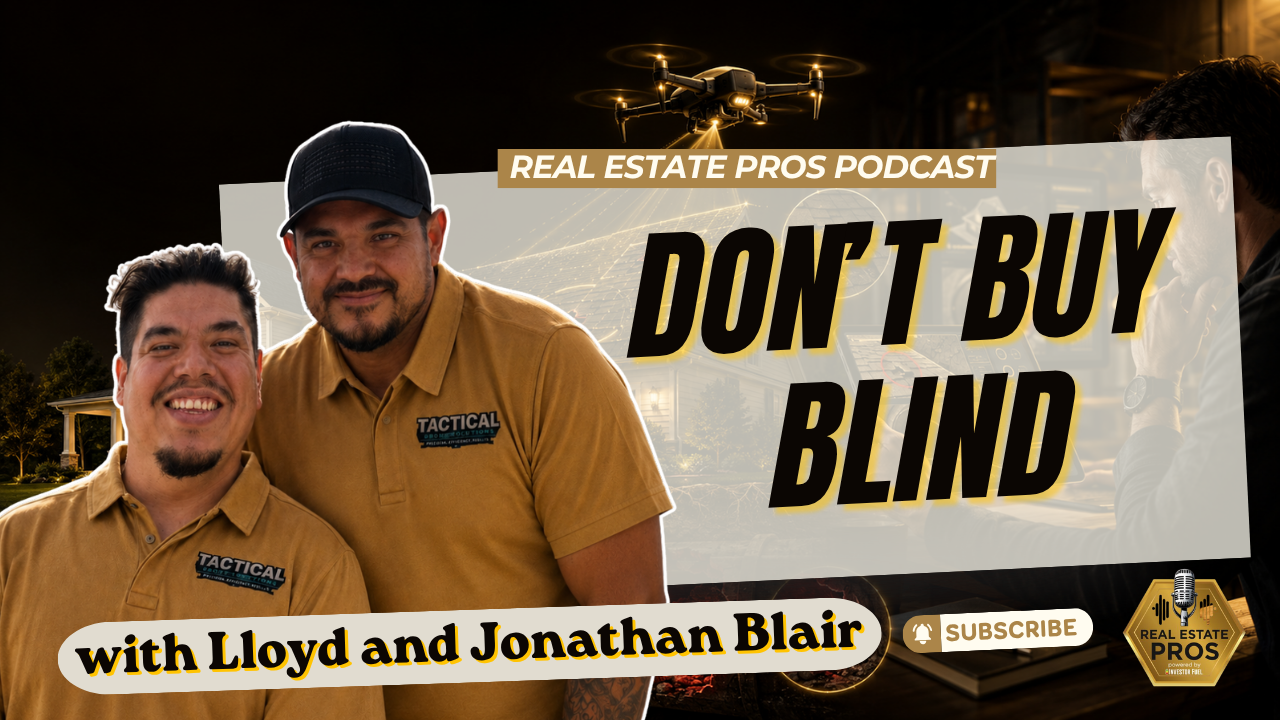
In this episode, Lloyd and Jonathan Blair share their journey into the inspection and aerial imaging business, highlighting their community focus, innovative use of technology, and growth strategies. They discuss overcoming challenges, marketing tactics, and future plans to expand their veteran-owned company in Southern California.

Resources and Links from this show:
Listen to the Audio Version of this Episode
Investor Fuel Show Transcript:
Lloyd and Jonathan Blair (00:00)
Because you don’t know what’s under there. On a normal walkthrough, you see everything else. You open some cabinet doors, you turn on the sink, make sure it’s draining. If the water goes down, you think great, it’s good. There’s nothing there. But what hurt would it do to you to see what’s going on under the ground before you make that investment? Because I don’t want to be that inspector that said everything was draining right, but then you buy your home or invest in your property…
Joseph Crooms (02:02)
Welcome to Investor Fuel Real Estate Pros Podcast. I’m here today. I got two brothers. I have Lloyd and Jonathan Blair, brothers. They’re chilling out, but they’re into some serious new tech how they handle the inspection business. But I’m going to let them talk about that, all right? Hey, John. My name is Joseph Crooms. It’s my pleasure to be here. I’m going to be your host. Let’s get right into it. Jonathan and Lloyd, say hello to everyone.
Lloyd and Jonathan Blair (02:29)
Thank you very much, everybody. It feels really cool to be here.
Joseph Crooms (02:31)
Sounds good. Sounds good. Jonathan, since you were so animated, let me ask you, what’s the first dive? What is the—give us the short version. What’s your main focus these days?
Lloyd and Jonathan Blair (02:40)
My main focus these days is just trying to put our name out there to let people know that Tactical Inspections and Aerial Imaging, we want to just be an option to the people with property investors or real estate agents. We want to be just an option for them to let them know that there’s multiple options here in the High Desert. As well, I wanted to push forward that people with physical disabilities, we can do work in the high industries, and people shouldn’t really take us for granted, and they should judge us on our work and not our look.
Joseph Crooms (03:10)
Sounds good. Sounds good. Anybody that judges you on the look, they’re a fool. That’s their problem, as I like to say. But anyway, hey, Lloyd, let me ask you this. What markets are you operating in right presently? Where’s your footprint at?
Lloyd and Jonathan Blair (03:27)
Right now our footprint is really focused more towards the real estate side and pushing into the property investors. We’re a young company, but growing very quickly. Started off with mainly real estate agents and then also Jonathan being a drone pilot doing aerial imaging, just random companies wanting drone footage and stuff like that. Right now our footprint in the Southern California High Desert is mainly real estate agents, but we’re wanting to push into property investors as well. We just want to help out any of the investors, buyers, real estate agents here in the High Desert know what they’re getting into before they leap into that commitment.
Joseph Crooms (04:14)
Hey, I know that makes a lot of sense, and I can already see in my mind how you guys have to be unique marketing to market this to a multiple audience. How long has Tactical been in the business? And then did you go into the drone or how did you do it?
Lloyd and Jonathan Blair (04:30)
It started out with our—there’s four of us. We’re only two of the four brothers, but we started out very young, thirteen, fourteen years old in the construction industry, doing renovation stuff. Then I went to school for construction and was in the union for a while. And then just continued to learn all the aspects of construction and this industry. We’re young in the inspection industry, but been our whole life in the construction and building industry and commercial industry through family. And so kind of now it’s just that’s where it bubbled from going into the inspection side of it and drone side of it.
Joseph Crooms (06:00)
Jonathan and Lloyd, either one, do y’all still have the construction side of the business?
Lloyd and Jonathan Blair (06:05)
No, we actually turned from that due to some—he was getting a little old, and I didn’t want him to do so much labor work anymore. And I said, “Let’s make it easier on us. Why don’t we just go tell people what potential problems they could run into, and we don’t need to fix it? We could just tell them about it.” And that gets me involved because I want to get—I was basically stuck in the office and I wanted to get out in the field. And he said, “Well, I need someone to fly a drone.” And I said, “Well, I played video games all day. I have good stick skills. My reaction time is really good.” I took the class, I got it, and we kind of—he said, “All right, now we’re going to add this to the company.”
And first it was a little more like it. We stopped doing construction, a little bit more just cleanup. And then I said, “Let me just—let’s just start inspecting and seeing what we can get.” And then once the drone got into our possession, we actually didn’t realize the revenues that it did open up because we were just going to use it just to look at the roofs. He didn’t have to get on a roof and fall down. We wanted to do that because there’s a lot of roofs here that are two, three-story properties, and it’s hard to get up on the top. And technology on it is use a drone with the 4K camera, get those angles that you can’t normally, and there you go. It’s done. Simple.
Joseph Crooms (07:15)
Makes sense. How long, Lloyd, have you guys literally been in business as Tactical?
Lloyd and Jonathan Blair (07:23)
As Tactical, we’ve been at it for two years now. We’re in our second year as Tactical Inspections and Aerial Imaging. And I’ve had other companies before that I started and sold in the Midwest. I had a renovation company out there that I started and sold. This is just our new push through the business side of it. And we’re on our second year in the inspection industry and aerial imaging industry.
Joseph Crooms (07:48)
What is your book of business? How much from say a year and a half to now, how much would you say your book of business is as far as revenue or volume? Either way you want to explain.
Lloyd and Jonathan Blair (08:01)
Like how much are we making a year or…
Joseph Crooms (08:04)
On a monthly basis, either can say how much volume you have or revenue, either one would you prefer.
Lloyd and Jonathan Blair (08:10)
I would say because prices fluctuate so much in the industry and what property you get and what other inspections they need. I would say on average, our volume now from when we first started the first year, I think we saw like maybe one a week. Now we’re up to probably five or six a week on the inspections, and then also maybe like ten a week on the aerial imaging job. The aerial imaging really is helping light a new light into the industry too because it’s fastly growing.
Joseph Crooms (08:43)
How much do you charge for general inspection and Lloyd, how much do you charge for the aerial?
Lloyd and Jonathan Blair (08:49)
Right now our base price, which would be like a three-bedroom, two-bath, 1500 square foot, we’re charging 350 for our inspection. That includes a little bit of thermal imaging, the roof inspection, and the actual inspection. And then we also put in a sewer scope, as to us, giving something valuable to people is what’s going to stick in their heart over—not overcharging, because I don’t want to say overcharging, because inspectors have got what they did or are at in pricing for their own reasons, right? But growing up in our family and our friend group and our mentors, it was give back to the community because what, you could sell 30 inspections at 350 instead of five at 700, and then—
Joseph Crooms (09:36)
It sounds cheesy, but we love thy neighbor.
Lloyd and Jonathan Blair (09:38)
Yes.
Joseph Crooms (09:38)
That’s how we look at it. Because we’re hoping that in the future they will return the favor to us in a different way or however they can.
Lloyd and Jonathan Blair (09:46)
Or coming back.
Joseph Crooms (09:47)
Makes sense. You guys, that’s pretty good salary. You’re doing about probably five or six thousand dollars a month now, and how long do you think you’ve been operating at that level?
Lloyd and Jonathan Blair (10:40)
For the last probably like five months, it’s just started to pick up because like I said, we’re obviously doing something right. We’re here on this podcast.
Joseph Crooms (10:51)
I got you, man. And listen, something unique that you said about—and talk to our audience, not just about the aerial, but this is really something that you do traditionally and this is personal to me. Why do you put the camera down in the ground?
Lloyd and Jonathan Blair (11:05)
Because you don’t know what’s under there. On a normal walkthrough, you see everything else. You open some cabinet doors, you turn on the sink, make sure it’s draining. And if the water goes down, you think great, it’s good, there’s nothing there. But what hurt would it do to you to see what’s going on under the ground before you make that investment? Because I don’t want to be that inspector that said, “Everything was draining right,” but then you buy your home or invest in your property and a couple months later you call me back, “And I don’t know why we’re having these drainage issues,” when it could have been easily not fixed, but found in a sense before you made that decision.
And that’s why we put the scope down, because that’s part of it. I mean, in a home inspection, I believe—I’m not going to say anything about anybody else, because everybody else does their thing and there’s plenty of work for all of us. But I believe if you’re giving everybody the full story, they walk away with a better understanding and feeling about you and the job you did.
Joseph Crooms (12:08)
Jonathan, let me ask you. Now I know why you put the scope down there. I used to work for Roto-Rooter and I was—and people ran into problems. They say, “I just bought this house and they sued me.” Well, later. And I know everyone is not doing what you do, Lloyd. Now the other piece of that is hey, when you market it, Jonathan or Lloyd, and you say, “We’re going to put a camera up there and we’re going to have a drone fly over your property,” what’s the reaction from the people when you tell them that?
Lloyd and Jonathan Blair (12:36)
I mean, we’ve had all, “You know that’s illegal.” But that’s with an FAA drone license. We just remind them that no, we’re doing this legally because all the loops and jumps that people have to go through or how to go through it, I went through it. And a good drone pilot, a licensed one, you tell them, “I’m not pointing that camera at anything but what I’m supposed to be shooting, whether it’s the residential, the property, the acres, or even a private event.” If I’m flying over, I gotta get the angle, but I’m not shooting you. Now if you pop up in the background, it kind of says it in the thing, that’s on you if you pop up in the background, but I’m not shooting you.
And it’s yes, again, like I went to the beginning back to the beginning where they’re like, “Wait, you’re the drone pilot?” Like, yes, I am the drone pilot. And they think he’s the drone pilot, he’s inspector, and they don’t realize technically he’s just an inspector. I am an inspector and a drone pilot because I took the ICA and InterNACHI courses to become a certified inspector as well. Because like I said, we thought it was just going to be inspecting the exterior of the home with the drone with the roof and stuff. And I learned a lot more that I can do with the drone.
Joseph Crooms (13:58)
Wow. Now say a second-time homeowner, Lloyd or Jonathan, and they got a general inspection, first time they used you guys. When they get your inspection, what’s the reaction? I’m looking for how do they react? Like you did underground, you did this, you did the roof.
Lloyd and Jonathan Blair (14:12)
Yeah. Their reactions are like, “Wait, how did you get that angle?” Or like, “Wait, that’s down there?” And we’re like, “Yeah.” And they’re pretty shocked on the angles and the pictures or images that we bring back to them. And to be honest, they like it because it’s easier for them to see. They say a picture’s worth a thousand words. Now they can have proof. When they go to the sewage person, “Nope, look, this is the reason why, I have a picture that these people helped me get.” I don’t know how they got it, but they got it.
And that too, the program we use is very client-friendly. It’s—I don’t, you know, I’m not trying to give a shout out, but we use a program called Spectora, and it’s a new and upcoming program in the industry. It’s growing super fast because it’s client-oriented. It gives you everything you do need to know. And then for the people that don’t understand, it’s pictures. It’s easier. You get the picture with what’s going on, that way you understand what the words mean. And I think that’s a huge change in the industry and these new programs that are coming out. They’re making it easier for us to explain what’s going on in their homes.
Joseph Crooms (15:05)
Lloyd, let me ask you this. How many return customers have come back to you? They’ve probably sold a home or they can invest in something else. How does that make you guys feel?
Lloyd and Jonathan Blair (15:14)
We love it when they come back. We’ve had quite a few come back. And all of them say it’s because, “We couldn’t stop laughing the whole time you guys were here.” We have—”We’re having a bad day at work and you guys come in smiling, joking, laughing, and we can’t help but smile.” And they’re like, “We want that. We want that energy.” And that’s just what we bring. We bring that happy-go-fun energy. Like, we don’t—we understand it’s serious. We understand this is serious. Yeah, and what you’re getting is serious, but sometimes serious things need an edge cutter. We use comedy.
Joseph Crooms (15:43)
Yeah, I got you. Let me ask you both a question. What’s been the key to keeping your machine running smoothly once you realize, “We got it”? What’s been the key to keeping it going smoothly?
Lloyd and Jonathan Blair (15:54)
I think for me, it’s that we don’t got it. There’s never an end to this. We continually need to continue our education, continue growing our specialized tool or capabilities, offering more things to our customer that can help them in the long run because that’s what we’ve decided to do is help our community make—help them make these hard major decisions with the knowledge they need. For us, I think it’s that, making sure.
Yeah. To be honest, I think it’s just staying up to date with the times. All of these high-tech technology tools that are coming out, we just have to stay up to date and be able to learn how to use them. Like I said earlier, social media is kind of playing a big part. That’s what people go to nowadays. You have to stay up with the times. And what are people on? They’re on their phone all the time. If you want to grab their attention, you gotta somehow get yourself on their phone, what they’re looking at. That’s kind of what we’re learning, and yeah, it’s just staying up with the time. Staying, as the kids say, stay here.
Joseph Crooms (16:55)
Guys, let me ask you a question. How long does a pretty nice size—let’s say five-bedroom house, how long does it take you to inspect that?
Lloyd and Jonathan Blair (17:02)
We take our time. I know we get—we’ve heard one or two, “You guys take a little long.” Well, what do you want, the right information or do you want just the skim over of things? I would think if I’m making a—and out here in California, a five-bedroom home is probably what, over a million dollars. If you’re making a million-dollar investment, I don’t think I would—give it the time and get all those answers that you really need. I would say for us, a five-bedroom, we would not be out of there at least two and a half hours.
Joseph Crooms (17:35)
And that’s the rule.
Lloyd and Jonathan Blair (17:36)
That’s everything, all the way down to the tubes underneath your feet. Yeah, because while he’s inside, I’m outside playing with—I’m not playing, feels like I’m playing. I’m outside taking pictures and checking out the exterior with the drone while he’s inside doing the rest. And then we kind of meet together towards the end and whatever needs to still be finished on the outside or interior, we kind of jump in and we help each other to get it going. It’s a team.
Joseph Crooms (18:00)
Gotcha. How has AI assisted you in your work? Do you or how—or has it?
Lloyd and Jonathan Blair (18:05)
Well, I’ll just tell you right now, we may look young, but we got the old school swagger. And this AI stuff, it helps us a lot, like making flyers and making posts and stuff. But the work and stuff, it’s supposed to make the work easier and make it look better, but I personally don’t like doing it because I feel like you’re messing around with the image too much and it’s not the authentic image. If you want a real authentic image, here it is in a 4K resolution picture. And they go, “Well, can you make the furniture fall out from the sky and into the thing?” And I go, “Whoa, that’s—I know AI can do that.” And yes, I would have to learn, and I am learning editing tools and stuff, but I’m the old school guy. Let me just give you your picture. I’ll put some words or a little fancy filter on it, but I can’t make—I know it’s possible and I know it’s good, but I personally just like to keep it plain Jane, as they say.
And that would be on his side, on the aerial and imaging side. Me on the other hand, not saying I want to go against him, but for my side, which is his side too when he’s up there writing the reports, but the report writing, these new programs, AI is integrated into it. And it helps you just cut down all the verbiage that like would probably confuse a client and it helps you from becoming that guy that scared him or something because you put too many words trying to explain something that could have easily been explained shorter. AI really helps me with my reports and getting the reports done faster. I don’t use AI for my work because I know what I know, but I was a Marine. Reading and writing wasn’t my first go-to.
Joseph Crooms (19:42)
Lloyd, thank you for answering that way. But also I didn’t understand, Jonathan, the aspect of you want to make sure the quality of picture—would it—but you answered that. You’re both answering that because I was saying, “Wow, what you guys are doing, it must really take in some time, say for Lloyd, for you or Jonathan to actually write out the report.” And now you’re saying, hey, you can generate that report and it’s really helped your business. I’m happy to hear that. Let me ask you this question: What are you guys focused on next? What do you think about solving or scaling next? What’s the next real goal?
Lloyd and Jonathan Blair (20:16)
Right now we would like to scale into more getting more inspectors, like maybe another inspector on the team. But we’re a small family and veteran-owned company. We kind of want to keep it small and geared towards our family and individuals that don’t normally get the opportunity. I think I didn’t mention at the beginning about the business—one of the aspects of our business is giving those who don’t get opportunities all the time. From personal experience and heartfelt digs, in the business world alone, it doesn’t matter what industry, I think they’ve all kind of started to push away from giving these individuals that should have the chance more than others, the God-honest opportunities that they’re promised and normally don’t get.
And we’ve seen it firsthand, people promise to help these individuals and then don’t. That’s one thing in our business we’re really wanting to bring in once we start growing is employing individuals that don’t get the opportunities, i.e., people in wheelchairs, maybe people with learning disabilities, because people don’t understand these individuals are just as talented as anybody else.
Joseph Crooms (21:30)
Are you thinking about going into commercial business? Any commercial?
Lloyd and Jonathan Blair (21:33)
Yes, we do commercial business, too. We do commercial inspections and it’s all of the same realm, whether you’re buying a home or a light commercial property. Where it would get different is those huge commercial buildings, which eventually that would be our potential growth target. But like Zoro said, hit your circles first, hit your inner circle, then the next one, then the next one. You can only walk before you run. Right now we have me and him, and then we have two part-timers: a driver for Jonathan, and he also helps with like office stuff, and then we also have another part-time editor who’s Jonathan’s best friend. And he’s also got arthrogryposis and is in a wheelchair as well. But he is a very good editor and web designer as well.
Joseph Crooms (22:28)
Got you. Before we wrap up, can you tell people what’s the best way to reach you?
Lloyd and Jonathan Blair (22:33)
Yeah, you can reach us on our Instagram, which is @tacticalinspections.ai, our Facebook, which is Tactical Inspections and Aerial Imaging LLC, or you can even take a look at our website, which is tacticalinspections-aerialimaging.com, or you could just give us a call and we’ll come out and show you our work firsthand.
Joseph Crooms (22:55)
If you want to just hang out, it’s cool, too. You can call us, it’s fine.
Lloyd and Jonathan Blair (22:58)
Wow, I love it.
Joseph Crooms (23:00)
Hey, listen, what happened, Lloyd, was you were giving that information and some people are just slow getting the pen. Give it to them one more time.
Lloyd and Jonathan Blair (23:06)
All right, our IG is @tacticalinspections.ai. Our Facebook is Tactical Inspections and Aerial Imaging LLC. And if you want to check out our website, it is tacticalinspections-aerialimaging.com. Or give us a call on our phone and we’ll come out to you personally. Or if you go on Google and you just type in “inspections in the High Desert,” we do come up now as a top five result on Google Review now.
Joseph Crooms (23:31)
Real story, that’s good stuff. I appreciate your time, guys. Jonathan and Lloyd, your story, your perspective, your goal, your service, and how you’re still community-oriented, man. We need more people in this space who are doing things the right way. Thank you both for being here.
Lloyd and Jonathan Blair (23:49)
Thank you for having us. We really appreciate you and God bless you. And we hope for more of these podcasts in the future.
Joseph Crooms (23:56)
Sounds good. For those of you tuning in, this has been Investor Fuel Real Estate Pros Podcast. We’ve been hanging out with Lloyd and Jonathan Blair, guys. And listen, they’re out there doing some serious business. They told you how to get in touch with them, make sure you do. And I know now you got value, make sure you subscribe. We got more conversations coming from operators just like Lloyd and Jonathan who are out there building real businesses, helping communities, doing it the right way. We’re going to see you on the next episode of Investor Fuel Real Estate Pros Podcast. Your host, Joseph Crooms. Thanks, guys. Hey, Jonathan and Lloyd, tell them guys we’ll see you later.
Lloyd and Jonathan Blair (24:28)
See you later.