Subscribe via:



Show Summary
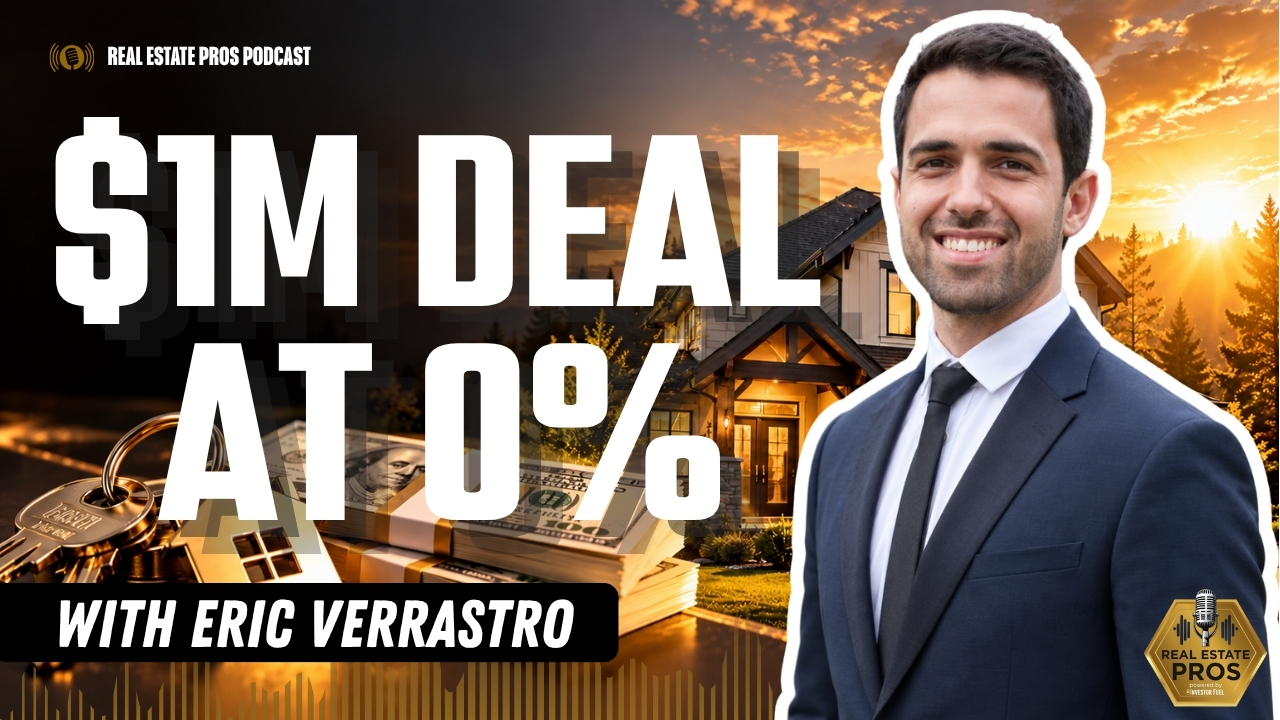
Eric Verrastro, an investor and agent with Emerald Sound Realty in the Seattle and Tacoma area, tells host Dylan Silver how he matches off-market and seller-financed deals to investors, mostly in the Hispanic community, including a Shelton, Washington tire shop he negotiated down from $1.2 million to $1 million with half of it financed by the seller at 0% interest. He shares how selling books door to door taught him Spanish and led him to an overlooked niche, how his team is putting AI agents to work on calls, texts and market research, why he just bought a six-bedroom house for co-living, and why buyers who have been waiting on the sidelines should act now.
Chapters
00:00 Real Estate Deals $125K Below Asking
01:02 Meet Real Estate Investor Eric Verrastro
01:52 Finding Profitable Off-Market Deals
02:56 Creative Financing and Subject-To Investing
04:04 How Seller Financing Works
05:30 Negotiating a $1M Deal at 0% Interest
07:23 Building Trust With Hispanic Investors
09:40 How AI Is Changing Real Estate
10:59 Automating Leads and Finding Deals With AI
12:16 Will AI Replace Human Conversations?
13:43 AI Agents and the Future of Business
17:09 Will AI Replace Real Estate Agents?
18:32 Co-Living and Single-Family Investments
22:48 Stop Waiting for the Perfect Market
25:37 Credit, Low-Down-Payment Deals, and Relationships
27:30 Buying Properties $125K Below Asking
Resources and Links from this show:
Listen to the Audio Version of this Episode
Investor Fuel Show Transcript:
Eric Verrastro (00:00)
People that have been waiting for the market to go down, this is your time, act now because we’ve been getting deals under contract for fifty, sixty, a hundred thousand dollars, a hundred and twenty-five thousand dollars below list price. some sellers are in desperate need to sell right now. So anybody who has some cash sitting on the side, who has been wanting waiting to invest in real estate, this is the time to do it.
I think there’s gonna be a huge transfer of wealth in the next coming years.
Dylan Silver (01:02)
Hey folks, welcome back to the show. Today we’re joined by Eric Verrastro, single family and multifamily investor and agent in the Seattle metro area and the Pacific Northwest. Eric, thanks for joining us here today.
Eric Verrastro (01:16)
Thank you, Dylan. It’s a pleasure to be here and thank you for the opportunity.
Dylan Silver (01:20)
Pleasure to have you. what types of deals are coming across your desk these days?
Eric Verrastro (01:25)
So I have a variety of deals always coming across my desk. I have a mix of on-market deals that are heavily discounted, off market deals and being single family commercial deals, business opportunities. So, we try to have a broad range of deals to cater to all of our investors. We also have a few
deals that are like development deals. So a little bit of everything, we dabble into different areas.
Dylan Silver (01:52)
I wanna talk about one of those niches. you mentioned I believe off I’ve myself cut my teeth in this space. That’s how I got started. Walk me through that off market space, the type of deals that you’re looking at, and what you’re looking for.
Eric Verrastro (02:06)
Definitely. So as you know, we cater mostly to the Hispanic community. So we try to basically match the right deals to the right investors. We have a range of commercial deals like for example multi-unit of apartment buildings that are five plus units. we have single family houses.
that are, best for fix and flips or buy and holds. basically I would say ninety plus percent of our deals are single family and the other ten percent are like commercial deals. that’s mostly what we have right now.
Dylan Silver (02:39)
If you’re looking at your real estate business as a whole, do you look at things first through that transactional brokerage hat, buyers and sellers? Do you look at it from the investor lens? Walk me through how you process deals and real estate as a whole.
Eric Verrastro (02:55)
Yeah, so I definitely look at it through the investor lens mostly, as that’s most of our business is dealing with investors. we also have been doing a lot of seller finance deals as well, either through Sub Two or like just regular seller finance. we can definitely find some creative opportunities that will
provide better quality deals to our investors. But yeah, definitely the lens that we look at first is the investor lens that’s pretty much what we do. I hope that answered your question.
Dylan Silver (03:29)
absolutely. there’s so much to break down when it comes to sub to seller finance, what those conversations look like, not just with your buyers, but also with the sellers. I’d like to start with the conversations with the buyers, which sometimes often doesn’t get enough shine. when you’re talking to your buyers who are buying these deals subject to or seller.
finance where the seller will hold the note. Are they always aware of what that looks like or in some cases are you explaining what that process may be and how it can benefit them?
Eric Verrastro (04:03)
So more often than not, we have to explain what the process looks like as a lot of people are not familiar with the different tools that are available for them. for example, we have a case of a client right now that’s looking for a property up north, like close to the Canada border, and they are looking for a sub two or seller finance deal because they’re
in the process of building the home. So they’re taking out this big loan and they don’t want to deal with the bank because they already have this loan that they’re taking out from the bank and so they’re looking for something where they can get in with fifty to sixty thousand dollars down and five year balloon payment. what’s nice about it is that these properties when they’re fully paid off, there’s a lot of negotiation that we can do as far as the terms, the rates.
the timeline. we’ve recently closed a deal in Shelton, Washington, a tire shop it’s been there for many years. And this client that I have, he is a tire shop business owner as well. And he dealt directly with the seller. we negotiated great terms for him.
I say the off market world is the wild west, it’s something that the sky is the limit. It can negotiate absolutely anything.
Dylan Silver (05:15)
I agree with you there. A tire shop. That’s an interesting deal. I’ve spoken with guests who have a favorite deal and deals that were maybe outside their wheelhouse that taught them a lot. walk me through that tire shop deal.
Eric Verrastro (05:29)
yeah, no, that was very interesting because we started off with having such difficulty getting a hold of the seller. and there was another agent involved that was actually speaking with the seller and dealing with him. but it was like early on, it was very, very hard to, reach them. But anyway, we were able to successfully do it.
They were wanting to sell it for 1.2 million. After a lot of back and forth, we negotiated the price all the way down to one million. And the buyer had a certain number in mind that he wanted to use as the down payment. He had like half a million dollars available to put down. So he wanted that other half financed in the span of five years.
fully amortized, but with the option to pay it off at any time with no prepayment penalties. So we were able to negotiate exactly those terms. But the best part is that we negotiated with 0% rate. So he’s not paying any interest over the next five years on a half a million dollar loan.
Dylan Silver (06:32)
What an amazing deal on all sides. I can also imagine that the seller was happy to sell their tire shop for a million dollars. Were they not? They must have been happy.
Eric Verrastro (06:42)
yeah, he was very happy because that property was in the family for a very long time. they probably bought it for dirt cheap, many, many years ago. It was obviously fully paid off. So I think it was actually a win win for everybody. and since, the new owner already has an up and running tire shop business, he just picked up where he left off and so it was a win win for everyone.
Dylan Silver (07:05)
one of the interesting things, and we were talking about this in the green room before hopping on here, you speak three languages or at least three languages, English, Spanish, Portuguese, and we were talking about how that enables you to really help more clients and have more reach. walk me through that.
Eric Verrastro (07:22)
Yeah, no, so I didn’t really design that. It was kinda happened by accident. mostly learning Spanish. I’ve always wanted to learn English and I was very interested in speaking it as best as I could. but coming to the US as a teenager,
never something that I was fully anticipating that I would actually be speaking Spanish most of the time. I was immersed in the culture here early on, and I was living with people from different countries from South America. and then not long after that I started selling books door to door, and those books were in Spanish as well. So
I was basically forced to learn the language, speaking it 247, selling books, and dealing with other people. And it honestly helped me out tremendously with my real estate business. several years later, I realized that there’s a demand for great Spanish speaking real estate professionals. it’s a very overlooked
niche. and I saw a tremendous opportunity for helping these succeed and actually build wealth in America through real estate. at the time when I started there were very few resources available for this community. So I just focused on educating myself as much as I could
on everything regarding real estate so I could pass these resources on to them. it was a game changer for me. because I became that trusted source for several families on getting deals done basically.
Dylan Silver (08:51)
it’s such a big difference maker. And particularly when there’s anything that could be difficult about a deal, certainly seller finance, if you’re trying to bridge a gap of understanding of how the deal’s getting financed, and there’s also potentially a language barrier, like that’s a lot to tackle. so that deal would fall through for other folks, which brings me to
My next question. You’ve got a rental portfolio, you’ve got a portfolio, you’re also involved in multifamily, you’re involved in the brokerage side, helping buyers as well. When you’re looking at the next opportunity, is there one thing that you’re looking at right now these days that has you particularly excited, whether that is bigger deals or helping more buyers? What’s got you excited right now?
Eric Verrastro (09:39)
I think the main thing that’s got me excited right now is AI. It’s honestly using the power and leveraging AI to have a bigger reach in your business and serving more people is really what has me excited. A lot of people are scared of AI, but I look at it with a very positive lens. I think it’s definitely gonna be a game changer.
If leveraged correctly.
Dylan Silver (10:43)
there’s so much to break down there and everyone’s talking about AI, without giving away all of the gold, right? We don’t want to create competition for you, but what are some things on a foundational level that you’re doing or starting to do to implement AI into your business?
Eric Verrastro (10:58)
Well definitely we have a lot of things that we’re doing in a very different way, especially with creating different agents, to basically answer calls, answer text messages. we have emails going out. So we basically are building a whole system where if all of these repetitive tests are automated.
and so it’s very new territory, but we’re very excited about it. also we use AI to research the market, to basically find us deals. there’s a lot that we’ve been doing that we’ve been very blown away by.
Dylan Silver (11:32)
One of the things people have noticed on this show, I’ve noticed it as well, is this idea of speed to lead and how important that is. And it was important before AI. It’s even more important now. Whether I’m looking for a home, I’m looking for a realtor, I’m looking for a distressed property to buy, I might find, a couple of names. And if that person doesn’t get back to me quickly, I’m going on to the next one.
On the flip side, there’s folks who say, I’m not gonna have an AI tool replace my voice. I might trust that in certain capacities, but not in others. How do you feel about delegating that first response, that first contact to an AI agent or AI tool?
Eric Verrastro (12:15)
we’ve started implementing that already. we have mixed responses. as far as how I feel about it, I think it’s only gonna get better. And pretty soon you’re not even gonna be able to tell if you’re actually talking to a human or an AI. that’s my honest take on it. as far as like the responses from the leads we have some people
get put off by it. they don’t like the fact that they’re talking to an AI. I think some of the older folks, they can really tell the difference. and some of them they just go with the flow. they just follow through and so there’s definitely a mix there that we’ve been seeing.
Dylan Silver (12:50)
I’ve talked to some guests recently that are doing some unbelievable things with AI. I had a guest recently in DFW who was managing a hundred and seven doors in the co-living space with an AI employee. It’s him and an AI employee. The employee will buy
goods online goods for the common area. If someone gets locked out, it’ll text other people living in the house to, hey, can you open this door for someone? It’ll screen and vet new tenants. It’ll reach out to contractors if work needs to be done. and it’s doing everything. And so when I hear stories like that, I think, okay, that’s even more than an outreach or responding
to a message. Do you think that there’s ways right now that people are missing on AI who are users themselves, but they might not be using it in the best capacity?
Eric Verrastro (13:42)
a hundred percent. And I think the people that are using it in the best capacity are still very few compared to the ones that are just using it to ask you questions and get answers back. they’re just using it like they use Google, that’s how you really leverage the power of AI by this example that you mentioned, by actually doing work for you.
and there’s ways that one AI can orchestrate a lot of other agents, and I think we’re pretty soon gonna be seeing billion dollar companies that are just with just one person.
Dylan Silver (14:51)
no question about that. and we’ve been seeing this idea of agents and sub agents. One question that I have that comes to mind is there’s so many different platforms that people can use. and again, without giving away all the gold, but maybe a nugget for us, there’s folks that are big clawed, folks that really love, Chat GPT, they love Notion, they love, Gemini, people that might use these tools at
in a orchestra, if you will, utilizing multiple tools. is there one tool that you’ve been using more recently for yourself?
Eric Verrastro (15:23)
I mostly use squad and chat GPT. those are my go to’s right now. Yes.
Dylan Silver (15:30)
thing
that I hear and I have experienced that probably many of our listeners have is you might use a chat GPT for image creation you might use Claude to do programming tasks. I felt like for a while Claude had a big edge and then chat GPT I forget if it’s called code or work ended up being I felt right almost as good and then
It has the image generation with it too, and then it has browser control and even computer control outside the scope of Chat GPT, right? it’s like we’re in the middle of this amazing technology race in real time, right?
Eric Verrastro (16:03)
Yeah, I think this last Chat GPT update, Chat GPT six, Astra, that’s what really came ahead of the curve, like ’cause as you said, Plaw was dominating, but then they came up with something just incredible. and the new LLM that Facebook released, Muse, is actually really good too. It’s like having a personal assistant next to you. Like it books your flights.
Like it’s crazy the thing that thinks you can do. I don’t know if you ever tried it, but it’s amazing.
Dylan Silver (16:30)
To try it now that I’m hearing you talk so highly about it. one of the things that I’ve asked agents whether they are involved in the AI space, whether they utilize it or not, is what they think might happen with the future of brokerage. I’ve had agents tell me, well, you can’t ever replace a realtor. And then I’ve had agents tell me, a lot of the buyers that we work with these days are more inclined to be buying across state lines, to be doing
virtual or remote closings and sometimes they might not even walk in the property. So this is only going to accelerate with AI. Do you have any guesses what the future of brokerage might look like?
Eric Verrastro (17:08)
Yeah, that’s a very interesting opinion. I would say I could see that happening to be honest with you, like people buying more remotely. I think the main challenge right now is the boots on the ground aspect of real estate where you have to show properties. But I heard Tesla is releasing Optimus next year.
So I think once robots start coming out then it could pretty much be over,
Dylan Silver (17:33)
if I’m doing an open house, right, and a robot walks in and is like, Hey, I wanted to inspect this home for my buyer, right? Yeah, that would be an interesting one. But
Eric Verrastro (17:43)
Yeah, okay.
Dylan Silver (17:44)
in Texas, what I’ve seen as well is I’ve seen homes that will have from some of the corporate builders a QR code. You scan it, you book a time, and then a door unlocks at that scheduled time and you’re walking in. So in some ways we are
close to that in some capacity.
Eric Verrastro (17:59)
Yes, we definitely are. And I think we just need to adapt or die, basically. It’s the people who are refusing to adapt are just gonna get left behind, it’s advancing at such a rapid pace that, the gap is gonna just get wider and wider,
Dylan Silver (18:15)
It’s gonna be interesting. Who knows what the future is gonna look like for sure. you’re also involved in the co living space, if I recall correctly. Single family and co living. is co living something new that you are investing in?
Eric Verrastro (18:30)
It’s something new. and I’m very excited about it. the world as we know is changing, right? And people I think today are valuing mobility, the fact that they can come and go and not be tied down to a specific location. So that’s part of the reason why I was very
interested in starting co-living. This last investment property I bought a month and a half ago. I saw the perfect opportunity for that. it’s a six bedroom property and in a great location. So I was like, well, I think this is definitely worth the try. and the bonus is that it has a garage in the back, a detached garage that could be turned into a dadu.
after running the numbers, it just made a lot of sense.
Dylan Silver (19:14)
I actually had the opportunity to talk with the CEO of Pad Split, which you’re probably familiar with in this space, Atticus. And one of the interesting things is if we are going about our everyday lives and we’re not living a transient existence or we’re in between cities, we might not be aware of how many people around us actually are. one good example of this is a lot of people
Who work at and for airlines. That’s not just pilots, but it’s also flight attendants and people who assist with the airlines and so forth. And that’s just one thing. Then you have, traveling nurses and you’ve also got folks who now even more are working remotely, right? Or maybe a hybrid schedule. They have the ability to take more time off. And then you also have a lot of young people’s it feels like I don’t have any data to back this up, but it feels like more young
are prioritizing being able to experience and see different places. And in some ways, maybe because they feel like, well, it’s harder to own a home. if I can’t own a home right now, I might as well be able to travel and see different things, right?
Eric Verrastro (20:19)
right. Yeah, no, absolutely. So I think co living is a product of that change, And yeah, I was very intrigued by it. I first heard of co living many years ago, but it’s crazy how wildly popular it’s becoming all over the nation.
Dylan Silver (20:35)
one of the challenges that people mention when talking about co-living specifically is okay, you’ve got people living together. How long are these people gonna be living together? is this going to be, a year to year lease? Is this gonna be something short term? What does that look like? I forget the name of the company, but there’s a company out there that will basically do instant lead not instant, but almost instant leasing decisions on
New applicants in co-living spaces. So you apply and then within 24 to 36 hours, you can be signing a lease virtually and then moving in for a set duration of time. And I think if my finger in the air, so to speak, is gauging the temperature correctly, more and more people want a seamless experience. They want to bring that short-term mentality to long-term leases. They don’t want to deal with all the hassle, right?
Eric Verrastro (21:27)
Absolutely right. Yes. And you mentioned Pats, but they build people weekly, not monthly. So that gives them the ability to come and go whenever they want.
Dylan Silver (21:38)
It’s such a huge deal. and another part of this too is that it’s an interesting real estate play because you have situations where people could be taking a home where there might have been one or two inhabitants and now there’s eight people living in. And then how does this get zoned exactly? how does the city view this? On the one hand, you have a dire need for truly affordable, workforce housing. And on the other hand,
if this is zoned single family, can you have eight people living in the home and so forth? I’m not sure what the future looks like, but I think we do need more answers for affordable housing.
Eric Verrastro (22:13)
Definitely. And one thing that we know for sure is that no matter how much AI advances, people will always need a roof over their head. So real estate is not going away anytime soon.
Dylan Silver (22:25)
Now for folks who may be newer investors or newer agents and you’re experienced in both, they’re looking at that on-ramp to getting their first property, they’re looking at that on-ramp to getting their first transaction. We’re talking right now, it’s October 2026. Talk to those folks. What message would you have to either of those groups?
Eric Verrastro (22:46)
just get started. Don’t try to time the market. Don’t wait for the market to go down or don’t wait for interest rates to go down. Just get started because the best time to buy real estate was yesterday. Second best time is today. I see a lot of people trying to time the market and they over time they just realize that they should have taken action.
’cause time flies and so you might as well just get started today.
Dylan Silver (23:12)
Yeah, and how many people we both know it, right, are sitting on the sidelines waiting for better market conditions. It’s easy to look at especially the past successes that you’ve had, the past successes of others, and think, well, I was able to flip that property, get it, below market value, and we sold it within two weeks, 30 days after completing the flip, and it went great. I want all deals to be like that. But sometimes markets
change and you have to have different strategies. And I think people now are looking at longer time horizons. I’ve heard this idea of a slow flip, not to say that flippers aren’t out there doing great, but there’s more folks that I think are buying and holding than there are pure flippers right now.
Eric Verrastro (23:53)
I do agree with that a hundred percent. Like all of the investors that I’ve been working with lately, very few of them are looking to fix and flip. And the ones that are looking to fix and flip, they’re being a lot more aggressive with their offers. they’re being way more conservative, they’re waiting for the market to, go even further down. but yeah, most folks are looking to hold on to real estate right now.
And that didn’t just, ride that wave of appreciation over time.
Dylan Silver (24:20)
Yeah, that’s the real play. And we see it not just in the single family space, we see it from syndicators, commercial syndicators, multifamily operators who took out, adjustable rate mortgages on these commercial properties that rate balloon with time and now they’re making double the mortgage payment while also realizing that in some markets, not everywhere in the country, but certainly where I’m licensed in Texas, rents have actually stabilized or gone down in certain areas.
There was overdevelopment, frankly. So, a lot of forces at play to indicate people should be prepared to buy and hold. I want to pivot here, Eric. When we look at the brokerage side, when we look at first-time buyers, especially, there you would think that there would be a lot of people who are out here in on not in the streets, so to speak, but kind of who are helping folks, especially young people, maybe recent college graduates.
Get into their first home. But as a realtor myself, and I’m sure you’ve seen the same thing, someone might go to a realtor, they’ll say, Hey, go to this lender, maybe they get turned down, they don’t get approved, and they think, I can’t buy a house. Yeah. And that’s the experience for so many people. what can and what should young people especially be doing in order to be able to get their first home in the Pacific Northwest?
Eric Verrastro (25:35)
Well, number one thing is to work on your credit. number two, don’t get into debt. A lot of people buy especially in the Hispanic community, they make the mistake of buying a car to improve their credit, but then they increase their income to debt ratio and that stops them from qualifying because they have too much debt.
another credit hack that a few people know about it is if you have somebody, a family member who has excellent credit, just have them add to their credit card as an authorized user and your credit’s gonna go up in the matter of a month. So I would say the two main things is having great credit, keeping your debt to income ratio low.
that way you will maximize your chances of qualifying for a home. also off market deals, that’s I think honestly is the way to go. there’s ways that you can buy real estate with very little money down, without even going through a bank to check the credit. you just gotta be savvy about it, gotta look in the right places, build the right relationships.
to people who can get you those deals. that’s what we try to do for our investors, our community. ’cause those opportunities are out there. You just gotta know where to look. at the end of the day, real estate is a relationship business. If you build the right relationships, you can go a lot farther, a lot faster.
Dylan Silver (27:01)
Absolutely. it’s about that sphere and the people around you. and you mentioned these off market deals, right? if you’re not talking with someone like yourself who doesn’t know where to look for those deals, you’re not gonna find a seller finance deal, especially working with a realtor who may not have done that before. Speaking of which, we are about coming up on time here. Any new projects or activities that you’re working on these days, also anything you’d like to mention directly to our audience.
Eric Verrastro (27:28)
Yes. we like I said, we are adapting to the new AI changes. so we’re very excited about that. we’re growing also on the investment side. I’m very excited about the co-living space. And we’re just excited about the market in general because right now there’s a lot of opportunity for buyers.
People that have been waiting for the market to go down, this is your time, act now because we’ve been getting deals under contract for fifty, sixty, a hundred thousand dollars, a hundred and twenty-five thousand dollars below list price. some sellers are in desperate need to sell right now. So anybody who has some cash sitting on the side, who has been wanting waiting to invest in real estate, this is the time to do it.
I think there’s gonna be a huge transfer of wealth in the next coming years. And the time to take action is now if you wanna change your life in a very short time from now.
Dylan Silver (28:25)
Absolutely. Amen to that. Eric, thank you so much for joining us here today and thank you for your time.
Eric Verrastro (28:31)
Thank you, Dylan. Thank you for having me. It was a pleasure.