Subscribe via:



Show Summary
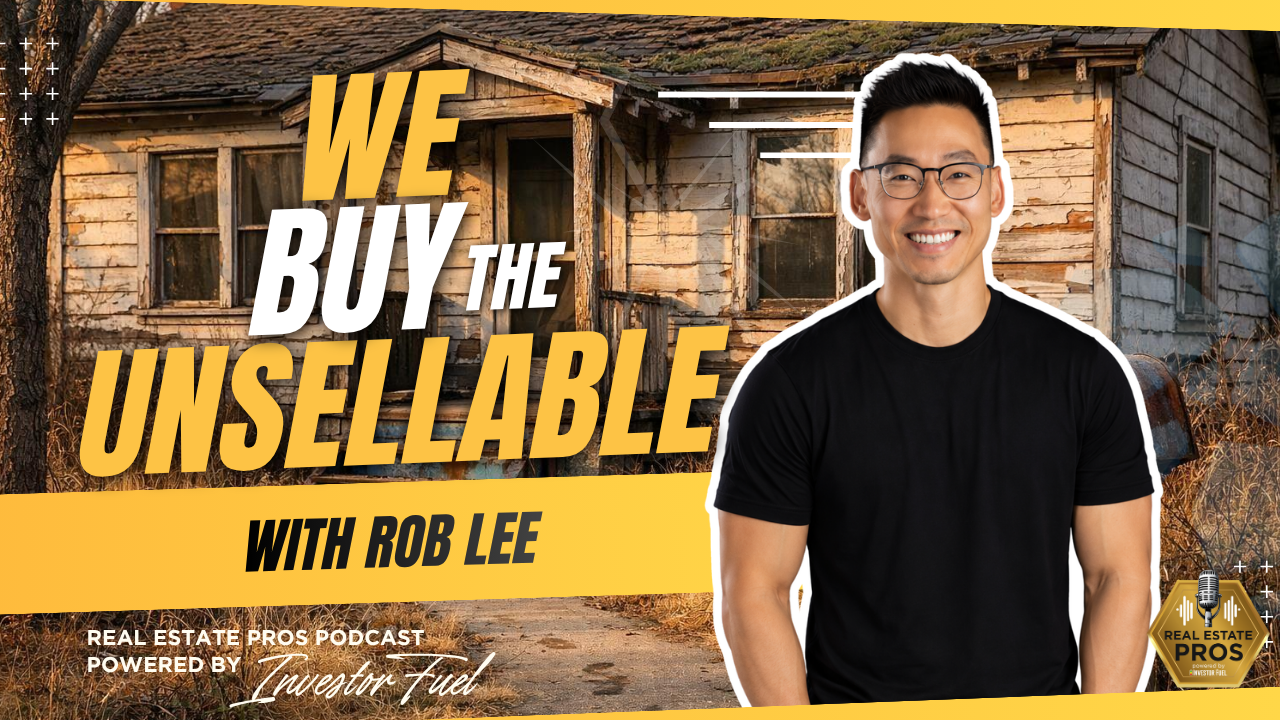
Rob Lee shares his journey from meditation to building a seven-figure real estate business focused on curative title deals. Discover how he leverages public data, legal strategies, and virtual talent to find and close complex property transactions.
Chapters
00:00 Introduction to Rob Lee
00:57 From Meditation to Real Estate Millions
02:46 Finding Free Real Estate Leads
04:11 Avoiding Risky Title Deals
05:34 Understanding Messy Property Titles
07:57 How Curative Investing Works
09:56 Best States for Probate Investing
11:09 Scaling With Virtual Assistants
12:43 Market Risks and Legal Changes
14:27 Five Keys to Underwriting Deals
17:14 The Power of Investor Networking
18:10 Title Research, Integrity and Final Advice
Resources and Links from this show:
-
-
- Investor Fuel Real Estate Mastermind
- Investor Machine Real Estate Lead Generation
- Mike on Facebook
- Mike on Instagram
- Mike on LinkedIn
- Rob Lee’s Phone Number: (703) 395-4990
- Rob Lee on Instagram
- Curative Investor on Skool
-
Listen to the Audio Version of this Episode
Investor Fuel Show Transcript:
Rob Lee (00:00)
So deals that simply can’t close because the title underwriter, right, they will not provide an insurance policy, a title policy for that property. So they’re uninsurable. So that’s those are the only deals we run to, the ones that most investors will run away from.
Scott Bursey (00:48)
Welcome back to the Real Estate Pros Podcast, powered by Investor Fuel. I’m your host, Scott Bursey. Glad you’re with us. Today we’re pleased to be joined by Rob Lee. Rob made an incredible leap from leading sound bath meditations to building a seven figure real estate business in his very first year. He’s closed over 600 transactions with more than 100 million dollars in total deal volume. Listeners, you can expect to learn how Rob uses curative investing to turn complex property problems into massive profit opportunities.
Scott Bursey (01:23)
Rob, welcome to the show.
Rob Lee (01:24)
Thanks, Scott. Appreciate the opportunity being here. Yeah, thank you.
Scott Bursey (01:28)
It’s awesome having you here, Rob. And to help our listeners get up to speed. Please give us the 90 second highlight reel of how your career ignited and where you’re pouring your fuel now.
Rob Lee (01:40)
90 seconds. All right, here we go. so I used to be a finance bro, had a quarterlife crisis, and eventually became this monk guy playing the ancient Tibetan singing bowls, sound baths in the DC, Maryland, Virginia community, grew the largest sound bath community there. COVID came, wiped everything out, pivoted some of the nonprofit staff to start wholesaling and flipping houses, made seven figures in our first 12 months, moved to Puerto Rico for some business and social. incentives that were out there and basically ran the virtual business four years, moved to Austin at the beginning of 2025. got a little office here where we’re building this curative investing business, which essentially we’ve pivoted from I was buying some distress HOA liens when I was on the island and realized there were better ways of acquiring deals, especially with the changing of the markets. And ultimately it’s been a little bit over a year, but essentially we’ve now fully pivoted 100% into buying messy title deals. So deals that simply can’t close because the title underwriter, right, they will not provide an insurance policy, a title policy for that property. So they’re uninsurable. So that’s those are the only deals we run to, the ones that most investors will run away from.
Scott Bursey (02:46)
Wow, what a wave of journey. That’s awesome. And what really caught my attention, Rob, about you was the way you’ve been able to go from Sound Bath Meditations to closing over 600 complex deals and doing 100 million dollars in volume so fast. And taking that a step further. Curious to know what’s working best for you right now in finding curative deals?
Rob Lee (03:12)
Yeah, what’s working for us right now is just really using publicly available information. coming from the wholesale space where you’re paying for AI enriched data and spending marketing, I was spending fifty thousand dollars a month and just mailers, right? And PPC, PPL, all all the things. And now our marketing spend is zero because we literally just pull a tax delinquency list, stack it with code violations, do some AI, Google Street View searching and ultimately it’s all free, it’s all public information. And so then we find, we reverse engineer the deals where it seems as though there’s a deceased owner of record and the heirs of which are not taking care of the estate or the property. And based on the multi-year delinquency, a specific amount of taxes, maybe seven to ten thousand dollars plus, and the fact that there might be physical distress on the property, we go and like do a genealogical work, do some title abstracting. Give those heirs a call and see if they want the opportunity to just walk away from the problem. Rather than having to pay a probate attorney to probate the estate and take care of the tax delinquency and pay all the, issues that may be going on with the property itself. and so we just give them an opportunity, just buy their undivided, their partial interest out for the property.
Scott Bursey (04:24)
What’s the key or your strategy to staying ahead of the competition?
Rob Lee (04:28)
the beautiful thing about this coming from the saturated wholesale space is the fact that there are so many opportunities. Leads are everywhere. And so to stay ahead, it’s really just understanding how to analyze risk more effectively. Because we came out of the gate, spent a million dollars very quickly because all this is cash funded out of our pocket. And we got into a bunch of deals that were more messy than we would have preferred. And so now it’s just about how do we find a sweet spot where it’s just messy enough that we know the cure is going to take anywhere between 30 to 90 days. because that wholesale money was nice, 30 to 60 day turns. Now with this legal curative title aspect of curing, the title can take anywhere from really three months to a year. And so that can get messy. So right now it’s just really the how to stay ahead of the curve, I think right now, is two things. One understanding how to enrich our data and get better quality leads through our data systems. And then furthermore, how to underwrite properly and analyze risk so that we’re not getting into all these crazy deals that are going to take a year plus to monetize.
Scott Bursey (05:29)
Thank you for highlighting that. And love to hear if you could go a step further on this. What’s the biggest obstacle in your business, your unique niche today?
Rob Lee (06:18)
The biggest the biggest obstacle in this niche, I would say in general, is the learning curve. man, it is intense. Like if you’re watching this, any investors watching this, how many times have you read your title commitment from front to back? it’s probably never that you’ve actually looked at what the Schedule A, the B, the C, all the exemptions and the encumbrances were and why they were there. And so You’re really reverse engineering why the title policy is even insuring the policy in the first place. And so that opens up a whole can of worms of which kinds of encumbrances, reasons why title won’t ensure policy. What are those reasons and how much of that curative process actually requires a ton of money? Or how much, how many times does that actually just require maybe an affidavit? And it’s just a piece of paper. And that cures pretty fairly quick. So there’s a learning curve in being able to do the abstraction and examination yourself. Like we’re literally in the land records, going back from deed to deed, going back in the chain of title and making sure that who the person thinks that they own it now actually is the vested owner based on the entire in the entire title chain. looking into the probate, looking into the court dockets, looking into the entire family tree of who really if the person had died without a will, we call that intestate. If they died intestate, who would the actual biological errors be? so I would say by and large, it is an academic approach and that learning curve is really the moat of why it’s the barrier to entry to get into this specific niche is fairly high.
Scott Bursey (07:53)
That leads me to think, Rob, where are deals falling through most often during title cleanup?
Rob Lee (07:59)
Following through for us or for the average investor? Or for us, I’m assuming.
Scott Bursey (08:02)
For your business.
Rob Lee (08:03)
Yeah. And when you say falling through, you mean like we they’re not monetizable anymore, or what do you mean exactly?
Scott Bursey (08:09)
Where are you perhaps losing deals, a challenger, something of that nature, if you could expand on your strategy when things when you have to pivot, when things aren’t going the way that you had planned, perhaps?
Rob Lee (08:21)
Yeah. Well, so the difference between wholesaling and this is that in wholesaling you have a contract out and then your interest is secured by paper, right? By a contract, and then you assign the rights to that contract. In this business, we actually send a deed, a closing package to the co owner. And then as soon as they sign that warranty deed and we record it, we just wire the money. So then we actually become a Owner. We become the co-owner with these people. So there’s no like falling apart at that point. It’s really like we’re an owner now. Now we have to find a way to negotiate, settle, joint venture, or file some kind of suit to enforce the sale. so times where I would say like that falls apart once we’ve actually obtained ownership is when there are some problematic heirs who don’t want to cooperate and they’re holding out. And so we’re like sending them cookies and flowers and All these things, we’re getting a notary to knock on their door and I’m there on FaceTime. Hi, like this is me. I apologize, I’ve been bothering you for so long, but I’m a real human being. I promise I’m not a scam. Right. And so there are creative ways that we go up and try to get people’s attention to know that hey, we’re real people. We will literally give you money to just walk away from this. but in terms of the breakdown and the challenge that you were referring to, I’d say it’s those kinds of heirs that really just put their head in the sand and don’t want anything to do with anything. at that point in time, there are legal remedies that can eventually have either liquidated their share, through a court action, or there are ways that we can foreclose on their interest through an equitable lien. there’s some advanced legal strategies that take place, but just take a lot of time.
Scott Bursey (09:57)
Appreciate that excellent breakdown, Rob. Help us understand where are you seeing the best opportunity right now for curative investing?
Rob Lee (10:07)
Yeah, the best opportunity right now are in states in which the process to start in terms of getting your first deed, right? Getting a partial interest into actually curing the title is relatively quick. So I’ll tell you some of the most challenging states would be places like California, like New York. There’s a very intense scrutinized probate process, which, then extends the cash conversion cycle if you were to try to monetize those deals. The quickest that I’ve seen so far are states like Texas, Florida, North Carolina, Tennessee, Georgia, places where some of the underwriting guidelines for issuing title policy are similar to places like where Texas in the model that has been created. Shout out to Logan Fulmer, my coach, my mentor, who I learned this model from, he’s really been pioneering this niche as a whole. And so if you can find other states that mimic some of the similarities in which, title as well as the legal and properties and their tax values like are like Texas, that’s a great model to start with.
Scott Bursey (11:07)
What is your next big move to grab more market share?
Rob Lee (11:10)
Next big move. Good question, man. So one of the things that we were just discussing about is being able to utilize virtual talent. And so because we have had a team that was basically scaling our wholesale shop, it didn’t make sense for us to just like, cut everyone and start from scratch. We gave everyone a ninety day process of hey, sink or swim. This is your chance to like fit within this new model, or we love you. But hopefully, unfortunately, we have to go our separate ways. And so what ended up happening was that fifteen out of the 20 people caught on. And some of these researchers that were, paying competitive virtual assistant rates would comparably be worth sixty to eighty thousand dollars here in the States for just doing title abstracting and title research and examination, right? Others would potentially be worth anywhere from seventy to a hundred twenty thousand dollars as a salesperson where they’re calling and breaking down the entire fact pattern of the probate and the title and the legal aspects while sounding American. And these are all people that we’ve trained and poured into for five plus years doing our wholesale business. And so we’ve been able to leverage these virtual assistants and we in fully intend to scale that aspect of leveraging that arbitrage right there.
Scott Bursey (12:22)
That’s great insight. What most concerns you in this market?
Rob Lee (12:27)
Man, that’s a good question. I don’t think private equity is gonna come in anytime soon because it’s just man, there’s it’s just so tedious. And I would say maybe if the bottom falls out, like if something happens World War Three, prices tank, eighty percent. But even then, I guess we just buy and hold all of our inventory and then just cash flow. but something like that, say for a black swan event, I like I feel that the prospect The long term prospect of this industry is very sound.
Scott Bursey (12:53)
What could potentially throw a wrench in your plans of probate regulations change?
Rob Lee (12:58)
probate regulations change. That’s a good question. I would say that depending on the severity of how they regulate probate, because there are times where we maintain a arm’s length distance. So we’re not the, personal representative. We’re not administering the estate. We’re providing value because the administrator or the potential heir just simply doesn’t have the means to actually hire an attorney and do all these things on their own. So as long as we feel like we’re providing a fair value, I don’t really see probate administration changing affecting us too much. however, I, I would say that it’s less about the probate administration change and more about the underwriting guidelines that might change. so that that’s my answer to that.
Scott Bursey (13:41)
Thanks for pointing that out. And let’s dig into where are you seeing an edge today when negotiating, let’s say, complex deals?
Rob Lee (13:50)
Yeah. the edge is the simple fact that you’re able to analyze and underwrite these deals properly. So I was telling you before that we got into many of these deals that were messy that required a substantial amount of legal cost and time. and so we’ve basically distilled our underwriting guidelines, and I’ll just share it with you all right now, into five different distinct elements. The people and their personalities, because inevitably you’re gonna be co-owners with these people, so their personalities matter. The probate and where it is exactly in the stage of probate, or if even there’s a probate at all. The property itself, is there an owner occupant? Is there an is there a tenant? Is there a squad or is it vacant? And the title, meaning in the chain of title, does it have clear title? Are there discrepancies in the legal description? Are there fraudulent documents that have been recorded? And then fifth but not least is a tax. And each jurisdiction or state has their own spectrum in which the tax delinquency escalates and then can lead to a tax auction or not. And so understanding how to underwrite each one of those five facets and the level of risk for each of those and how they interplay with one another is really important. And so as we continue to refine this underwriting guideline, both in Texas and how we apply it to other states is I think our edge to ensure we’re getting at, the right deals based on how we analyze risk.
Scott Bursey (15:08)
Really appreciate you sharing that grounded approach with our listeners. And Rob, if you could give us the scoop, what does your professional network look like right now?
Rob Lee (15:18)
professional and I don’t know probably not as good as yours bro like what how do you I don’t even know how to answer that. I got I got some friends. I lived in Puerto Rico for four years so I know some crypto bros and some whales out there on the island. And then I’m grateful for my time in the Boardroom Mastermind taking a little bit of a hiatus right now but still friends with a lot of the guys and girls over there. and then I’m originally from the DC area. And so born and raised Virginia Tech alumni. so I have a lot of friends and family still in the DC area. But right here, in Austin, I’m kind of the new kid on the block. I’ve just been, working and in the office and I like also I’m really into the spiritual consciousness meditation stuff. So I’m slowly building a meditation community here in Austin, Texas. so I’d say my professional network here is a little bit lacking, if I’m being honest. So we got some suggestions, but like you put me on the spot. I didn’t know how to answer that.
Scott Bursey (16:07)
Let me ask you this, what type of value have you found being around like minded individuals in your career thus far?
Rob Lee (16:15)
my gosh, invaluable. the amount of I think Napoleon Hill said the mastermind is one of the most profound examples of how you can create success with other people, obviously for yourself, but especially with other people. Because when two or people come together, there’s a hive mind, another consciousness that’s greater than any one individual that’s formed as a result. And so the ability to be in the space of like-minded people is. an invaluable gift that I would recommend anyone who’s on the journey of investing, to partake in. it’s yeah, hugely valuable.
Scott Bursey (16:49)
That network strength is so critical. Rob, let’s dive deep. If you had to give one sharp piece of tactical advice to unlock a nice profit from a stuck deal, what would it be?
Rob Lee (17:03)
my gosh, I there’s so many, but the not just one, but the thing that I would encourage people to do is develop a skill. Cause when you develop a skill, no one can take that from you. it’s a gift that keeps on giving. And so the skill, there’s many skills, but one hugely important skill is to understand how to do title research yourself. Cause just because a person thinks they own the property doesn’t mean that they do. Just because a person is named in the county assessor’s office or the tax office or the appraisal district, whatever those names are that the county lists as the supposed owner of record, doesn’t actually mean they’re the owner. And it’s only when you look at the title and you understand what you’re looking at can you determine who actually should be the owner. So research.
Scott Bursey (17:45)
sharp advice right there. And you’ve given us a lot of really good words of wisdom here today, Rob. Thanks. But is there an additional word or two that you would like to leave with our listeners?
Rob Lee (17:58)
sure, absolutely. I think out of all of the skills, the lessons, the wisdom I’ve been able to glean from people way smarter than myself, I think at the end of the day, in order to create a strong network, in order to create a strong reputation, in order to lead a team with a strong culture, it’s the utmost importance that one maintains integrity with self and with others. Because integrity is something that compounds, both within yourself and with others. And when you have a reputation of being an integritous person, people will look to do deals with you and you’ll it’ll gravitate and beget more benefit and more prosperity. And so I think it starts and it ends with integrity.
Scott Bursey (18:38)
That’s so powerful. Thank you for that. And Rob, for those of our listeners that would like to keep this conversation moving, stay in your lane, or perhaps collaborate with you on future deals. Yeah. What’s the best way for them to plug into your pipeline and reach you directly?
Rob Lee (19:31)
Yeah. thanks, Scott. they can I I gave my cell phone number on Steve Trang’s podcast. So I’ll give my number here again. It’s (703) 395-4990. You can also find me an IG at @real.roblee. shoot me a DM and hopefully we can help you through a stuck deal and or a joint venture or whatever the case is. We also have a Skool community, it’s completely free. skool.com/curative-investor, like it’s written on that sign. and we’re just wanting to kind of share the wealth and the gold that this opportunity has afforded us. So
Scott Bursey (20:03)
Rob, thank you so much for joining us today on the Real Estate Pros Podcast.
Rob Lee (20:07)
Thank you, Scott. You’re awesome.
Scott Bursey (20:12)
And to our listeners, we appreciate you. If you receive value from today’s episode, please subscribe. We’ll be fueling your tanks with a lineup of elite guests, just like Rob Lee, who are accelerating and setting the pace for the rest of the industry. Until next time, keep your standards high and your vision clear. We’ll see you in the next episode, everyone.