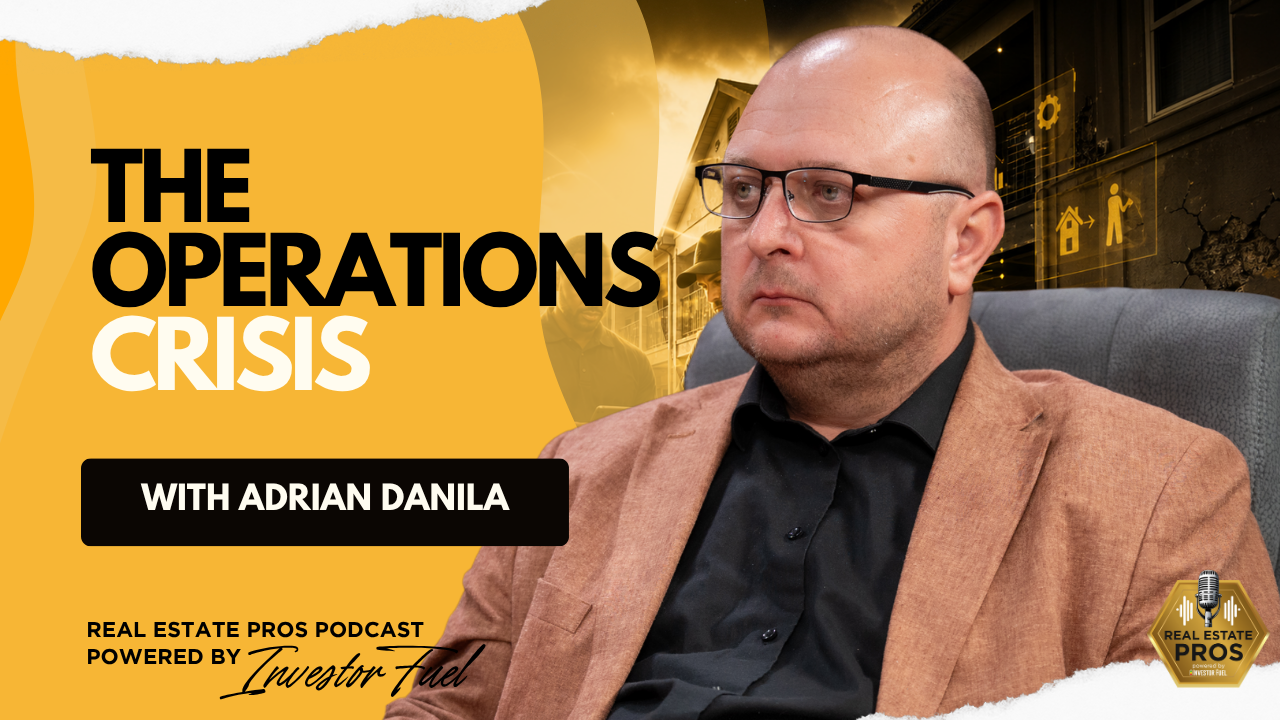
How Cost Segregation Helps Real Estate Investors Save Big on Taxes
Show summary
In this episode, Scott Bursey interviews Dan Boyd of CSSI to explore how operational excellence and technology integration can transform real estate investment strategies. They discuss cost segregation, maximizing depreciation, and leveraging emerging tech for efficiency and growth.
Key takeaways
- Cost segregation delivers positive ROI on properties valued at $150,000 or more, contrary to the idea it's only for expensive properties.
- A cost segregation study can accelerate 20-25% of a building's value in depreciation; a $200,000 property could yield a $50,000 first-year tax deduction.
- 100% bonus depreciation was restored under the 'big, beautiful bill,' creating a strong tailwind for investors using cost segregation right now.
- CSSI positions cost segregation as comparable to or better than a 1031 exchange for many investors, with lower cost and higher ROI on accelerated depreciation.
- Tax savings from cost segregation free up cash to pay down debt, fund upgrades, or acquire additional properties rather than paying it to the IRS.
- Before adopting any strategy (1031 exchange, creative financing, cost segregation), investors should 'pencil it out' themselves rather than relying on secondhand advice.
- CSSI has completed over 60,000 cost segregation studies over 20+ years and offers free estimates on owned or prospective properties via daniel.boyd@cssiservices.com or cssiservices.com.
In this episode
- 00:00Cold open: when cost segregation makes sense
- 02:02Introduction to Dan Boyd and CSSI
- 02:49Dan's career path from education to specialty tax
- 04:30How CSSI accelerates depreciation and cash flow
- 06:50CSSI's strategy for the next 12-18 months
- 08:07AI, machine learning, and the 1% improvements approach
- 09:42Data security and compliance for investors
- 11:37Advice: pencil it out before trusting advice
- 13:03Cost segregation basics and the $150,000 property threshold
- 14:37Biggest opportunity: zeroing out tax burden
- 16:50Why work with CSSI and how to get an estimate
About Dan Boyd
Dan Boyd is VP at CSSI, a specialty tax firm that performs cost segregation studies for real estate investors ranging from first-time owners of $150,000-$200,000 properties up to multi-million dollar portfolios. He started his career in education, earning a doctorate and working as a principal/superintendent, before moving into sales and consulting with a specialty tax firm. He says CSSI has completed over 60,000 cost segregation studies over more than 20 years.
Listen to the audio
“Nothing compares with cost segregation for the ROI in terms of the low cost and the usually the very high return on accelerated depreciation in the tax savings that it generates.”
Dan Boyd
“You can pay the IRS or you can find a way to defer those taxes, reinvest that and grow your business.”
Dan Boyd
“If you can't do that, it means you probably don't understand it well enough to put your time and money behind it.”
Dan Boyd
Questions answered in this episode
At what property value does cost segregation make sense?
Dan Boyd says if you're holding a property valued at $150,000 or more, cost segregation will generate a positive ROI that makes sense. He pushes back on the idea that it's only worthwhile for very expensive properties.
How much depreciation can cost segregation accelerate?
Boyd states cost segregation can accelerate 20 to 25 percent of a building's value in terms of depreciation. As an example, he says someone buying a $200,000 building could get a $50,000 deduction on their taxes in the first year.
Is cost segregation better than a 1031 exchange?
Boyd argues cost segregation is just as good, if not better, of a strategy for a lot of people than a 1031 exchange, and that nothing compares to it for ROI given its low cost relative to the high return on accelerated depreciation and tax savings.
What tax law change is currently benefiting cost segregation strategies?
100% bonus depreciation was restored under what Boyd refers to as the 'big, beautiful bill' last year, and he says it has bipartisan support, so CSSI isn't worried about it changing or going away anytime soon.
How experienced is CSSI in cost segregation studies?
Boyd says CSSI has completed over 60,000 cost segregation studies over more than 20 years and considers the firm the leader in the middle market for this service.
What should an investor do before committing to a tax or investment strategy?
Boyd's advice is to 'pencil it out' rather than take people's word for it, meaning investors should run the actual calculation to determine if something is a good investment before putting time and money behind it.
Resources and links
- CSSI Services’ Website
- Dan Boyd’s Email: daniel.boyd@cssiservices.com
- Dan Boyd on LinkedIn
Full transcript
Daniel Boyd, VP At CSSI (00:00)
Sure. So for anybody getting in getting started in investing in real estate, think understanding cost segregation is is a really important step for you to see you understand when you should do it. And so in general, if you’re holding a property and the property value is one hundred and fifty thousand dollars or more, cost segregation is going to be a positive ROI and it’s going to be an ROI that makes sense. And so, you know, you’ll hear people say things like, you know, it’s only for really expensive properties or it’s really expensive or.
You know, you have to worry about recapture, pencil it out.
Scott Bursey (02:02)
Welcome back to the Real Estate Pros podcast powered by Investor Fuel. Today we are bringing in a guest who specializes in turning complexity into pure scalable efficiency. He’s the person you call when your real estate business has outgrown its systems. Our guest Dan Boyd of CSSI brings the field of operational excellence. He is an absolute master at integrating technology so that your business can run on autopilot and scale without the usual headaches.
Get ready for some high octane insights because Dan is firing up everybody’s engine. Dan, welcome to the show.
Daniel Boyd, VP At CSSI (02:40)
Thanks so much. you for the introduction, Scott.
Scott Bursey (02:43)
For our listeners who may not be familiar with your journey, please tell us, how did your career begin and what is your main focus now?
Daniel Boyd, VP At CSSI (02:49)
Sure. So I started in education and ended up getting a doctorate because I saw the role that a principal and a superintendent could do. And as is the case with many superintendents, they migrate into sales and consulting after their time in education is done. So I found a great opportunity with a specialty tax firm. And great way to think about specialty taxes.
What are all of the things related to your taxes that are beyond the scope of what a typical CPA does? So CPA is going to prepare your taxes, but there’s tax advice, there’s tax planning, there’s specialty tax. So we work in and occupy that space and we’re the leader in the middle market. So we provide our services for real estate investors ranging from small first time investment properties that are in maybe the 150 to $200,000 range up to multi, multi or mini property portfolios that go into the millions of
dollars in their value.
Scott Bursey (03:41)
And Dan, what really caught my attention about you was the way you’ve been able to simplify complex system integration for large scale real estate investors making their operations run like a well-oiled machine.
Daniel Boyd, VP At CSSI (03:55)
Yeah, you we really want to make it easy for people to input what really all of their information into the process for getting a cost segregation study done. We know that everybody’s busy or there’s you know, somebody is not returning your call. It’s not because they don’t care. Normally it’s because they have 15 other competing priorities. And so our job is to make working with us as easy and simple as possible and ultimately to put more cash flow back into the pockets of our clients because you can pay the IRS or you can find a way to defer those taxes, reinvest that and grow your business.
And I think all of us would rather grow our business than have to have a higher tax bill than necessary.
Scott Bursey (04:30)
And Dan, if you could walk us through this, what’s the biggest strength in your system integration method right now?
Daniel Boyd, VP At CSSI (05:25)
Yeah. So what we’re best at and what we really shine at is helping building owners, helping real estate investors accelerate depreciation. And so if you think of kind of the you all of your your investments and your plan, your exit strategy as a system, really what that needs is that needs input and the input is cash. And so it’s kind of like the fuel for the engine. So we’re able to accelerate and provide more fuel for that engine, especially in the early years of owning real estate. We accelerate cash flow better than any other strategy out there. So things like 10
exchanges are great, but nothing compares with cost segregation for the ROI in terms of the low cost and the usually the very high return on accelerated depreciation in the tax savings that’s generates, which just allows people to grow, scale, hang on to properties that they otherwise would have sold, pay down debt, you name it.
Scott Bursey (06:13)
And Dan, I’d be remiss if I didn’t ask this. What’s one thing that you’re still trying to figure out business related or work around recently?
Daniel Boyd, VP At CSSI (06:21)
You know, with the big, beautiful bill, we saw a huge influx in business. And so we were prepared for that. And we’re still operating within the budgeted timelines that we have. But, you we always want to push that and see how much more quickly can we deliver results and respond to people, because nobody’s disappointed when they receive their results faster than they expect. And so that’s where we want to be. We don’t want to be just, yeah, we met our timeline, but we exceeded our or we beat our timeline, exceeded it on the short end.
Scott Bursey (06:50)
It’s a constant battle. Now let’s talk short-term strategy. What are some of your focal points? What’s some of your strategy for the next, let’s say, 12 to 18 months, Dan?
Daniel Boyd, VP At CSSI (07:01)
Yes. So I would say the big one is just continuing to represent the company and let the companies in the middle market, tax professionals, large firms, investment managers, real estate brokers realize the value of this for their clients. So we’re in the business of consulting and education just as much as we are doing our specialty tax work. so people will they might ask us, how come I’m not familiar with the strategy and the responses because there’s so much in the tax code. Very few people know it all. Certainly nobody knows it perfectly.
And so our job is to help educate and spread the word. Things like 1031 exchanges are those are common terms and common ideas that are used in a lot of real estate circles and cost segregation is just as good if not better of a strategy for a lot of people than a 1031. And so say we’re already leaning heavily into that and we do that very well by going to trade organizations and you know state CPA organizations and whatnot. But you know there’s always the need to go educate and present what
what’s core and unique about any company. And so that’s the task that we’re really leaning into.
Scott Bursey (08:07)
I love that framing. And give us the play-by-play on this, Dan. What emerging technology excites you the most right now for generating efficiency in property management?
Daniel Boyd, VP At CSSI (08:20)
Sure. you know, I would rather than just saying kind of AI broadly and generally, which I think is what a lot of people are going to go to, I think understanding more of the specifics of what AI does. So we’re all familiar with Chat GPT or Claude, which is a large language model, but that’s a little bit different than something like machine learning. And so just understanding how you can use that to analyze really, really large data sets to make better decisions. And so
If a company can do that, they can understand their market, their target demographic, things like the ideal properties, the ideal zip code, zoning, whatnot, ⁓ that’s going to just help them increase their margins. I love borrowing the idea from James Clear in Atomic Habits. He showed the story of how the British cycling team or club went from being kind of last place in the Tour de France to having a dominant run. And they did it by finding lots of little things that allowed for 1 % improvements. And those improvements stack.
So if you can find 10 things that improve your speed or efficiency 1 % each, well now you’ve grown by 10%. And 10 % growth is really hard to do. And so I think kind of taking that approach, looking at your business and saying, obviously, if you can grow 15 % in one shot, great, do it. But after a while, all of those low-hanging fruits have already been taken. And so you have to look for the things that can stack together to give you combined really big growth.
Scott Bursey (09:42)
The future is all about efficiency and that sounds like a massive leverage point for our pros. Dan, take us underneath the hood on this. What unexpected change in data security or compliance could significantly disrupt existing operational systems in let’s say the next 18 months in your view?
Daniel Boyd, VP At CSSI (10:39)
Yeah, so I can speak broadly to this.
to the extent that I’m familiar with it. Certainly not an expert in this, but just understanding the effort that our company has made to remain compliant and to keep our clients’ information secure. ⁓ IRS compliance and client data security are really paramount for us because even before we deliver high quality results, we want to make sure that we’re checking those two boxes and staying completely in the zone of where we need to be. So I’d say just recognizing that there’s bad actors out there and you need to be proactive and it’s probably worth spending
some money to avoid a very expensive and drawn-out headache further down the road. so taking the time to understand what are the regulations that govern your industry and what are the very least the minimum standards of security that you need to put into place. And often, know, working with companies like insurance companies, they have their own requirements for what you need in order to be covered. And so those can be helpful places to start.
Scott Bursey (11:31)
Staying ahead of the curve is key.
Daniel Boyd, VP At CSSI (11:34)
Absolutely, you don’t ever want to get behind on that.
Scott Bursey (11:37)
No, and what is one simple system or integration every small real estate investor should be implementing today to save time tomorrow?
Daniel Boyd, VP At CSSI (11:46)
You know, I’d say we’re such a specialty firm and so I can’t speak to all of the kind of complex software systems that people are going to use in their tech stack. So I’d say just broadly speaking, this is one of those pieces of advice that feels like it’s what your grandma or grandpa would give you. it’s, you know, like don’t take people’s word for it, pencil it out. So I like this example. I like to go fishing and no matter where I fish, there’s people who will say, you don’t want to catch that fish. It doesn’t taste very good or you can’t eat that. It doesn’t taste very good.
those people have never actually eaten that fish. They’ve just heard from somebody who’s heard from somebody who’s heard from somebody. It’s like cow tipping. I’ve never been anybody who’s gone cow tipping, but I’ve met hundreds of people who swear they know somebody who has. And so verify for yourself, right? And in real estate, that usually means penciling it out. So do the calculation to determine if something is a good investment. And if you can’t do that, it means you probably don’t understand it well enough to put your time and money behind it.
Scott Bursey (12:43)
That’s high octane advice right there. Start simple, but start small.
Dan, we talk about high octane fuel and this is where you supply it. let’s ask this here. What is some big, words of encouragement, some advice that you could give with, leave with our listeners today?
Daniel Boyd, VP At CSSI (13:03)
Sure. So for anybody getting in getting started in investing in real estate, think understanding cost segregation is is a really important step for you to see you understand when you should do it. And so in general, if you’re holding a property and the property value is one hundred and fifty thousand dollars or more, cost segregation is going to be a positive ROI and it’s going to be an ROI that makes sense. And so, you know, you’ll hear people say things like, you know, it’s only for really expensive properties or it’s really expensive or.
You know, you have to worry about recapture, pencil it out.
Just sit down and do the math and understand, you know, what kind of return is this going to have for you? And, you know, we I think I mentioned earlier.
the frequency with which people talk about, you should do this strategy. You should do this other one. If you don’t understand it, then take time to look into it. So people talk about 1031 exchanges all the time and similar things in real estate, creative financing, whatnot. But cost segregation is such a tried and true method. I it can accelerate 20 to 25 percent of a building value in terms of depreciation. So if somebody is investing, just getting started, you know, maybe they buy a two hundred thousand dollar building. You can get a fifty thousand dollar deduction on your taxes.
by doing a cost segregation on that property in the first year. And so, you know, for a lot of people to have to not pay taxes on $50,000 worth of income, that’s a dramatic change. And they now all of a they have the money to do some more upgrades, to pay down debt, maybe to acquire another property. And so it really just accelerates your timeline, whether that’s growing your portfolio, things you’re going to hold instead of flip and sell. So it’s really one of, if not the most powerful strategy for real estate investors.
Scott Bursey (14:37)
On that note, cost segregation, what do feel is the biggest opportunity right now?
Daniel Boyd, VP At CSSI (15:23)
So I’d say for investors out there to recognize how much you can increase cash flow. So this really changes the size or the value of the building you can invest in because before you had to account for how much your tax burden was going to be. Well, now you can in many ways completely zero out what you would owe in taxes and you’re going to defer that till much later when you sell the property, which might be years or decades down the line. And so to recognize looking at a property going in,
going to calculate what do you think your rent is going to be? What do you think your costs are going to be in terms of the interest and the taxes and the principal and whatnot? ⁓ But also understanding, okay, on the backpack end, after you’ve made your money and now you’re figuring out what do you owe in taxes, what if you can completely zero that out? How much more money do you have available to put back in real estate and grow your business? And so that’s the opportunity, I think, moving forward.
Scott Bursey (16:15)
any challenges that you’re watching closely.
Daniel Boyd, VP At CSSI (16:18)
You know, not really. It seems like we’ve we’ve got some pretty significant tailwinds in that 100 percent bonus depreciation, which was restored in the big, beautiful bill last year that seems to have bipartisan support. And so we’re not worried about that changing or going away anytime soon. And so as long as that’s in place, that’s really a boon for investors because it allows them to acquire property, but then get their money back out of that property sooner so they can spend it and put it to use for working for themselves, growing their business ⁓ or doing
what they think they need to do with their money.
Scott Bursey (16:50)
If someone’s listening and they’re thinking, hey, this is somebody that I like to partner with, what’s the first thing that you would like them to know about CSSI?
Daniel Boyd, VP At CSSI (16:58)
Absolutely.
So I’d say we’re the leader in cost segregation. We’ve done over 60,000 of these studies. We’ve been doing it for over 20 years. There’s nobody as big as us in the space or with the same track record. So oftentimes people will say, well, I’m the biggest, but that doesn’t mean you’re the best, right? Like just because a company sells more hamburgers, it doesn’t mean they sell the best hamburgers, right? It just means they sell the most convenient and affordably priced hamburgers. And so we kind of fill that niche very nicely where, we are the biggest and the quality is unparalleled and or at least unsurpassed. And so
If somebody’s curious about a cost segregation, they can reach out to me or they can go to our company website which is cssiservices.com My contact is daniel.boyd@cssiservices.com and they can just request an estimate on a property they either own or they’re looking at owning so they could get an idea of what the tax savings would be.
Scott Bursey (17:45)
Awesome. Dan, this has been pure gold.
Daniel Boyd, VP At CSSI (17:49)
I’m very happy to hear that. I’m glad that you enjoyed it. I hope your audience gets a lot out of it.
Scott Bursey (17:53)
Thank you so much for joining us today.
Daniel Boyd, VP At CSSI (17:55)
You’re very welcome, my pleasure. Take care, everyone.
Scott Bursey (17:57)
And to our listeners, we appreciate each and every one of you. If you got value from today’s episode, please subscribe. We’ve got a lineup of exceptional guests, just like Dan, who are making huge moves in the market. Until next time, keep your standards high and your vision clear. We’ll see you on the next episode, everyone.