Subscribe via:



Show Summary
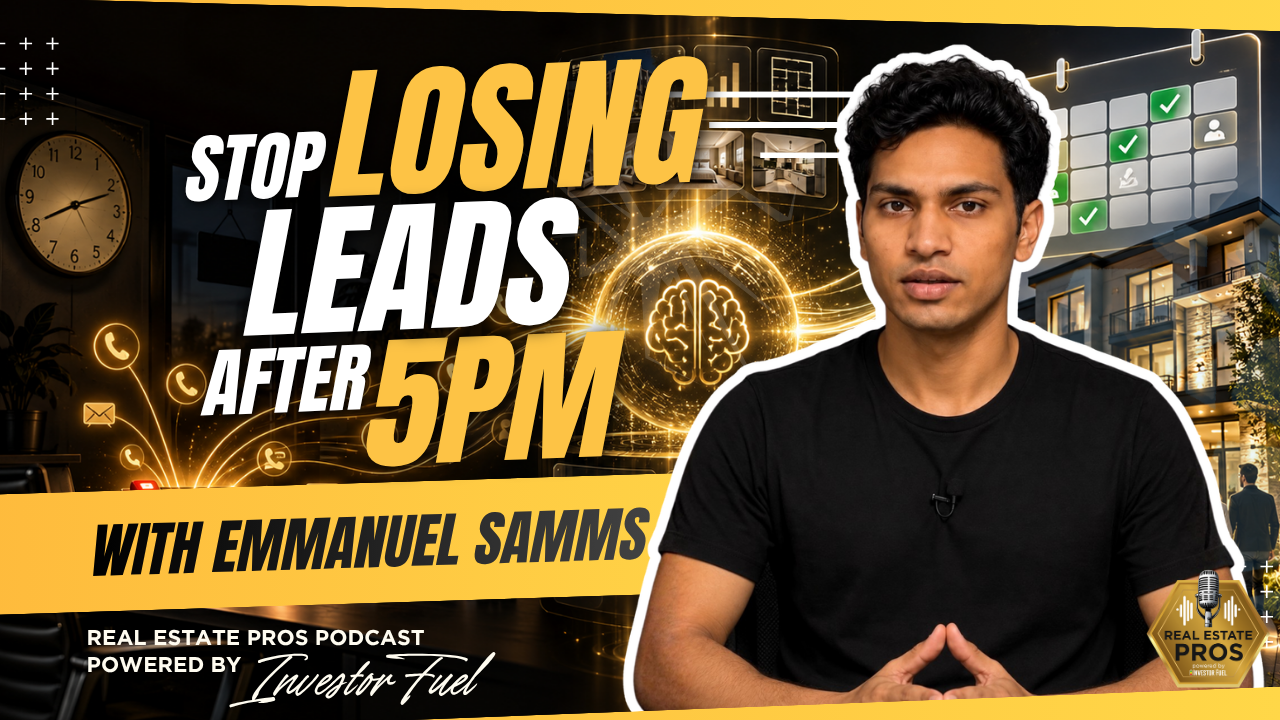
In this episode, Emmanuel Samms shares his journey from sales to tech, his innovative AI platform for real estate, and his vision for the future of AI in property management and beyond.
Resources and Links from this show:
Listen to the Audio Version of this Episode
Investor Fuel Show Transcript:
Emmanuel Samms (00:00)
So AI does it within minutes. The second a person uploads their pay stub, gets their background check, the AI does all the verification. It does the pre-screening. Rather than taking weeks for this process, AI does it in minutes,
and then sends a text message to the leasing team that, “Hey, this person for sure is qualified, chase that person.” And once the team understood the value behind this, they started implementing it. And most property management companies saw an increase of revenue of at least 60% in the first three months.
Issa Hanna (02:04)
Welcome back to another episode of the Real Estate Pros Podcast. I’m your host, Issa Hanna, and today I have Emmanuel Samms here to share his knowledge and his vision with us. Emmanuel, what’s up? How are you?
Emmanuel Samms (02:14)
Hi, Issa, thank you for inviting me on the show, and I appreciate the kind words. So I am the founder and CTO of Lease Tab, and the reason why we built Lease Tab is we are an AI infrastructure in the real estate space.
Issa Hanna (02:27)
I love that, man. I love that. An AI infrastructure in the real estate space. And we’re gonna dive right into what exactly he means by that. And it’s revolutionary, I’m telling you guys. But first, AI tech… What does a day look like in your world? Well, take me through a day in your world. What do you do from day to day?
Emmanuel Samms (02:43)
Where do I start? I start with three cups of coffee. Let me start there. It takes a lot of brainpower to sit in front of a screen and code for hours and solve operational problems. And every day I talk to a lot of real estate property management executives—C-level executives, operational executives—and they all have the same problem: They tell me the technology that doesn’t work,
and then they ask me how they can fix these problems in their operation with AI. Since AI is around the block, everyone’s talking about it, everyone knows what AI is, but still finds it hard to figure out what problems it can solve and to put that in place. So my everyday is just drinking a lot of coffee and having these solution-based conversations in real estate.
Issa Hanna (03:34)
And as a real estate professional, the coffee crosses the boundaries. We’re—we’re all coffee addicts. We need that caffeine to do what we do and serve the—our community and our people well. But speaking of that, as a real estate professional, you were telling me a little bit about your platform and I’m like, “Man, this thing can really, really take me as an agent…”
I was a former agent, over 250 first-time home buyers, let alone transactions. I know that this thing could take me to the next level. This thing will answer your phone, it will schedule appointments. Can you take us through what it does a little bit—the features?
Emmanuel Samms (04:09)
Absolutely. So the biggest problem we are solving is leads. So after 5:00 p.m. when the leasing office gets closed, or which any office gets closed in real estate, calls start coming in after those hours. The reason being is most people who are looking to rent their apartment or a place to live, they get the time to look at these apartments, the websites, the portfolio, the communities that you’ll have when they’re at home,
nobody’s doing it between 9:00 to 5:00 when they’re at work. And when they’re at home going through the communities and trying to decide which one to pick, they often call and ask for questions and information, and 100% of those leads are lost, because every property has an answering machine. It’s either “press one” or “press two” or “leave a voice note.”
And the next day when the leasing team
comes in, they do not check that. As a matter of fact, nobody even—I don’t check that, because I have a lot of pending work. So that was the first problem we started solving. And what we did was we built a conversational AI where the second a phone call comes in, the AI not only answers the call, but also gathers all the information that they want, conveys the right information about the community, pricing,
how many square feet, do you require pets, and any additional questions. Then it schedules a tour so that the leasing agent understands that someone called in and we have to cater to their needs. And it also sends a text message of the entire conversation that it had and the tour that it booked. It sends a text message to the caller and the leasing team so that the leasing team can follow up.
Once that is done, once the tour is done, what we started noticing was there was no retention on conversion. So most of these operating teams were like, “Okay, we toured, but we didn’t get any response.” So we started building another arm to the AI where, once the tour is done, the AI could reach back to the caller, send them another text message with a link that says, “Hey, let’s do the screening process.
Let me upload your pay stubs, let’s do a background check, let’s get you pre-qualified.” And the problem is, leasing team has so much work, they cannot go after every single caller that comes in.
So AI does it within minutes. The second a person uploads their pay stub, gets their background check, the AI does all the verification. It does the pre-screening. Rather than taking weeks for this process, AI does it in minutes,
and then sends a text message to the leasing team that, “Hey, this person for sure is qualified, chase that person.” And once the team understood the value behind this, they started implementing it. And most property management companies saw an increase of revenue of at least 60% in the first three months.
So this was where we started off and started evolving.
And now we’re at the stage where we have an AI infrastructure. So what we did is we don’t replace your traditional software, we actually integrate it with your legacy software. So it could be either Entrata or AppFolio. It just integrates with these softwares and turns those software into AI-native infrastructure. And for example, you could ask the AI, “Hey,
how much revenue did we lose last year compared to the previous year?”, or what—you can ask it very technical questions, financial questions, and it will go through all of those data points and give you a smart answer and recommendation. And then we also did another cool thing, is where we saw a problem. Another problem is most of the leasing agents get replaced every six months to a year, so you find a new management or a new employee
always trying to work around these new softwares, and they are never able to learn all of them completely. So rather than learning a software, you could just talk to the AI and the AI would execute the task behalf—on your behalf. So I could be like, “Hey, update Unit 201’s policies,” and the AI would execute that task.
Issa Hanna (09:01)
Exactly.
Emmanuel Samms (09:02)
These are the things that we have built with Lease Tab.
Issa Hanna (09:04)
Wow. Like I said, guys, truly revolutionary. It will take your game to the next level. Every successful professional in our industry knows: A, accessibility, that’s key. When people can access you, when they can—they can contact you, that’s key. So if you’re home on Saturday with the kids, you’re out at a game, you’re—you’re whatever you’re doing, you can’t answer the phone, Lease Tab will do it for you. It’ll schedule you the appointment,
it—it’ll have you ready to go on your calendar. Truly amazing. And then the follow-up: Everybody knows how important following up is. A lot of professionals watch my show, and I hope by now, with all the guests that come on, all the opinions expressed, follow-up is like a common theme on here. So the fact that it follows up and not just follows up, it gets them approved: “Let’s get you pre-approved, let’s get you in there.”
It solidifies that lead for you, it makes it so hot without you really having to do any work besides just implement Lease Tab into your already existing software. Truly, truly, truly, truly, truly amazing. All the great minds in the AI space, they know how to solve problems, absolutely. And that’s how you become great: on solving common problems that we have.
And this has seemed to solve a lot of these problems. Your infrastructure, everything—everything is in place. And now I want to talk five years down the line, because we—we talked about it earlier, and you said one of your company’s strengths is the infrastructure. So you’re gonna be adding a lot of different features to
not just Lease Tab, but you guys are so well positioned in the AI space, you could take it from there where you think you’ll be in five years. And I’m in total agreement with him, guys.
Emmanuel Samms (10:43)
Absolutely. So we—so in the last six months to a year, the AI space has evolved from just conversational AI to AI agents. And what a lot of people don’t understand is an agent is a layer where you can just tell it what to do and it will do it. It does repetitive, redundant tasks—that’s what an agent does. If there is any task in your operations that
is repetitive and redundant—for example, the follow-ups. Every single person has to be followed up, every single lead has to be catered. And this is a redundant job. And where AI agents outperform humans is because of the redundancy. Humans lack doing the same thing again and again. If you tell me to do the same thing a thousand times, I would be frustrated, my performance would decrease drastically. That, compared to my first
performance to my a thousandth one, I would—I would be less than half of my—of my best. But AI has no problem. It in fact gets better and better and better since it learns from its previous mistakes. And the way people are building AI agents, at least in the Silicon Valley, is they’re making sure it learns from the past mistakes,
or just learns from the past data. And over time, it’s just going to be so intelligent that you throw anything at it, it will be smart enough to rebuttal. It’ll be like, “Sure, we already faced that problem, this is how we solve it.” So since we have such great knowledge about AI agents, my—me and my team, I think in the next five years we want to
implement a feature or probably another SaaS model where any business could just plug it in and turn their company AI-native. And what that means is it’s not going to replace your employees, it’s going to empower your employees to perform better. That’s basically what we’re going to do.
Issa Hanna (12:37)
And that—and that’s what AI is being designed for. That’s what it’s supposed to be used for, you guys. So all the people back there resisting AI, it’s like resisting the internet when the internet took over. It’s coming and you better embrace it, and you better get with guys like Emmanuel, because these are the guys that are going to take you to the Promised Land, so to speak. And he didn’t get this knowledge
by studying in books. He did—I’m—he’s a very well-read guy, but firsthand knowledge, real-world knowledge, this guy got as an entrepreneur. And before he was an entrepreneur, he’s—he’s gone from sales to tech. He was in the sales world before, so he knows what it is to be tenacious and witty. And I’m gonna kinda let you take the floor now and give us a little bit about your entrepreneurial background and then how you went from sales to tech.
Emmanuel Samms (13:26)
Absolutely. So one of my first jobs was selling alcohol. I used to work for Budweiser, and I was very young when I started it, but I thought it would be the easiest job on the planet because selling alcohol is super easy. Who doesn’t want to get drunk in a bar? If you’re in a bar, you’re there to get drunk. But that was the hardest thing to ever do, because the second someone saw a sales guy, they were like, “I don’t want to talk to you.” And
growing from there, I realized that it’s all about the conversation. It’s not what you sell, it’s the relationship that you build, because I realized that they are going to buy from you, but they don’t even know you. That’s the problem. Once they know you, they would buy anything from you. And so my initial days were just figuring out how to communicate with people, how to build those relationships. And then over time,
while I was doing this, I saw tech taking off tremendously. Everyone was just heavily invested in technology and I felt left out at some point, so I decided to just start learning about it. And once I started learning about it, the initial phase was very difficult. I didn’t even know how to code. I did learn when I was in school, but building an infrastructure or building software was
completely different. Learning how to do the front end, back end, being a full-stack engineer was super difficult. That’s why we just have people just focusing on one little element. But then I got so interested in it, I just became a full-stack engineer. I became a data freak, because people—like I couldn’t fathom how people were selling software for free, because I was like, how can you give someone something for free? And then I realized
the entire gameplay is around data. They repurpose the data and sell it further, or give analytical information to other companies, or do marketing, or do sales with this data. And so I just dived deep into this tech space and spent the last 10 years in just polishing myself. So that’s what—that’s—I think that’s a strength, that I went from being a sales guy to a tech guy,
because most tech guys are so nerdy, they will not talk. And I just stand out. I’d be like, “Hey, I don’t care, let’s start the party.”
Issa Hanna (15:45)
Yeah. I love that, man. And you do, you have to have that personality. When you have the personality and then you back it up with all the stuff the tech guys have, but even better on top of it, how could they resist you? Unbelievable, unbelievable. And now you—you’re young, you look pretty young. So I’m gonna ask you a question for the young guys.
There’s a lot of guys just starting out, and they’re probably watching this and they’re watching you and they’re like, “Man, I want to be like that guy,” like getting inspiration from you. You said a whole decade, you started off as a really young buck getting into this, and here you are ten years later, all this knowledge. If you had to give them one piece of advice on how to establish business relationships, grow their network, because it’s very important to do that, what would you tell them?
Emmanuel Samms (16:29)
Ask questions. That is where you start, because most people think they know it all. Like every person I meet, they are just trying to give information now, but they have nothing to show for it. So I would suggest every young person just ask questions. And don’t ask questions to a random stranger down the road, ask questions to those people in your industry. Ask questions to those people who you want to
get the right information from. If I had to ask investment-related questions, if I wanted to be an investor, I wouldn’t ask my neighbor because they have not done a single investment. I would try reaching out to a guy like Mark Cuban, I would go to the top investors in my area, I would go to these networking events and just ask questions. And the questions have to be simple:
How you started, what did you do, tell me your struggles, because they have a history that you can absorb within 15 to 20 minutes. And that would give you more information than going to a school. Like I’m not saying don’t go to a school, go to a school because you do need to understand the technicality of things. But the real game is played in the real world. School is just a controlled environment.
But in the real environment, it’s completely brutal. So if you want to toughen up and if you want to get better, my advice is go out there, ask stupid questions, play dumb, play smart when you have to. Just be street smart. That’s what I would recommend people doing.
Issa Hanna (18:00)
Hundred percent. And people that watch this show, they hear it echoed by the successful, by the bright minds on the show all the time. Get out there, ask questions. We’re never experts. Here he is sitting here, he’s designed this crazy platform that solves all these problems, and he says, “I don’t know everything yet.” That’s the right attitude to have, and that’s how you be successful in the game. And now if my viewers, if people at home
wanted to get involved with Lease Tab, if they wanted to get you guys downloaded and use you in their company, where could they find you at?
Emmanuel Samms (19:14)
Absolutely. All you have to do is go to LeaseTab.com and fill out a form, and I will reach out, trust me. But if you personally want to connect with me, you can connect with me through LinkedIn. My name is Emmanuel Samms, and you can just find me on LinkedIn. And you can just send me a message and I will reply to every question y’all have, because my motive in life is to build relationships and be connected with people.
I have a long way to go and a lot of relationships to build, so shoot me a message.
Issa Hanna (19:46)
A hundred percent, guys at home, make sure LinkedIn, look him up, Emmanuel Samms, LeaseTab.com. Go fill that form out and get acclimated with this great AI that he’s designed. And definitely it was a pleasure to connect with you and build this connection, Emmanuel. Thank you so much for coming on.
Emmanuel Samms (20:04)
I appreciate you.
Issa Hanna (20:05)
I appreciate you, too, man. I super enjoyed our conversation. And to the viewers at home, if you enjoyed my conversation and want to see more like it, make sure to hit like and subscribe. I talk to people every day that can bring us different knowledge on every aspect of the real estate industry. Until next time, the Real Estate Pros are out.