Subscribe via:



Show Summary
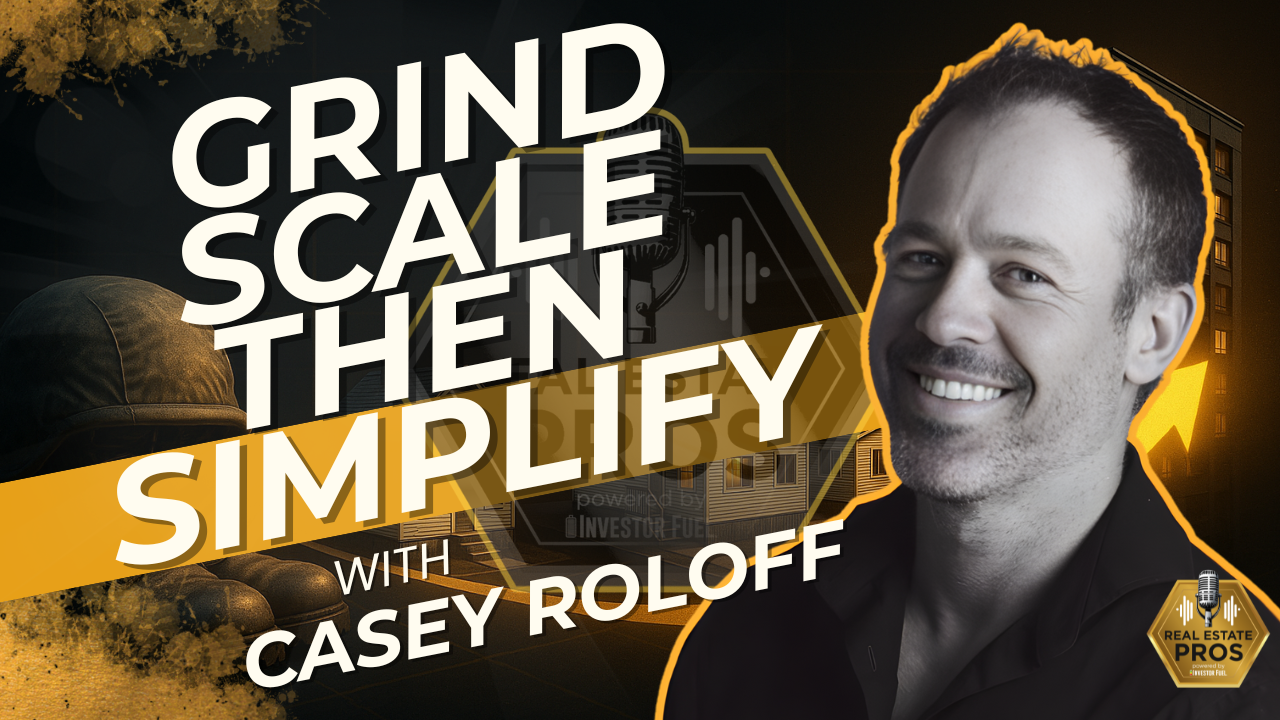
In this episode of the Real Estate Pros podcast, host Erika speaks with Casey Roloff, a serial entrepreneur and Army veteran who transitioned into real estate. Casey shares his journey from military service to real estate investment, discussing the lessons learned from his past experiences and how they shaped his business approach. He emphasizes the importance of education, networking, and community in achieving success in real estate. Casey also recounts challenges faced in managing properties and navigating complex deals, highlighting the significance of resilience and problem-solving in the industry.

Resources and Links from this show:
-
Listen to the Audio Version of this Episode
Investor Fuel Show Transcript:
Casey Roloff (00:00)
And so the very final piece of that looks like ⁓ I found out a way to get ⁓to a million dollars in funding from the state to do the remediation of the previous gas station and then ⁓ worked with a ⁓ consultant in the area to be able to draft some sort of management plan so that this plan would be in place, it would monitor the entire remediation and it would make the lender feel comfortable that…
everything is gonna be resolved ⁓ in a timely manner. And so just kinda like step by step, headache after headache, sleepless night after sleepless night, trying to figure out how we could get this deal done and make it a win-win situation for both parties.
Erika (02:23)
Hey everyone, welcome to the Real Estate Pros podcast. I’m your host Erika. And today I’m excited to be chatting with Casey Roloff. He is a serial entrepreneur and I think we’re going to have a lot to learn from Casey today. Welcome to the show today.Casey Roloff (02:40)
Hey, thank you for having me on. Excited to be here.Erika (02:44)
So Casey, let’s dive on in with your story. I know it’s a unique one. Can you share with our listeners how you got into real estate and how you knew that that was where you wanted to be?Casey Roloff (02:58)
Yeah, so I’ll share a super, super high level overview, but I am an Army veteran. I was a board of patrol agent for 17 years. I recently retired in June and I was able to retire because I found real estate. I found a passion that just absolutely lit me up and kind of got started on that path. So back in 2015, I started investing in single family homes and then justIncrementally scaled from single-family to multi-family and then now into businesses so we own about 180 spaces between three mobile home parks and an apartment complex and then we own a pool service and repair business and a med spa all in Yuma, Arizona
Erika (03:52)
Wow. And ⁓ I’m sure that didn’t happen all at once. also, Casey, thank you so much for your service there, too. Were there any lessons that you had from before you were in real estate, whether it was being in the Army or being a Border Patrol agent that you carry with you today as you manage your businesses?Casey Roloff (03:56)
right.You know, that’s such a good question and one that I rarely ask, but I think that ⁓ going back to being in Army, I actually joined when I was 17 years old and I attended boot camp between my junior and my senior ⁓ high school summer. ⁓
I think I was there for like 10 weeks or something like that. And I think every single day I wanted to quit, but I knew that I had signed a contract and I didn’t have an opportunity to quit. And I just kind of like developed this mindset or this mental toughness that kind of cascaded throughout the rest of my career and helped me ⁓ progress through
matter what the obstacle was. so learning something like
that at such a young age has certainly helped me be successful.
Erika (06:00)
Yeah, wow. just looking at what you’re doing now, we can clearly see that. Can you share for our listeners in your opinion what were some of the biggest pieces for growing and scaling your businesses? How do you manage all those plates you have going on?Casey Roloff (06:20)
Yeah, I think the biggest thing is really just not being afraid to dive in. Not getting analysis paralysis and wondering about what all of the bad things that could go wrong, but potentially flipping the script and saying like, what are potentially all of the good things that could go right and what could this potential investment or this experience lead to later on in life.And so I really think that obviously getting a baseline education so you know more or less of what you’re getting yourself into and then just pulling the trigger. think that looking back, I certainly could have tried to find a mentor or somebody that had maybe been there done that. I didn’t do that and I certainly made countless mistakes, but in the long run, it all kind of worked out to my advantage.
the market appreciated. ⁓ I was able to utilize all of the skill sets and experience that I had learned from being in the military and in law enforcement. And ⁓ it just helped drive success long term.
Erika (07:36)
Yeah, speaking of education, if you were to kind of start all over and if you were building a real estate portfolio now, building your businesses, what would you do to set a good foundation?Casey Roloff (07:52)
It’s funny that you asked that another great question, but I always I always like to say that my secret ingredient is listening to podcasts and and getting Remotivated day after day after day hearing all of these success stories and what’s possible because I try to listen to a podcast or a book while I’m working out in the morning while I’m driving to and from work and I’ll probably listen tosomewhere between two and four hours of.
a day just constantly trying to continue learning. And every time that I hear an amazing story, it fires me up and gets me excited to take on the next task or to maybe be a little bit more re-energized towards something that I kind of lost steam on. And so I definitely say that. Just going out there and listening to all of the free
education that is readily available to everybody is definitely that first step to figuring out where you want to go and how you want to get there.
Erika (09:09)
Yeah, speaking of which, with what you have going on, Casey, where do you want to go or what are you most excited about right now in the real estate world?Casey Roloff (09:19)
So I certainly think there’s seasons in life and from your early 20s to 30s, it’s all about the grind. You don’t have a lot of experience, you don’t have a lot of money and so you’re trading that time to gain that experience and that money. And then as you move into your 30s to your 40s, you’re transitioning from being a solo, like an individual, intopotentially a husband or a wife, and then ⁓ a father.
And so your priorities shift a little bit. so then you hopefully you’ve put in all of the work
at that early on in your life that you’re able to leverage all of that time that you have spent gaining experience and you’re kind of starting to start to flip that balance of the time and energy you put into things. So hopefully your dollar per hour is increasing as
life is progressing, you know, even into your 40s and 50s to where hopefully you’re starting to transition into things that only give you the most energy and only give you the biggest sense of purpose ⁓ on a daily basis. And so I’d say that with that kind of concept,
in mind that I’m really trying to offload a lot of the things that no longer give me the energy. And so ⁓ I currently have a portfolio of Class C properties that ⁓ the amount of drama that I deal with on a weekly basis, whether it’s unreliable residents or it’s just bad things happening to people in the community. ⁓
wanting to offload some of that and then get into more of a class B and a class A to where you have a more stabilized, maybe your returns aren’t quite as good, but it’s a lot less work on the day to day. And so I’m really trying to transition my focus into that type of asset class.
Erika (12:08)
Looking at the experience that you’ve had, Casey, I’m sure there’s been a moment, maybe it could have to do with the mobile home parks, but maybe you had a deal that went sideways, maybe you had to completely pivot. Can you share one of those moments on your journey and what you learned?Casey Roloff (12:29)
Yeah, so off the top of my head, the first one that comes to mind is my three mobile home park portfolio in Kentucky. So I’ve been managing these properties for the last four years from several thousand miles away, ⁓ which isn’t always the easiest thing because you’re relying on team members to bring your vision to life, but you don’t necessarily have that day-to-day accountability that you would if you were working with thatperson in the same city at the same time. And so we actually put all of those properties for sale and had them under contract for about 18 months. And it should be closing next week, but there’s always some sort of a hurdle that has to be overcome. so through the buyers not being able to receive funding,
through getting sued because they only wanted to buy one of the properties, not all three, and then renegotiating ⁓ and getting it going again. And then finding out that after ⁓ an environmental survey that one of the parks had a gas station on it ⁓ and the lender would not.
end because we found contaminated soil and it needed remediation etc etc. It was just a constant battle of like asking how we could get this deal done versus just throwing our hands up and walking away.
so the very final piece of that looks like ⁓ I found out a way to get ⁓
to a million dollars in funding from the state to do the remediation of the previous gas station and then ⁓ worked with a ⁓ consultant in the area to be able to draft some sort of management plan so that this plan would be in place, it would monitor the entire remediation and it would make the lender feel comfortable that…
everything is gonna be resolved ⁓ in a timely manner. And so just kinda like step by step, headache after headache, sleepless night after sleepless night, trying to figure out how we could get this deal done and make it a win-win situation for both parties.
Erika (14:57)
Yeah, that’s always what we’re looking for is win-win, Casey.Casey Roloff (14:59)
Right.Erika (15:44)
Maybe this is just my own curiosity, but maybe the listeners here are kind of curious too. When it came to that issue with the soil, how did that happen? How was that discovered?Casey Roloff (15:58)
Yeah, so some lenders, ⁓ they have stricter due diligence items that need to be required or that need to be completed than others. And so when I purchased the parks, there was no environmental survey requirement. And quite honestly, ⁓ I didn’t even know what an environmental survey was or how that could potentially impact the future sale of the property. And so ⁓ it was identified througha phase one environmental survey, it was determined that there was a gas station that was operational. I think it was between 1969 and 1974. And there was evidence that there were holding tanks still on the property. And so then that kind of progressed a stage two and the identification of the contaminated soil and kind of so on and so forth.
Erika (17:00)
Yeah, and then, so then you were saying that there’s now a fund through the government that will help take care of that. Is that supposed to be a smooth process or ⁓ what stage is that in?Casey Roloff (17:13)
It is actually pretty smooth because there are consulting companies that completely manage, like this is their job to manage the remediation for these types of projects. And so the state funding that I receive is basically reimbursing the consulting company for the management of the entire remediation process. And so as far as the amount of work on my end, it’s been very little.been signing applications to receive the funding, signing the bids and the proposals to move forward, and checking in with the consulting company periodically to make sure that everything is moving forward in a timely manner.
Erika (18:03)
Yeah, that’s a relief that, you know, at least with all the headache that you had before, that that part’s pretty smooth.Casey Roloff (18:09)
Yeah, I mean the alternative is if that funding wasn’t received, then what kind of an impact does that have on the property? Like what kind of an impact does that have on the financial well-being of that property and what are the implications of that? So definitely nice to know that there are resources out there that kind of help homeowners or property owners out.Erika (18:37)
Yeah, yeah, and not necessarily that this, that your network could have help in this situation, but you know, when you do go through tough times, it is really good to have, have a network for you, Casey, what, you know, where do you network and what’s made the biggest difference for you with leveling up and building relationships?Casey Roloff (18:58)
Yeah,I love that question. ⁓ So I’m a giant fan of Pace Morvey, guys like Brandon Turner, that’s how I got into mobile home parks. But I’m a member of Pace’s sub 2 community and then I have also… ⁓
elected to be a part of his owner’s club, which is about 500 members of very high high performing high highly experienced entrepreneurs in the real estate space and I’ve just been been able to surround myself with them and every time that I have a question or every time that that I might need some sort of a partnership or to be able to leverage a different skill set I have a community where I can reach out to and there is
there is someone in that community that has probably done 10 times of what I’m asking. And it’s so amazing having a resource that you can reach out to at any given time and finding the answers to your problems.
Erika (20:06)
Yeah, that’s awesome. If someone’s looking to join a similar group, how should they vet that group? What should they look for?Casey Roloff (20:14)
Certainly referrals. ⁓ You want to make sure that you are aligning with the members of that group. And so I think when you’re looking at this, there’s going to be all sorts of different mindsets.You really just have to make sure that once you start peeling the layers of this mindset, that there is depth to it, that there are people that are in this group that share a lot of the same values as you do. Because you don’t want it to be a one-off instance where this person you align with and you make a giant investment to be in…
that community, you want to make sure that you’ve vetted appropriately and really ⁓ talk to a lot of people that have only raving things to say about the community.
Erika (21:12)
Yeah, totally. Well, you know, all the advice that you’ve given today for ourhas been really solid. If ⁓ someone today wants to connect, reach out, learn more, maybe collaborate on a deal, what’s the best way for them to reach you?
Casey Roloff (21:31)
Yeah, I think that the best way is either Facebook or Instagram. I have the same handle on each and it’s just my first name, dot my last name, so Casey.Roloff. And I would be happy to connect and help anybody else progress their family legacy.Erika (21:53)
Well again Casey, thanks for being on the show and inspiring our listeners what’s possible in real estate.Casey Roloff (22:00)
I appreciate it. Thank you for having me on.Erika (22:03)
And for our listeners, if you got value from this episode, make sure that you’re subscribed to the Real Estate Pros podcast. We’ve got more conversations lined up with experts like Casey, who are out there building fantastic real estate businesses. We’ll see you on the next episode.