Subscribe via:



Show Summary
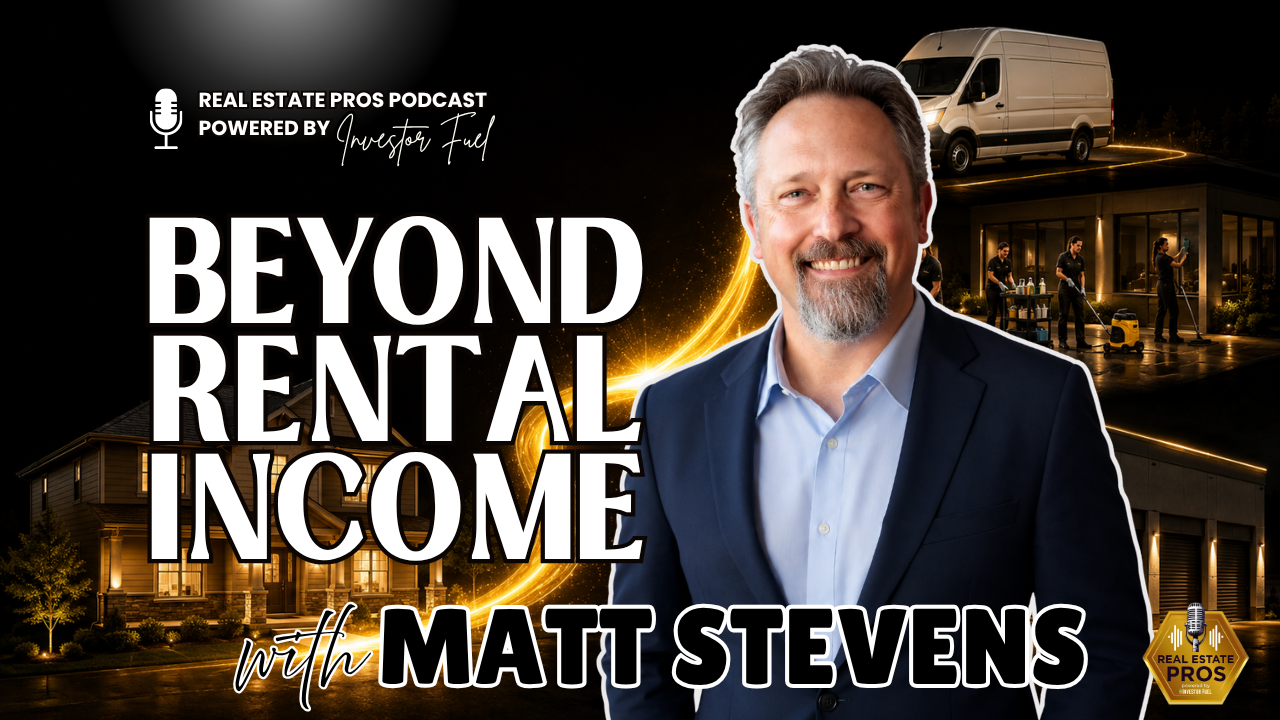
In this episode, Cody Crabb interviews Matt Stevens, the franchise guy, about how real estate investors can leverage franchising to diversify their income, utilize their resources more effectively, and explore new opportunities beyond traditional real estate investing.

Resources and Links from this show:
Listen to the Audio Version of this Episode
Investor Fuel Show Transcript:
Matt Stevens (00:00)
If you love real estate, there are adjacent opportunities in franchising in real estate for extremely high leverage. And what I mean is opportunities where you might invest 300K cash, plus borrow some, but even after debt service, be able to take home six figures a year without maintaining that opportunity more than two to five hours a week. Those are real situations. I’m not sharing brands or industries, but those are real situations that I have placed dozens of people in.
Cody Crabb (01:59)
Welcome back to the Real Estate Pros podcast by Investor Fuel. I’m your host, Cody Crabb, and today I’m joined by Matt Stevens, the franchise guy. Matt has spent nearly four decades in franchising, helping entrepreneurs find the right opportunities. And today we’re going to talk about how real estate investors can use franchising to put their capital, experience, and resources to work in new ways. Matt, thank you for joining us today. Welcome to the show.
Matt Stevens (02:24)
Cody, that was an absolutely fabulous intro introduction. I appreciate that. Thank you.
Cody Crabb (02:30)
Yeah, love it. Well th thank you for giving us some time today. So Matt, for after nearly four decades in franchising, what do you think most people kind of misunderstand about getting into the franchise world?
Matt Stevens (02:44)
Great question. I think that people believe that a common name, a familiar name, is due diligence, and that’s all you need to know. And frankly, there’s over forty three hundred franchises out there in more than 80 industries. And e the best ones that are at 40 or 70 or 112 franchise owners right now, they ha you have to realize McDonald’s used to be at one, operation. Hilton used to be at one operation. And I place people in some fantastic opportunities.
where they got in early or they got in mid-range, where they saw there was some steamrolling success and they took over a market near them as quickly as possible. So I work with people in due diligence. So the short answer to your question is preconceived notions and prejudice steers people away from up great opportunities on a regular basis. And I try to help people avoid that.
Cody Crabb (03:29)
Yeah, I feel like that’s true with a lot of different industries where you kind of just have an impression in your mind before you ever learn about it. And then, it becomes you you’re kind of fighting those impressions as you’re as you’re getting more involved in it.
Matt Stevens (03:42)
It’s true. As adults, I mean, shortcutting has proven us efficiency, right? When you go to the store, you don’t take a twenty mile route. You take the half a mile route. You don’t go and explore things. Well, sooner or later you need to realize the best opportunities in franchising could be something you’ve never heard of, which means it’s still available in your backyard and that has 17 or 100 or 250 other people just kicking tail, but because you’ve never heard of it, you never gave it an opportunity. And now might be the time.
Cody Crabb (04:09)
So if name recognition is not a good shortcut, what actually should somebody be looking at in to be able to tell whether a franchise is a good opportunity for them or maybe they just have really good marketing like these kind of course gurus that we see all over the internet?
Matt Stevens (04:25)
Yeah, great point. There are a lot of franchises advertising like crazy right now. There’s a ton of money that goes into franchise advertisement. And I think what happens there is people just again, we quick, we quick decide. We see a logo and a blurb, and that’s our decision. Well, that wouldn’t work here. Or gee, my cousin had a terrible experience in that industry and I would never touch it, or my neighbor’s in that. And he says it’s more difficult than anything, which by the way, I was taught as a franchisee, even though we were kicking tail. We were told to say,
this is a really tough business, but it’s worked out okay for me, just to turn people away from it. Yeah so that no one became our competitor. That was what we were trained, and that was that was decades ago. So it still goes on all the time. So the answer to your question is this you can’t look at the cover, you can’t even look at the forward or the first chapter. You have to get into pages 20 through 40 of a 100 page book, if it’s about a franchise.
You have to get to page twenty to forty before you realize, okay, there’s some meat here that’s really floating my boat, or yeah, this isn’t for me for reasons A, B, and C and all of that is good information for me. We can use that to your advantage.
Cody Crabb (05:32)
That’s a really good that’s really interesting. Yeah. I think a lot of times a lot of times people will kind of take they use their gut for a lot of things. And I think it can really help you to spot some stuff early on, but there comes a point where it’s not gonna tell you everything. So one thing that I’d be what I’d love to do is kind of bring this to a real estate more of a real estate lens, in
on these in f in franchising, obviously like you said, there’s so many industries and so many ways to kind of frame this. Tell me kind of if you’re talking to a real estate investor audience, what types of opportunities exist for people like that? The assets they’ve already got, the types of things they do or they’re interested in, I’d love to hear a little more about that.
Matt Stevens (06:16)
Yeah, I appreciate it. Cody, here’s the thing. I used to have 14 rental properties from 1998 to 2017. I didn’t buy in the right areas, and that’s why I eventually got out of it. I got tired of it. I wasn’t a great property manager. So here we are. but it was a learning experience for me. I made some money, I lost some money, and so forth. What I learned in that process is the resources that me and my friends ended up really swimming in on a regular basis is we end up with cash access, and then the bank says, Nope, no more for you.
We end up with access to personnel and human resources that can work to our advantage or that we learn sooner or later disappoint us. And we learn knowledge about real estate, which is a such a highly and wonderfully leverageable asset, that if you really have control of all these other aspects, you can do a lot with that leverage. And so the investors see opportunities in leverage asset growth.
Personnel and money and they also see roadblocks and challenges. And there is money to be made in both the open upside in each of those areas in the
In franchising and in real estate, a continuity to tackle the downside and the challenges with the resources that you have become accustomed to and familiar with, and that you have in your coffers and in your Rolodex, if you will, that you could leverage for the advantage of yourself and other people in the real estate industry. Because that other real estate professional would probably rather I mean they’re gonna make friends with you in the first place. They’d rather possibly
work with someone like you who has these resources, then try to find another stranger to replace someone who disappointed them.
Cody Crabb (07:55)
Hmm. Interesting. Yeah. I think I I’d love to hear like what does this actually look like in practice? So like give me an example of a type of business where a real estate investor could kind of take all these knowledge and resources and contacts and turn this into another revenue stream.
Matt Stevens (08:56)
Let’s say a real estate, an owner of real estate, someone who’s just inundated and engulfed in the industry, has excess access to capital. It’s not making the money they want it to make. Maybe it’s a recession or something else, or they just got into a bad spot, or with their properties, or let’s say they have a challenge with personnel, or let’s say the bank stopped lending them some money. they hit a cap with the bank. Let’s pick the first one.
If you love real estate, there are adjacent opportunities in franchising in real estate for extremely high leverage. And what I mean is opportunities where you might invest 300K cash, plus borrow some, but even after debt service, be able to take home six figures a year without maintaining that opportunity more than two to five hours a week. Those are real situations. I’m not sharing brands or industries, but those are real situations that I have placed dozens of people in.
another opportunity would let me let’s say you just have access to a to wonderful human resources who are just bankable, as far as You could go around the world for a hundred days and everything on your property would be taken care of. There are opportunities adjacent in franchising where that person, you could turn them into your partner or your key employee in your business outside of the real estate you own and build a multi million dollar revenue stream.
Catering to other properties, catering to short-term rentals, catering to long-term rentals, catering to fix-ups on properties or cleanouts or cleanups or moves or storage. There are so many areas that are real estate owner and adjacent where you could leverage that human resource capital and asset and start making a bunch of money on it.
And those are the opportunities that I see. A lot of folks who come to me in real estate, they just have a great interest in real estate, or they’ve come up to a stop hold on the bank. Their bankers won’t lend them any more money because they’re tapped out. Or they’re just looking to make more cash. They don’t want to make five or 10% a year. they want to make 20 to 30% a year. And there are opportunities to do that with the right assets in place.
Cody Crabb (10:58)
So for it, the investor who’s hit a ceiling in real estate, how do when it makes more sense to kind of diversify like this or keep putting that capital back into real estate, like you said?
Matt Stevens (11:09)
Yeah, great question. That’s a personal decision. And each person will make their own. What we do, what usually with someone in real estate, they usually come to me and say, Hey, I’m making whatever, eight, ten, twelve, fourteen percent on my real estate right now. I’m very comfortable with that. I don’t need anything else. Then my question is gonna be, well, okay, what is your what is your personal problem that has caused you to call me? Well, I’d just like I’d like to is there an opportunity? I’m curious, is there an opportunity to make more elsewhere? And so we delve into that. We delve into the reasons for their pain.
Frankly, we delve into the opportunities for their ambition, what their tolerance levels are. And there are either opportunities with franchise brand names that come out there, or there are none. And I’m very honest in sharing with you. These are the opportunities I’ve uncovered for you. I will say my experience has afforded me a lot of access to a ton of private, non public information that AI and Google will never share with you. and so I can afford that information to my candidates and we can go down that path.
Or I come back to them, Cody, and I say, what? Based upon your criteria, there is nothing that matches what you’re trying to do where you live. If we bent one of your criteria in this way, then we could look at this D E and F option. But otherwise, there’s nothing there for you. If you want to look at D E and F, we can do that. And they will share with me their honest response.
Cody Crabb (13:07)
Well, this has been really interesting. I think a lot of people that are in real estate, like you said, they’re sometimes like I mean, look at your example, right? You were in real estate, you saw it was a good opportunity, but it just didn’t work with exactly how you wanted to operate. And so I think there’s a lot of investors that kind of find out they are in the same boat where maybe they like the idea of real estate, but it hasn’t exactly worked out the way they want to in terms of the life that it provides them, or like they haven’t been able to make it work for them themselves.
so I think this is a good a great way to look into, diversifying in a way that’s not necessarily removing yourself entirely from that industry. so for the investor listening who’s built some success in real estate, the what would you tell what would what tells you that they might actually be a good fit for owning a franchise? Like what are the kind of some of the criteria points that you would look for?
Matt Stevens (13:57)
Yeah, the criteria there would be we again we talked about what the problems are. Where do your shortages? What are the hopes for you? if you if someone comes to me and they’ve got 20 properties and they don’t need a darn thing, right? They’re gonna be fine whether I entered their life or not. And that’s okay. We just have a candid conversation. And it usually comes down to maybe they’re bored and they have intellectual capacity they want to explore, maybe it’s diversification because they think something’s gonna happen in real estate or they’re looking to clean out some opportunities.
Or their adult children want nothing to do with that they’re doing currently. or they have excess capital that they want to explore other opportunities. I mean, we’ve we can talk about investments that are seven figures, six figures, or high five figures. There are opportunities all over the place, and we talk about their specific interests. So if it comes down to leveraging the knowledge and the resources in the market they have right now, there’s great discussions we can have about that.
It really just comes down to a discussion and interest is either peaked or not. Problems are either solved or not and we go from there. But we have some wonderful conversations. The worst that can happen, Cody, is we explore the space and they say, Yeah, it’s just not enough meat on the bone for me. Or I was looking
And now, honestly, in a forty five minute conversation, it could take as little as 15 minutes, frankly, where we learn you don’t need to waste your time on this anymore.
Cody Crabb (15:17)
That’s just not for you. Yeah.
Matt Stevens (15:18)
I I’ve had people, Cody, come to me who literally they claim I’ve been looking at opportunities. I have a questionnaire in front of me 10 years. And so my question is, what have you been looking for 10 years that you haven’t found? And we have that discussion. And in that case, it’s often they’re looking for something that is a unicorn. It is not realistic at all. But for the folks who are looking 18 months, two years, three years, and they’ve invested hundreds of hours in that.
We can get to the point right off the bat. And I did have a gentleman in real estate. His father was in Pennsylvania. He was out west in Phoenix. And they’d been looking, according to them, for three years and couldn’t find anything. We had a 15-minute call, then we had a 60-minute call. And after that 60-minute call, I pointed them to three opportunities where one of them they absolutely fell in love with. They ended up getting into three of those operations and they couldn’t be happier. And I got a phone call from him.
And he said, Man, I just want to thank you. We’ve been busting our tail for three years, trying to find our right opportunity. And this one’s it. And they’ve been up and running now for seven or eight years.
Cody Crabb (16:14)
Awesome. Well that’s I love that. That’s that that’s a great example of you get connected with the right person. They’re just they’re gonna it’s not that they’re gonna work less hard, but they just don’t have to work as hard because they’ve done all this legwork previously. So thank you so much for joining us today, Matt, and giving us kind of this perspective. If somebody wants to reach out to you, learn more about this, see if they’re a good fit, how can they get in touch with you?
Matt Stevens (16:36)
Cody, the best bet is go to my website. I am Matt Stevens. Go to heisthefranchiseguy.com He is heisthefranchiseguy.com You’ll find an aptitude test on there. You’ll find some questionnaire on there. You’ll find some questions to ask yourself. And you’ll also find some great information and updated about me and a way to reach me on there as well. And if you want to connect with me for a short call, you can hit a button on my website and we’ll do that too.
Cody Crabb (16:59)
Great. Well, thanks again, Matt. we really appreciate you and we’ll see you next time. Listeners, we appreciate you as well. Make sure you join us for our next episode and we’ll catch you on the next one. See ya. Thanks again.
Matt Stevens (17:11)
Thanks so much, Cody.