Subscribe via:



Show Summary
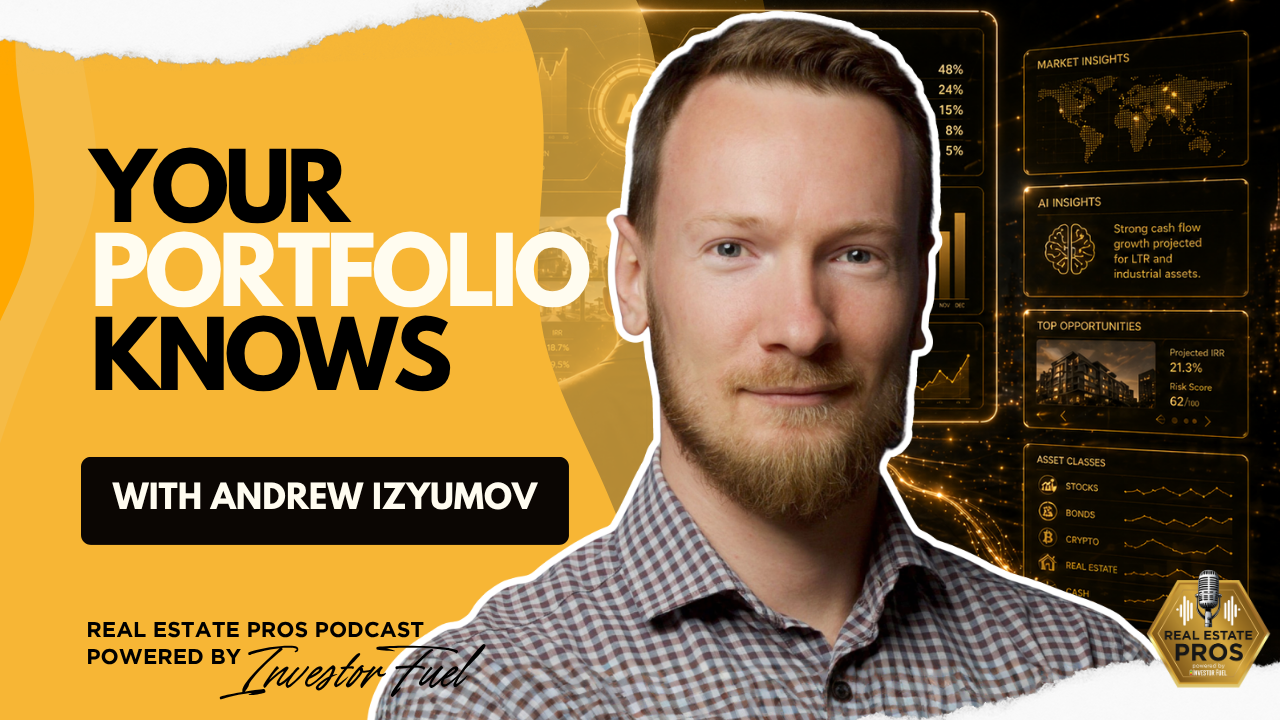
In this episode, Andrew Izyumov, co-founder of 8FIGURES, shares his journey from institutional investing at Goldman Sachs to building an AI-powered investment platform. He dives into how investors can analyze real estate deals using metrics like yield, leverage, and IRR, while emphasizing the importance of evaluating investments within the context of an overall portfolio. Andrew also explains how 8FIGURES leverages multi-agent AI systems to provide smarter, more personalized investment insights, helping users track assets, manage risk, and make data-driven decisions. The conversation highlights how technology is transforming investing by making advanced analytics and portfolio management more accessible to everyday investors.

Resources and Links from this show:
Listen to the Audio Version of this Episode
Investor Fuel Show Transcript:
Andrew | 8FIGURES (00:00)
What we built is a multi-agent system where you have one agent looking after new opportunities, another one is kind of analyzing them deeper, another one is analyzing your holistic portfolio, another one is risk manager, another one is tax advisor. So you’ve got all these agents and the orchestration kind of layer agent on top, they talk to each other, they try to kind of…
you know, work it out, even if there is some hallucination in one of them, the other are gonna correct it.
Cody Crabb (02:01)
Welcome back to the Real Estate Pros podcast. I’m Cody Crabb with Investor Fuel. Today I’m talking with Andrew Izyumov, co-founder of 8 Figures, an AI investment advisor and portfolio tracker, helping investors analyze and manage assets, including real estate in real time. He’s got experience through institutional investing and building AI-driven tools, but also personal real estate investing. So I’m excited to talk to him about this. Andrew, thank you so much for joining us today.
Andrew | 8FIGURES (02:30)
Alright, thanks for having me.
Cody Crabb (02:33)
Of course. So ⁓ take me back. How did you kind of get into the world of real estate? And tell me about kind of the early days of Andrew investing in real estate.
Andrew | 8FIGURES (02:46)
Right, right, right. Well, actually, I first started investing in real estate professionally as an analyst at Goldman Sachs. ⁓ I worked in a group that was part of the asset management division. And we have quite a broad mandate. We invested in stocks and bonds and real estate as well. It was actually a big part of our portfolio. through investing professionally, I learned how to analyze, how to pick the assets.
how to underwrite and frankly, I build my own capital as I grew through the ranks and that’s how I started investing myself in real estate as well. So I’ve got this kind of both professional and personal experience and obviously the asset, real estate is a big segment. There is a lot of kind of particular ways to invest in real estate. can get commercial real estate, can get housing, you can have.
even investments in a real estate developers. So these are all a bit different. So we can, we can discuss any of those, I guess.
Cody Crabb (03:52)
So Andrew, I’d love to hear the story of kind of your first venture into personal ⁓ investments after, I mean, it’s one thing to invest an institution’s money, it’s another thing to invest your own money. So I’d love to hear kind of how that first step for you was.
Andrew | 8FIGURES (04:10)
Right, so for me, my first real estate investment was an apartment ⁓ that I kind of bought already constructed. And ⁓ I thought, all right, I got to fit it out because it was sold without fit out. ⁓ before doing that, I was calculating, all right, how much I want to spend on that fit out. Also, I had mortgage on that as well. And how much I can rent it for. And I calculated the yield and did all the math.
And yeah, just went for it. We eventually renovated, of not fitted out and rented out and I got a good yield. I mean, you can calculate it on your ⁓ actual capital invested net of mortgage payments and that was ended up very good yield.
Cody Crabb (04:58)
Great, and I think, I mean, obviously,
that’s not your typical someone just kind of reading about real estate and starting out. Like, you had some experience, you knew what to look for. So what were those initial things that you looked for right away? I mean, as someone who’s starting out ⁓ with some experience, what did you know to look for right away?
Andrew | 8FIGURES (06:08)
Well, look, it really depends if we are talking about, ⁓ let’s say, residential real estate, be it apartment, be it home. ⁓ Even that has a lot of kind of sub segments. You can buy something without fit out or without like, you know, that needs to be renovated and go through this whole kind of renovation or fit out process.
which could be quite onerous and you got to budget it really, really well. And then you can rent it out. So that’s one kind of case, right? Another case is when you kind of flip, okay, right? So you buy something like, let’s say the residential building that is being constructed. So it’s not ready yet. You buy it at a lower price, wait before it kind of gets fully completed. And then you sell it maybe without even like any fit out, if it’s sold without fit out or…
maybe do some basic fit out and sell it straight away. So we don’t rent it out, you just sell it and you go for the next property. The apartments and the homes kind of also a bit different as to how you analyze those. So there is a lot of these kind of sub segments and each of them kind of warrants it’s kind of separate, slightly separate analysis. So I don’t know which one you wanna cover in more detail. I’m happy to share my experience.
Cody Crabb (07:28)
Good question. I mean, what would you say you you prefer as an investment and have invested in more?
Andrew | 8FIGURES (07:35)
Right, it really depends. I experienced both when you buy a radio apartment and rent it out and you calculate the yield. Well, in this case, you typically have mortgage as well. So you want to make sure that your capital is efficiently invested. So let’s say loan to value. I mean, if you divide the loan, the mortgage size to the value of your apartment, can target like 70, 80 % to be reasonable.
maybe down to 50%, but that would be a reasonable range, and definitely not above 90%, in which case it just becomes a bit too risky. then you calculate how much you can rent it for. So you go to like Zillow, you kind of try to analyze the market situation, how much people are paying for similar properties in the area that you are targeting, and that’s how you can work out the yield, all right? How much you can make.
on that property as a yield. And then you obviously got to subtract the interest that you pay to the bank that provided the mortgage, right? And so that would be kind of your net yield, right? So that’s how you calculate your return. And then you can see whether it’s attractive or not. On another hand, if you buy the, let’s say the apartment or house that wasn’t constructed yet, well, then in that case, you need to forecast
how much is gonna be priced at when the building is fully constructed, right? And in this case, it’s a bit of a art rather than science to forecast real estate prices, but you have to because that’s how you make your return. It’s obviously much more riskier than just build something that is already kind of constructed and just rented out. But at the same time, the return could be much higher, especially if you lever it up with mortgage, you can make like 3X, 5X on
just on your equity investment.
Cody Crabb (09:35)
So ⁓ at some point ⁓ in your investing journey, ⁓ I’m guessing that you hit a point where you were like, this is hard to keep track of, this is difficult to track, ⁓ or you maybe felt like something’s a little difficult here. Can you kind of tell me about that realization? I’m guessing that because of what you’ve built here, but I’m sure there’s a story there.
Andrew | 8FIGURES (10:00)
Right, absolutely. Well, look,
since I started my career at Goldman Sachs, I invested not only professionally but personally as well, and not only just to real estate but to all sort of asset classes like stocks, bonds, and even crypto and so on and startups, and obviously real estate as well. And at some point, I just realized that to keep track, all of it is kind of becoming too…
on the rest to keep updating my spreadsheet. Obviously, as many investors know, you just keep track of everything in Excel. And at some point, I want to automate that. So that’s how we build 8 figures. But then we kind of realized that on top of just the tracking piece of it, won’t really get an AI, by the way, also like those LLMs kind of got really advanced. to the extent that they can actually understand the context and your data.
and get you some useful advice, we kind of put an LLM on top, AI advisor on top of these kind of tracking data layer that we built. And that’s how 8 figures kind of evolved into AI investment advisor. Now ⁓ you can track literally every asset on our platform, including real estate with some sophisticated metrics. For example, we calculate levered returns and unlevered returns and price per square meter, including cash flows.
Calculate IRR, including all your cash flows and so ⁓ on. And for me, it is really, really useful because you don’t have to do it of manually anymore. You have everything in one place and then AI knows all your context and can advise you accordingly. So that’s what we built in the nutshell.
Cody Crabb (12:17)
So something I
asked you, something I asked you about at the beginning, because this is, and maybe this is just a question of mine, but I I said, well, I’m scared of AI because it’s wrong sometimes. And I mean, it’s one thing if I say, give me a recipe for banana bread and it gives me a wrong recipe. gives me something that tastes horrible. But if I’m investing actual money, that’s a scary, scary thing. So tell me, I was very interested in how you kind of mitigated that in your app.
Andrew | 8FIGURES (12:48)
Sure,
What we built is a multi-agent system where you have one agent looking after new opportunities, another one is kind of analyzing them deeper, another one is analyzing your holistic portfolio, another one is risk manager, another one is tax advisor. So you’ve got all these agents and the orchestration kind of layer agent on top, they talk to each other, they try to kind of…
you know, work it out, even if there is some hallucination in one of them, the other are gonna correct
And then the orchestration layer on top that actually talks to the end user, trying to make sure that there is no hallucination. Of course, having said that, with LLMs, it’s never guaranteed that there is no mistake whatsoever. But if you think about it, you know, even the human advisor can make a mistake. We are, as a human, sometimes we do make mistakes, unfortunately.
And I think LLMs ⁓ generally getting to the level if they kind of orchestrated properly that, you know, the probability of that mistake could actually be lower than your average advisor. So that’s what we are building at 8 figures. you know, even the existing level of the LLMs already kind of achieve that kind of, you know, the advice is already on.
with what you can expect from the human advisor. And as LLMs develop further, the quality of advice is only going up. Obviously, again, it’s about this orchestration as well. You’ve got to make sure that you’ve got this kind of thing right. If you just go to chatGPT and without much context start asking for financial advice, sometimes, more often rather than not, you might get a generic answer.
Put it this way.
Cody Crabb (14:37)
Yeah, I mean just to kind of in layman’s terms, tell me if I’m getting this correctly. But like this sounds to me like you have a group of friends that are experts in something and you instead of asking one person a question, you ask like five or six people a question and the odds that all of them would get the same wrong answer is very, very low. So it’s just again, like you said, never guaranteed but.
that makes it so if there is a, if the, answer is wrong, but from one of them, then they can discuss it and say why it’s wrong and maybe correct it. So is that, I getting, am I kind of getting the right idea?
Andrew | 8FIGURES (15:58)
Yeah, yeah, absolutely. And also, you know, it’s a matter of definition, like what is wrong answer? You know, sometimes in investment world, there is no right or wrong answer, you know. It’s about like analysis, it’s about like assumptions, right? These assumptions, maybe they are less probable, these assumptions may be more probable, but still these are, I mean, no one knows like what’s gonna happen exactly, right? it’s, there is, sometimes there are factual mistakes that LLM can make.
That’s for sure. And that’s why this kind of orchestration, multi-agent layer is very important to make sure there is no factual mistakes. But then, when it comes to underwriting specific investment, be it in real estate, be it another asset class, it’s about kind of probabilities. It’s about probabilities of what’s going to happen. yeah, this real estate, this area, for example, I want to buy something or invest in some real estate in that area. Is the area going to develop or not in the next 10 years?
Who knows, right? So it’s about kind of this kind of fundamental kind of basic analysis, right? And there is no right or wrong answer.
Cody Crabb (17:03)
And like you said, think a lot of the right or wrong answer depends on the situation. Like it depends on the person. So I think, ⁓ like you said, being able to understand this context of everything.
is probably a lot smarter than just trying to say, ask ChatGPT, should I invest in this apartment complex down in the street? It doesn’t know all this stuff, but maybe being able to pull in all this data is much more helpful. ⁓ So another question I have for you would be, ⁓ what differences do your users see being able to track all these metrics and not only track all these metrics, but track them side by side next to each other? Like what kind of things are they able to do that?
a user of some other app may not be able to do.
Andrew | 8FIGURES (17:48)
Well, as I mentioned, for example, for real estate specifically, you want to understand. Like if you look at your real estate investments, well, let me step back. First of all, the personalization is very important. something that is kind of useful or makes sense to do for one investor might not be so for another one. So it’s important to look holistically at your portfolio, right? So if you are a real estate investor, all right, what are the other kind of, you know,
capital or portfolios or asset classes you own, right? Because that’s important because as we know, real estate is not the most liquid asset class out there. So you wanna maybe, you wanna make sure that you have enough liquidity and when you consider leverage, for example, for your real estate, you wanna make sure that that leverage is not making that investment too risky because overall you’re kind of risk averse or you’re conservative investor and so on.
Again, that kind of holistic approach, that’s what defines 8 figures. talking about real estate specifically, we made this kind of exact, calculate those exact metrics that I used to calculate manually in Excel back at Goldman Sachs days, know, like IRR for like your levered return, for unlevered return, like, you know, levered that kind of including mortgage on your capital, on your equity that you invested, right? Unlevered.
means like ignoring mortgage as if you finance that all like through equity without any leverage and so on like and the cash flows as well like you know the price per square meter and so on so like you know it’s not just about like this apartment cost cost cost x and you know hopefully it’s going to cost y but you want to go a bit deeper just one layer deeper into metrics and try to understand what’s really
you know, the wood behind the trees, basically. And that’s what we build in 8 figures. So we try to make those kind of, we try to make them simple enough so even non-professional kind of investor could understand easily. But at the same time, we try to add that kind of, you know, that kind of professional taste, let’s say, and, you know, that a bit of a finance education angle to it. And LLM has all that context. That’s really important. So.
LLM can actually understand what exactly you have, all those metrics and can advise on these. So even if you don’t fully get something, you can always ask basically.
Cody Crabb (20:17)
Yeah, I like that. One especially, something I’ve found with LLMs, and I’m sure you’ll know exactly what I mean here, there’s no such thing as a dumb question. Whereas I may not want to reach out to my financial advisor and ask something really simple that would be kind of maybe embarrassing to even ask. They don’t judge. They’re just like, whatever, it’s fine, I’ll tell you. And so it’s in a lot of ways, if there is something that you’re missing, someone that is really just kind of getting into it on their own, DIY, that would be pretty comforting.
to me at least, knowing that I could just ask anything I needed to know. And even better than that, because it has this full understanding, it’s not just some question I’m asking somebody that’s an expert that doesn’t know my situation. It’s like you get the best of both worlds too.
Andrew | 8FIGURES (21:08)
Yeah, yeah, absolutely.
Cody Crabb (21:10)
⁓ So, okay, how does looking at your entire portfolio together, how would that change how you would evaluate a single new real estate deal?
Andrew | 8FIGURES (21:22)
Right, well, I would first look at my liquidity. Like, what am I trying to achieve, basically? All right? ⁓ I want to buy effectively illiquid asset, which is real estate. ⁓ you know, ⁓ obviously, I would reduce kind of my liquid portfolio in favor of that real estate asset. So what I’ve seen many times, those people who understand real estate investments really, really well, ⁓
they might allocate ⁓ disproportionately large portion of their networks just to real estate and even more often just to a single asset, their home basically. So like 80 % of their networks is just their home. ⁓ Well, from diversification perspective, I would be a bit more cautious about it. again, when I look at that single real estate investment in the context of my overall portfolio, I would look at liquidity. Obviously, I would look at the expected return and I would compare that
to the alternative. right, so that real estate investment, is it gonna make me like 5 % a year? All right, well, maybe I can get it like in liquid bonds. why would I like, you know, with a similar ⁓ risk profile, I can get a kind of maybe similar return, but it’s gonna be liquid. I can sell that bond anytime, right? And you know, I don’t have to, I have much less headache. Like I just go to my broker and just buy that bond, right? So, you know, I would definitely underwrite that. ⁓
Again, in the portfolio context from the return perspective and how that compares to the other ⁓ opportunities that I have in my portfolio from liquidity perspective, as I mentioned. And then I would just go deeper into the asset itself, like what it is, like what kind of type of real estate is that, like location, location, location. It’s always like number one consideration for any real estate, any asset, any type of real estate.
And so now we can go deeper into like what exactly I would look at on an individual asset basis, but in the whole portfolio context, I would probably look at ⁓ liquidity and the alternatives in terms of risk return profile.
Cody Crabb (23:31)
Sure, okay, give me an example of, well, let me ask it this way. ⁓ What are some things that you see in the future for 8figures that you maybe are thinking about adding or thinking about changing or maybe even some things that you would like to do in the future that would help your users?
Andrew | 8FIGURES (23:54)
One of the really exciting things that really excites me we want to do is adaptive ⁓ UI on demand. So we all kind of get used to the regular apps that ⁓ you see the kind of prescribed layout that someone else decided that that’s the best layout, that’s the best dashboard, that’s the best way to put stuff together, right? With AI, all of a sudden, you can actually adapt
that UI user interface for the user. All right, so you want to look at your dashboard this way or that way. All right, you just customize. Just tell LLM what exactly you want to see. You want to see the discharge that way or that way. You want to add this. It’s not like, ⁓ let’s say, constructor. It’s not like you have a limited set of instruments and you have to know how to use it. You actually just explain in plain English what you want to see.
Cody Crabb (24:49)
Yeah.
Andrew | 8FIGURES (24:52)
And voila, you just got your own kind of app, right? And it keeps tracking or showing, the dashboard keeps showing what you actually want, the way you want, right? And historically, you have to build it in Excel and you have to know and you have to adjust and you have to spend a lot of time and so on and so forth. Now we just tell, okay, I wanna see it that way. Boom, you’ve got it. That what we’re gonna release.
Cody Crabb (24:57)
Yeah, that’s.
Wow, that’s
fantastic. Yeah, I feel like I wish every single app that I used had something like that because it’s never exactly what you want. And especially in this dashboard type situation, you need to see certain things for certain reasons. that sounds like it would be super helpful. That is pretty exciting. ⁓ So if people want to find out more about 8 Figures, maybe look into signing up. ⁓ Where can they go online to look at more?
Andrew | 8FIGURES (25:48)
Absolutely, you can just go to 8figures.com and find everything about us, how we work, what we built, about the product, about our socials as well, so you can follow us and educate yourself on the investing in every asset class, not just about real estate, but we cover pretty much every asset class out there.
Cody Crabb (26:07)
And so is that the number 8 and then the word figures is that how it is?
Andrew | 8FIGURES (26:11)
8 as a number,
8 as a number and then figures is all just kind of one word and dot com. (8figures.com)
Cody Crabb (26:18)
Well, thank you so much for all that you’ve provided today. This has been really, really helpful. And thank you listeners for joining us as well. If you got something out of today’s episode, or if you’re interested in 8 figures, go ahead and give us a like, subscribe, comment, review, all the things, and make sure you follow us so that you don’t miss more awesome conversations like this one we had today with Andrew. Thank you so much for your time once again, and it’s been a real pleasure. We’ll catch you later.