Subscribe via:



Show Summary
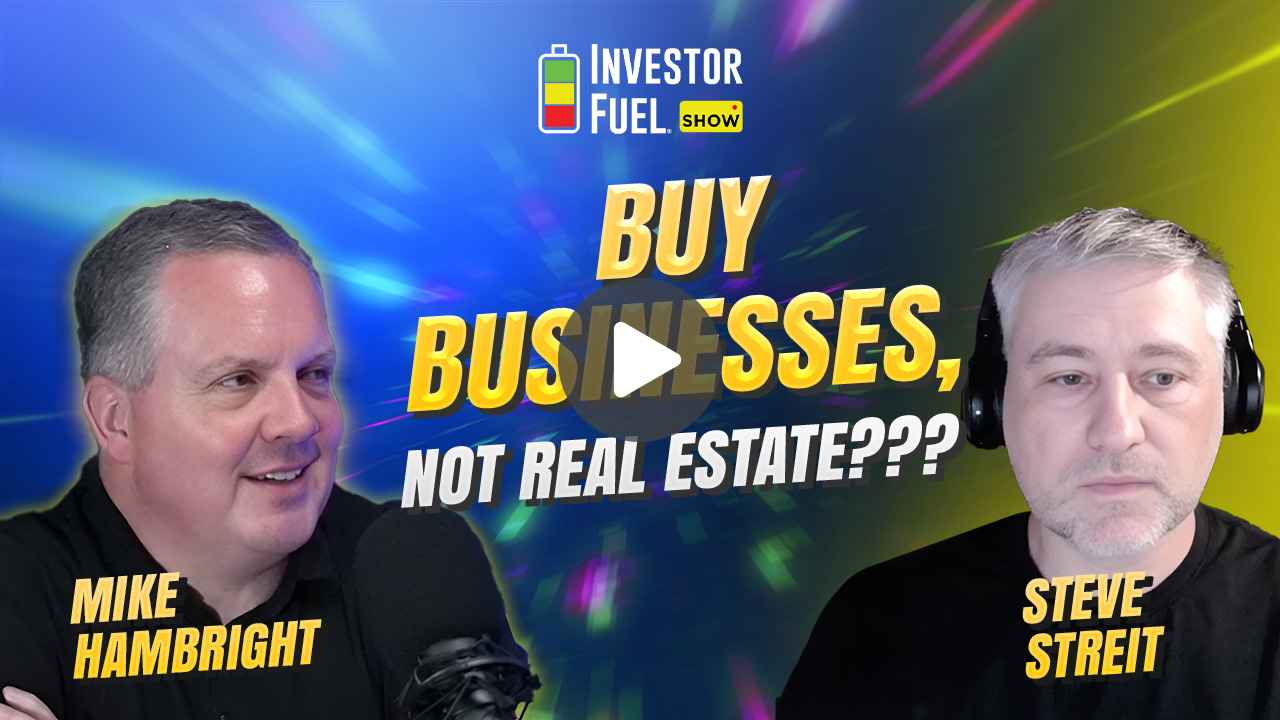
In this conversation, Mike Hambright and Steve Streit discuss the transition from real estate investing to acquiring businesses. They explore the skills necessary for evaluating business opportunities, the importance of management, and how to choose the right industry for acquisition. The discussion highlights the similarities between real estate and business investments, emphasizing the need for effective management and understanding of financial metrics. Steve shares insights on the types of businesses to consider and the emotional aspects of buying a business, providing valuable takeaways for aspiring entrepreneurs.

Professional Real Estate Investors – How we can help you:
Investor Fuel Mastermind:
Learn more about the Investor Fuel Mastermind, including 100% deal financing, massive discounts from vendors and sponsors you’re already using, our world class community of over 150 members, and SO much more here: http://www.investorfuel.com/apply
Investor Machine Marketing Partnership:
Are you looking for consistent, high quality lead generation? Investor Machine is America’s #1 lead generation service professional investors. Investor Machine provides true ‘white glove’ support to help you build the perfect marketing plan, then we’ll execute it for you…talking and working together on an ongoing basis to help you hit YOUR goals! Learn more here: http://www.investormachine.com
Coaching with Mike Hambright:
Interested in 1 on 1 coaching with Mike Hambright? Mike coaches entrepreneurs looking to level up, build coaching or service based businesses (Mike runs multiple 7 and 8 figure a year businesses), building a coaching program and more. Learn more here: https://investorfuel.com/coachingwithmike
Attend a Vacation/Mastermind Retreat with Mike Hambright:
Interested in joining a “mini-mastermind” with Mike and his private clients on an upcoming “Retreat”, either at locations like Cabo San Lucas, Napa, Park City ski trip, Yellowstone, or even at Mike’s East Texas “Big H Ranch”? Learn more here: http://www.investorfuel.com/retreat
Property Insurance:
Join the largest and most investor friendly property insurance provider in 2 minutes. Free to join, and insure all your flips and rentals within minutes! There is NO easier insurance provider on the planet (turn insurance on or off in 1 minute without talking to anyone!), and there’s no 15-30% agent mark up through this platform! Register here: https://myinvestorinsurance.com/
New Real Estate Investors – How we can work together:
Investor Fuel Club (Coaching and Deal Partner Community):
Looking to kickstart your real estate investing career? Join our one of a kind Coaching Community, Investor Fuel Club, where you’ll get trained by some of the best real estate investors in America, and partner with them on deals! You don’t need $ for deals…we’ll partner with you and hold your hand along the way! Learn More here: http://www.investorfuel.com/club
———————–
🎧 Subscribe to the Podcast
Apple → https://podcasts.apple.com/us/podcast/investor-fuel-real-estate-investing-show/id943707421
https://open.spotify.com/show/0yjlEMMn52BRrrlhfxCn4S?si=48f4b577276246e6
YouTube →
https://www.youtube.com/@investorfuel
🤝 Stay Connected with Mike
Follow on Facebook → https://www.facebook.com/realmikehambright
Follow on Instagram → https://www.instagram.com/realmikehambright/
Follow on Linkedin →
https://www.linkedin.com/in/mikehambright
📈Free Training and Resources for Professional Real Estate Investors
Acquisitions Manager Hiring Guide → https://my.investorfuel.com/if-lm-optin-acquisitions-guide
COO Hiring Guide → https://my.investorfuel.com/mm-lm-coo-hiring-guide
Executive Assistant Hiring Guide → https://my.investorfuel.com/mm-lm-ea-hiring-guide
Fuel 5 → https://my.investorfuel.com/mm-lm-fuel5
Triple Your Profits Masterclass → https://go.investorfuel.com/triple-your-profits
🏠Free Training and Resources for New Real Estate Investors
Rehab Live → https://my.investorfuel.com/rehab
Find Your First Deal in 5 Days challenge → https://go.investorfuel.com/find-your-first-deal-5-day-challenge
Join My next 4 Day Live Training Event (Virtual)
https://investorlaunchpad.com/
Resources and Links from this show:
Listen to the Audio Version of this Episode
Investor Fuel Show Transcript:
Mike Hambright (00:33)
Hey everybody, welcome back to the show. Today I’m here with my buddy Steve Streit out of Detroit. We’re gonna be talking about how to transition or when it makes sense to transition into buying businesses instead of buying real estate. And there’s a lot of similarities that we’re gonna talk about as well. So exciting topic. I know a lot of people have moved in that direction. That’s what we’re talking about today. Steve, what is happening?
Steve Streit (00:51)
Hey, what’s happening, Mike? Thanks for having me ⁓ on. Long time to get face to face with you on camera. ⁓
Mike Hambright (00:54)
Yeah.
Yeah. Have you been on?
Have you been on a podcast before with us? I mean, we’ve known each other for a long time. So yeah, I know it’s been a while. Yeah, yeah. Yeah, cool. Well, hey, before we before we jump in, tell us a little bit about your your background. What’s your backstory?
Steve Streit (01:02)
Yeah, it’s been some years, yeah. Yeah, it’s been some years, kind when I first getting going in the real estate game, so.
Okay, so kind of lifetime entrepreneur. As long as I can remember thinking about capitalizing on something or how to make money, kind of started off as a kid with baseball cards. The older generation, the Gen Xers and the Baby Boomers kind of flooded the market with their dirty stock of these wax packs era cards, all the Frank Thomas’s, the Nolan Ryan’s, the Ken Griffey’s, all the late 80s, early 90s stuff.
And I thought I was getting rich at eight, nine, 10 years old. lo and behold, I realized that it wasn’t worth the paper that it was written on. So however, I did learn how to determine value. was reading price guides at an early age, not online. This is like the actual books, like the Beckett’s. So I would find cards and then I would try to resell them. And I would take pop cans back and try to return.
return pop cans to make extra money to buy packs of baseball cards. So was always into like, you know, finding a score, so to speak, and trying to determine what the value was. You know, I wouldn’t say that I was like a fanatic, but it was something that I was interested in. Definitely didn’t make any significant money as a kid, but I liked to be able to provide for myself. And then I got started my, you know,
Mike Hambright (02:20)
Yeah.
Steve Streit (02:28)
first business, kind of like side hustles when I was 17, 18, painting houses, learned to trade, started my first corporation in 2005 when I was early 20s. So I’ve kind of been like entrepreneur, it’s been in my blood for a while. I did have a stint to where I did work for people as well, but that didn’t last. So I started kind of construction services, painting drywall floors, got my builder’s license.
And then I dabbled in flipping houses during the crash. And then I kind of went all in, I think 16, 17, I hung up that business, which is actually really hard for me to do. And then went all in on real estate. And as I was looking for people to show me, to help me, I was actually watching a podcast on YouTube, Investor Fuel podcast. Mike was on there. And it was like my first foyer to actually expanding.
Mike Hambright (03:14)
Mmm.
Steve Streit (03:18)
my horizons, like getting around other people other than myself that were doing the same thing as me, because I was operating in a silo. And then I joined Fuel. So I know it was a long introduction, but there was a reason for it. So I joined Fuel, and that’s how we met. And then the rest is kind of history.
Mike Hambright (03:24)
Yeah.
Yeah, yeah.
Yeah, that’s great.
You asked me like ahead of time you’re like, cause we’re doing a lot of podcasts. think, ⁓
Steve Streit (03:39)
Yeah.
Mike Hambright (03:40)
Not exact number, but I’ve done about 160 this year. We have another show that we’ve done thousands of shows this year. We’re actually doing 20 to 30 a day, which is kind of crazy. And we’re planning to launch more. And it’s kind of funny. I’ve always been the host for 13 years, almost 13 years now. I’ve been the host of, it started as the Flip Nerd show for a long time. It was under the Flip Nerd brand and then transitioned to the Investor Fuel several years back now. But yeah, you kind of asked like, why do you do all this? And I was like, it’s just, you know, when you say like,
Steve Streit (04:00)
Flip nerd, yeah.
Mike Hambright (04:08)
I first met you on your podcast essentially or kind of listen to your podcast and I’m a network guy I’m all about like my network and relationships and and building a community and stuff like that It’s a perfect tool for that. So so glad to hear that that was In the early stages, that’s kind of where we proverbially proverbially met I guess
Steve Streit (04:28)
We
did, yeah, it was like, so if you guys think back, mean, stuff’s changing so fast. Media’s changing, tech is changing, we got AI, we didn’t have full-blown AI now. And two years ago, we didn’t have full-blown AI. And then seven, eight years ago, it was less video, it was more audio, I think there was more audio podcasts. I think it was probably, could have been audio, was maybe I would just listen to the audio, but it was on YouTube, perhaps.
Mike Hambright (04:39)
Right.
Yeah.
Yeah,
yeah. We’ve always done video from day one and it’s kind of funny that you say that because for many years we were like, nobody’s even watching it. Like it’s all like 90 % of the consumption was all audio. But I still, you know, as a tool to network with people, like I want to look them in the eyes. So we still recorded it like and we stripped out an audio version that we put on in some places and we had a video version put in some places. But but yeah, I’ve been video from day one.
Steve Streit (04:57)
Yeah.
Yeah, and I think you were ahead of the game in many ways because if you were doing this, like you said, or yeah, 13 years ago, 2012, that was early. And I was thinking about doing it. I was thinking about recording and I would, we would record stuff, but you gotta remember it’s like, and I sound like antiquated here, but the phones weren’t as capable. So if you wanted to record something, you would have to have a proper setup.
Mike Hambright (05:26)
2012 yeah 2012
Yeah, for sure.
Yeah.
Steve Streit (05:45)
You couldn’t just rip videos on your iPhone that shoots cinematic quality videos. Like 2012, you couldn’t rock that, not as much. So I think doing that early just kind of shows, I mean, it tells me that you were invested in. You were invested in the media. You saw the power of media, you saw the power of broadcast, getting your name out there.
Mike Hambright (05:48)
on your flip phone.
Steve Streit (06:09)
I think you’re ahead of the game in many ways in that aspect.
Mike Hambright (06:12)
Yeah, thank you. So let’s talk a little bit about, you’ve done a lot of real estate stuff. You’ve started a lot of businesses. I know you’re spending a fair bit of time now on looking at other businesses to buy or consult. And the reality is, is I think real estate, I’ve always said this, like, I don’t want to say if you’ve been a real, if you’ve been a successful real estate investor for some period of time that you could do any small business, but it’s a great place to kind of build your skills up, right?
Steve Streit (06:38)
Yeah, you learn everything. You learn how to negotiate. You learn how to deal with contractors. You got a good mix. got law, you got marketing, you got law. That’s the title companies, the dealing with attorneys for closings. You got negotiation. You got the settlements. You have all the process work with the titles. And then you got contractors negotiating. Again, you’re playing interior designer if you’re flipping houses. You got to hire one.
It’s a good mix of everything to really like, I think everybody should do it. Here, go flip this house. Go do this. This would be your high school project or something, right? I think it’s, you learn a lot and I’m a person, I was the C and D student. I did not, I barely got through high school. It was kind of a night school slash alternative.
Mike Hambright (07:10)
Hahaha.
Yeah.
person.
Steve Streit (07:28)
school, think they called it adult ed or something back then. So it was like, was lumped in with the undesirables of society and thrown in a basement on Eight Mile and Northland Drive and I was able to acquire my GED for my diploma. It was a diploma and it said the school. it’s like, and I think there’s a lot of people like that. kind of just get like, you know, they’re not college material, although I did end up going to college.
Mike Hambright (07:53)
Yeah.
Steve Streit (07:54)
They’re not college, but they’re not great students, so it’s almost like they’re marginalized in some ways. But what I realized is I was more of a, my learning style was different. It was not the same as everybody else’s at that time. I couldn’t just do the worksheets and read the books. I wasn’t a good test taker at all. And in order to get good grades, you have to pass your tests.
and I didn’t like homework either, so that didn’t work out too well. My point in saying all this is that you kind of learn, when you get into this, you learn as you go. And I think most people, think mentorship’s important, getting in a community is important, and then actually doing the deal. That’s very important is taking that risk. So, yeah.
Mike Hambright (08:16)
Right.
Yeah, for sure.
And I
think in our lifetime, in our lifetime, I guess there’s, know.
Steve Streit (08:42)
I digress. I digress.
Mike Hambright (08:50)
there’s not as well laid out paths now as there were in the past. you don’t like college isn’t quite as important. You can get educated in a lot of ways. You can build skills in a lot of ways. And I think you see that in a lot of ⁓ certainly real estate and all probably all the trades like, you know, a lot of folks that, you know, found their way there one way or another and had to build a skill in a certain thing. But it wasn’t the traditional, the traditional kind of education model. So anyway, let’s jump into like what, what are some of the, what are some of the skills that you need to
to
really kind of evaluate a business, if it makes sense to buy it. Is that primarily what you’re focused on? I was actually buying business. I know you’ve done some consulting for small businesses to kind of help them scale and grow as well. So a lot of the skills are the same, whether you’re looking to evaluate it as a business or whether you’re looking to consult on it to improve the business. If you buy it, you want to improve it. So there’s a lot of overlap there. But what are some of the skills that are important for that?
Steve Streit (09:39)
Yeah, so you’re asking good questions. So yes, it’s we’re actively seeking service businesses, either professional services like survey companies, title companies, mortgage brokers, PNC casualty, like businesses like that. And then home services, roofing companies, plumbing, HVAC, electrical, right? Very, very bullish on all those. I think recently many viewers that you’re probably hearing a lot of the chatter is buying the
There’s a lot of people in the space. There’s lot of influencers in the space. I think historically the space was reserved for private equity and it was kind of a quiet business. there was millions and billions of dollars kind of moving hands. And one thing that I’ve noticed that I want to bring in this out there is that through the democratization of information, the podcasts, the shows, and there’s just getting everything out there,
it’s become more popular. So more people understand the terms of EBITDA. This is a term that’s thrown around, which is the same thing as just essentially at the end of the day, net cash flow, net free cash flow. But it’s a fancy term that somebody created that people are using now. In real estate, it’s NOI, it’s cap rate. We’re talking about the same things, it’s just kind of a different name. And I really wanna transition into that, it’s like buying
Mike Hambright (10:48)
Mm-hmm.
Right.
Steve Streit (10:56)
buying a multifamily piece or real estate deal is almost identical as to buying a business. And that’s where I learned how to kind of underwrite these deals. And I don’t think I could have done it unless I would have understood the management piece or the lack thereof.
Mike Hambright (11:11)
Yeah, and the game that, obviously the game that we’ve played, there are some institutional buyers that are just buying cash flow, but the business that we’ve always done is a value add business. You’re looking like, well, what price do need to buy it at to be able to add a certain amount of value to make it worth more so that I can sell it and make a spread, or rent it and make a spread, right? mean, so it’s very similar.
Steve Streit (11:32)
It’s almost identical, but the upside is bigger in business. And I’m gonna explain that right now. So when you go buy a multifamily, let’s say you find 150, 100 units, 150 units, doesn’t matter. You have a few levers, right? You got your income lever and you got your expense lever. And then you got a couple creative things, which I’ll talk about in a minute. But your income levers are number one, your rents, right?
Mike Hambright (11:39)
Yeah, let’s do it.
Steve Streit (11:58)
That’s the biggest income that you’re getting is through your tenants paying rent. Your tenants are also known as your customers. know many people don’t want to call them customers, they want to call them tenants, but they’re customers, which I’ll come back to. So you have paying tenants for your rents, and then you have additional fees that you can charge them. Like if they have free friends, charge them pet fees. A lot of people went crazy on these pets over last five, 10 years. ⁓
Mike Hambright (12:08)
Yeah.
Steve Streit (12:22)
There’s more pets in this country than there’s people, I think.
Mike Hambright (12:25)
They’re all,
every one of them are emotional support animals too, by the way, so.
Steve Streit (12:29)
Yeah, yeah, and I think some days we all need an emotional support animal, right? So, but if we find out that it’s not an emotional support animal, you know, there’s a line item on there, on the P &L, and it’s pet fees, right? And then there’s late fees, and then there’s garbage collection, and there’s concierge service, and then there’s, you know, hey, I’m gonna put in like, you know, 50 carports and then charge an extra $270 a month for carports.
So those are your income levers on, let’s say, a real estate deal, a multifamily deal. And then you have your expenses. So you got your management. So you can negotiate a really good management fees. You got four or 5 % for management. You’ve got that down pretty tight. You got your taxes, insurance, your maintenance, your onsite manager cost. And then you got your capex and your insurance and your property taxes. And then after.
After it’s all left over, you take your expenses and your debt service, don’t forget your debt service. You subtract all that and what’s left over is usually a single digit return. It’s not 20%, you’re not making 20 % annually on these things. You’re making maybe 3 % after debt service, 4 % after debt service if you’re lucky. If you’re on it cash, it’s 7%, 8%, whatever. We call this, what do we call this? Cap rate, I think.
or NOI, right, net operating income. So that’s a business. So what you’re doing is you’re buying a business and then you’re installing a management company to manage that business. And the management company’s responsibility is to make sure that the money comes into the accounts, the taxes get paid, all the vendors get paid, and then the debt service gets paid and then they pay you a check at the end of
So not only are they managing the complex, managing the issues with the tenants that have a leak, they’re managing the P &L. So they’re managing your entire business. And I want to transition this. And I think one of the things that I notice is that people have no problem spending $10 million on a business that looks like an
Mike Hambright (14:30)
Mm-hmm. Yeah.
Steve Streit (14:31)
But
it’s intimidating when they go to buy a business that’s $10 million that doesn’t have any real estate attached to it. But it’s the same thing, just more moving parts.
Mike Hambright (14:38)
Yep. Right.
Steve Streit (14:41)
so I learned how to read a P &L from real estate and that transitions to business in many ways. One thing that I notice is that people don’t put the same amount of effort into managing businesses the same way that they manage real estate. So, half way they’ll pay a property manager 5%, 10 % on single family to basically manage all their investments.
Mike Hambright (14:41)
go ahead.
Steve Streit (15:04)
but they’re not putting that same effort and emphasis on a business, but essentially it’s the same thing when you break it down. Because you have, it’s a lot of crossover. It’s a lot of crossover.
Mike Hambright (15:14)
Yeah, it’s interesting because…
You know, I think the other thing is people are, they go, if they, if you were to go to buy a business, they’re much more aware of the fact that they generally are not trying to buy a job. But a lot of real estate investors operate at the level where they have a job. They’re self-employed, but they’re very much involved in the business. And if you, you know, the same people now that are real estate investors that are going to buy businesses are often saying, well, I, know, I need management or as management come with it.
because I don’t want to go run that right. And so what they what they often didn’t do that as a real estate investor.
Steve Streit (15:51)
Yeah, that’s a good point. So they’ll go buy off these one-off deals and try to piece everything together themselves. I’d kind of scrap together whatever you can.
Mike Hambright (15:58)
Right. Yeah. So let’s talk about the importance
of kind of good management. Because if you’re buying a business, most people are not out there trying to buy a job. Some might be, but most are not,
Steve Streit (16:09)
Yeah, so putting a management team in place day one when you buy this thing is essential. like for the real estate investors out there, imagine buying even a 50 unit just not having management. All of sudden, you’re going to go ahead and collect all the rents, talk to the tenants, you’re going to reconcile the books, you’re going to just go ahead and do everything. It’s kind of a crazy thought, right? ⁓
Mike Hambright (16:31)
Yeah. Yeah.
Steve Streit (16:34)
Unless that’s your strong suit, maybe your deal is management. I think a lot of people want to shy away from that part of the business because it’s the unsexy side of the business. It’s the business to where you have to do, right, you got to get your hands dirty, you have to do work. But one of the things that I did learn early on from buying a multifamily deal is that when we outsourced absolutely everything, what we noticed is that
Mike Hambright (16:42)
Yeah, for sure.
Steve Streit (16:57)
You know, sometimes we just wouldn’t get a return or we wouldn’t have our hand on the pulse just because we were looking for that passive check, somebody else to kind of take care of it. I would just caution everybody, whether you’re, know, whatever you’re doing, if it’s a multifamily dealer, whatever else, have your hand on the pulse of management, understand it enough to be able to read a report that they give you to understand where your expenses are going.
where the income’s coming from and the levers you can pull. I think, I was guilty of when I was doing smaller deals is that it was just kind of not worth the time of the management to give me an extra bit of information or kind of insight on that P &L. But somebody on your team has to be able to read that. Somebody needs to be able to watch that because you’re dealing with a lot of income.
and it’s easy to just spend everything on, know, CapEx or repairs or whatever. mean, it’s like, best thing about a management company is that I never got a phone call. The worst thing about a management company is that I never got a phone call. And mysteriously, we just kind of broke even every month. Yeah.
Mike Hambright (17:55)
Right.
Yeah.
Yeah. Until
it’s too late, like something bad might have gone, might have happened, but she didn’t.
you didn’t have any early inclinations that something bad was gonna happen. yeah. Let’s talk about just like, how do you pick the right kind of trade or industry? Like there’s a lot of, obviously a lot of service, service businesses are very broad term, but, some are better than others, right? For different reasons, but how do you pick the right kind of industry or trade?
Steve Streit (18:35)
So my rule is anything with the dry time I stay away from. So no painting businesses, nothing that requires something to set up. And it’s kind of a joke, but I did that for a while and it was just, there’s a little barrier to entry on like the cleaning businesses, the painting businesses, just the lawn care, stuff like that.
More power to you if you want to go after that or you’re picking one up from somebody. But what we’re interested in is a business with built-in profit centers. So just the nature of the business itself lends to a healthy P &L that can give us double digit returns, 20 % or better at the end of the day after everybody’s paid. Those businesses include heating and cooling, plumbing, electrical.
Roofing, stuff like that. And you notice I didn’t say like kitchen and bathroom remodeling, basement remodeling. So I’m not looking for like general services to where it’s like a building company or remodeler that just kind of does everything. And that’s the trap that I was in before is I thought that I could just, if we did everything, we could just sell everything.
Mike Hambright (19:26)
the
solid.
Right.
Steve Streit (19:42)
And it sounds good. It’s like, you walk in, you you have a customer, they’re going to spend, you know, X amount of dollars with you on one thing, you can just, you know, kind of do everything. And I think that’s, I think certain industries have profit centers. It’s almost like going after real estate deal. You’d only buy a deal in your, in your certain buy box. You’re not going to buy it on the edge of town or in the middle of a farm field that you don’t know. You want to make sure that you have the right, the right vehicle, so to speak. And, ⁓
those, like I said, the profit centers and the nature of the business itself, lends to the ability to grow and scale in those industries.
Mike Hambright (20:17)
Yep. So Steve, with seemingly so many people that are have kind of moved over into buying businesses, especially because a lot we can talk a little bit about.
the financing side of it. know a lot of people are looking to basically get the seller to own or finance it to them, which is kind of a play right now or one of the major plays. I want talk about that, just like the idea of somebody that’s looking to retire that doesn’t have a lot of options for exiting and they might still want the cash flow to come in over a period of time. It’s better for them for tax purposes to just sell it on an installment sale, essentially. We’ll talk about that a little bit. And then let’s talk about how do you stand out with a lot of people that are
There’s a lot of competition in that space too to kind of buy businesses now.
Steve Streit (20:57)
Yeah, so standing out is just, you know, kind of not being… Brokers are like the realtors. This is the other crossover. You got the business broker world. They’re like the realtors of the businesses. So a lot of times, the sellers will want to deal with the direct buyer, and then other times they want to deal with the broker, right? So you’re going to find deals from these business brokers.
Mike Hambright (21:09)
Right.
Mm-hmm.
Steve Streit (21:20)
some of them and sometimes they can help you. Sometimes they can help you present this offer and kind of act as a buffer between the seller. So it’s not as intimidating for them. If somebody’s owned a business for 30, 40, 50 years, there’s probably some emotion tied to it. Their whole life is kind of wrapped up in that business. What I’m noticing is these things are harder to let go of than
Mike Hambright (21:39)
Yeah, for sure. Right.
Steve Streit (21:47)
than the old rental house that they had for 30, 40 years. So you get that with the motivated sellers in real estate is the emotional attachment. It’s bigger with the businesses.
Mike Hambright (21:50)
Yeah.
Yeah,
because they put a lot of blood, sweat and tears into that building that, you Yeah.
Steve Streit (22:02)
Yeah, yeah, and the cool thing is you’re literally taking over, you’re taking over 30 years of that, you know, blood, sweat, and tears. And many of you guys know when you’re working in a business and not on a business, there’s just a lot of blind spots. So yeah, you can say, hey, can update my website, I can get AI to answer my phones and implement a CRM and all that stuff. But there’s also,
There’s also kind of larger plays to where they’re just not seeing the whole chessboard. And when you come in as an outsider that’s not emotionally involved, what I’ve found is it’s easier to identify those opportunities early on to be able to.
Mike Hambright (22:35)
Yeah.
Yeah, I think that’s one of the big
plays, Is a lot of the, certainly the mom and pop style businesses that we’re talking about here, were very much run like a lifestyle business. they…
If they didn’t feel like working, they didn’t work. If they didn’t want to do something, or probably a lot of outdated tech, right? So you can inject a few things and it doesn’t take, it might not take long to double the business or better or double the profitability or better just by doing some basic things that if you’ve been, you know, we’re talking about kind of real estate investors transitioning into that. If you’ve been a real estate investor, you’ve had to be on your toes. Otherwise people are running circles around you, right? And so if you’ve been an operator, I guess,
Steve Streit (23:10)
100%.
Mike Hambright (23:23)
on the real estate side, it’s easy to go in and say like, if they just did this, this, this, and this, like the business is worth double, right?
Steve Streit (23:30)
100 % yeah, so we’re looking for opportunities to where, you know, they are profitable businesses, much like multifamily. The crossover is you couldn’t get a loan to buy a non-performing asset. Like if you buy a multifamily deal that’s at 50 % occupancy and you’re not going to get debt service on that thing. So we’re looking for an asset that is producing
Mike Hambright (23:50)
Right.
Steve Streit (23:54)
So the minimum standard is, you know, does the cash flow cover the debt service?
Mike Hambright (24:00)
Yeah. Cool. Well, Steve, if folks wanted to connect with you up in the Detroit area, you’re looking at everything you’re looking at in the Detroit area. that correct? you Midwest big time?
Steve Streit (24:02)
You
Midwest no, I’m going Midwest. So I’ll do Yeah,
yeah. Yeah, it’s kind of all the same, know, we got cornfields cities woods. It’s kind of all looks the same. So
Mike Hambright (24:21)
Right. Yep. So if folks want to connect with you, where can they go?
Steve Streit (24:24)
So yeah, reach out to me on LinkedIn. I’d love to connect with you. It’s Steve Streit on LinkedIn. Also on Instagram, steve.streit. yeah, I’d love to talk to you guys about business, real estate, and keep the conversation going.
Mike Hambright (24:41)
Sounds good, good. Cool buddy, well hey thanks for sharing some insights with us today. Thanks for joining me.
Steve Streit (24:45)
Thanks for having me on, Mike.
Mike Hambright (24:46)
Yeah, good to see you.
Hey everybody, thanks for joining us today. Hope you got a lot of good insights out of the show. You know, there’s a lot of opportunity. What I’ve kind of found is a lot of real estate investors and I’m not an advocate for, you know, just jumping into the next kind of shiny object. You need to make sure that you’re getting into this with a high level of thought that’s gone into that because truthfully everything is hard. So whenever it seems like something is easier, it’s just a matter time before that gets hard too. So just make sure that you’re not jumping from thing to thing. Like there’s a lot of opportunity.
in any of these businesses we’re talking about and all of them quite frankly if you focus right so hope you got some good insights from today we’ll see on the next show.